Blog

  • Cuisine de Jiangnan

    Vie et folklore

    Cuisine de Jiangnan

    River Fish, Rice, and Refined Broth

    The cooking of the lower Yangtze favours freshwater fish, seasonal greens, and delicate stocks.

    Section
    Vie et folklore
    Région
    Zhejiang
    Ère
    À travers les époques
    Étiquettes
    Food, Geography

    Jiangnan cooking grew in the wet, rice-growing country south of the Yangtze. Its reputation rests less on spice than on timing: a fish steamed just long enough, a broth cleared and simmered, or a vegetable picked before it toughens.

    A Landscape of Water and Rice

    Jiangnan means the land south of the Yangtze, a region of canals, lakes, and irrigated fields centred on Jiangsu and Zhejiang. From the Song dynasty (960–1279), the lower Yangtze became China’s densest and wealthiest farming region, supported by double-cropping rice, fish ponds, and silk production. Cities such as Hangzhou and Suzhou developed a class of officials, merchants, and literati who recorded dining in essays and cookbooks. Lin An, today’s Hangzhou, was the Southern Song capital after 1127, and its markets sold freshwater fish, crab, bamboo shoots, and lotus root. Local cooking took shape around what the water and nearby fields supplied in season.
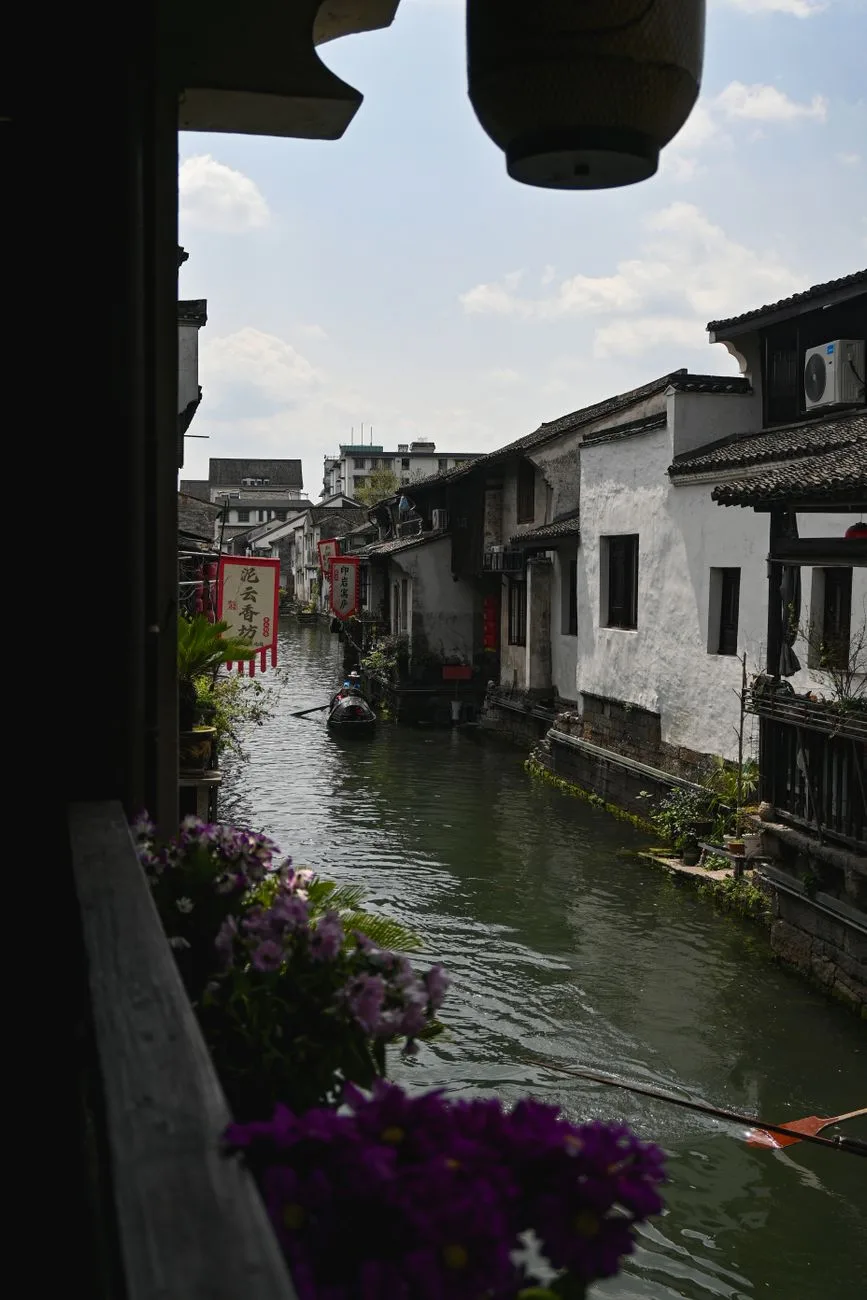
    Canals and rice fields in the Jiangnan countryside near Suzhou
    Canals, fish ponds, and irrigated fields shaped the Jiangnan pantry. 木 灬 | Pexels License (https://www.pexels.com/license/)

    Techniques of Cleanness

    Jiangnan cooks prize the natural flavour of ingredients, so technique often means restraint. Steaming preserves the texture of fish and glutinous rice; quick stir-frying keeps greens crisp; slow simmering turns pork bones and chicken into clear, aromatic broth. Shaoxing in Zhejiang is famous for yellow rice wine, used in marinades and for deglazing a hot wok. Vinegar from Zhenjiang balances sweet and sour dishes. Hangzhou’s famous West Lake vinegar fish uses a fish from the lake, scored and fried, then finished with a sweet-sour sauce. The dish is now a restaurant set piece, but it began as a local preparation of available freshwater fish.
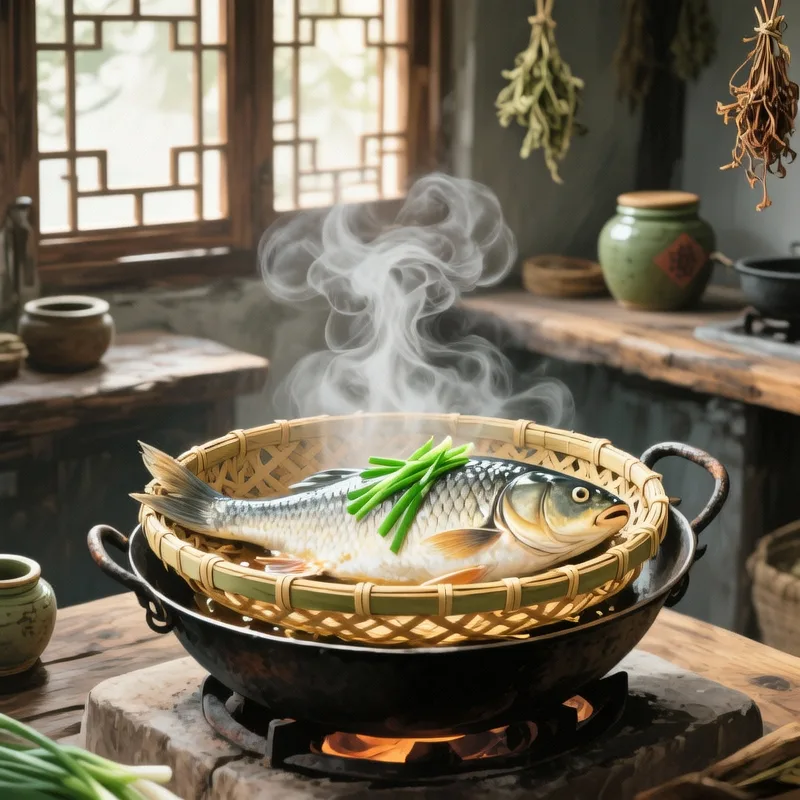
    A whole freshwater fish steaming in a bamboo basket over a wok in a Jiangnan kitchen
    Steaming is a defining Jiangnan technique because it preserves delicate texture. Illustration générée par IA · SinoViz

    A Calendar of Local Dishes

    Seasonality gives the cuisine its rhythm. Spring brings bamboo shoots, shepherd’s purse, and the first river shrimp; autumn brings hairy crab from lakes and the slow-growing taihu whitebait. Suzhou’s squirrel-shaped mandarin fish is butterflied, scored, fried, and glazed, while braised pork belly is cooked until fat and lean layers hold together without hardness. Ningbo, on the Zhejiang coast, adds salted and dried seafood, and its tangyuan glutinous-rice balls filled with black sesame are eaten at the Lantern Festival. Shanghai, later and more cosmopolitan, absorbed these traditions into benbang cooking, favouring soy, sugar, and seafood.

    • West Lake vinegar fish from Hangzhou
    • Squirrel-shaped mandarin fish from Suzhou
    • Hairy crab from Taihu lakes in autumn
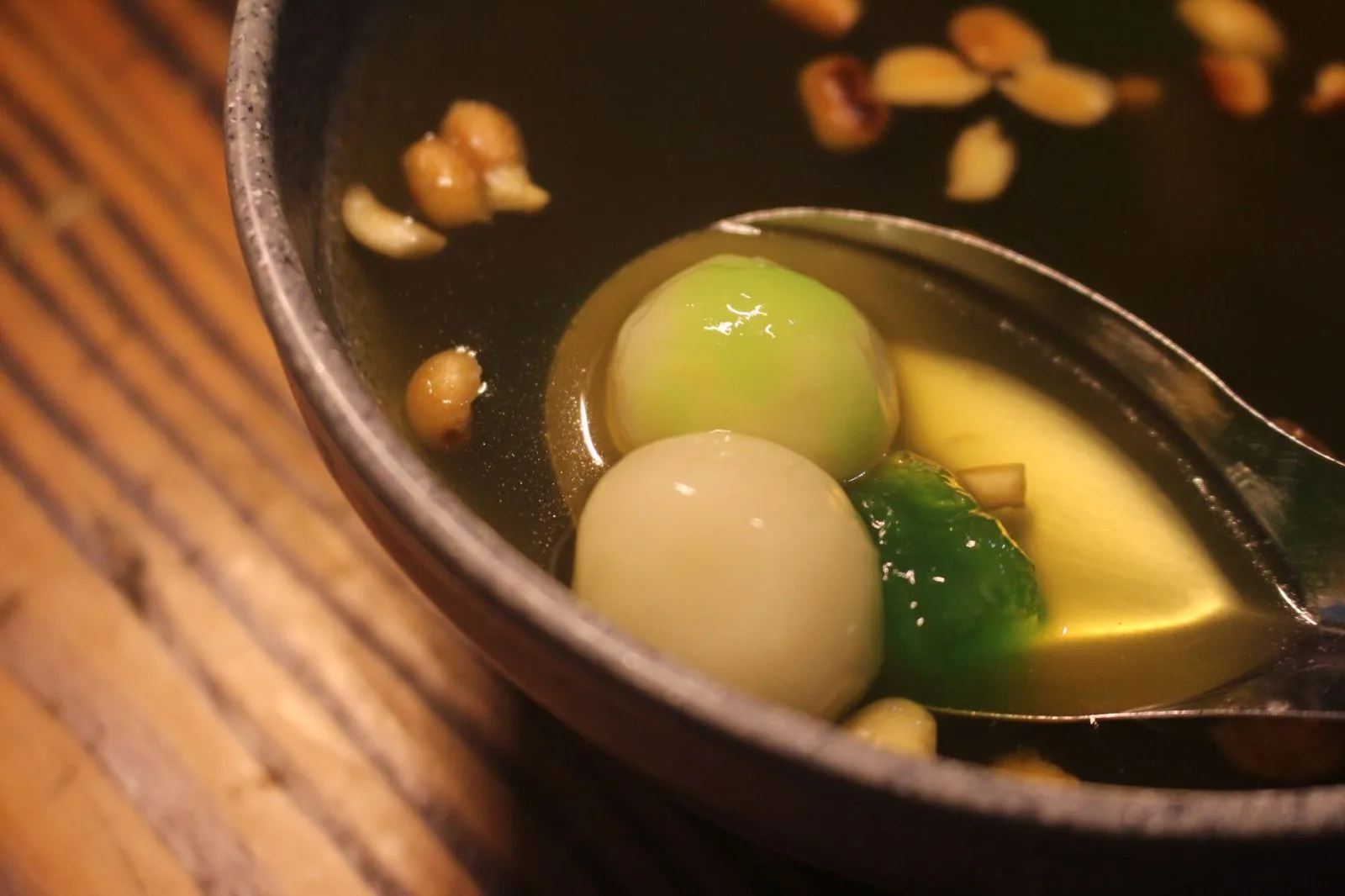
    • Black-sesame tangyuan for the Lantern Festival
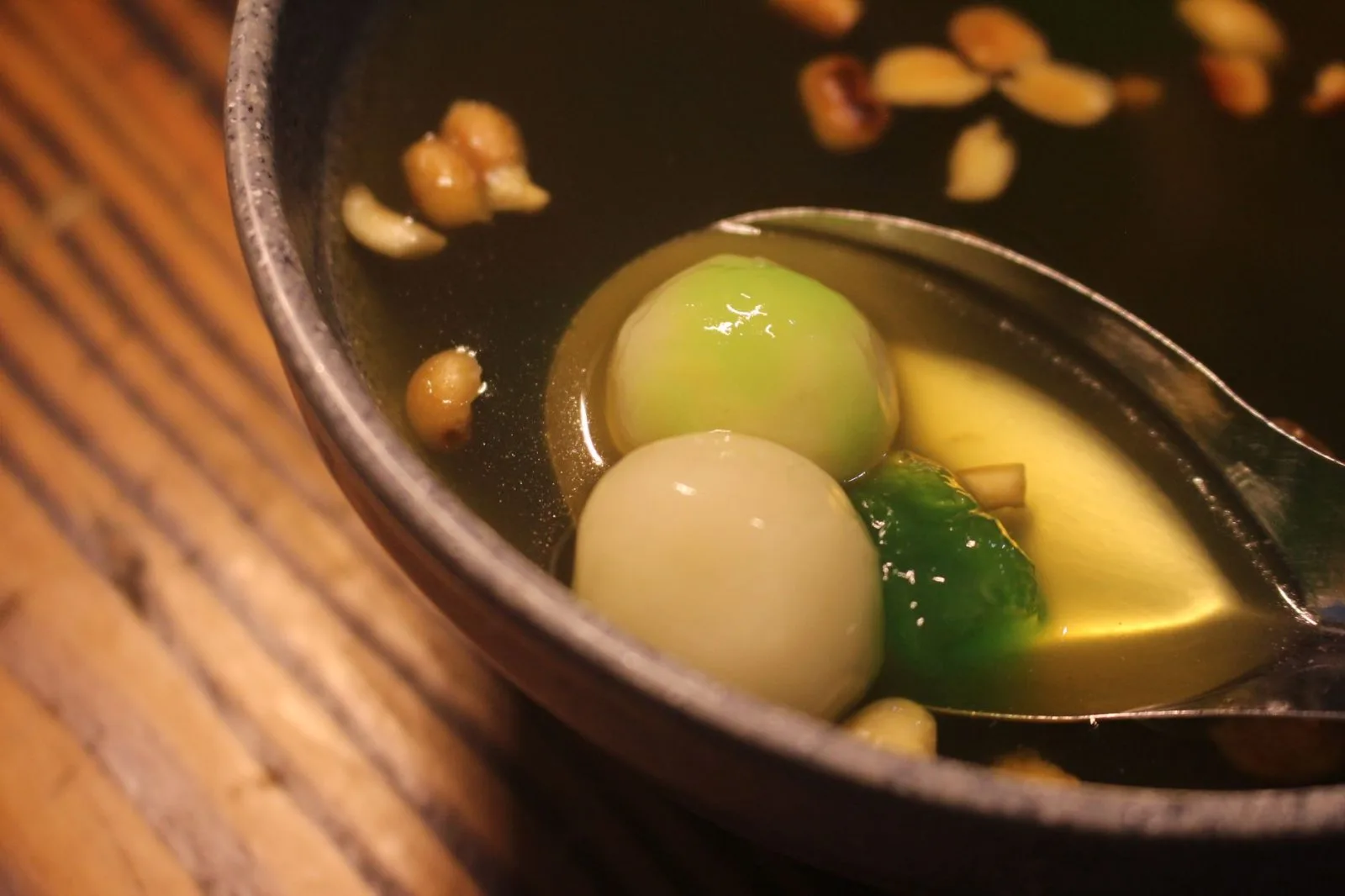
    Small glutinous rice balls with black sesame filling served in a warm bowl
    Tangyuan mark the Lantern Festival across the lower Yangtze. Jauhar Musthofal Qulub | Pexels License (https://www.pexels.com/license/)

    Gardens, Teahouses, and the Table

    Meals in Jiangnan were historically tied to gardens and teahouses, where scholars met over small dishes and wine. The region’s cookbooks, including Yuan Mei’s Suiyuan Shidan of 1792, record recipes alongside comments on market ingredients and household methods. Yuan Mei argued that a cook should understand each ingredient rather than bury it under sauce. That ideal still shapes the region’s public image, even when restaurant versions are elaborate. For a visitor, the useful lesson is to order by season and region: a lake crab in autumn, a bowl of noodles in Suzhou, or a pot of longjing tea near Hangzhou.

    In Jiangnan, the test of a dish is often how little the cook has done to spoil the ingredient.

    Sources et lectures complémentaires

    1. Chinese Regional Cooking — Encyclopædia Britannica.
    2. Hangzhou — Centre du patrimoine mondial de l'UNESCO.
    3. Hangzhou — Encyclopædia Britannica.

    Voyez-le sur place

    Suivez ce lien jusqu'à la région correspondante.

    Explorer par carte

    Suivez le fil de discussion

    Consultez les autres articles qui partagent les mêmes étiquettes.

    Parcourir l'étiquette
  • Cuisine cantonaise

    Vie et folklore

    Cuisine cantonaise

    Steam, Wok Heat, and Coastal Markets

    Guangdong cooking turns local seafood and temple fair foods into a refined restaurant tradition.

    Section
    Vie et folklore
    Région
    Guangdong
    Ère
    À travers les époques
    Étiquettes
    Food, Geography

    Cantonese cuisine is the cooking of Guangdong and its diaspora, built on river deltas, coastal markets, and the heat of the wok. Its best-known dishes—roast goose, dim sum, and steamed fish—sit beside home-style soups and street snacks.

    The Pearl River Pantry

    The Pearl River Delta gave Cantonese cooking an unusually broad pantry. Rice grows in the lowlands, fish and shellfish come from the estuary, and hills behind Guangzhou supply vegetables, pork, and poultry. Guangzhou was a major port under the Tang and again after European traders arrived in the seventeenth and eighteenth centuries. Merchants, officials, and temple fairs supported restaurants that could pay for skilled chefs. By the Qing period, Guangzhou’s tea houses served small plates known as dim sum through the morning and midday. Emigrants from Guangdong later carried these dishes to Southeast Asia, North America, and Europe, adapting them to local supplies.

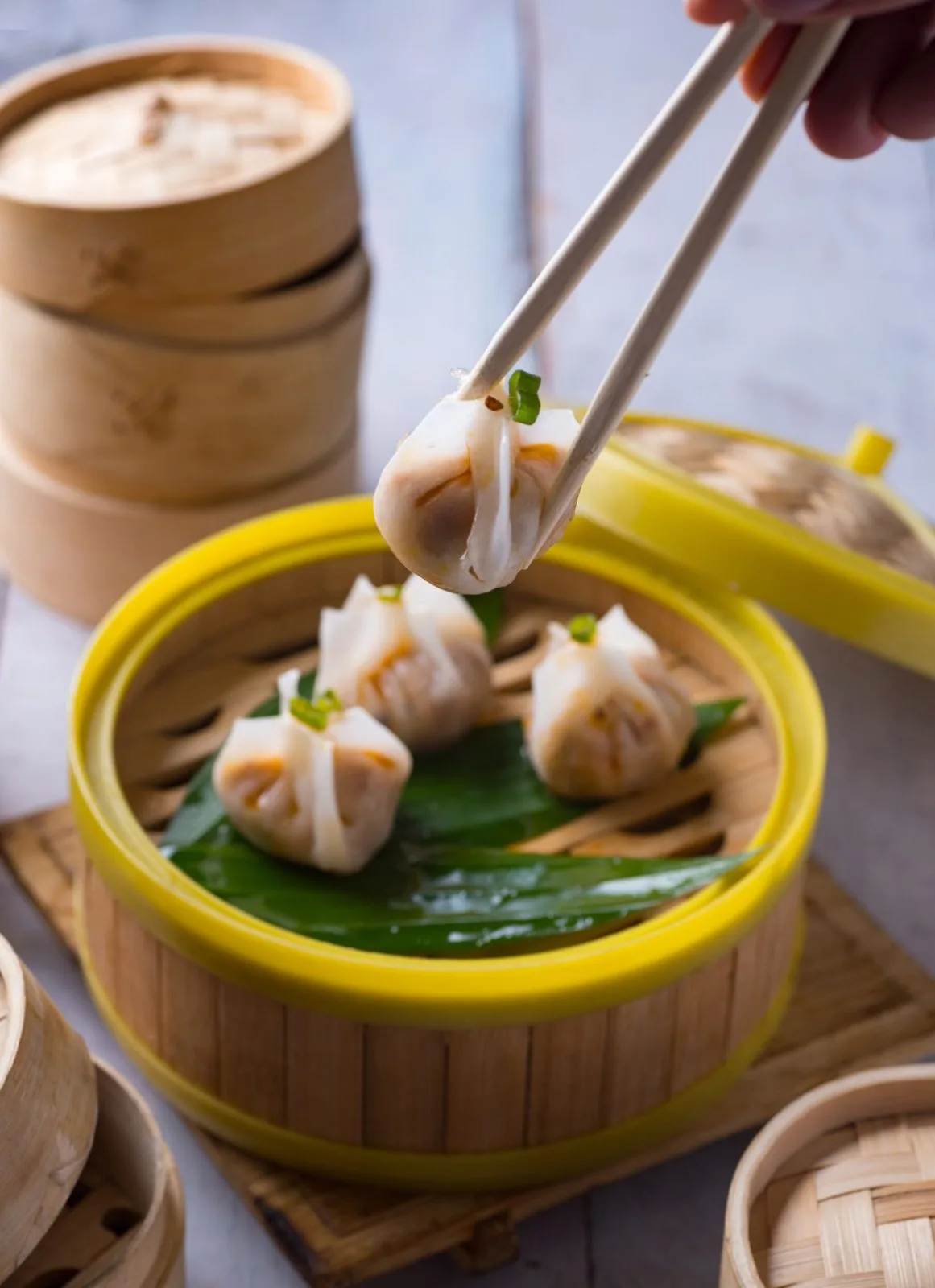
    Bamboo steamers filled with dim sum
    Dim sum developed in the teahouses of Guangzhou and spread with Cantonese migration. parveen tasud | Pexels License (https://www.pexels.com/license/)

    Wok Hei and the Roast House

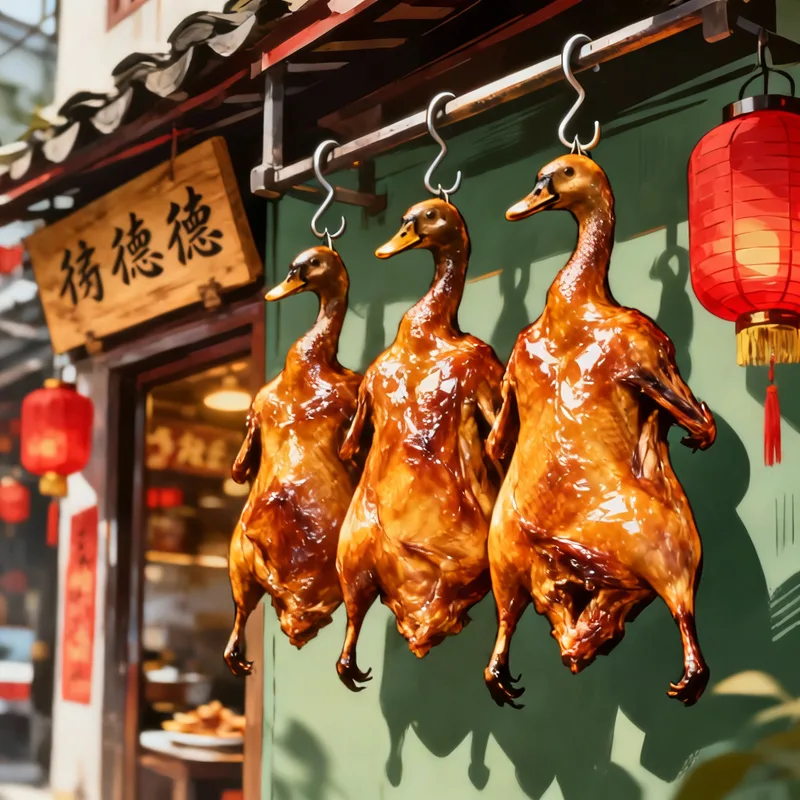
    Cantonese stir-frying depends on wok hei, the barely definable aroma produced when hot oil, vapours, and food meet a very hot wok. Chefs toss ingredients to keep them moving and prevent scorching; sauces are added late, often with cornstarch to give a light coating. Roasting is another speciality. Guangzhou-style white-cut chicken is poached and served with ginger and spring onion, while roast goose from Shunde is glazed, air-dried, and hung in a brick oven until the skin blisters. Char siu pork is marinated with honey and red fermented bean curd, then roasted with sugar caramelising at the edges.

    Roast geese hung to dry before roasting outside a Shunde restaurant
    Air-drying the skin is a key step in Shunde’s roast goose. Illustration générée par IA · SinoViz

    Dim Sum and Morning Ritual

    Dim sum means a light snack, but in Cantonese practice it describes a meal of small portions ordered from trolleys or a paper card. Har gow wrap shrimp in a translucent wheat-starch skin; siu mai open-topped dumplings hold pork and shrimp; char siu bao are soft steamed buns with sweet roast-pork filling. Cheung fun are broad rice-noodle sheets rolled around shrimp, pork, or beef and dressed in soy sauce. Tea accompanies the meal, and the old custom of tapping a pot’s lid to signal for a refill is still performed, though younger diners may simply ask. The ritual is social as much as culinary, filling teahouses from early morning.

    • Har gow with translucent shrimp filling
    • Siu mai topped with a single shrimp
    • Cheung fun rice rolls with soy dressing
    • Egg tarts adapted from British custard pastry
    A trolley of bamboo steamers and tea pots beside a crowded Guangzhou dining room
    A dim sum meal is ordered in small dishes and shared across the table. minchephoto photography | Pexels License (https://www.pexels.com/license/)

    Regional Range and Diaspora

    Cantonese food is not one style. Shunde is known for delicate dairy desserts and fish dishes, Chaozhou nearby has a separate tradition of braised goose, seafood, and strong oolong tea, and Hakka communities in the hills favour preserved vegetables and stuffed tofu. Teochew and Hainanese migrants carried their own versions abroad. In Chinatowns from San Francisco to Singapore, Cantonese restaurants adapted to local tastes while keeping techniques such as steaming, roasting, and long simmered double-boiled soups. The resulting cuisines are mixed, but they preserve a central idea: fresh ingredients, precise heat, and a sauce that supports rather than hides them.

    Cantonese cooking asks a wok to do in seconds what other traditions give hours of stewing.

    Sources et lectures complémentaires

    1. Chinese Cuisine — Encyclopædia Britannica.
    2. Cantonese cuisine — Encyclopædia Britannica.
    3. Guangzhou — Centre du patrimoine mondial de l'UNESCO.

    Voyez-le sur place

    Suivez ce lien jusqu'à la région correspondante.

    Explorer par carte

    Suivez le fil de discussion

    Consultez les autres articles qui partagent les mêmes étiquettes.

    Parcourir l'étiquette
  • Le festival des lanternes

    Vie et folklore

    Le festival des lanternes

    Lights on the Fifteenth Night

    The fifteenth night of the first lunar month closes the New Year with lanterns and sweet rice balls.

    Section
    Vie et folklore
    Région
    Pékin
    Ère
    À travers les époques
    Étiquettes
    Douanes, alimentation

    The Lantern Festival falls on the fifteenth day of the first lunar month, the first full moon of the year. Lanterns, night markets, riddles, and tangyuan rice balls mark the end of the New Year period.

    Origins in Calendar and Court

    The festival’s date follows the lunar calendar, so its Gregorian date changes each year. Several origins are cited. Emperor Wen of Han is said to have declared a public holiday around 180 BCE after defeating the Lü clan, while the Eastern Han emperor Ming promoted lantern displays in the first century CE as Buddhism spread. Daoist tradition associated the day with the heavenly official who grants blessings. By the Tang dynasty, the festival had become a major urban occasion: court records describe vast lantern displays in Chang’an and Luoyang, and the poet Su Weidao wrote of night markets bright as day. The Tang court relaxed curfew so people could view the lights.

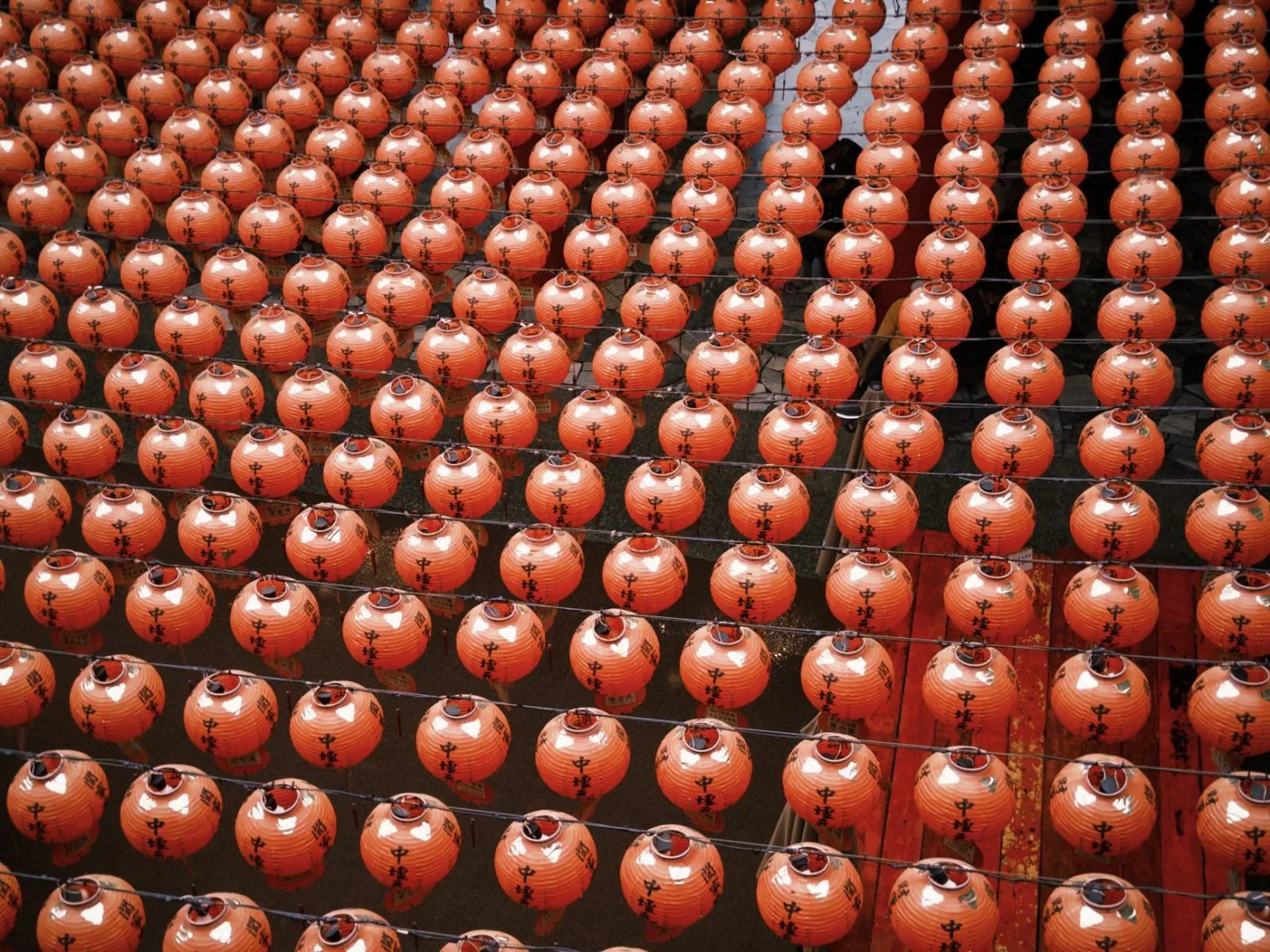
    Rows of illuminated red lanterns hanging along a street during a night festival
    Tang cities relaxed curfew so residents could walk among the lanterns at night. zack ZHUO | Pexels License (https://www.pexels.com/license/)

    Riddles, Lions, and Processions

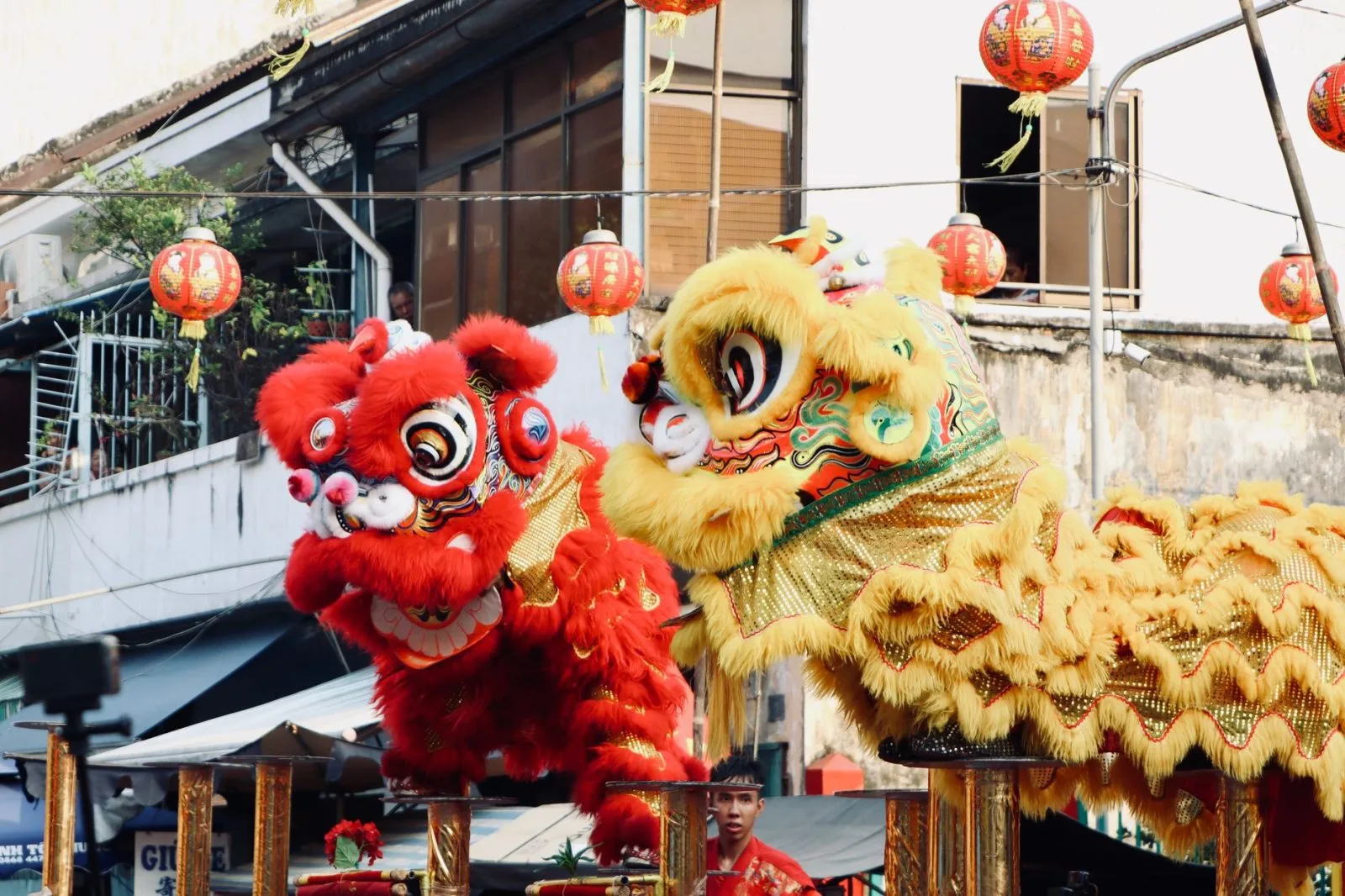
    Lantern riddles are written on slips attached to the lamps; solving one is a small test of wordplay and classical learning. Lion dances, dragon dances, and walking-on-stilts performances draw crowds in the streets, with local troupes competing for space and applause. In some places, people carry lanterns representing animals or characters, and children pull small lanterns on sticks. Beijing’s temple fairs once gathered vendors, performers, and visitors around temple courtyards; today the festival is also marked in parks and commercial districts. Taiwan is known for large lantern festivals and elaborate installations, while Nanjing has long been associated with elaborate lantern craft along the Qinhuai River.

    A lion dance troupe leaping beneath hanging lanterns during a street celebration
    Processions and lion dances turn the festival into a public performance. Pham Huynh Tuan Vy | Pexels License (https://www.pexels.com/license/)

    Tangyuan and the Taste of Reunion

    The festival food is tangyuan in southern China and often yuanxiao in the north, both made from glutinous rice flour around a sweet filling. The names and methods differ: southern cooks wrap a soft dough around filling, while northern cooks may roll moistened filling in dry rice flour in repeated layers. Fillings include black sesame paste, red bean, peanut, and osmanthus sugar. The round shape suggests family unity, and the bowls are shared after the evening’s walk. In Ningbo, black-sesame tangyuan are a local speciality; in Shanghai and Suzhou they are sold from neighbourhood shops. Sweet rice wine and small glutinous balls are also served in some regions.

    • Black sesame, red bean, and peanut fillings
    • Southern wrapped tangyuan and northern rolled yuanxiao
    • Lantern riddles attached to public displays
    • Dragon and lion processions after dark
    A bowl of small white glutinous rice balls in clear sweet soup
    Round rice balls symbolise reunion at the first full moon. Jauhar Musthofal Qulub | Pexels License (https://www.pexels.com/license/)

    The Festival in Modern Cities

    The festival remains a public holiday in mainland China, though the number of days off and the school calendar vary. Major cities install temporary lighting, close some streets to traffic, and run lantern displays in parks and along rivers. Viewing a lantern show often means walking slowly in crowds; in Beijing, the temperature can still be below freezing, so warm layers matter. Photographers should check local rules on tripods and drones. Shopping districts extend the season commercially, but temple fairs and neighbourhood associations keep older practices alive. The date’s movement also means the festival may fall during term time or a working week, changing how families gather.

    The first full moon turns a winter street into a temporary gallery of paper, silk, and light.

    Sources et lectures complémentaires

    1. Festival des Lanternes — Encyclopædia Britannica.
    2. Chinese Lantern Festival — Faits saillants de la Chine.
    3. Yuanxiao Festival — Encyclopédie de l'histoire mondiale.

    Voyez-le sur place

    Suivez ce lien jusqu'à la région correspondante.

    Explorer par carte

    Suivez le fil de discussion

    Consultez les autres articles qui partagent les mêmes étiquettes.

    Parcourir l'étiquette
  • La Cité interdite

    Chronique

    La Cité interdite

    The Ming and Qing Imperial Palace

    A walled palace in Beijing that served as the seat of Ming and Qing imperial government.

    Section
    Chronique
    Région
    Pékin
    Ère
    yuan-ming-qing
    Étiquettes
    History, Scenic Sites

    The Forbidden City was built as the ceremonial and administrative centre of the Ming and later Qing dynasties. Its courtyards and halls express rank in stone, timber, colour, and route: the emperor alone crossed the central axis to the throne hall.

    Building an Imperial Axis

    Construction began in 1406 under the Yongle Emperor, who had moved the capital from Nanjing to Beijing. The palace took roughly fourteen years to complete and opened in 1420. Its site lay south of the Yuan dynasty’s capital, Dadu, whose planner had already established a north-south axis. More than a million workers and artisans were mobilised, including convict labour and skilled craftsmen from across the empire. Timber came from southern forests, stone from quarries near Beijing, and glazed tiles from kilns in the capital’s outskirts. The name Zijin Cheng, or Purple Forbidden City, referred to the polarised Heavenly Emperor and the restrictions on entry.

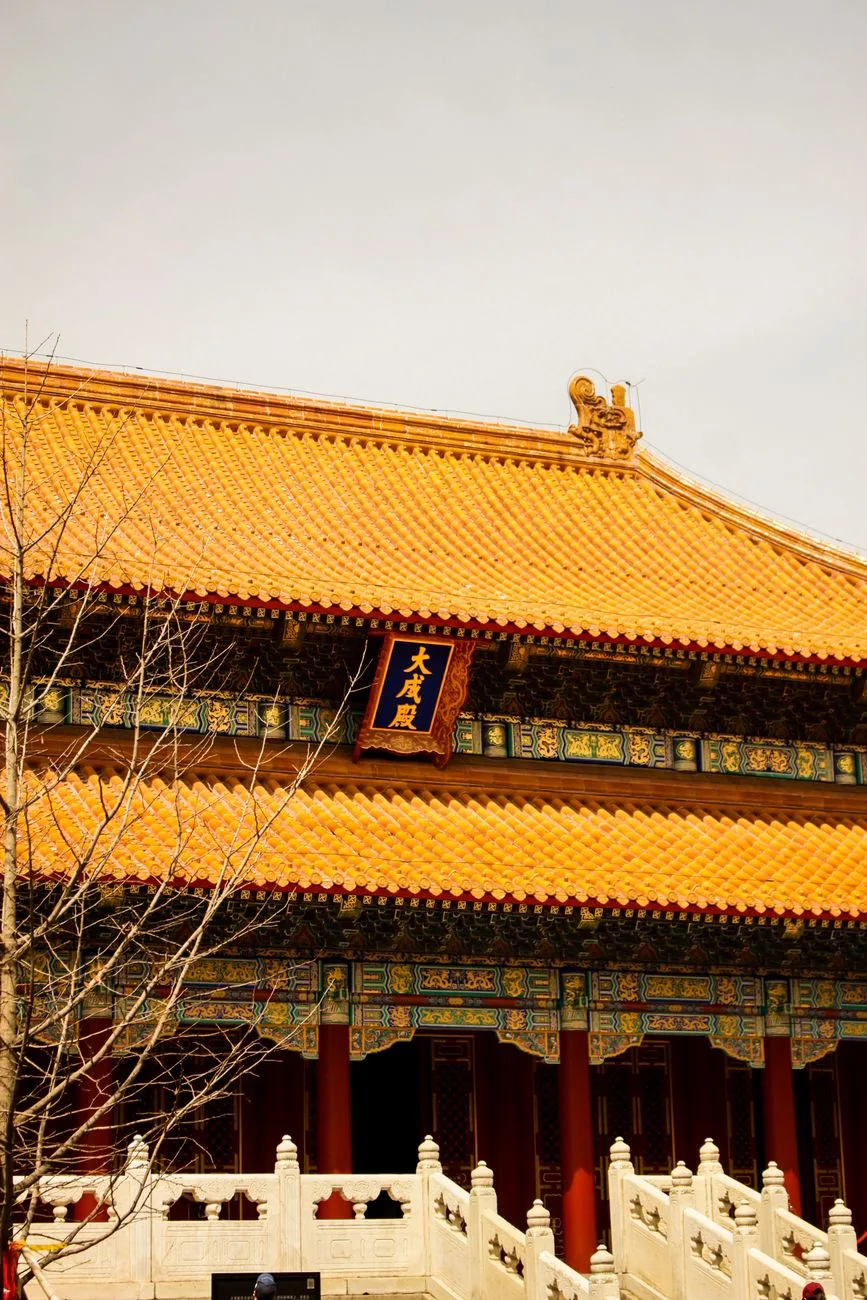
    The Hall of Supreme Harmony rising above broad terraces on Beijing’s central axis
    The main throne hall stands on the palace’s central ceremonial axis. Lan Yao | Pexels License (https://www.pexels.com/license/)

    Front Court and Inner Quarters

    The palace is organised into an outer court for ceremony and an inner court for residence. The Hall of Supreme Harmony, the largest and highest hall, was used for enthronements, imperial weddings, and the winter solstice audience. Behind it stand the Hall of Central Harmony and the Hall of Preserving Harmony. The inner court includes the Palace of Heavenly Purity, the Hall of Earthly Tranquility, and the empress’s quarters. Officials approached through the Meridian Gate and crossed the Golden Water River on bridges that marked status. The design did more than impress: it separated ranks and turned movement through space into a visible grammar of power.

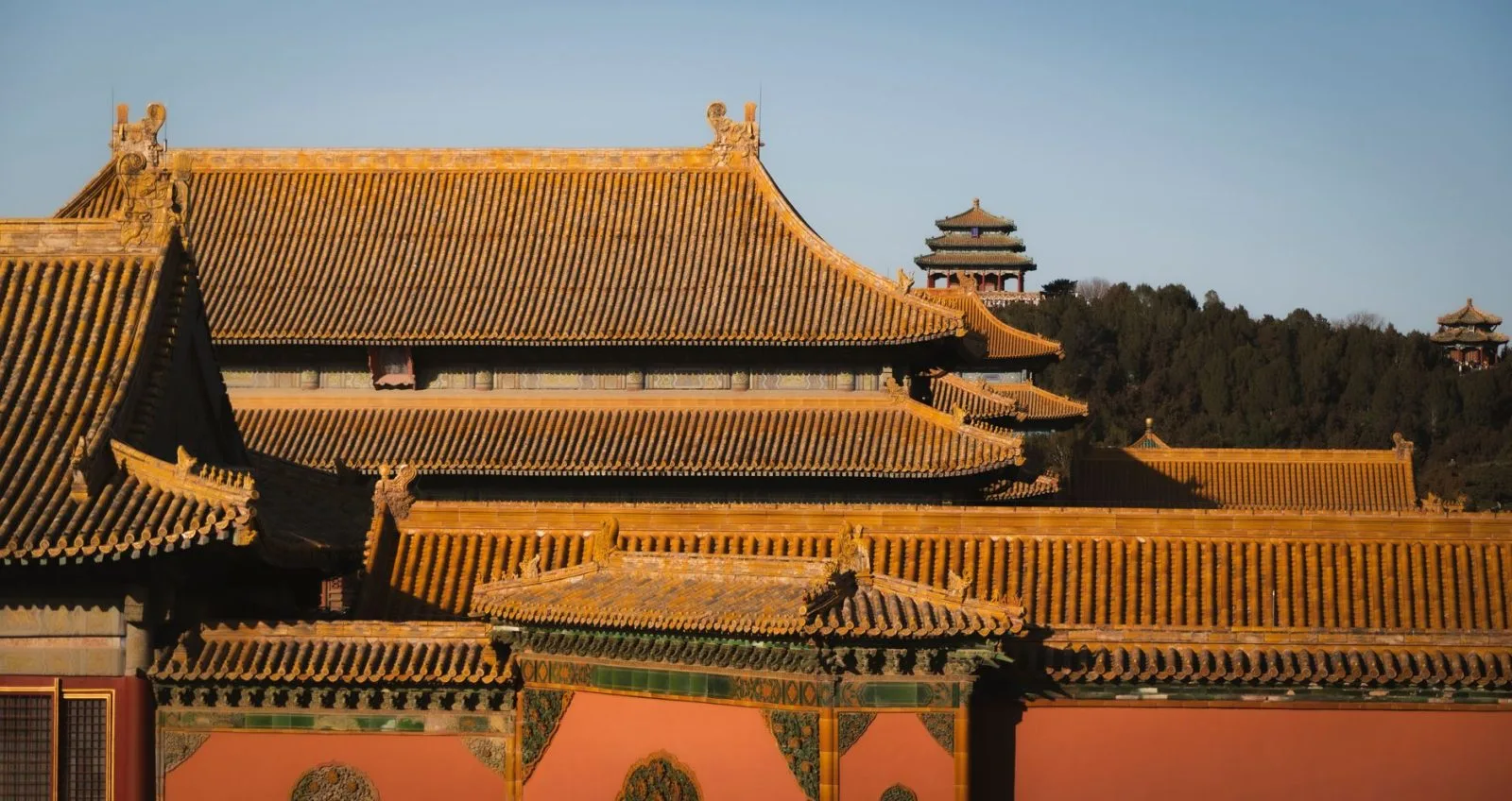
    A succession of red-walled courtyards and golden roofs viewed from a palace terrace
    Repeated courtyards made ceremonial progress part of the architecture. 虎 曼 | Pexels License (https://www.pexels.com/license/)

    Colour, Number, and Craft

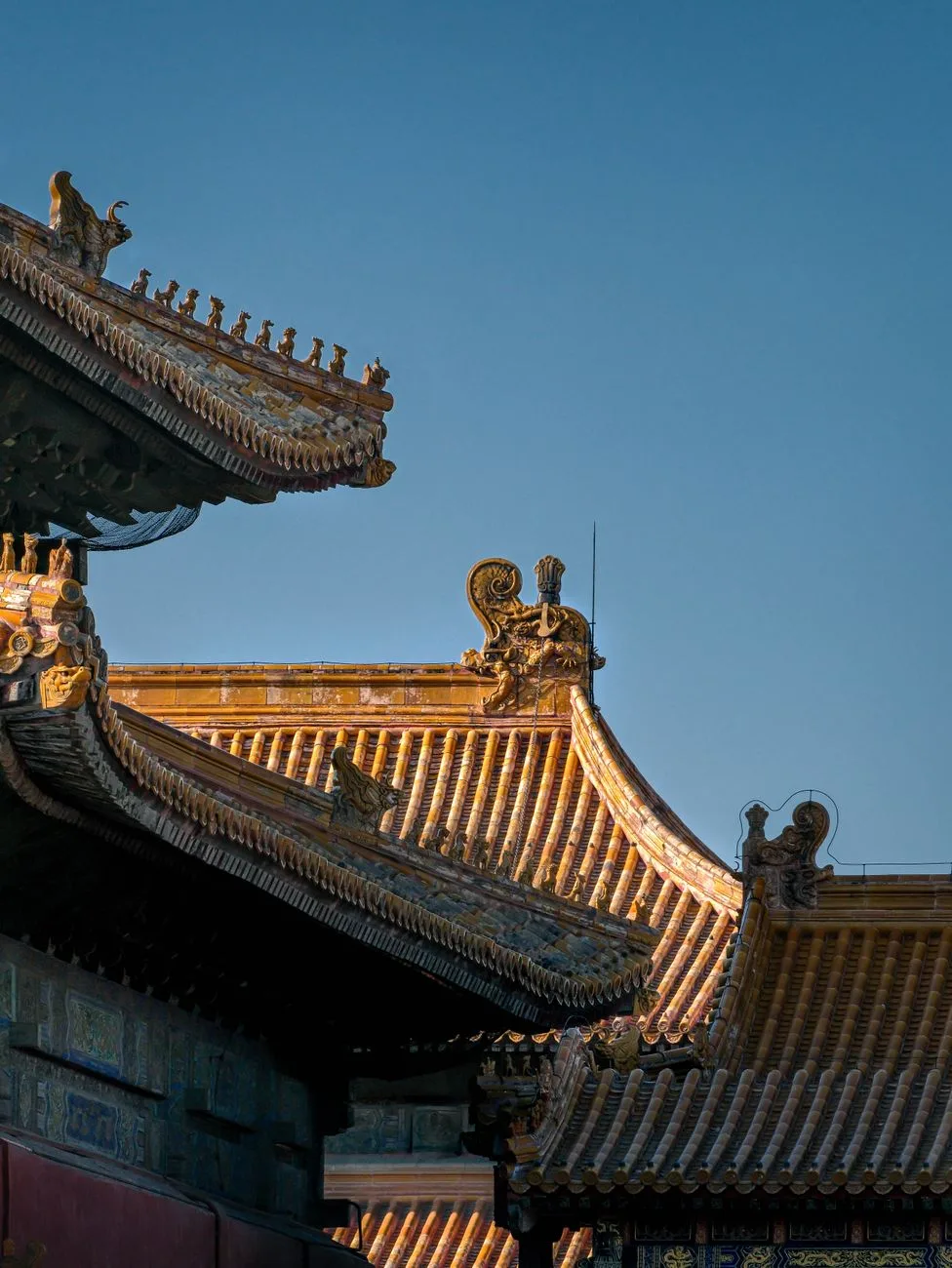
    The surviving buildings show Ming and Qing carpentry at large scale. Timber frames stand on stone plinths, with dougong bracket sets supporting deep eaves. Yellow glazed roof tiles were reserved for imperial buildings; vermilion walls, white marble terraces, and dark blue-green beams created a controlled palette. The Hall of Supreme Harmony carries ten roof figures, the highest rank, and its terrace holds bronze cranes and a tortoise. Numbers were symbolic: nine marked the emperor, and the palace is said to have 9,999 rooms, though the count depends on how spaces are defined. The Palace Museum, opened in 1925 after the last emperor left, now preserves the buildings and collections.

    • Begun in 1406 and occupied in 1420
    • Outer court for audiences, inner court for residence
    • Yellow roof tiles restricted to imperial use
    • Palace Museum opened to the public in 1925
    Golden roof tiles, bracket sets, and carved beams on a Qing palace hall
    Dougong brackets and yellow glazed tiles carried imperial rank. ravencrow BI | Pexels License (https://www.pexels.com/license/)

    Visiting the Palace Today

    The complex covers about 720,000 square metres and holds thousands of rooms, so a visit needs a route. Most visitors enter from the south at the Meridian Gate, pass the three great halls, then turn north to the inner court and the Garden of Cultivation. The Treasure Gallery and the Clock Gallery occupy separate wings and often require extra tickets. Ticket sales normally close in the afternoon and the palace is closed on Mondays except during peak holidays, so checking current rules matters. Tiananmen Square security adds time. The best views of the roofscape are from Jingshan Park to the north, which also marks the site where the Ming dynasty’s last emperor died in 1644.

    The palace made ceremony architectural: every gate, terrace, and roof colour told a visitor where power stood.

    Sources et lectures complémentaires

    1. La Cité interdite — Centre du patrimoine mondial de l'UNESCO.
    2. La Cité interdite — Encyclopædia Britannica.
    3. The Palace Museum — The Palace Museum.

    Voyez-le sur place

    Suivez ce lien jusqu'à la région correspondante.

    Explorer par carte

    Suivez le fil de discussion

    Consultez les autres articles qui partagent les mêmes étiquettes.

    Parcourir l'étiquette
  • train à grande vitesse

    Guide de voyage

    train à grande vitesse

    A National Network at 300 km/h

    China’s high-speed lines connect major cities with frequent, electrified, mostly elevated track.

    Section
    Guide de voyage
    Région
    Pékin
    Ère
    Chine moderne
    Étiquettes
    Geography, Transport

    China’s high-speed rail network is the largest in the world, measured by route length. It grew from a single 2008 line between Beijing and Tianjin into a national system linking regional capitals, coastal cities, and tourist gateways.

    From the Beijing–Tianjin Line

    The Beijing–Tianjin intercity railway opened in August 2008, just before the Beijing Olympics, with trains designed for 350 kilometres per hour. It followed the Sixth Railway Speed-Up campaign, in which conventional lines were upgraded and new rolling stock imported from Siemens, Alstom, Bombardier, and Kawasaki. Technology transfer and domestic redesign produced the CRH family and later the Fuxing series. The 2011 Wenzhou accident on the Beijing–Shanghai line, caused by signalling failures during a thunderstorm, killed forty people and led to speed reductions, audits, and a slower pace of construction. The network nevertheless expanded rapidly after 2013.

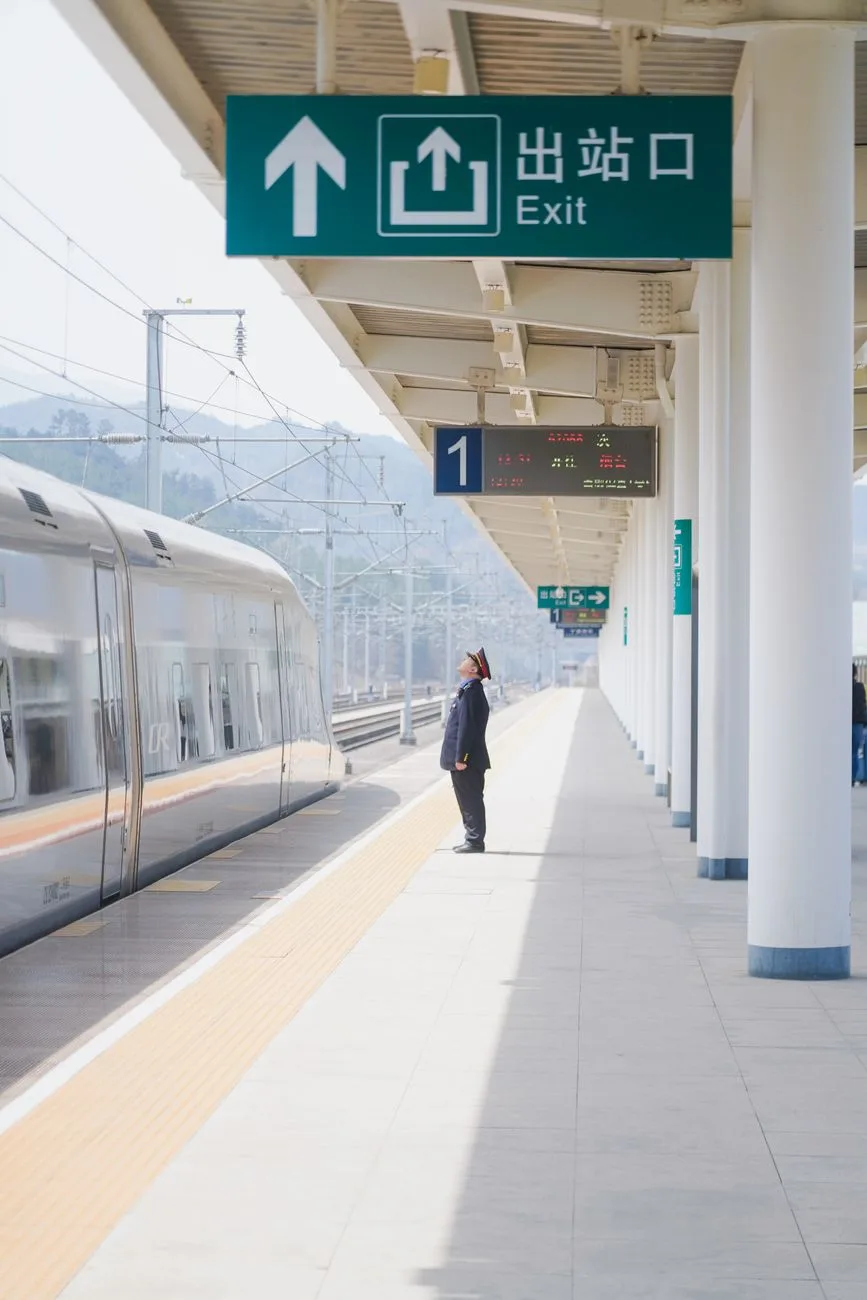
    A streamlined white high-speed train standing at a modern elevated platform
    The CRH and Fuxing trains developed from imported designs and domestic redesign. travelers_tw | Pexels License (https://www.pexels.com/license/)

    How the Network Is Built

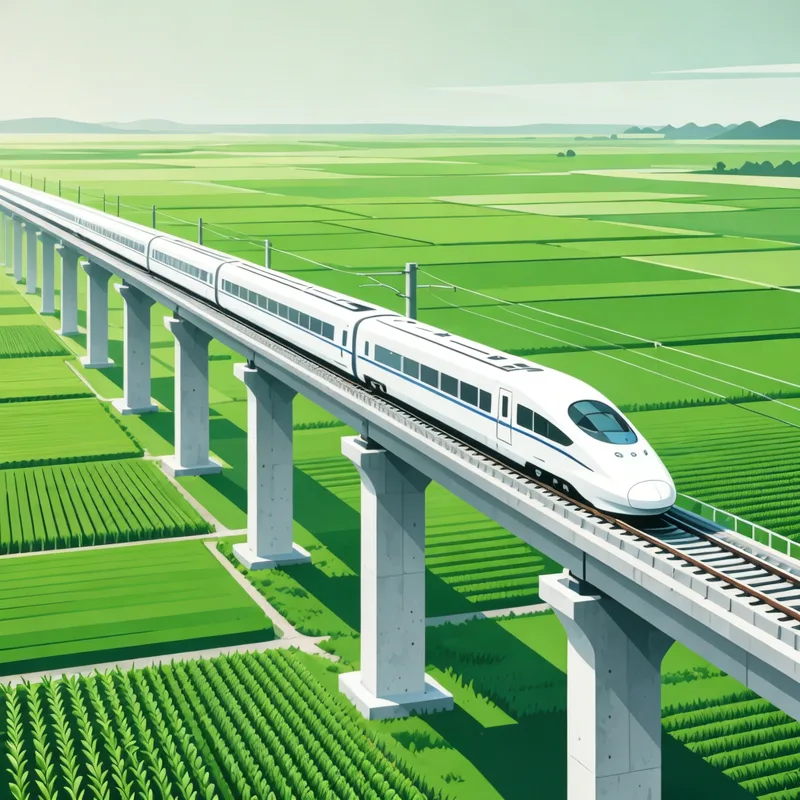
    High-speed lines require gentle curves, long tunnels, and level track, so much of the network rides on concrete viaducts. Bridges keep routes straight, reduce land take, and allow farm traffic and roads to pass underneath. Continuous welded rail, slab track, and overhead catenary carry trains at operating speeds commonly around 300–350 kilometres per hour on the fastest services. Automatic train control limits speed and spacing; drivers monitor the system rather than relying only on signals beside the track. Stations are often built outside old city cores, where land was available, so a central railway station and a high-speed station may be different places in the same city.

    Elevated high-speed railway crossing agricultural land on concrete piers
    Viaducts keep high-speed alignments straight and limit the footprint on farmland. Illustration générée par IA · SinoViz

    Using the System

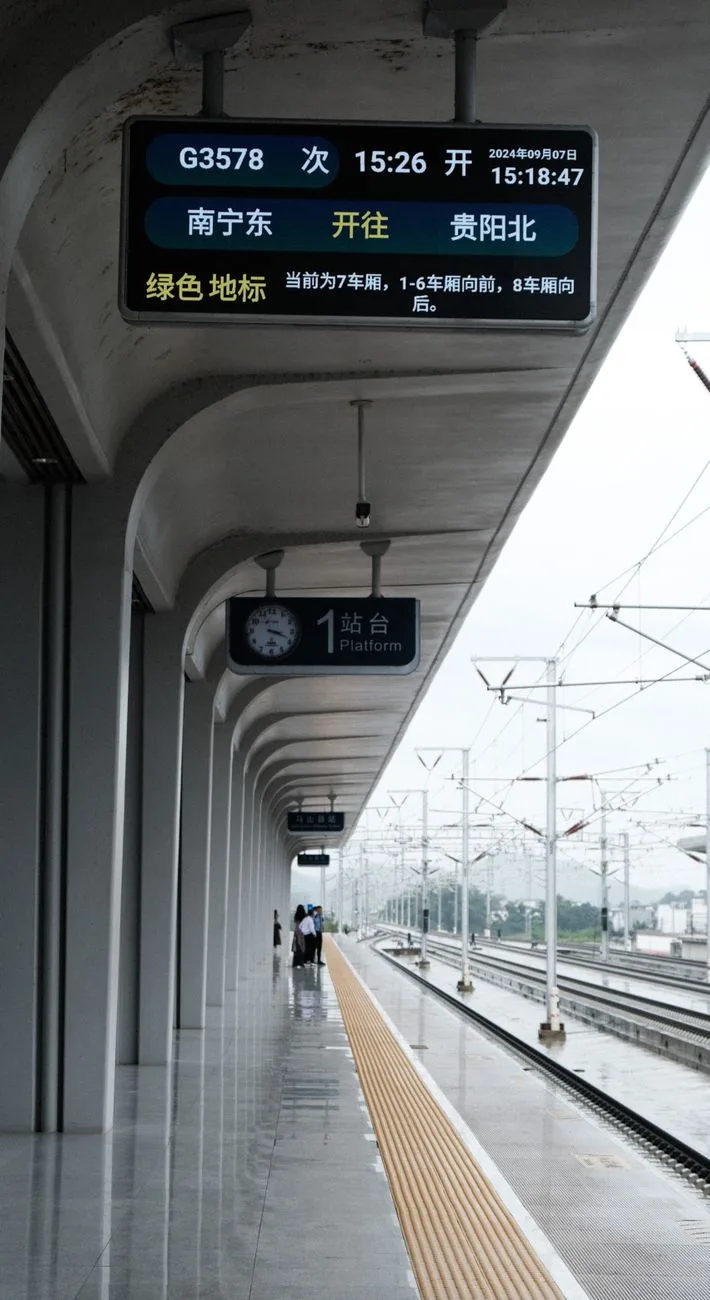
    Tickets are sold through the official Railway 12306 website and app; passports or resident identity documents are checked at entry, and names must match the booking. The G-series are the fastest passenger services, D-series generally run on upgraded or slightly slower lines, and overnight high-speed sleeper trains now cover longer routes. Larger stations use airport-style security, so arriving well before departure is wise. Seats are assigned, restaurant cars or at-seat delivery are common, and station boards use Chinese characters and Roman letters. Beijing West, Beijing South, and Beijing Chaoyang serve different lines, so the station name on the ticket matters as much as the city.

    • Book through Railway 12306 with an identity document
    • Allow time for security screening at large stations
    • Check whether the ticket says Beijing South, West, or Chaoyang
    • G trains are generally faster than D trains
    A departure board listing high-speed train times in a large Chinese station
    Check the exact station name: major cities may have several high-speed terminals. 航皓 陈 | Pexels License (https://www.pexels.com/license/)

    What the Routes Connect

    The Beijing–Shanghai line, opened fully in 2011, links the political capital to the financial centre in about four and a half hours on the fastest trains. The Beijing–Guangzhou line, completed in 2012, runs south through Shijiazhuang, Zhengzhou, Wuhan, and Changsha. The Lanzhou–Xinjiang line reached Urumqi in 2016, extending high-speed service deep into the northwest. Coastal lines connect Tianjin, Jinan, Nanjing, Hangzhou, and Shanghai, while newer routes serve Chengdu, Chongqing, Kunming, and Xi’an. Trains are frequent on busy corridors, but distances remain continental: a traveller crossing several time-zone-widths of China should still allow a full day.

    A high-speed station may sit far from the old city centre, so the ticket’s station name is part of the journey.

    Sources et lectures complémentaires

    1. High-speed rail in China — Encyclopædia Britannica.
    2. China Railway High-speed — Encyclopédie de l'histoire mondiale.
    3. China Railway 12306 — China Railway.

    Voyez-le sur place

    Suivez ce lien jusqu'à la région correspondante.

    Explorer par carte

    Suivez le fil de discussion

    Consultez les autres articles qui partagent les mêmes étiquettes.

    Parcourir l'étiquette
  • Boulettes

    Vie et folklore

    Boulettes

    Caisses de blé remplies et rituel d'hiver

    Les raviolis du nord de la Chine transforment une pâte à base de blé et des farces de saison en un repas convivial.

    Section
    Vie et folklore
    Région
    Pékin
    Ère
    À travers les époques
    Étiquettes
    Douanes, alimentation

    Les jiaozi sont des raviolis farcis à base de blé, cuits à l'eau bouillante, à la vapeur ou frits. Dans le nord de la Chine, ils sont préparés pour célébrer le solstice d'hiver et le Nouvel An lunaire : les familles se réunissent alors autour d'une table pour confectionner des jiaozi, qu'elles plient à la main.

    Le blé dans l'alimentation nordique

    Les raviolis sont originaires de la région du blé et du millet du nord de la Chine, où la farine de blé devint un aliment de base sous les Han et les dynasties suivantes. Leur forme a été comparée à l'ancienne monnaie chinoise, ce qui explique leur présence dans le vocabulaire du Nouvel An : « jiaozi » sonne comme une expression désignant l'échange de trésors. Une tradition bien connue associe les raviolis au médecin Zhang Zhongjing, qui aurait confectionné des petits paquets de pâte farcis pour soigner les engelures aux oreilles durant la dynastie Han. Cette histoire est difficile à vérifier, mais elle explique la coutume de les consommer par temps froid. Les preuves archéologiques concernant les aliments à base de blé farcis sont plus claires que celles permettant d'attribuer un inventeur unique à ce mets.

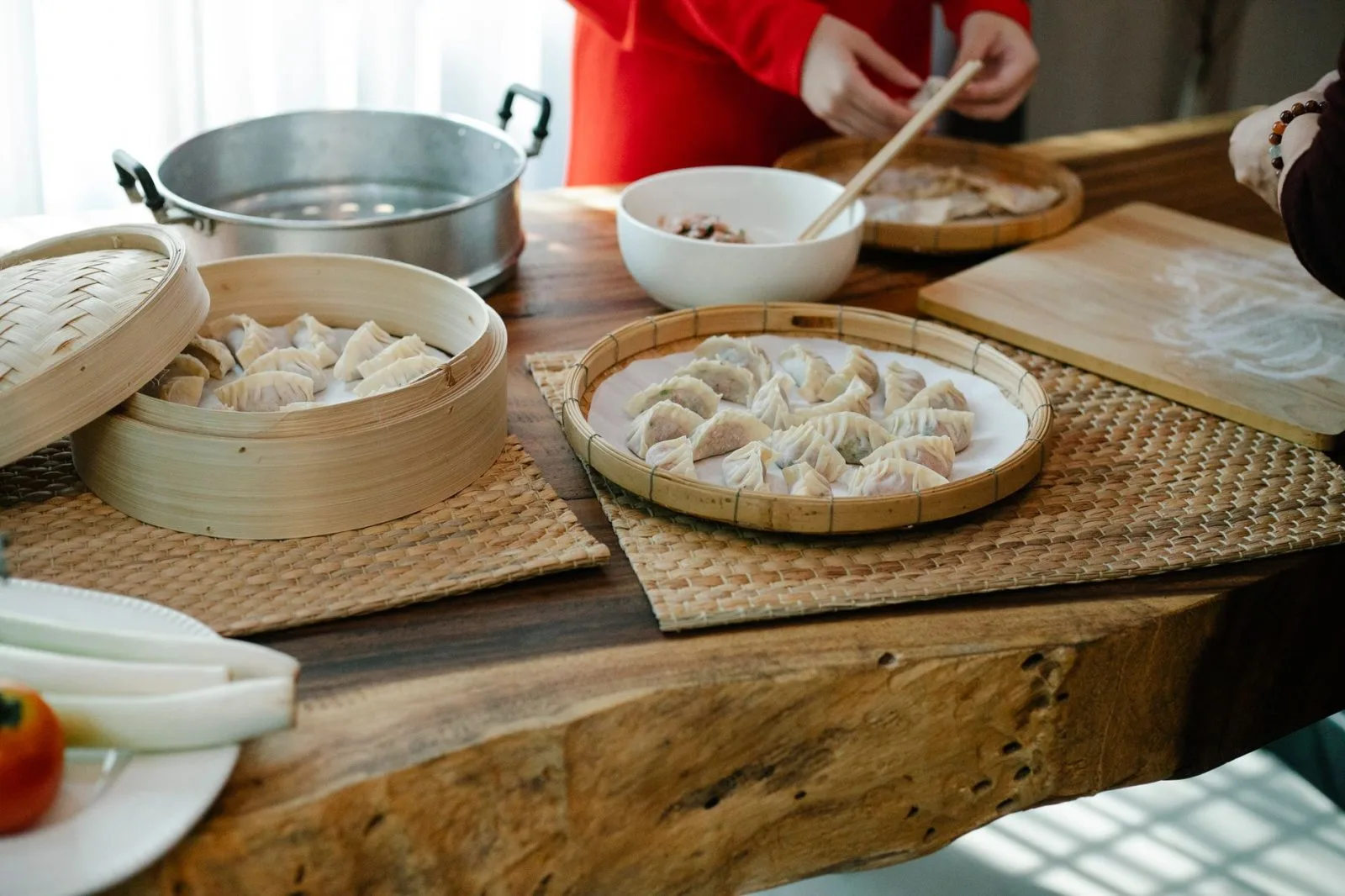
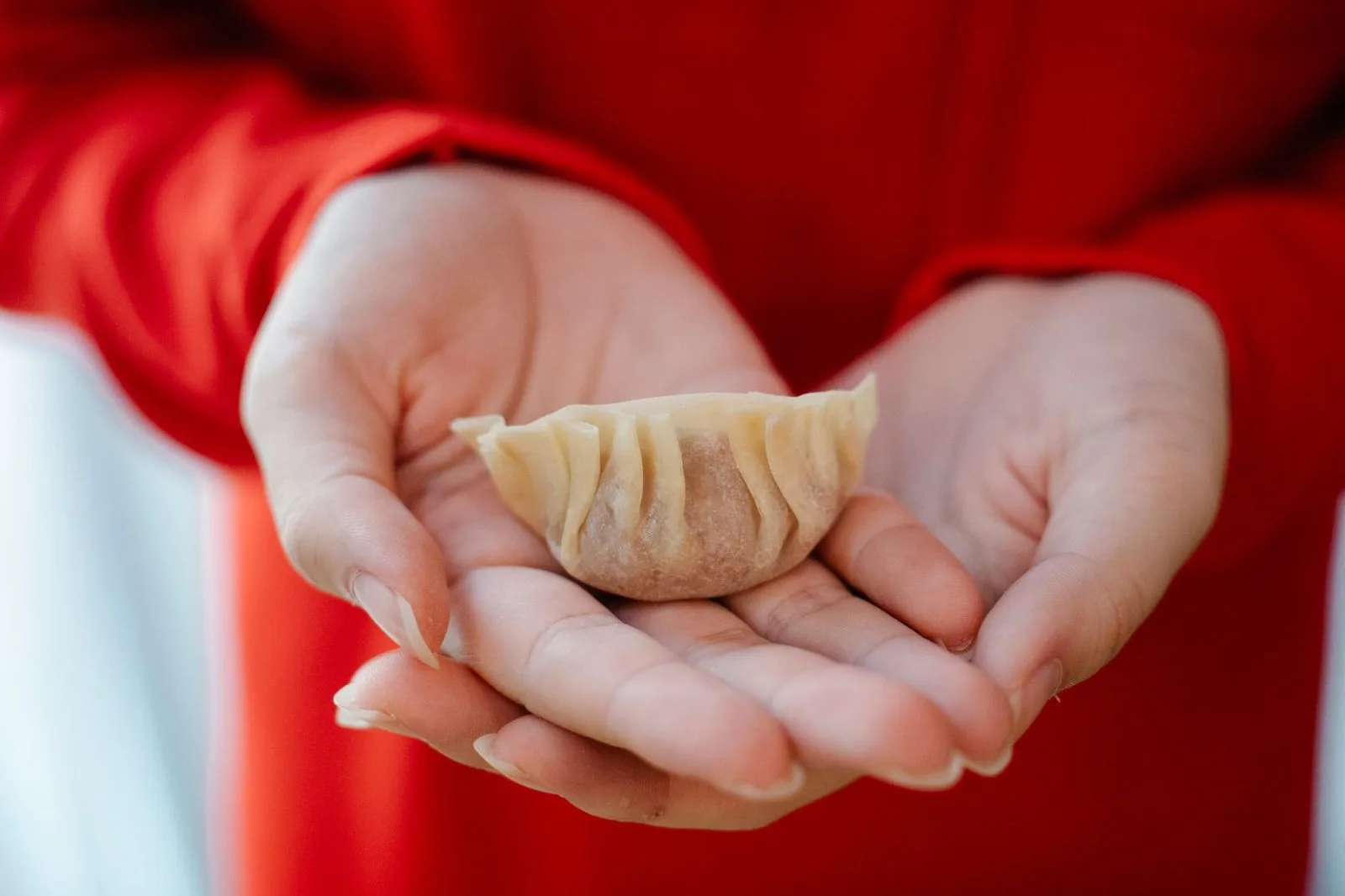
    Une rangée de raviolis jiaozi plissés posés sur une planche en bois farinée
    Le bord plissé scelle la farce et donne à chaque ravioli sa forme familière. Angela Roma | Licence Pexels (https://www.pexels.com/license/)

    Pâte, farce et pliage

    La pâte de base des jiaozi est composée de farine de blé et d'eau. On la laisse reposer pour que le gluten se détende et que la pâte puisse être étalée finement sans se déchirer. Certains cuisiniers ajoutent un œuf ou utilisent de l'eau chaude en remplacement d'une partie de la farine pour obtenir une texture plus moelleuse. La farce est finement hachée pour bien cuire : porc avec chou, ciboulette ou poireaux ; agneau avec oignon dans le nord-ouest ; crevettes et œuf dans les régions côtières. On place la farce au centre, on replie la pâte et on presse les plis le long de la jointure. Une fermeture hermétique est essentielle, car la cuisson à l'eau risque d'ouvrir la pâte si de l'air reste emprisonné. Les farces végétariennes à base de tofu, de champignons ou d'œuf sont courantes, notamment pour les visites aux temples et les périodes de jeûne.

    Des mains pincent les plis le long du bord d'un ravioli cru
    Le pliage scelle le paquet ; chaque famille peut préférer un pliage différent. Angela Roma | Licence Pexels (https://www.pexels.com/license/)

    Bouilli, cuit à la vapeur et frit

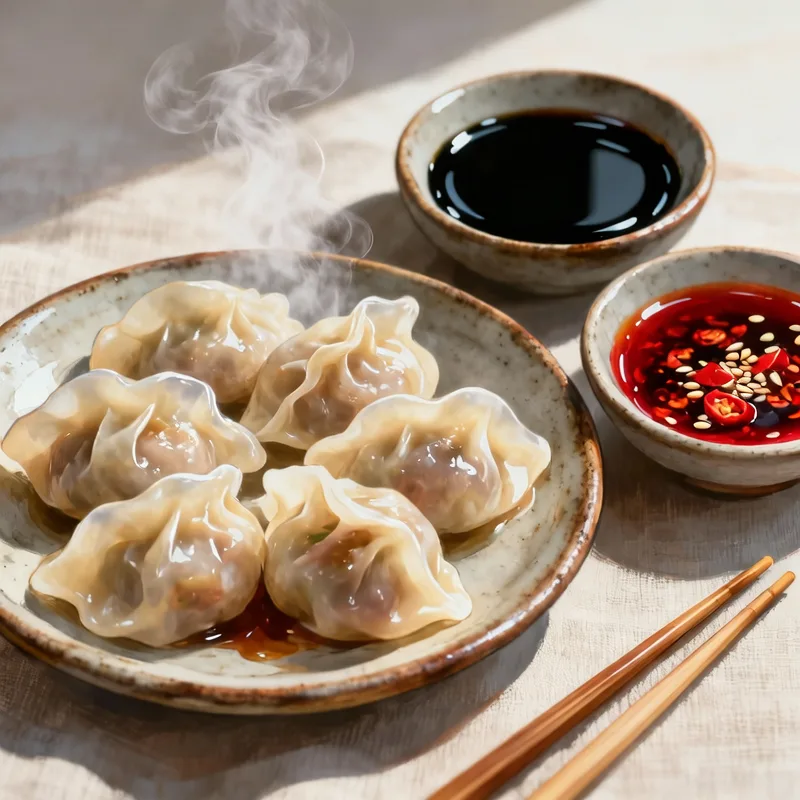
    La méthode la plus courante est la cuisson à l'eau bouillante : les raviolis sont placés dans une grande casserole, remués délicatement du fond, et cuits jusqu'à ce qu'ils remontent à la surface et gonflent. Dans le nord du pays, on ajoute souvent un peu d'eau froide lorsque l'eau bout à nouveau, et l'opération est répétée trois fois pour obtenir une pâte ferme. Le potsticker, ou guotie, est frit d'un côté, puis cuit à la vapeur à couvert avec un peu d'eau, ce qui lui confère une base croustillante. Les versions du sud et de la diaspora incluent les har gow cuits à la vapeur avec des crevettes et une pâte translucide à base d'amidon de blé. Les sauces varient, allant du vinaigre noir et du gingembre à la sauce soja avec de l'huile de piment ou de l'ail. Les farces varient également : le porc et la ciboulette dominent à Pékin, le bœuf et l'agneau apparaissent dans les communautés musulmanes, et le chou ou les champignons conviennent aux villes plus froides de l'intérieur des terres.

    • Jiaozi bouilli pour le Nouvel An et le solstice d'hiver
    • Guotie avec une base frite croustillante
    • Vinaigre noir et gingembre, une trempette classique
    • Garnitures régionales à base de porc, d'agneau, de crevettes ou de légumes
    Boulettes bouillies servies avec des petits ramequins de vinaigre et d'huile pimentée
    Une sauce au vinaigre et au gingembre permet de contrebalancer la richesse des farces au porc. Illustration générée par IA · SinoViz

    Les fabriquer ensemble

    Les raviolis sont un mets convivial car leur préparation prend du temps. La veille du Nouvel An lunaire, plusieurs générations peuvent rouler la pâte, hacher la farce et plier des dizaines, voire des centaines de raviolis ensemble ; certains ont la forme de pièces de monnaie ou contiennent une pièce propre, symbole de chance. Le repas est souvent organisé autour des membres les plus âgés de la famille. Les restes sont frits le lendemain, et on trouve désormais des raviolis surgelés dans les supermarchés en Chine et à l’étranger. Les versions proposées dans les restaurants varient, des raviolis d’agneau des maisons pékinoises aux guotie de Shanghai et aux xiaolongbao fourrés à la soupe, qui appartiennent à une famille de brioches vapeur apparentée mais distincte.

    Préparer des raviolis, c'est un petit morceau d'organisation domestique : de la pâte, de la farce, des mains et une raison de se réunir.

    Sources et lectures complémentaires

    1. Dumpling — Encyclopædia Britannica.
    2. Jiaozi — Encyclopædia Britannica.
    3. Nouvel An chinois — Encyclopædia Britannica.

    Voyez-le sur place

    Suivez ce lien jusqu'à la région correspondante.

    Explorer par carte

    Suivez le fil de discussion

    Consultez les autres articles qui partagent les mêmes étiquettes.

    Parcourir l'étiquette
  • Poésie Tang

    Chronique

    Poésie Tang

    L'âge d'or de la poésie chinoise

    Les poètes Tang ont transformé l'artisanat de cour, les voyages aux frontières et la pensée bouddhiste en poèmes courts et intemporels.

    Section
    Chronique
    Région
    Shaanxi
    Ère
    sui-tang
    Étiquettes
    Coutumes, Histoire

    La dynastie Tang (618-907) a produit le corpus le plus célèbre de la poésie classique chinoise. Les poèmes ont voyagé dans des manuscrits, des anthologies, des inscriptions et des représentations, reliant la capitale Chang'an aux postes frontières et aux monastères.

    Chang'an et le poète officiel

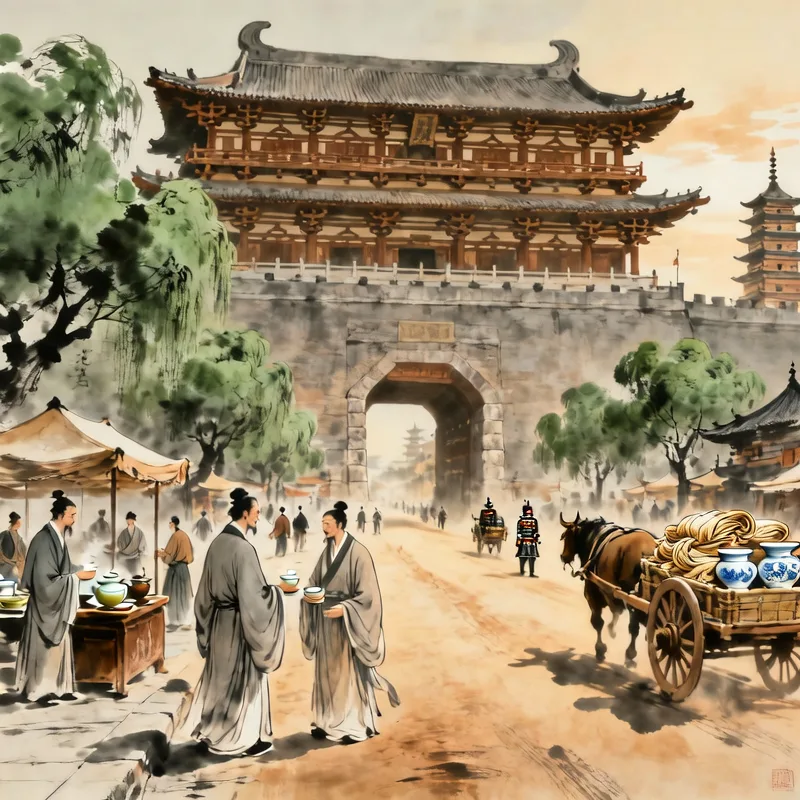
    Sous la dynastie Tang, la poésie était intimement liée au système des examens et à la vie officielle. Les candidats étaient évalués sur leur capacité à composer des vers réguliers, et leurs essais en prose étaient accompagnés de poèmes ; la réussite pouvait leur valoir des nominations et la possibilité de diffuser leurs œuvres auprès de mécènes. Chang'an, la capitale proche de l'actuelle Xi'an, comptait environ un million d'habitants à son apogée, et possédait des marchés, des temples et des communautés étrangères. Les poètes occupaient des postes éloignés, écrivaient des poèmes d'adieu et composaient pour les occasions publiques. Le Quan Tangshi, compilé au début du XVIIIe siècle sur ordre impérial, conserve plus de quarante-huit mille poèmes de plus de deux mille auteurs. Son ampleur témoigne de l'importance de la poésie dans la vie des lettrés.

    Une porte de ville et une large avenue de l'époque Tang dans l'ancienne capitale Chang'an
    Des fonctionnaires et des poètes déambulaient dans les marchés, les temples et les bureaux gouvernementaux de la capitale. Illustration générée par IA · SinoViz

    Règle et liberté dans la poésie réglementée

    Les poètes Tang exploraient plusieurs formes poétiques. Le lüshi, ou vers régulier, se compose de huit vers de cinq ou sept caractères, avec des schémas tonaux stricts et un parallélisme marqué entre les distiques centraux. Les jueju sont des poèmes de quatre vers, d'apparence familière, mais souvent construits sur une réflexion profonde. Les anciennes formes de ballades yuefu et les poèmes en prose fu restèrent en usage. Du Fu (712-770) maîtrisa le vers régulier et y intégra l'observation sociale, écrivant sur la corruption, la guerre et la famine, ainsi que sur les paysages. Li Bai (701-762) est connu pour une voix plus libre et plus ample, bien que ses meilleurs poèmes soient également d'une grande précision. Wang Wei (701-759) écrivit des poèmes paysagers concis, influencés par le bouddhisme Chan.

    Un paysage ouvert de montagnes et de brume rappelant les décors des poèmes paysagers Tang.
    La poésie paysagère utilise souvent une scène restreinte pour suggérer un état d'esprit plus vaste. Illustration générée par IA · SinoViz

    Frontière, exil et Sud

    Les décennies qui suivirent la rébellion d'An Lushan (755-763) redessinèrent le paysage poétique. Du Fu s'enfuit à travers le nord de la Chine ravagé par la guerre et s'installa plus tard à Chengdu, où ses poèmes, inspirés par les huttes de chaume, mêlent détails du quotidien et souffrance politique. Les fonctionnaires exilés vers le sud écrivirent sur les fleuves, la chaleur et les langues étrangères. La frontière inspira des poèmes sur les armées en marche, le vent du désert et la vie quotidienne d'un soldat, comme dans l'œuvre de Cen Shen et Gao Shi. Les voyages de Li Bai le menèrent du Sichuan au Yangtsé et vers le nord ; la légende de sa mort par noyade dans un fleuve du sud, bien que répandue, demeure incertaine. Ces mouvements diversifièrent les thèmes de la poésie classique et diffusèrent le style Tang dans les cercles littéraires régionaux.

    • Les vers de Du Fu sur la guerre, la pauvreté et la vie ordinaire
    • Les longs voyages et les chansons à boire de Li Bai
    • Les paysages de Wang Wei influencés par le Chan
    • Poèmes de frontière de Gao Shi et Cen Shen
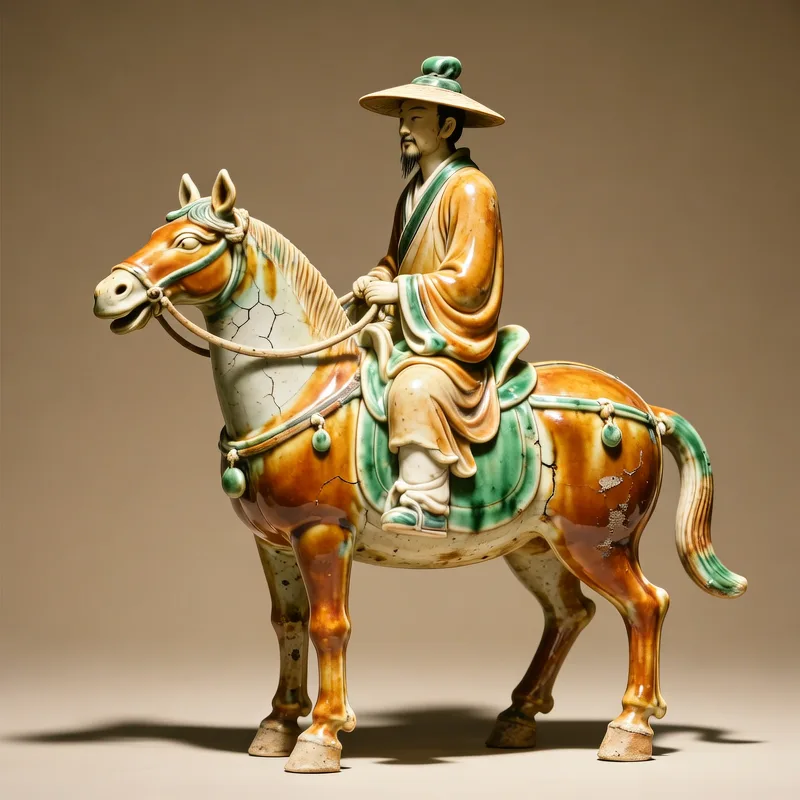
    Une figurine en céramique de la dynastie Tang représentant un voyageur à cheval lors d'un long voyage.
    Les voyages, l'exil et le service militaire ont fourni à la poésie Tang nombre de ses sujets. Illustration générée par IA · SinoViz

    Vie après la mort du poème Tang

    La poésie Tang est devenue un patrimoine culturel partagé. Les écoliers apprenaient les vers par cœur, les calligraphes recopiaient les poèmes et les auteurs Song, loin de rejeter les modèles Tang, les remettaient en question. Le canon Tang a également été façonné par les anthologies : le Tangshi Sanbaishou, compilé au XVIIIe siècle par Sun Zhu, demeure un recueil d’introduction de référence. Dans la Chine moderne, les poèmes de Li Bai et Du Fu sont récités lors d’occasions officielles et cités dans la conversation courante. Les traducteurs rendent les vers codifiés dans d’autres langues, bien que les schémas tonaux et les distiques parallèles rendent difficile une traduction littérale. Les visiteurs de Xi’an peuvent établir des liens entre ces poèmes et les musées du Shaanxi, les remparts de la ville Tang et les sites des quartiers et marchés de Chang’an.

    Un poème Tang peut contenir la politique d'un empire en huit vers, ou une montagne entière en quatre.

    Sources et lectures complémentaires

    1. dynastie Tang — Encyclopædia Britannica.
    2. littérature chinoise — Encyclopædia Britannica.
    3. Poésie Tang — Le Metropolitan Museum of Art.

    Voyez-le sur place

    Suivez ce lien jusqu'à la région correspondante.

    Explorer par carte

    Suivez le fil de discussion

    Consultez les autres articles qui partagent les mêmes étiquettes.

    Parcourir l'étiquette
  • Le Grand Canal

    Exploration de la carte

    Le Grand Canal

    An Inland Waterway Across China

    The Grand Canal links northern and southern China through rivers, locks, and warehouse towns.

    Section
    Exploration de la carte
    Région
    Zhejiang
    Ère
    À travers les époques
    Étiquettes
    Geography, History, Transport

    The Grand Canal is a system of artificial channels and connected rivers, not one continuous trench. For centuries it moved grain, salt, silk, and imperial correspondence between the Yellow River and the Yangtze delta.

    From Warrior States to Imperial Route

    Canal building began before unification. The state of Wu dug the Han Gou channel in the fifth century BCE to move troops and grain between the Yangtze and the Huai. The Qin and Han maintained regional waterways, but the Sui dynasty (581–618) created the first broadly connected system. Emperor Yang ordered hundreds of thousands of labourers to dig the Tongji Canal, linking Luoyang toward the Yangtze, and the Yongji Canal toward the north. The cost contributed to Sui collapse, yet the route remained useful. The Yuan dynasty (1271–1368) redirected the canal around the Yellow River toward Beijing, and Ming and Qing engineers rebuilt sections with locks and stone banks.

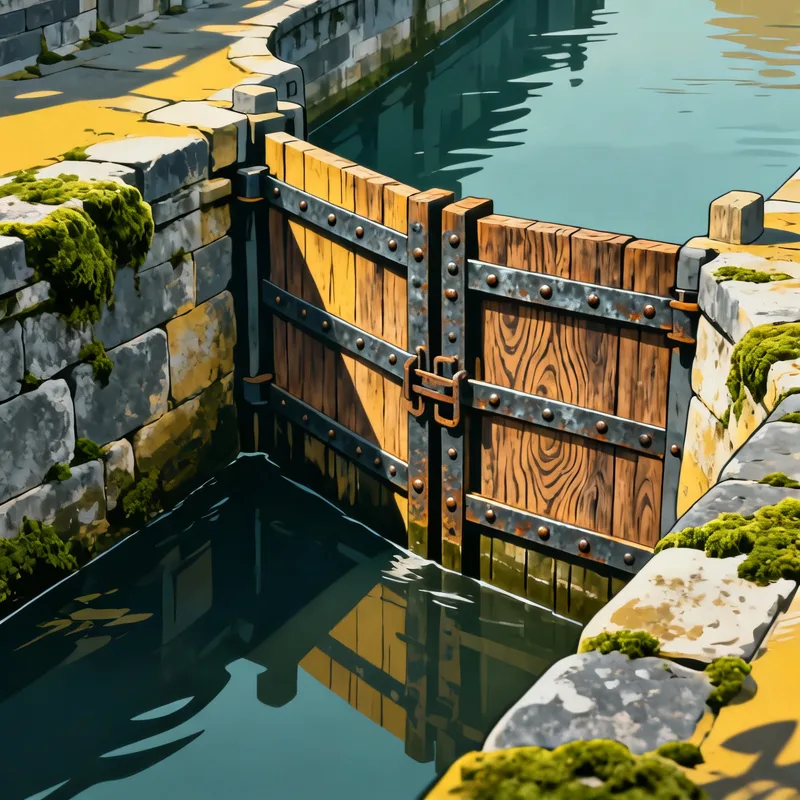
    An ancient canal lock with stone banks and a narrow timber water gate
    Locks allowed boats to cross differences in water level between river basins. Illustration générée par IA · SinoViz

    Grain Boats and Market Towns

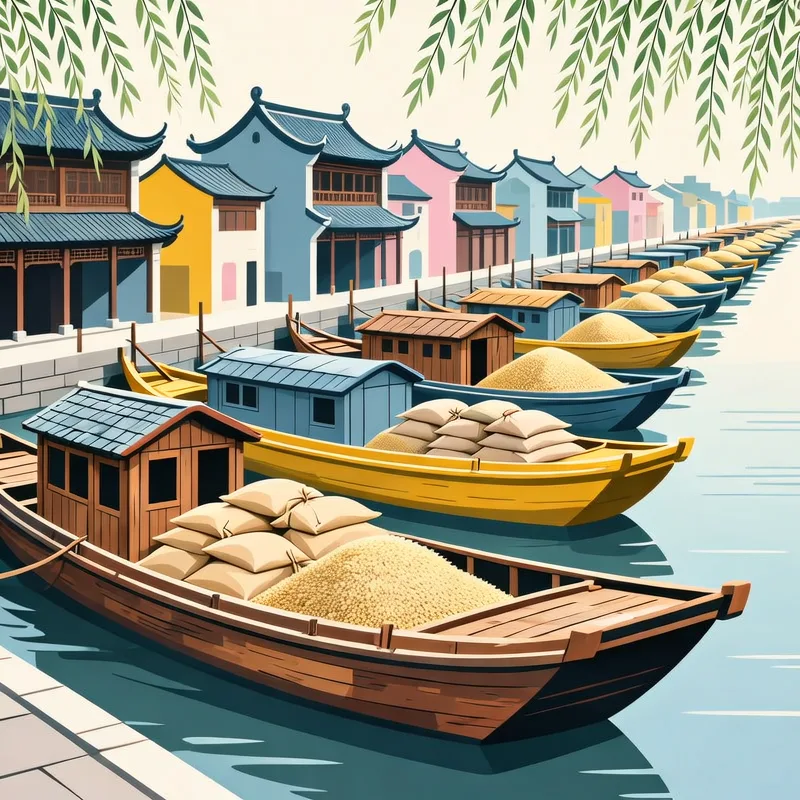
    The canal’s central purpose was transport. Under the Ming and Qing, tribute grain from the lower Yangtze moved north in huge flotillas of flat-bottomed boats, with relay crews and storage depots at key cities. The annual shipment fed the capital and the northern garrisons. Canal towns grew around wharves, granaries, guild halls, and money lenders: Linqing, Jining, Huai’an, and Yangzhou became exchange points as much as transit stops. Salt from the Huai coast, silk from Suzhou and Hangzhou, porcelain from Jingdezhen, and coal from northern mines moved along the same water. A journey that took weeks by road could be made with far greater bulk by boat.

    A long line of flat-bottomed grain boats moored along a canal wharf
    Grain flotillas tied the Yangtze delta to the political capital. Illustration générée par IA · SinoViz

    Southern Sections and Historic Cities

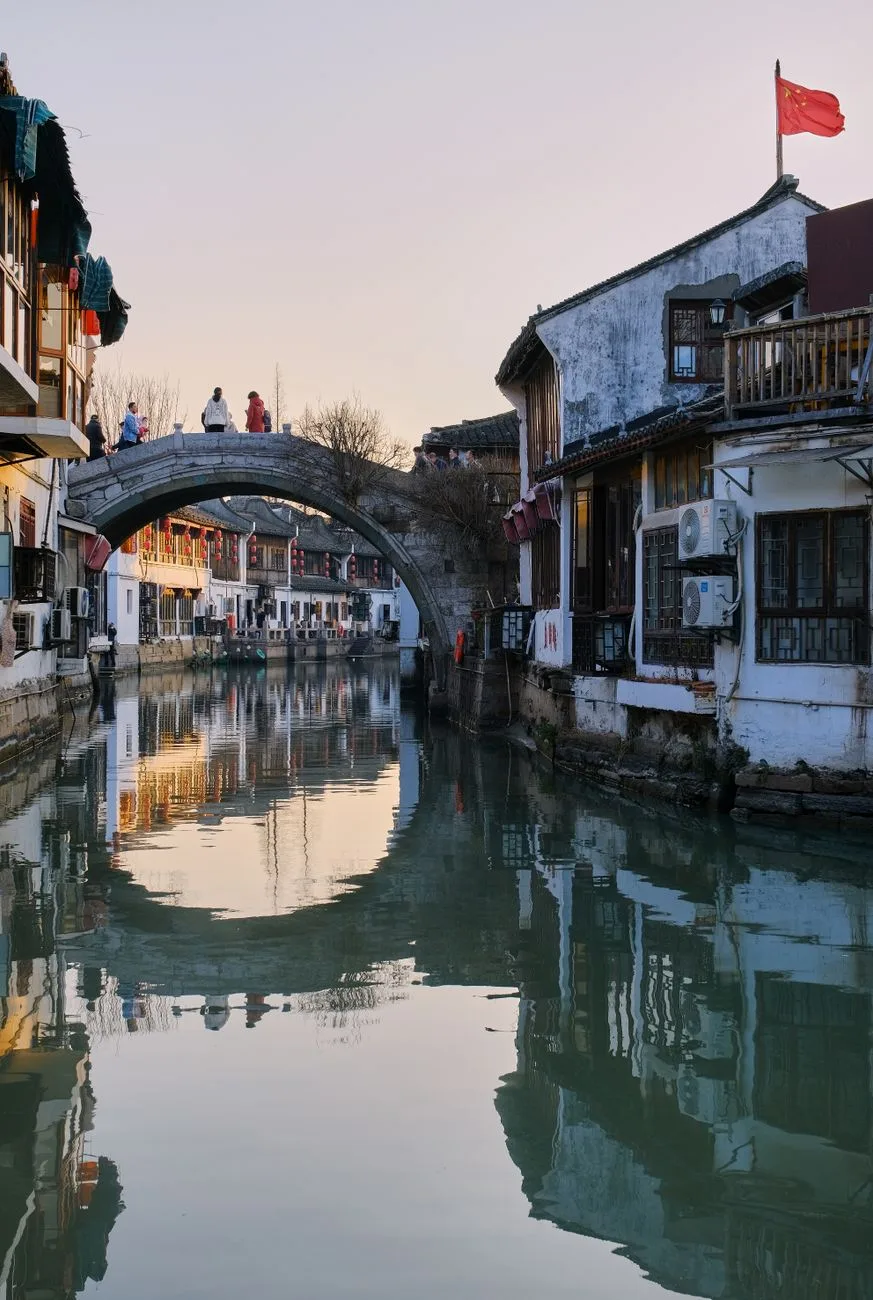
    The southern canal runs through the lowlands of Zhejiang and Jiangsu, where bridges, warehouses, and waterside houses still mark older commercial geography. Hangzhou is the southern terminus of the Sui-era system and a gateway to the Qiantang River. Suzhou’s canals were both transport routes and parts of the city’s garden landscape; its humpbacked stone bridges allowed boats to pass while pedestrians crossed. Wuxi and Zhenjiang sit at important junctions, while the Jiangnan section near the Yangtze has been widened and industrialised. UNESCO inscribed the Grand Canal on the World Heritage List in 2014, identifying thirty-one sections and twenty-seven components. The listed property includes canals, locks, bridges, and administrative sites.

    • Sui channels linked Luoyang with the Yangtze
    • Yuan engineers redirected the route toward Beijing
    • Tribute grain moved north in large boat flotillas
    • UNESCO listed thirty-one canal sections in 2014
    Stone arch bridges and old waterside houses along a canal in southern China
    In Jiangnan, canal transport and city life developed together. Vind 🌙 | Pexels License (https://www.pexels.com/license/)

    Reading the Canal Today

    Much of the northern canal is no longer navigable end to end; railways and roads took over long-distance freight, and parts were buried or rerouted during the twentieth century. Southern sections remain busy with barges, and several cities operate passenger boats for residents and visitors. A useful route for a first visit is Hangzhou or Suzhou, where canal life is visible beside gardens and markets. Water levels, engineering works, and modern flood control change the scene, so boats and landing stages may shift. The canal’s historical importance lies not in scenic continuity alone but in the way it joined climates, crops, taxes, and cities over more than a thousand years.

    The Grand Canal was less a single road of water than a machine for moving grain, tax, and news.

    Sources et lectures complémentaires

    1. Le Grand Canal — Centre du patrimoine mondial de l'UNESCO.
    2. Grand Canal — Encyclopædia Britannica.
    3. Grand Canal of China — Encyclopédie de l'histoire mondiale.

    Voyez-le sur place

    Suivez ce lien jusqu'à la région correspondante.

    Explorer par carte

    Suivez le fil de discussion

    Consultez les autres articles qui partagent les mêmes étiquettes.

    Parcourir l'étiquette
  • Orfèvrerie Miao

    Vie et folklore

    Orfèvrerie Miao

    Ornement, souvenir et tenue de fête

    Les ornements en argent Miao véhiculent l'histoire familiale et l'identité locale dans les costumes de fête à travers le sud-ouest de la Chine.

    Section
    Vie et folklore
    Région
    Yunnan
    Ère
    À travers les époques
    Étiquettes
    Coutumes, ethnies, sites pittoresques

    L'orfèvrerie Miao désigne une famille de parures — coiffes, colliers, boucles d'oreilles et bracelets — confectionnées par les communautés Miao du Guizhou, du Yunnan et des régions voisines. Ces pièces sont portées le plus souvent lors des fêtes et des mariages.

    Une tradition artisanale distribuée

    Les communautés Miao sont présentes dans les provinces du Guizhou, du Yunnan, du Guangxi, du Sichuan et en Asie du Sud-Est, et leur travail de l'argent varie selon les régions. Au Yunnan, les villages Miao autour de Wenshan et Honghe perpétuent des styles différents de ceux des comtés plus connus du Guizhou, comme Xijiang et Kaili. Les ornements sont fabriqués par des orfèvres spécialisés qui travaillent dans de petits ateliers, souvent au service de plusieurs villages. Les motifs s'apprennent par apprentissage plutôt que par modèles écrits : un jeune orfèvre reproduit des formes copiées sur des pièces plus anciennes et sur les vêtements de fête. Les motifs peuvent s'inspirer des oiseaux, des fleurs, des insectes et des pièces de monnaie locales, bien que leur signification ne soit pas figée. Les familles accumulent les ornements de génération en génération, et la coiffe de fête d'une fille peut représenter des années d'économies.

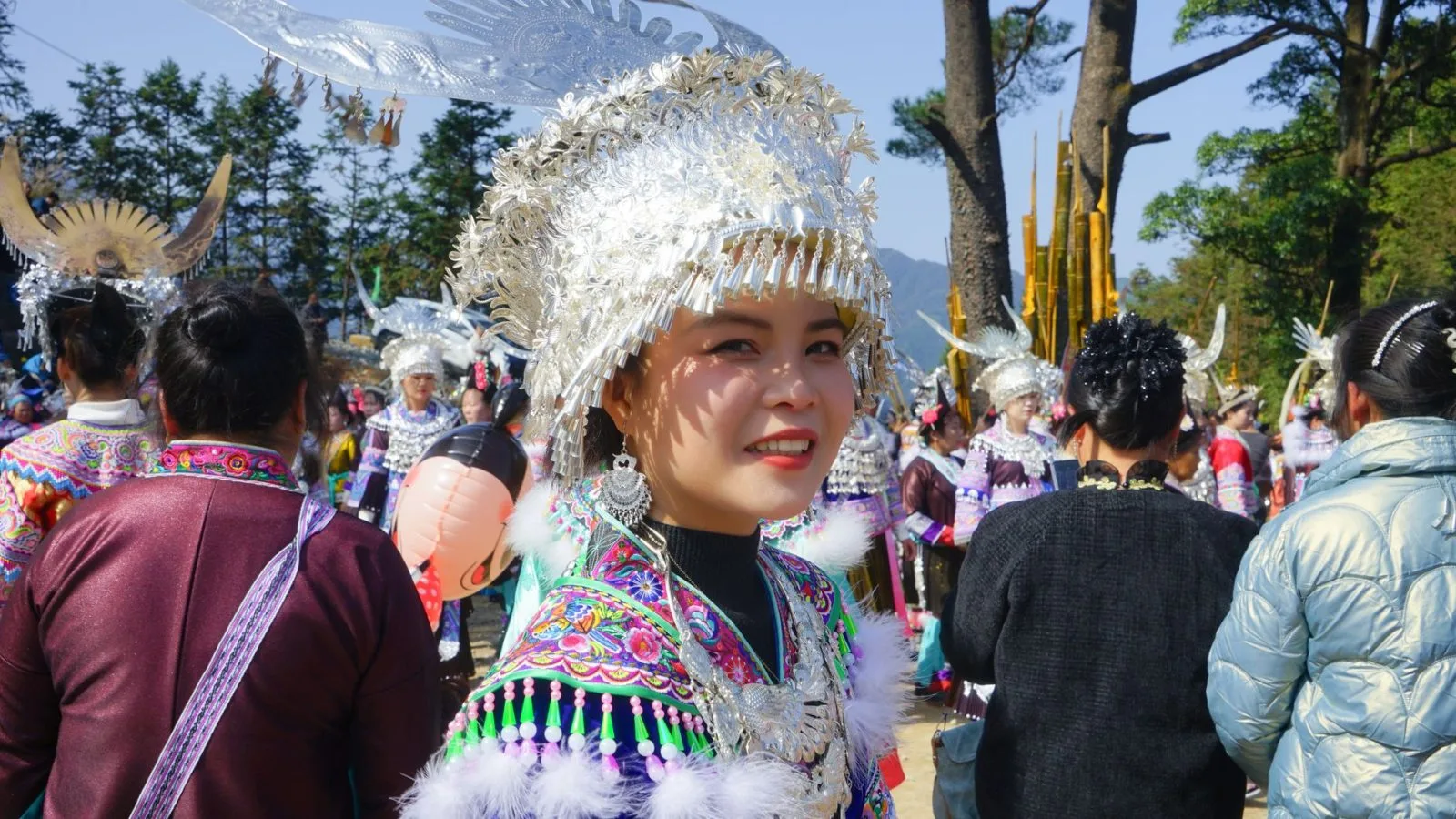
    Une coiffe Miao ornée de cornes en argent, de plaques et de décorations suspendues lors d'un festival
    Les coiffes associent des bijoux de famille à des pièces confectionnées pour une occasion particulière. Jaqor Q.I. | Licence Pexels (https://www.pexels.com/license/)

    Feuilles, fils et repoussé

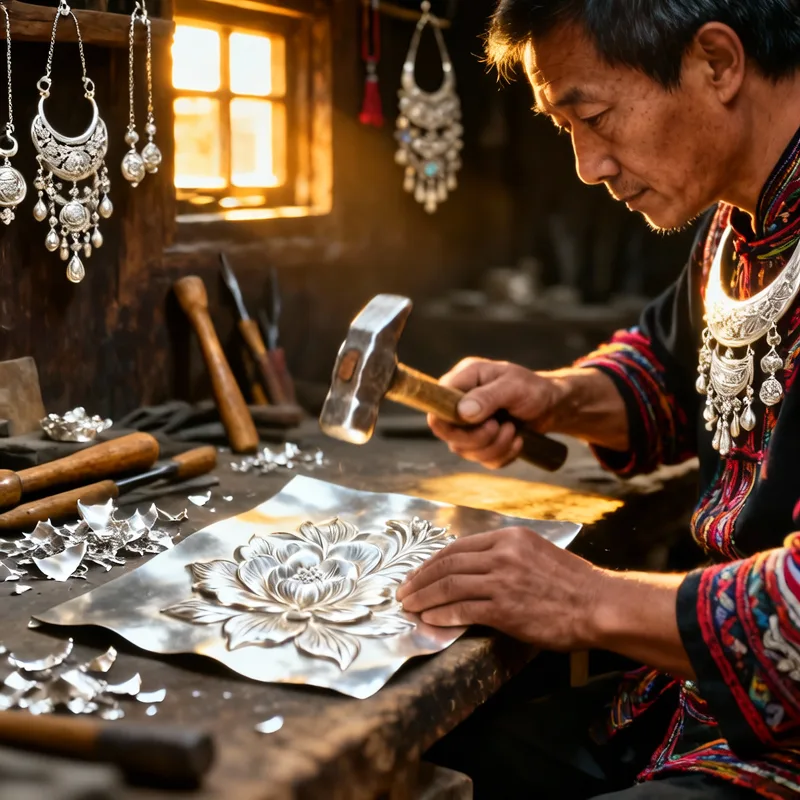
    La plupart des objets en argent Miao sont fabriqués à partir de feuilles et de fils d'argent. L'orfèvre martèle les lingots pour en obtenir de fines feuilles, découpe des bandes et crée des motifs en relief grâce à la technique du repoussage, qui consiste à poinçonner et à ciseler l'argent. Des fils aussi fins que des crins de cheval sont torsadés et soudés pour former des filigranes, puis intégrés à des ailes ajourées, des cornes et des ornements floraux. Une grande coiffe peut combiner un bandeau martelé, des chaînes pendantes, des plaques en repoussage et des rangées de petites clochettes qui s'animent au gré des mouvements de la personne qui la porte. L'argent est prisé pour sa couleur, sa malléabilité et son association traditionnelle avec la protection et la prospérité. De nombreux ornements sont creux afin d'en réduire le poids, car une coiffe cérémonielle complète peut être suffisamment lourde pour en limiter le port prolongé.

    Un orfèvre Miao martelant une fine feuille d'argent pour en faire une plaque florale en relief
    Le repoussé consiste à faire ressortir le motif au verso d'une fine feuille d'argent. Illustration générée par IA · SinoViz

    Tenues de festival et signification sociale

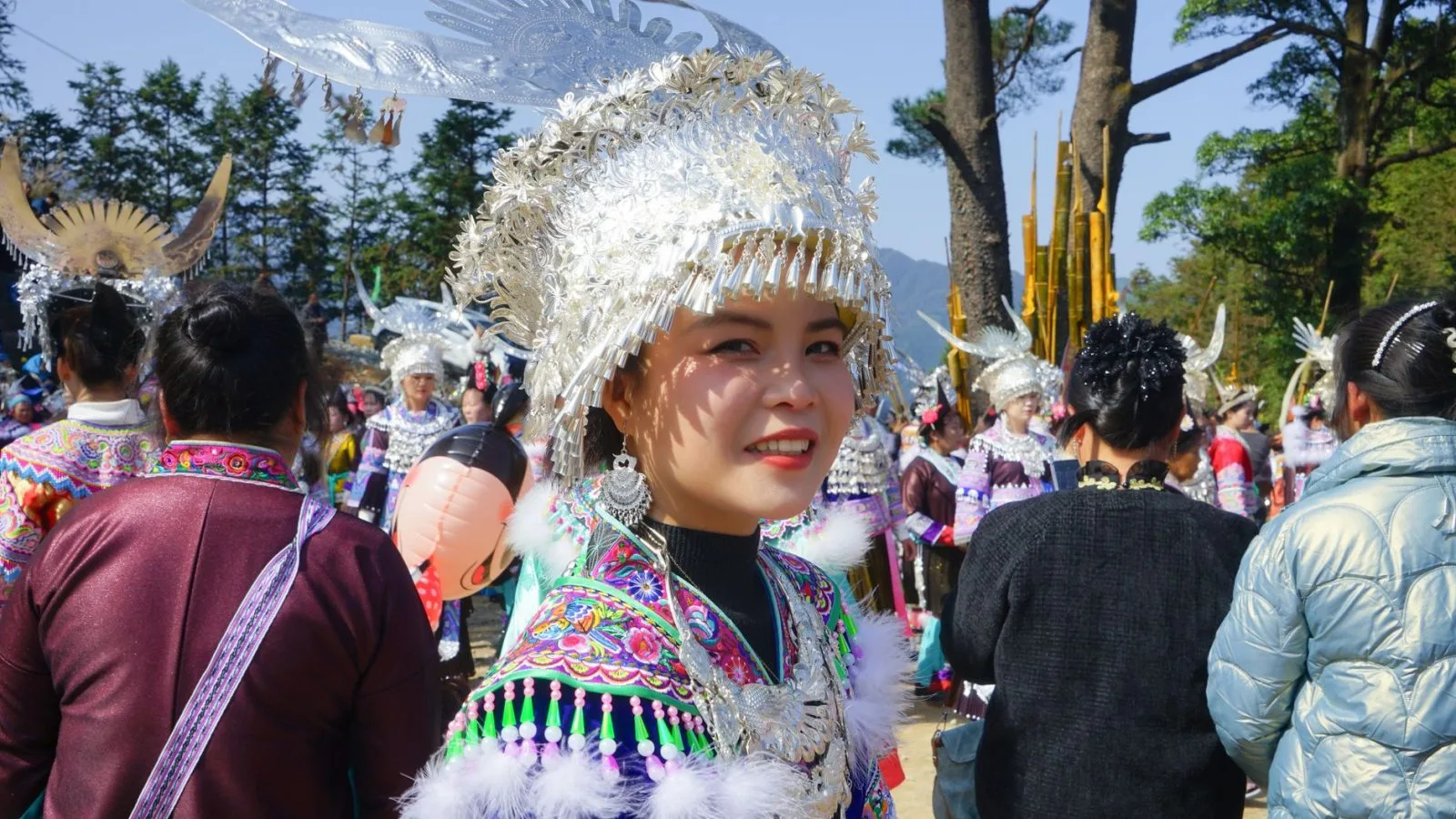
    Les ornements en argent sont perçus comme faisant partie intégrante du costume, et non comme des bijoux isolés. La tenue de fête d'une femme Miao peut comprendre une jupe plissée, une veste brodée, une ceinture tissée et un collier en argent en forme de croissant ou d'ailes. Dans certaines communautés, le nombre et la forme des boucles d'oreilles ou des anneaux de cou indiquent l'appartenance au village ou le statut marital. Lors du Nouvel An lunaire, des fêtes des récoltes et du Nouvel An Miao dans certaines régions, les femmes et les filles portent des parures familiales tandis que les groupes chantent, dansent et défilent entre les villages. Les ornements captent la lumière au gré des mouvements, faisant de la tenue un élément visuel de la performance. Les hommes peuvent porter des boutons, des chaînes ou de petits pendentifs en argent, moins chargés symboliquement.

    • Plaques repoussées en relief à partir d'une fine feuille d'argent
    • Filigrane torsadé et ajouré
    • Coiffes ornées de cornes, de chaînes et de clochettes
    • Costumes portés pour le Nouvel An et les rituels de mariage
    Des femmes en robe brodée de festival Miao, portant de lourds colliers et boucles d'oreilles en argent.
    Les ornements sont portés avec des broderies et des tissages, formant un système de costume unique. Jaqor Q.I. | Licence Pexels (https://www.pexels.com/license/)

    Marchés, tourisme et continuité

    L'orfèvrerie circule à travers les ateliers villageois, les marchés régionaux et le tourisme. Dans les villages Miao du Yunnan et du Guizhou, les visiteurs peuvent observer les orfèvres façonner de petites pièces, même si les objets les plus précieux, transmis de génération en génération, ne sont généralement pas à vendre. Les reproductions vendues comme souvenirs vont des miniatures soignées aux pièces en métal plaqué bon marché ; il est donc important de se renseigner sur la composition d'une pièce : est-elle en argent massif ? Les musées et les centres culturels documentent les coiffes et les colliers anciens, mais le costume traditionnel reste la norme. Certaines communautés ont remis au goût du jour les costumes de fête et enseignent l'orfèvrerie aux jeunes, tandis que les migrations et le salariat modifient la disponibilité de ceux qui les fabriquent et les portent. L'avenir de cet artisanat repose moins sur la nouveauté que sur la continuité des occasions de l'utiliser.

    La coiffe Miao est à la fois un bijou et une archive portable du travail familial.

    Sources et lectures complémentaires

    1. Peuple Miao — Encyclopædia Britannica.
    2. bijoux en argent chinois — Musée Victoria et Albert.
    3. culture ethnique Miao — Faits saillants de la Chine.

    Voyez-le sur place

    Suivez ce lien jusqu'à la région correspondante.

    Explorer par carte

    Suivez le fil de discussion

    Consultez les autres articles qui partagent les mêmes étiquettes.

    Parcourir l'étiquette
  • Cuisine du Sichuan

    Vie et folklore

    Cuisine du Sichuan

    Chilli Oil, Ferment, and the Numbing Pepper

    Sichuan cooking balances chilli heat, Sichuan pepper numbness, fermented bean paste, and rich broth.

    Section
    Vie et folklore
    Région
    Sichuan
    Ère
    À travers les époques
    Étiquettes
    Customs, Food, Geography

    Sichuan cuisine is known for bold seasoning, but its classic dishes are built on contrast: chilli with Sichuan pepper, hot oil with cool cucumber, or a clear broth beside a fiery one.

    A Basin Pantry and Early Flavours

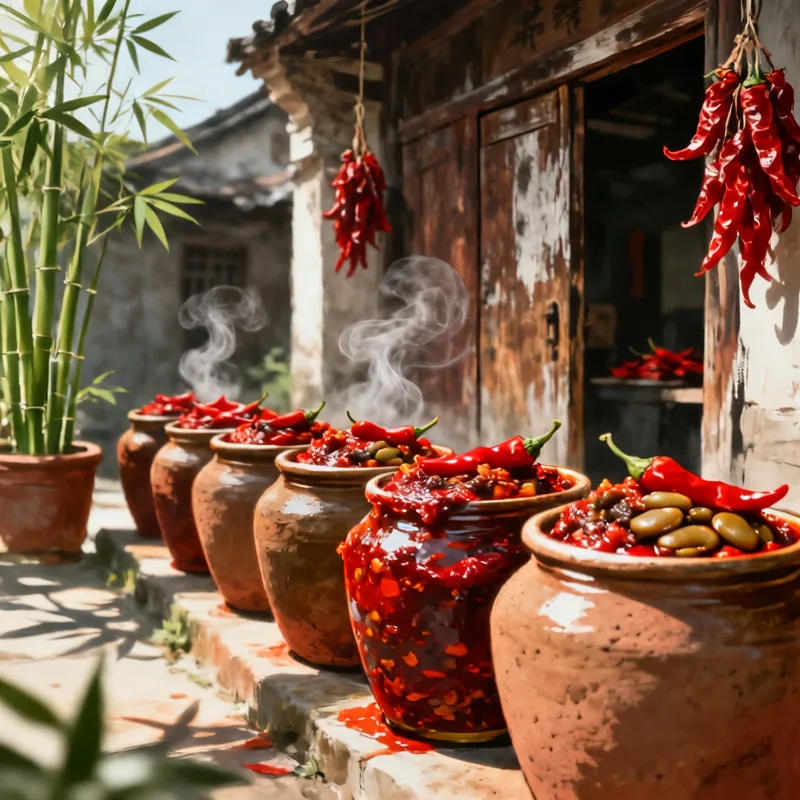
    The Sichuan Basin has fertile fields, rivers, and a humid climate, but its early elite cooking was not defined by chilli. Chilli peppers reached China from the Americas in the sixteenth century and became a Sichuan staple later, especially among ordinary households. Before that, cooks used ginger, garlic, mustard, vinegar, and the distinctive Sichuan pepper, Zanthoxylum simulans, whose husks cause a tingling sensation rather than heat.Fermented bean pastes from the basin towns added depth. Pixian doubanjiang, a broad-bean and chilli paste fermented in Pixian near Chengdu, became a foundation of many red-braised and stir-fried dishes. The province’s food therefore combines older preservation methods with ingredients that arrived through global trade.

    Jars of red chilli and broad-bean paste fermenting outside a Sichuan workshop
    Fermented doubanjiang gives many Sichuan dishes their deep red base. Illustration générée par IA · SinoViz

    The Grammar of Heat

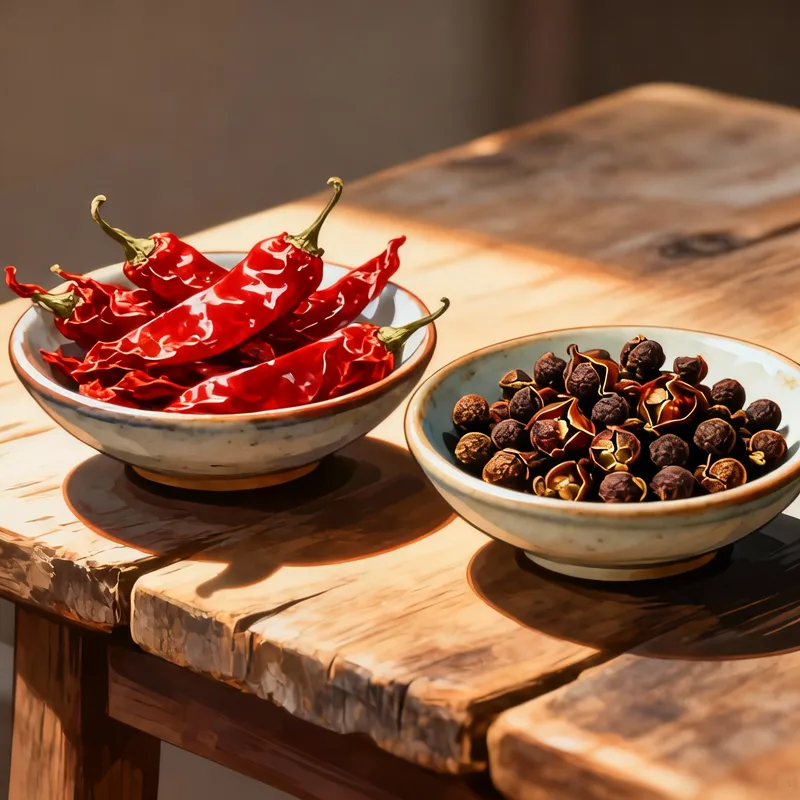
    Sichuan cooks distinguish several kinds of chilli heat. Dried chillies are fried in oil until fragrant but not blackened; chilli oil is steeped and aged; chilli bean paste supplies fermented heat; and fresh peppers give a brighter bite. Sichuan peppercorns, often toasted and ground, produce the málà combination of numbness and spice. Official Sichuan cookbooks describe more than twenty recognised flavour profiles, from guaiwei, strange or complex, to yuxiang, fish-fragrant, which uses no fish. Mapo tofu, associated with Chengdu in the nineteenth century, combines soft tofu, minced meat, doubanjiang, chilli oil, and Sichuan pepper. Kung Pao chicken uses dried chillies, peanuts, and a sweet-sour soy sauce.

    Dried red chillies and Sichuan peppercorns in separate shallow bowls
    Chilli heat and peppercorn numbness are distinct, and cooks balance them separately. Illustration générée par IA · SinoViz

    Hotpot and the Two-Flame Bowl

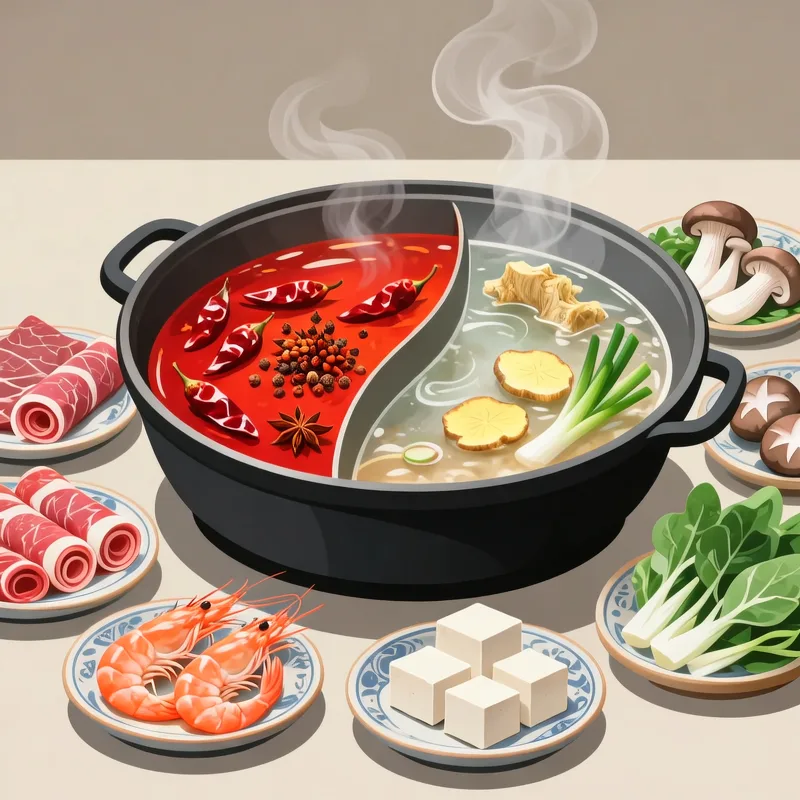
    Chengdu hotpot is a social meal built around a divided pot. One side may hold a red broth of chilli oil, doubanjiang, beef fat, and spices; the other a clear chicken or mushroom stock. Diners cook thinly sliced beef, tripe, duck blood, fish balls, vegetables, and mushrooms, then dip them in sesame oil, garlic, and chopped herbs. The sesame dip cools the palate and coats the mouth against spice. Chongqing hotpot is often heavier and more direct, traditionally using beef tallow; Chengdu versions are commonly more aromatic and varied. Yibin and other southern cities add their own chilli blends. Restaurants label spice levels, but heat can still be adjusted only by asking.

    • Pixian doubanjiang as a fermented chilli-bean base
    • Málà: chilli heat plus peppercorn numbness
    • Two-flavour hotpot with red and clear broth
    • Sesame oil dip to moderate the heat
    A divided hotpot with red chilli broth and clear broth surrounded by ingredient plates
    A two-flavour pot lets a table divide heat from clarity. Illustration générée par IA · SinoViz

    Beyond the Fiery Stereotype

    Not every Sichuan dish is hot. Sichuan’s most ceremonial dish, Gongbao chicken and the banquet classic ‘sweet and sour’ aside, the cuisine includes clear broths, steamed dishes, and delicate pastry. Zhangcha duck is smoked with tea leaves and camphor before steaming, while boiled pork slices are served in a clear broth with mustard greens. Chengdu’s teahouses and dish shops serve small noodles, sweet-water noodles, and dumplings. The province also includes Tibetan and Yi food traditions in its western highlands, where barley, yak products, and different seasonings dominate. Reading Sichuan cuisine only as heat misses its central achievement: layering aromas, textures, and ferments so that strong flavours remain controlled.

    Sichuan cooking is not simply hot; it is a carefully graded argument between chilli, pepper, oil, and ferment.

    Sources et lectures complémentaires

    1. Sichuan cuisine — Encyclopædia Britannica.
    2. Chinese Cuisine — Encyclopædia Britannica.
    3. Sichuan Food — Faits saillants de la Chine.

    Voyez-le sur place

    Suivez ce lien jusqu'à la région correspondante.

    Explorer par carte

    Suivez le fil de discussion

    Consultez les autres articles qui partagent les mêmes étiquettes.

    Parcourir l'étiquette