Blog

  • Jiangnan Cuisine

    Kehidupan & Cerita Rakyat

    Jiangnan Cuisine

    River Fish, Rice, and Refined Broth

    The cooking of the lower Yangtze favours freshwater fish, seasonal greens, and delicate stocks.

    Seksyen
    Kehidupan & Cerita Rakyat
    Wilayah
    Zhejiang
    Era
    Merentasi zaman
    Tag
    Food, Geography

    Jiangnan cooking grew in the wet, rice-growing country south of the Yangtze. Its reputation rests less on spice than on timing: a fish steamed just long enough, a broth cleared and simmered, or a vegetable picked before it toughens.

    A Landscape of Water and Rice

    Jiangnan means the land south of the Yangtze, a region of canals, lakes, and irrigated fields centred on Jiangsu and Zhejiang. From the Song dynasty (960–1279), the lower Yangtze became China’s densest and wealthiest farming region, supported by double-cropping rice, fish ponds, and silk production. Cities such as Hangzhou and Suzhou developed a class of officials, merchants, and literati who recorded dining in essays and cookbooks. Lin An, today’s Hangzhou, was the Southern Song capital after 1127, and its markets sold freshwater fish, crab, bamboo shoots, and lotus root. Local cooking took shape around what the water and nearby fields supplied in season.
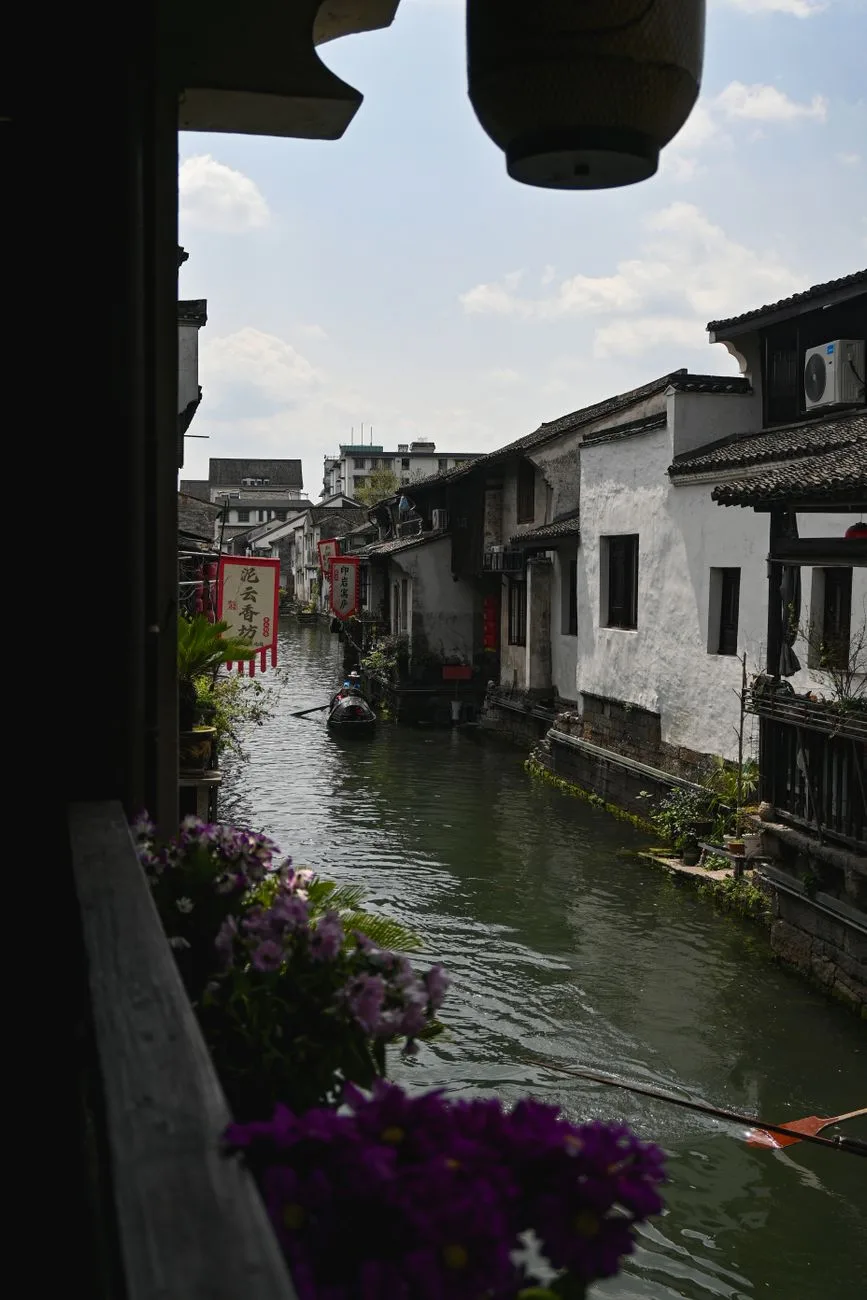
    Canals and rice fields in the Jiangnan countryside near Suzhou
    Canals, fish ponds, and irrigated fields shaped the Jiangnan pantry. 木 灬 | Pexels License (https://www.pexels.com/license/)

    Techniques of Cleanness

    Jiangnan cooks prize the natural flavour of ingredients, so technique often means restraint. Steaming preserves the texture of fish and glutinous rice; quick stir-frying keeps greens crisp; slow simmering turns pork bones and chicken into clear, aromatic broth. Shaoxing in Zhejiang is famous for yellow rice wine, used in marinades and for deglazing a hot wok. Vinegar from Zhenjiang balances sweet and sour dishes. Hangzhou’s famous West Lake vinegar fish uses a fish from the lake, scored and fried, then finished with a sweet-sour sauce. The dish is now a restaurant set piece, but it began as a local preparation of available freshwater fish.
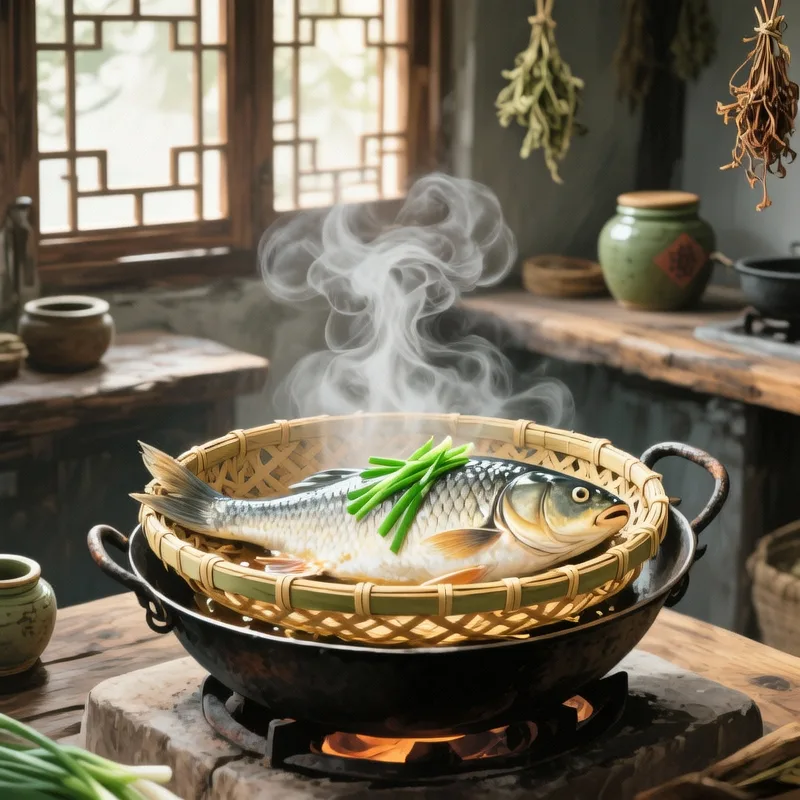
    A whole freshwater fish steaming in a bamboo basket over a wok in a Jiangnan kitchen
    Steaming is a defining Jiangnan technique because it preserves delicate texture. Ilustrasi yang dijana AI · SinoViz

    A Calendar of Local Dishes

    Seasonality gives the cuisine its rhythm. Spring brings bamboo shoots, shepherd’s purse, and the first river shrimp; autumn brings hairy crab from lakes and the slow-growing taihu whitebait. Suzhou’s squirrel-shaped mandarin fish is butterflied, scored, fried, and glazed, while braised pork belly is cooked until fat and lean layers hold together without hardness. Ningbo, on the Zhejiang coast, adds salted and dried seafood, and its tangyuan glutinous-rice balls filled with black sesame are eaten at the Lantern Festival. Shanghai, later and more cosmopolitan, absorbed these traditions into benbang cooking, favouring soy, sugar, and seafood.

    • West Lake vinegar fish from Hangzhou
    • Squirrel-shaped mandarin fish from Suzhou
    • Hairy crab from Taihu lakes in autumn
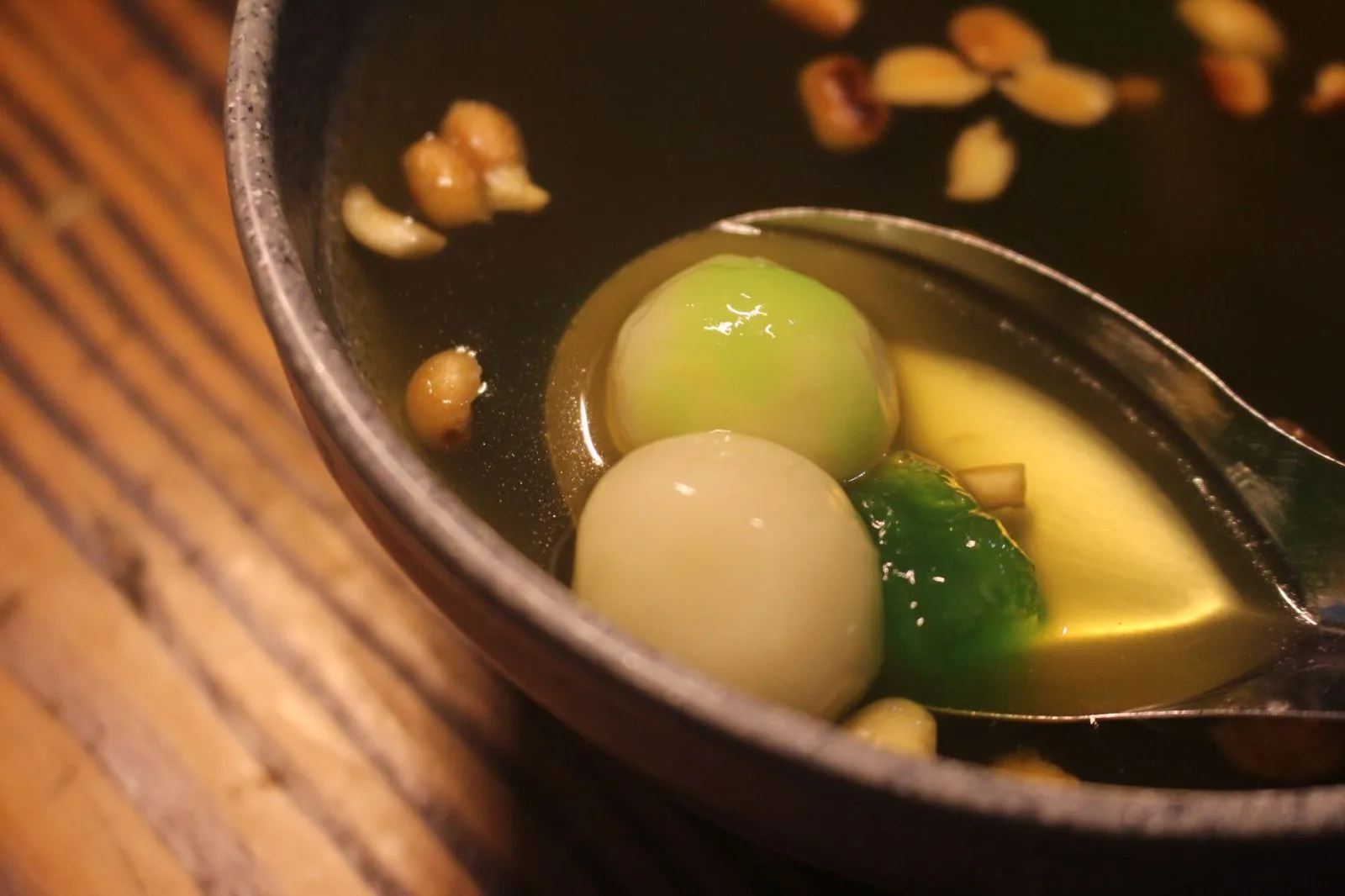
    • Black-sesame tangyuan for the Lantern Festival
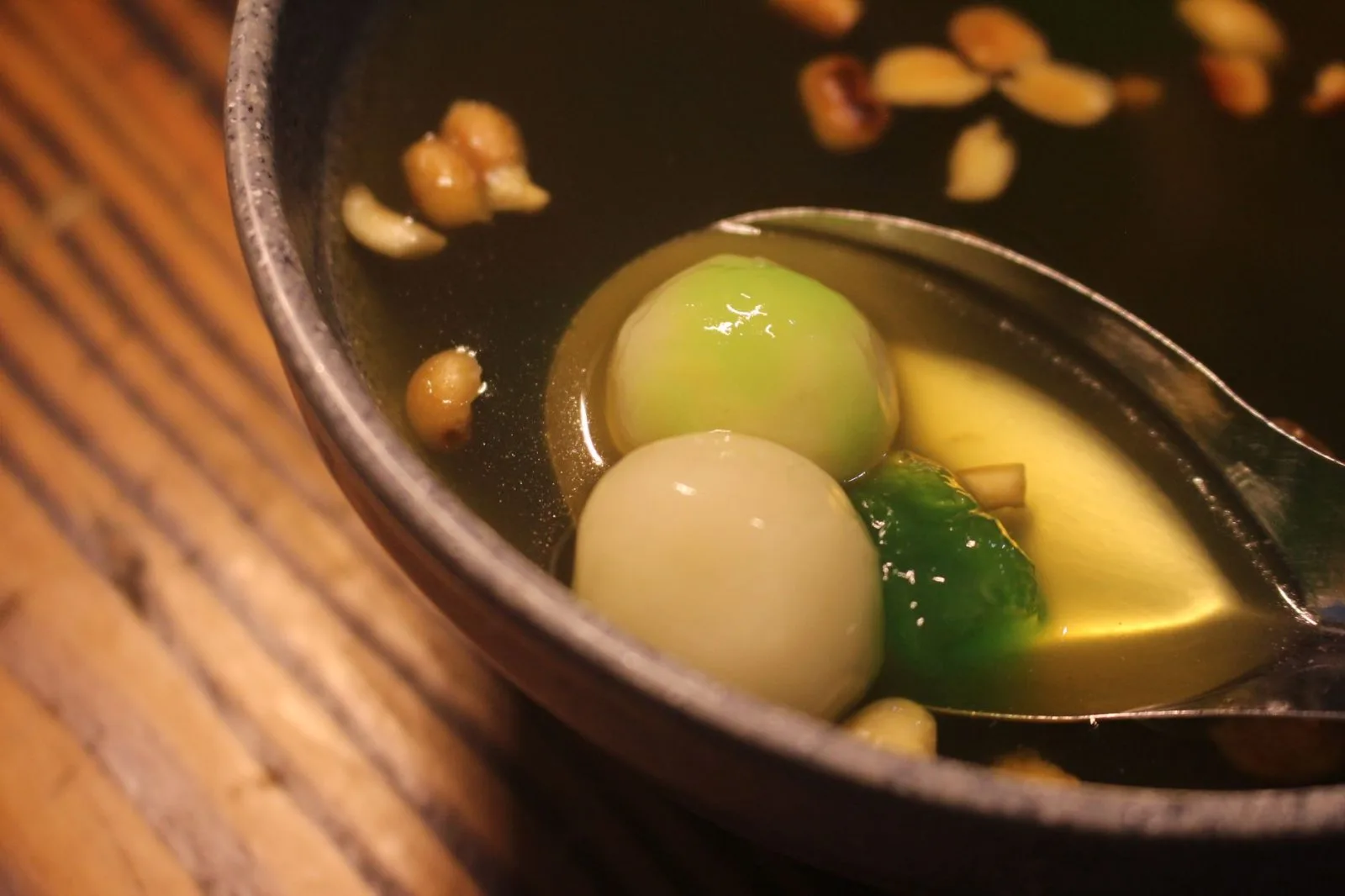
    Small glutinous rice balls with black sesame filling served in a warm bowl
    Tangyuan mark the Lantern Festival across the lower Yangtze. Jauhar Musthofal Qulub | Pexels License (https://www.pexels.com/license/)

    Gardens, Teahouses, and the Table

    Meals in Jiangnan were historically tied to gardens and teahouses, where scholars met over small dishes and wine. The region’s cookbooks, including Yuan Mei’s Suiyuan Shidan of 1792, record recipes alongside comments on market ingredients and household methods. Yuan Mei argued that a cook should understand each ingredient rather than bury it under sauce. That ideal still shapes the region’s public image, even when restaurant versions are elaborate. For a visitor, the useful lesson is to order by season and region: a lake crab in autumn, a bowl of noodles in Suzhou, or a pot of longjing tea near Hangzhou.

    In Jiangnan, the test of a dish is often how little the cook has done to spoil the ingredient.

    Sumber & bacaan lanjut

    1. Chinese Regional Cooking — Ensiklopedia Britannica.
    2. Hangzhou — Pusat Warisan Dunia UNESCO.
    3. Hangzhou — Ensiklopedia Britannica.
    Lihat di tempatnya

    Ikuti entri ini ke rantau tempat ia berada.

    Terokai mengikut Peta

    Ikuti thread ini

    Layari entri lain yang berkongsi tegnya.

    Layari tag
  • Cantonese Cuisine

    Kehidupan & Cerita Rakyat

    Cantonese Cuisine

    Steam, Wok Heat, and Coastal Markets

    Guangdong cooking turns local seafood and temple fair foods into a refined restaurant tradition.

    Seksyen
    Kehidupan & Cerita Rakyat
    Wilayah
    Guangdong
    Era
    Merentasi zaman
    Tag
    Food, Geography

    Cantonese cuisine is the cooking of Guangdong and its diaspora, built on river deltas, coastal markets, and the heat of the wok. Its best-known dishes—roast goose, dim sum, and steamed fish—sit beside home-style soups and street snacks.

    The Pearl River Pantry

    The Pearl River Delta gave Cantonese cooking an unusually broad pantry. Rice grows in the lowlands, fish and shellfish come from the estuary, and hills behind Guangzhou supply vegetables, pork, and poultry. Guangzhou was a major port under the Tang and again after European traders arrived in the seventeenth and eighteenth centuries. Merchants, officials, and temple fairs supported restaurants that could pay for skilled chefs. By the Qing period, Guangzhou’s tea houses served small plates known as dim sum through the morning and midday. Emigrants from Guangdong later carried these dishes to Southeast Asia, North America, and Europe, adapting them to local supplies.

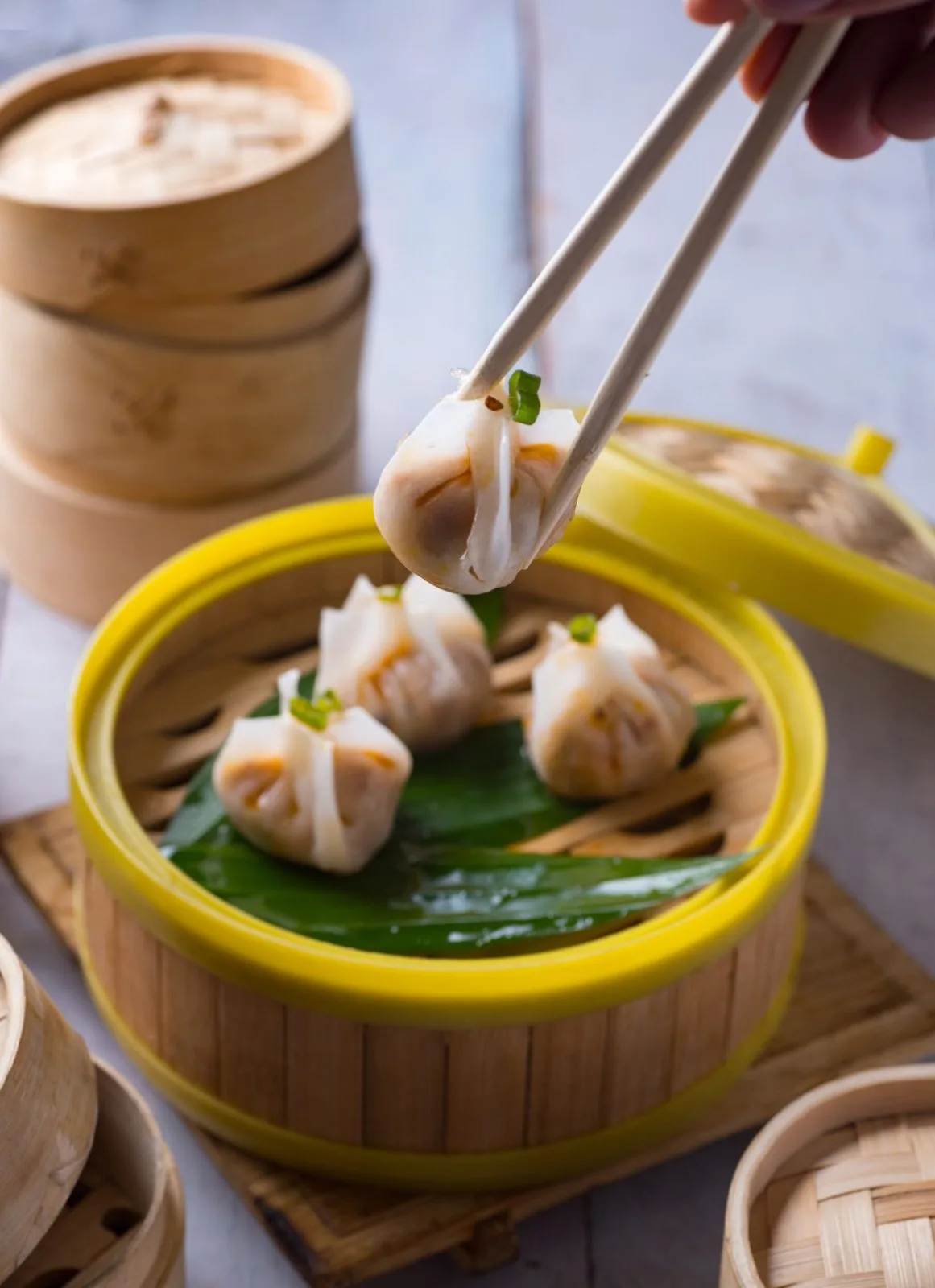
    Bamboo steamers filled with dim sum
    Dim sum developed in the teahouses of Guangzhou and spread with Cantonese migration. parveen tasud | Pexels License (https://www.pexels.com/license/)

    Wok Hei and the Roast House

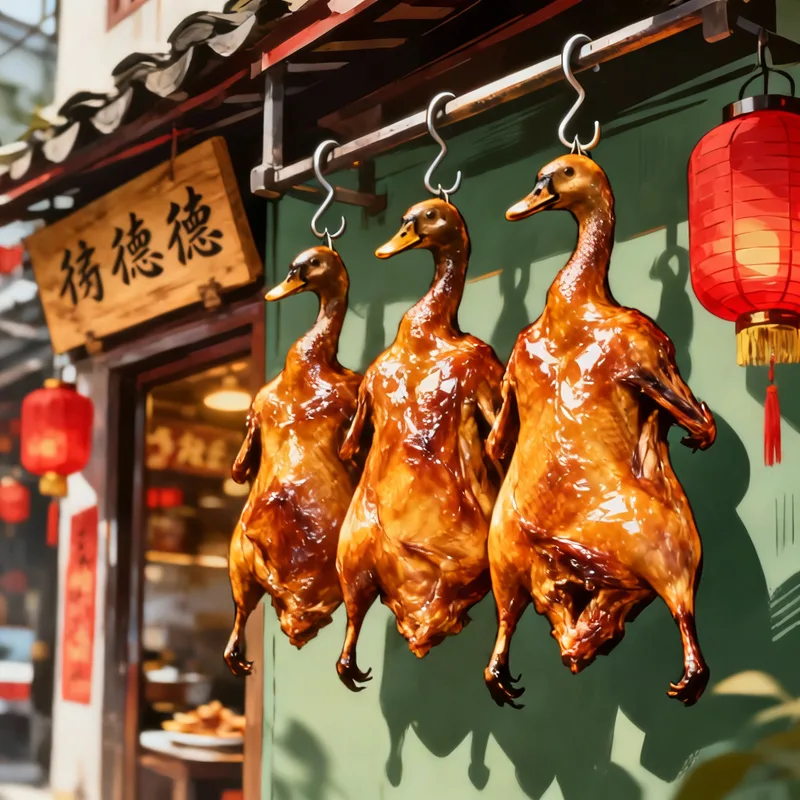
    Cantonese stir-frying depends on wok hei, the barely definable aroma produced when hot oil, vapours, and food meet a very hot wok. Chefs toss ingredients to keep them moving and prevent scorching; sauces are added late, often with cornstarch to give a light coating. Roasting is another speciality. Guangzhou-style white-cut chicken is poached and served with ginger and spring onion, while roast goose from Shunde is glazed, air-dried, and hung in a brick oven until the skin blisters. Char siu pork is marinated with honey and red fermented bean curd, then roasted with sugar caramelising at the edges.

    Roast geese hung to dry before roasting outside a Shunde restaurant
    Air-drying the skin is a key step in Shunde’s roast goose. Ilustrasi yang dijana AI · SinoViz

    Dim Sum and Morning Ritual

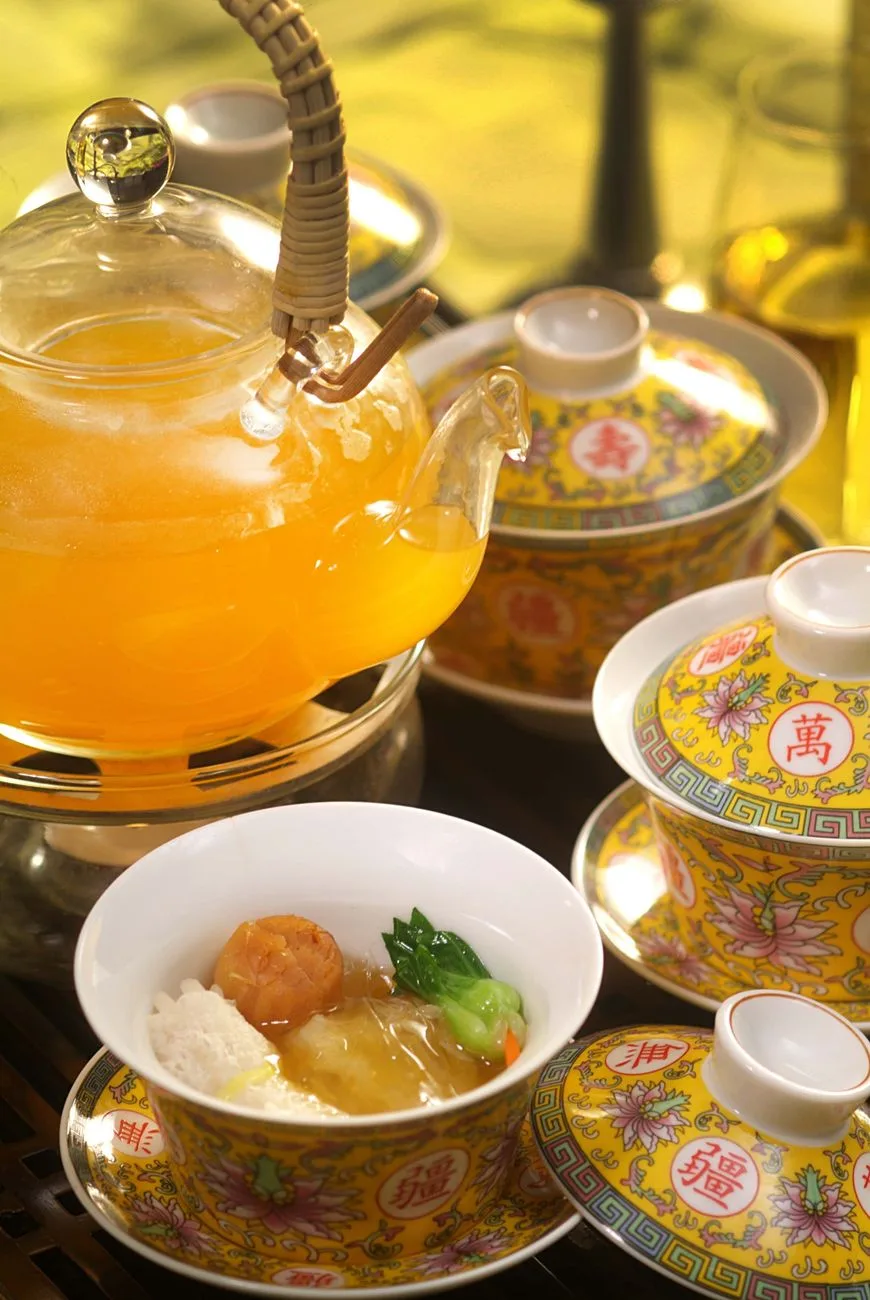
    Dim sum means a light snack, but in Cantonese practice it describes a meal of small portions ordered from trolleys or a paper card. Har gow wrap shrimp in a translucent wheat-starch skin; siu mai open-topped dumplings hold pork and shrimp; char siu bao are soft steamed buns with sweet roast-pork filling. Cheung fun are broad rice-noodle sheets rolled around shrimp, pork, or beef and dressed in soy sauce. Tea accompanies the meal, and the old custom of tapping a pot’s lid to signal for a refill is still performed, though younger diners may simply ask. The ritual is social as much as culinary, filling teahouses from early morning.

    • Har gow with translucent shrimp filling
    • Siu mai topped with a single shrimp
    • Cheung fun rice rolls with soy dressing
    • Egg tarts adapted from British custard pastry
    A trolley of bamboo steamers and tea pots beside a crowded Guangzhou dining room
    A dim sum meal is ordered in small dishes and shared across the table. minchephoto photography | Pexels License (https://www.pexels.com/license/)

    Regional Range and Diaspora

    Cantonese food is not one style. Shunde is known for delicate dairy desserts and fish dishes, Chaozhou nearby has a separate tradition of braised goose, seafood, and strong oolong tea, and Hakka communities in the hills favour preserved vegetables and stuffed tofu. Teochew and Hainanese migrants carried their own versions abroad. In Chinatowns from San Francisco to Singapore, Cantonese restaurants adapted to local tastes while keeping techniques such as steaming, roasting, and long simmered double-boiled soups. The resulting cuisines are mixed, but they preserve a central idea: fresh ingredients, precise heat, and a sauce that supports rather than hides them.

    Cantonese cooking asks a wok to do in seconds what other traditions give hours of stewing.

    Sumber & bacaan lanjut

    1. Chinese Cuisine — Ensiklopedia Britannica.
    2. Cantonese cuisine — Ensiklopedia Britannica.
    3. Guangzhou — Pusat Warisan Dunia UNESCO.

    Lihat di tempatnya

    Ikuti entri ini ke rantau tempat ia berada.

    Terokai mengikut Peta

    Ikuti thread ini

    Layari entri lain yang berkongsi tegnya.

    Layari tag
  • The Lantern Festival

    Kehidupan & Cerita Rakyat

    The Lantern Festival

    Lights on the Fifteenth Night

    The fifteenth night of the first lunar month closes the New Year with lanterns and sweet rice balls.

    Seksyen
    Kehidupan & Cerita Rakyat
    Wilayah
    Beijing
    Era
    Merentasi zaman
    Tag
    Kastam, Makanan

    The Lantern Festival falls on the fifteenth day of the first lunar month, the first full moon of the year. Lanterns, night markets, riddles, and tangyuan rice balls mark the end of the New Year period.

    Origins in Calendar and Court

    The festival’s date follows the lunar calendar, so its Gregorian date changes each year. Several origins are cited. Emperor Wen of Han is said to have declared a public holiday around 180 BCE after defeating the Lü clan, while the Eastern Han emperor Ming promoted lantern displays in the first century CE as Buddhism spread. Daoist tradition associated the day with the heavenly official who grants blessings. By the Tang dynasty, the festival had become a major urban occasion: court records describe vast lantern displays in Chang’an and Luoyang, and the poet Su Weidao wrote of night markets bright as day. The Tang court relaxed curfew so people could view the lights.

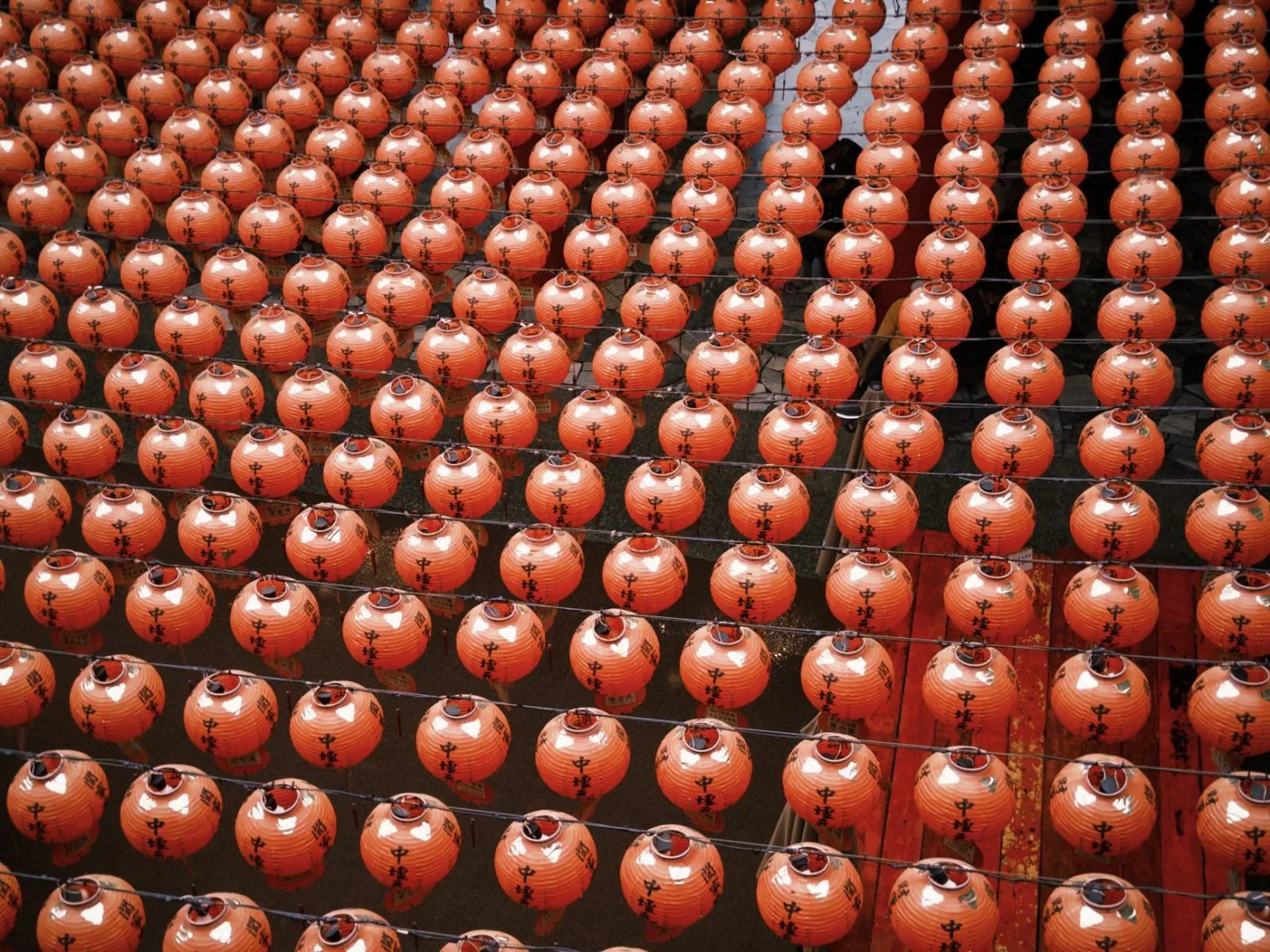
    Rows of illuminated red lanterns hanging along a street during a night festival
    Tang cities relaxed curfew so residents could walk among the lanterns at night. zack ZHUO | Pexels License (https://www.pexels.com/license/)

    Riddles, Lions, and Processions

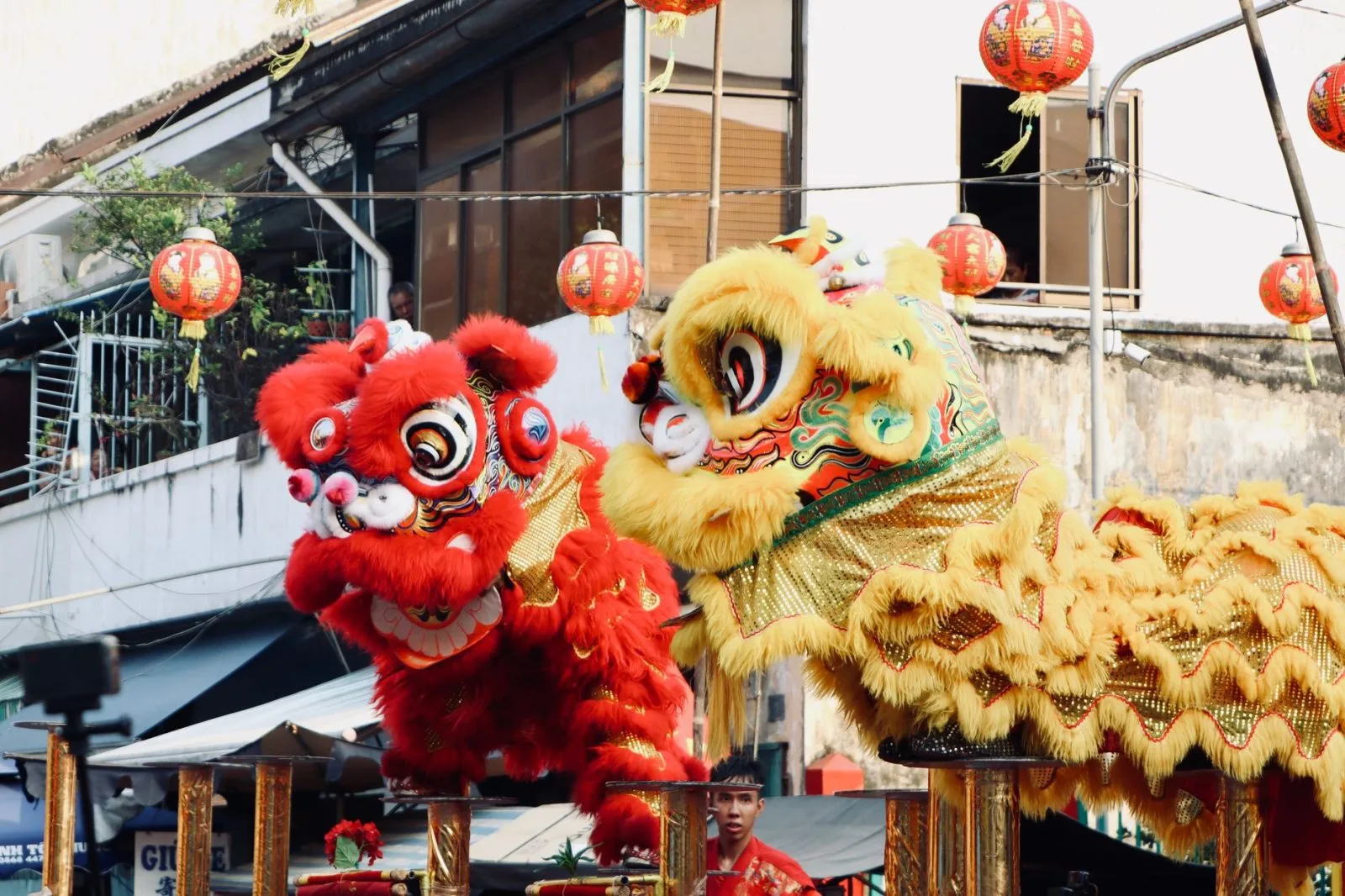
    Lantern riddles are written on slips attached to the lamps; solving one is a small test of wordplay and classical learning. Lion dances, dragon dances, and walking-on-stilts performances draw crowds in the streets, with local troupes competing for space and applause. In some places, people carry lanterns representing animals or characters, and children pull small lanterns on sticks. Beijing’s temple fairs once gathered vendors, performers, and visitors around temple courtyards; today the festival is also marked in parks and commercial districts. Taiwan is known for large lantern festivals and elaborate installations, while Nanjing has long been associated with elaborate lantern craft along the Qinhuai River.

    A lion dance troupe leaping beneath hanging lanterns during a street celebration
    Processions and lion dances turn the festival into a public performance. Pham Huynh Tuan Vy | Pexels License (https://www.pexels.com/license/)

    Tangyuan and the Taste of Reunion

    The festival food is tangyuan in southern China and often yuanxiao in the north, both made from glutinous rice flour around a sweet filling. The names and methods differ: southern cooks wrap a soft dough around filling, while northern cooks may roll moistened filling in dry rice flour in repeated layers. Fillings include black sesame paste, red bean, peanut, and osmanthus sugar. The round shape suggests family unity, and the bowls are shared after the evening’s walk. In Ningbo, black-sesame tangyuan are a local speciality; in Shanghai and Suzhou they are sold from neighbourhood shops. Sweet rice wine and small glutinous balls are also served in some regions.

    • Black sesame, red bean, and peanut fillings
    • Southern wrapped tangyuan and northern rolled yuanxiao
    • Lantern riddles attached to public displays
    • Dragon and lion processions after dark
    A bowl of small white glutinous rice balls in clear sweet soup
    Round rice balls symbolise reunion at the first full moon. Jauhar Musthofal Qulub | Pexels License (https://www.pexels.com/license/)

    The Festival in Modern Cities

    The festival remains a public holiday in mainland China, though the number of days off and the school calendar vary. Major cities install temporary lighting, close some streets to traffic, and run lantern displays in parks and along rivers. Viewing a lantern show often means walking slowly in crowds; in Beijing, the temperature can still be below freezing, so warm layers matter. Photographers should check local rules on tripods and drones. Shopping districts extend the season commercially, but temple fairs and neighbourhood associations keep older practices alive. The date’s movement also means the festival may fall during term time or a working week, changing how families gather.

    The first full moon turns a winter street into a temporary gallery of paper, silk, and light.

    Sumber & bacaan lanjut

    1. Lantern Festival — Ensiklopedia Britannica.
    2. Chinese Lantern Festival — China Highlights.
    3. Yuanxiao Festival — Ensiklopedia Sejarah Dunia.

    Lihat di tempatnya

    Ikuti entri ini ke rantau tempat ia berada.

    Terokai mengikut Peta

    Ikuti thread ini

    Layari entri lain yang berkongsi tegnya.

    Layari tag
  • Kota Terlarang

    Kronik

    Kota Terlarang

    The Ming and Qing Imperial Palace

    A walled palace in Beijing that served as the seat of Ming and Qing imperial government.

    Seksyen
    Kronik
    Wilayah
    Beijing
    Era
    yuan-ming-qing
    Tag
    History, Scenic Sites

    The Forbidden City was built as the ceremonial and administrative centre of the Ming and later Qing dynasties. Its courtyards and halls express rank in stone, timber, colour, and route: the emperor alone crossed the central axis to the throne hall.

    Building an Imperial Axis

    Construction began in 1406 under the Yongle Emperor, who had moved the capital from Nanjing to Beijing. The palace took roughly fourteen years to complete and opened in 1420. Its site lay south of the Yuan dynasty’s capital, Dadu, whose planner had already established a north-south axis. More than a million workers and artisans were mobilised, including convict labour and skilled craftsmen from across the empire. Timber came from southern forests, stone from quarries near Beijing, and glazed tiles from kilns in the capital’s outskirts. The name Zijin Cheng, or Purple Forbidden City, referred to the polarised Heavenly Emperor and the restrictions on entry.

    The Hall of Supreme Harmony rising above broad terraces on Beijing’s central axis
    The main throne hall stands on the palace’s central ceremonial axis. Lan Yao | Pexels License (https://www.pexels.com/license/)

    Front Court and Inner Quarters

    The palace is organised into an outer court for ceremony and an inner court for residence. The Hall of Supreme Harmony, the largest and highest hall, was used for enthronements, imperial weddings, and the winter solstice audience. Behind it stand the Hall of Central Harmony and the Hall of Preserving Harmony. The inner court includes the Palace of Heavenly Purity, the Hall of Earthly Tranquility, and the empress’s quarters. Officials approached through the Meridian Gate and crossed the Golden Water River on bridges that marked status. The design did more than impress: it separated ranks and turned movement through space into a visible grammar of power.

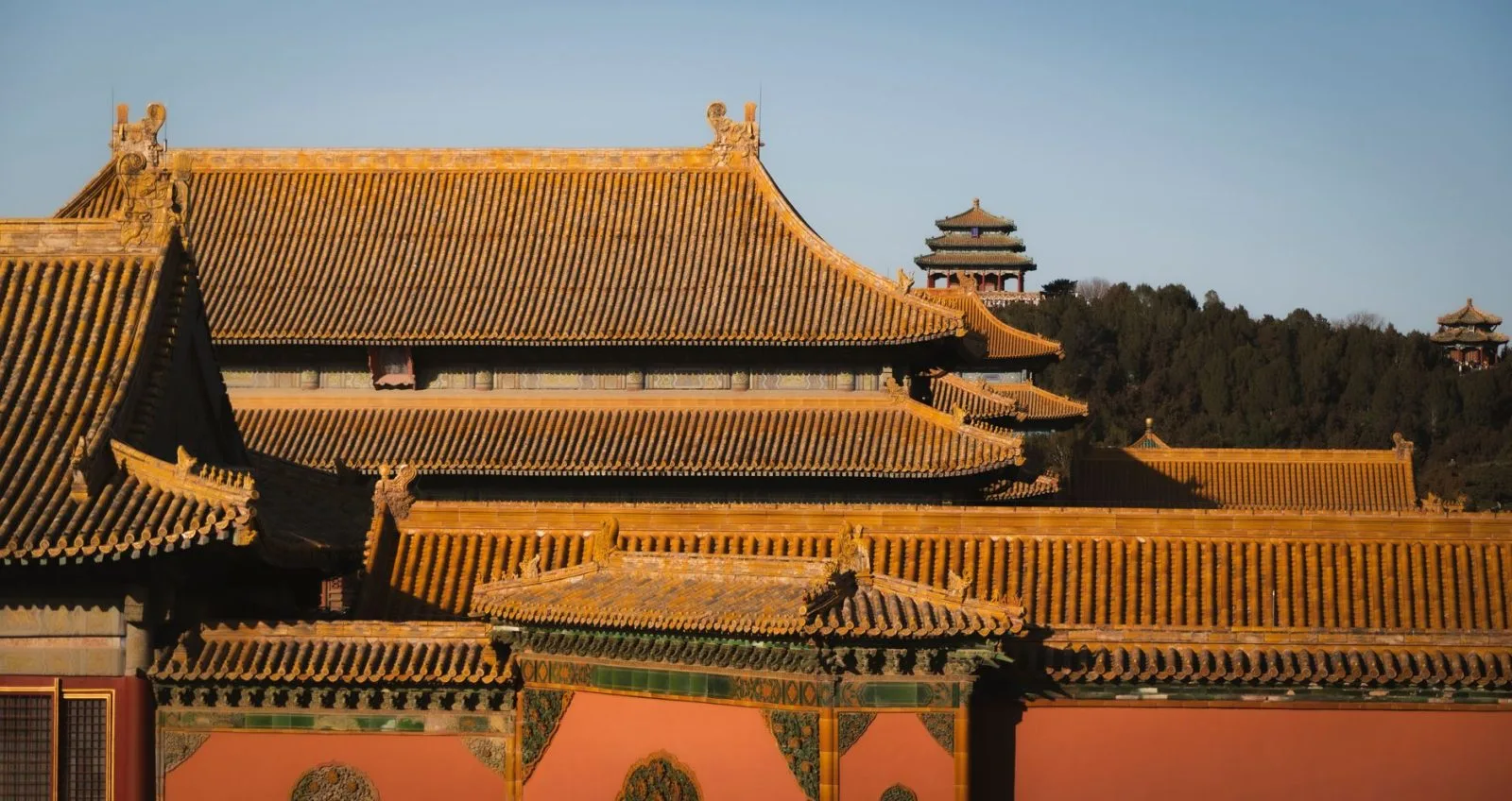
    A succession of red-walled courtyards and golden roofs viewed from a palace terrace
    Repeated courtyards made ceremonial progress part of the architecture. 虎 曼 | Pexels License (https://www.pexels.com/license/)

    Colour, Number, and Craft

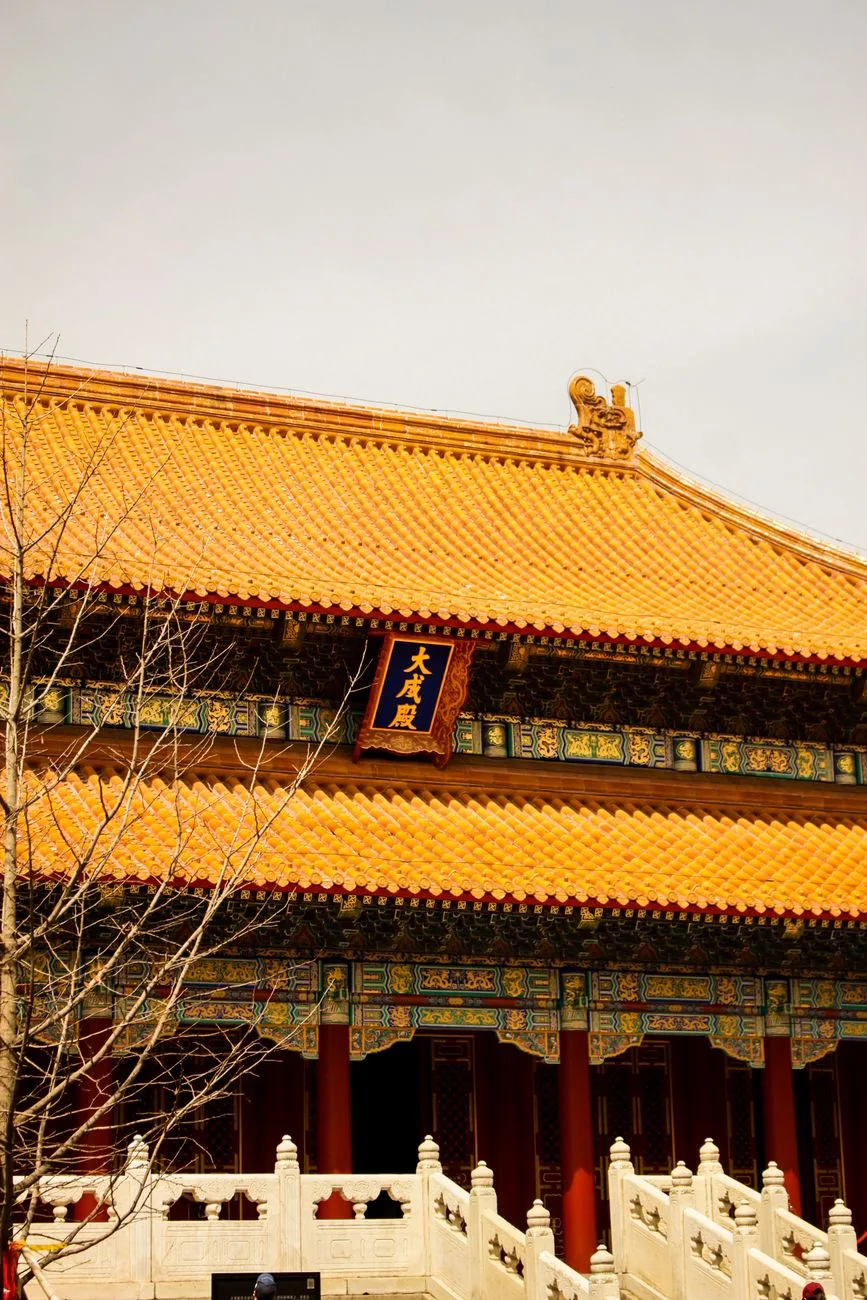
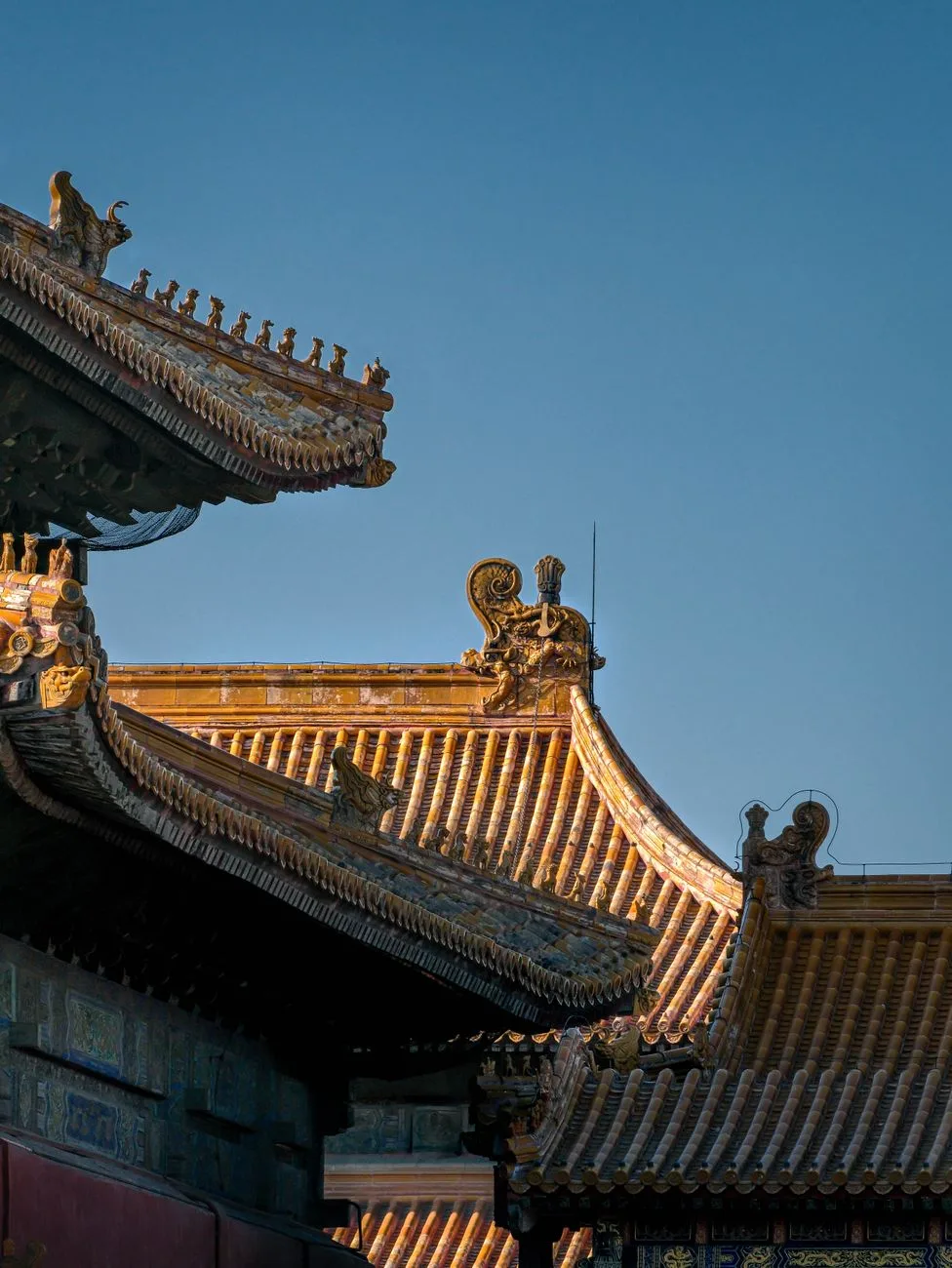
    The surviving buildings show Ming and Qing carpentry at large scale. Timber frames stand on stone plinths, with dougong bracket sets supporting deep eaves. Yellow glazed roof tiles were reserved for imperial buildings; vermilion walls, white marble terraces, and dark blue-green beams created a controlled palette. The Hall of Supreme Harmony carries ten roof figures, the highest rank, and its terrace holds bronze cranes and a tortoise. Numbers were symbolic: nine marked the emperor, and the palace is said to have 9,999 rooms, though the count depends on how spaces are defined. The Palace Museum, opened in 1925 after the last emperor left, now preserves the buildings and collections.

    • Begun in 1406 and occupied in 1420
    • Outer court for audiences, inner court for residence
    • Yellow roof tiles restricted to imperial use
    • Palace Museum opened to the public in 1925
    Golden roof tiles, bracket sets, and carved beams on a Qing palace hall
    Dougong brackets and yellow glazed tiles carried imperial rank. ravencrow BI | Pexels License (https://www.pexels.com/license/)

    Visiting the Palace Today

    The complex covers about 720,000 square metres and holds thousands of rooms, so a visit needs a route. Most visitors enter from the south at the Meridian Gate, pass the three great halls, then turn north to the inner court and the Garden of Cultivation. The Treasure Gallery and the Clock Gallery occupy separate wings and often require extra tickets. Ticket sales normally close in the afternoon and the palace is closed on Mondays except during peak holidays, so checking current rules matters. Tiananmen Square security adds time. The best views of the roofscape are from Jingshan Park to the north, which also marks the site where the Ming dynasty’s last emperor died in 1644.

    The palace made ceremony architectural: every gate, terrace, and roof colour told a visitor where power stood.

    Sumber & bacaan lanjut

    1. Kota Terlarang — Pusat Warisan Dunia UNESCO.
    2. Kota Terlarang — Ensiklopedia Britannica.
    3. The Palace Museum — The Palace Museum.

    Lihat di tempatnya

    Ikuti entri ini ke rantau tempat ia berada.

    Terokai mengikut Peta

    Ikuti thread ini

    Layari entri lain yang berkongsi tegnya.

    Layari tag
  • Rel Berkelajuan Tinggi

    Panduan Perjalanan

    Rel Berkelajuan Tinggi

    A National Network at 300 km/h

    China’s high-speed lines connect major cities with frequent, electrified, mostly elevated track.

    Seksyen
    Panduan Perjalanan
    Wilayah
    Beijing
    Era
    modern-china
    Tag
    Geography, Transport

    China’s high-speed rail network is the largest in the world, measured by route length. It grew from a single 2008 line between Beijing and Tianjin into a national system linking regional capitals, coastal cities, and tourist gateways.

    From the Beijing–Tianjin Line

    The Beijing–Tianjin intercity railway opened in August 2008, just before the Beijing Olympics, with trains designed for 350 kilometres per hour. It followed the Sixth Railway Speed-Up campaign, in which conventional lines were upgraded and new rolling stock imported from Siemens, Alstom, Bombardier, and Kawasaki. Technology transfer and domestic redesign produced the CRH family and later the Fuxing series. The 2011 Wenzhou accident on the Beijing–Shanghai line, caused by signalling failures during a thunderstorm, killed forty people and led to speed reductions, audits, and a slower pace of construction. The network nevertheless expanded rapidly after 2013.

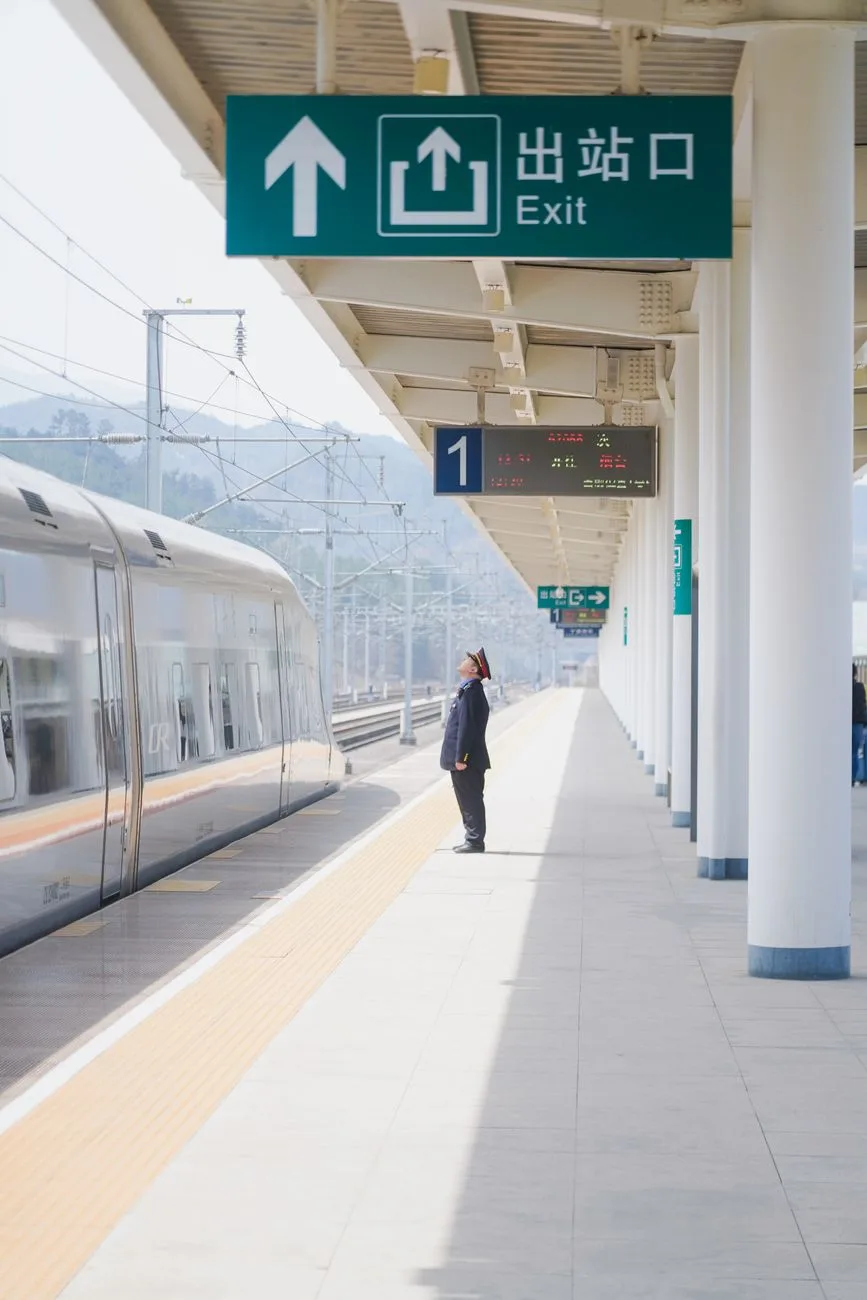
    A streamlined white high-speed train standing at a modern elevated platform
    The CRH and Fuxing trains developed from imported designs and domestic redesign. travelers_tw | Pexels License (https://www.pexels.com/license/)

    How the Network Is Built

    High-speed lines require gentle curves, long tunnels, and level track, so much of the network rides on concrete viaducts. Bridges keep routes straight, reduce land take, and allow farm traffic and roads to pass underneath. Continuous welded rail, slab track, and overhead catenary carry trains at operating speeds commonly around 300–350 kilometres per hour on the fastest services. Automatic train control limits speed and spacing; drivers monitor the system rather than relying only on signals beside the track. Stations are often built outside old city cores, where land was available, so a central railway station and a high-speed station may be different places in the same city.

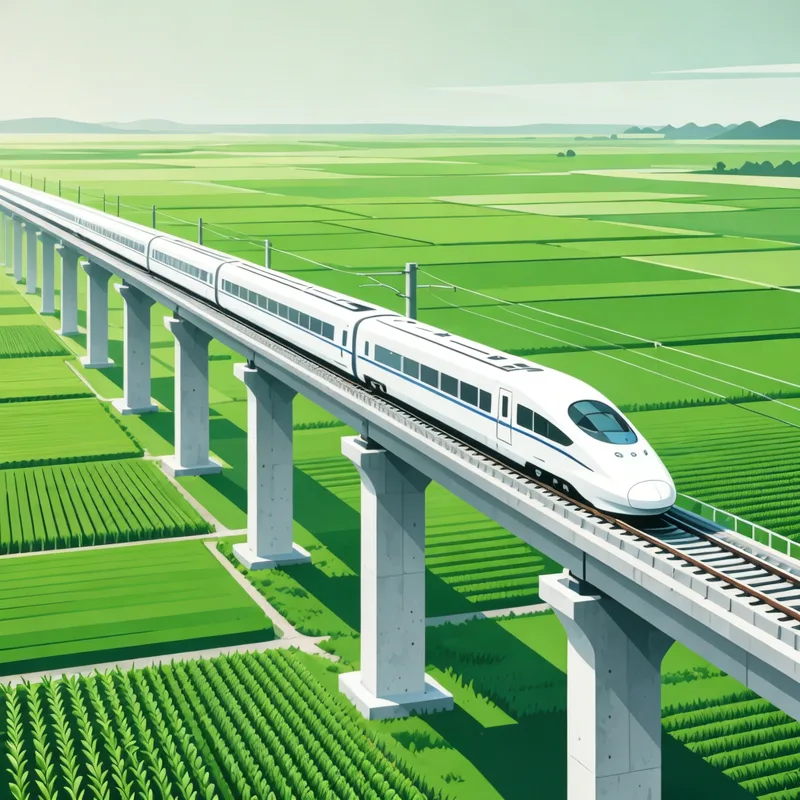
    Elevated high-speed railway crossing agricultural land on concrete piers
    Viaducts keep high-speed alignments straight and limit the footprint on farmland. Ilustrasi yang dijana AI · SinoViz

    Using the System

    Tickets are sold through the official Railway 12306 website and app; passports or resident identity documents are checked at entry, and names must match the booking. The G-series are the fastest passenger services, D-series generally run on upgraded or slightly slower lines, and overnight high-speed sleeper trains now cover longer routes. Larger stations use airport-style security, so arriving well before departure is wise. Seats are assigned, restaurant cars or at-seat delivery are common, and station boards use Chinese characters and Roman letters. Beijing West, Beijing South, and Beijing Chaoyang serve different lines, so the station name on the ticket matters as much as the city.

    • Book through Railway 12306 with an identity document
    • Allow time for security screening at large stations
    • Check whether the ticket says Beijing South, West, or Chaoyang
    • G trains are generally faster than D trains
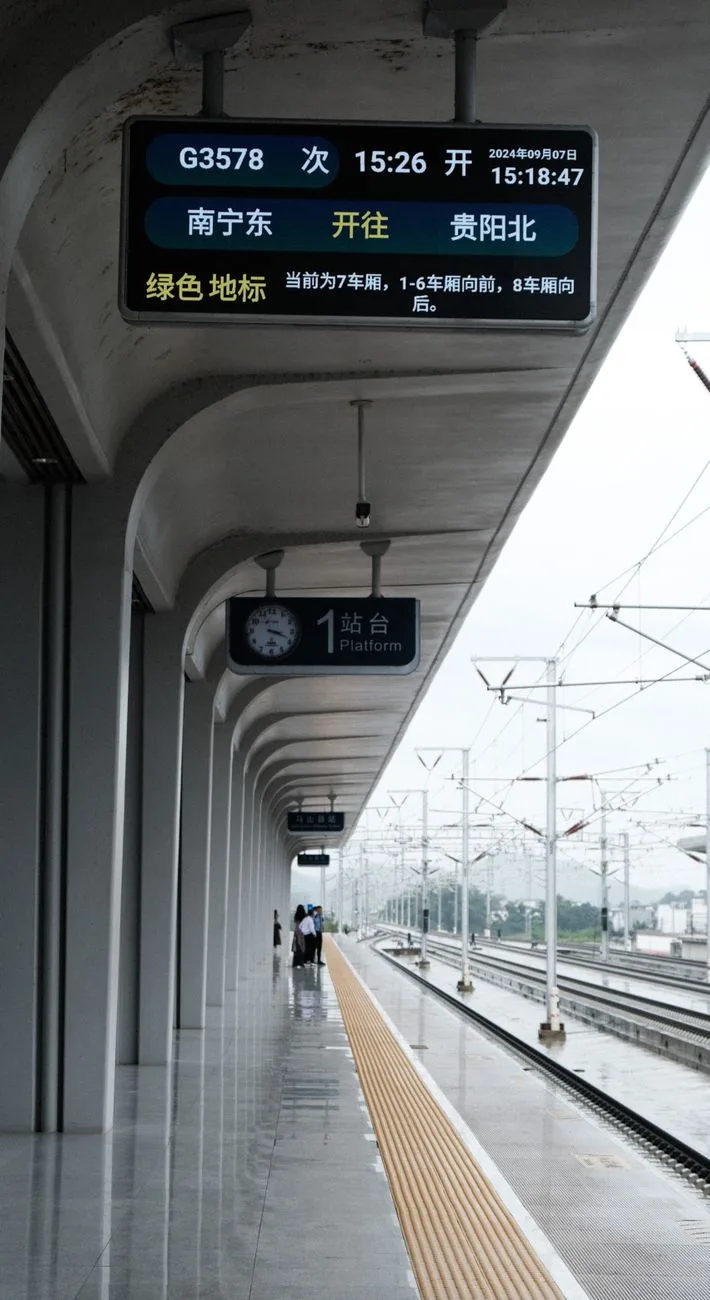
    A departure board listing high-speed train times in a large Chinese station
    Check the exact station name: major cities may have several high-speed terminals. 航皓 陈 | Pexels License (https://www.pexels.com/license/)

    What the Routes Connect

    The Beijing–Shanghai line, opened fully in 2011, links the political capital to the financial centre in about four and a half hours on the fastest trains. The Beijing–Guangzhou line, completed in 2012, runs south through Shijiazhuang, Zhengzhou, Wuhan, and Changsha. The Lanzhou–Xinjiang line reached Urumqi in 2016, extending high-speed service deep into the northwest. Coastal lines connect Tianjin, Jinan, Nanjing, Hangzhou, and Shanghai, while newer routes serve Chengdu, Chongqing, Kunming, and Xi’an. Trains are frequent on busy corridors, but distances remain continental: a traveller crossing several time-zone-widths of China should still allow a full day.

    A high-speed station may sit far from the old city centre, so the ticket’s station name is part of the journey.

    Sumber & bacaan lanjut

    1. High-speed rail in China — Ensiklopedia Britannica.

    2. China Railway High-speed — Ensiklopedia Sejarah Dunia.
    3. China Railway 12306 — China Railway.

    Lihat di tempatnya

    Ikuti entri ini ke rantau tempat ia berada.

    Terokai mengikut Peta

    Ikuti thread ini

    Layari entri lain yang berkongsi tegnya.

    Layari tag
  • Dumpling

    Kehidupan & Cerita Rakyat

    Dumpling

    Kotak Gandum Berisi dan Ritual Musim Sejuk

    Ladu Cina Utara menjadikan doh gandum dan inti bermusim sebagai hidangan bersama.

    Seksyen
    Kehidupan & Cerita Rakyat
    Wilayah
    Beijing
    Era
    Merentasi zaman
    Tag
    Kastam, Makanan

    Dumpling ialah bungkusan gandum yang diisi dan dimasak dengan cara direbus, dikukus, atau digoreng. Di utara China, ia menandakan solstis musim sejuk dan Tahun Baru Cina, apabila keluarga mengumpulkan jiaozi di sekeliling meja dan melipat setiap bungkusan dengan tangan.

    Gandum dalam Diet Utara

    Dumpling berasal dari zon gandum dan sekoi utara China, di mana tepung gandum menjadi makanan ruji dalam dinasti Han dan kemudian. Bentuknya telah dibandingkan dengan wang Cina kuno, yang memberikan tempat kepada hidangan ini dalam bahasa Tahun Baru: bunyi jiaozi berkaitan dengan frasa untuk bertukar harta karun. Satu tradisi yang terkenal mengaitkan dumpling dengan doktor Zhang Zhongjing, yang dikatakan telah membuat bungkusan doh berisi untuk merawat telinga yang membeku semasa zaman Han. Kisah ini sukar untuk disahkan, tetapi ia menjelaskan adat memakannya dalam cuaca sejuk. Bukti arkeologi untuk makanan gandum berisi adalah lebih jelas daripada mana-mana pencipta tunggal.

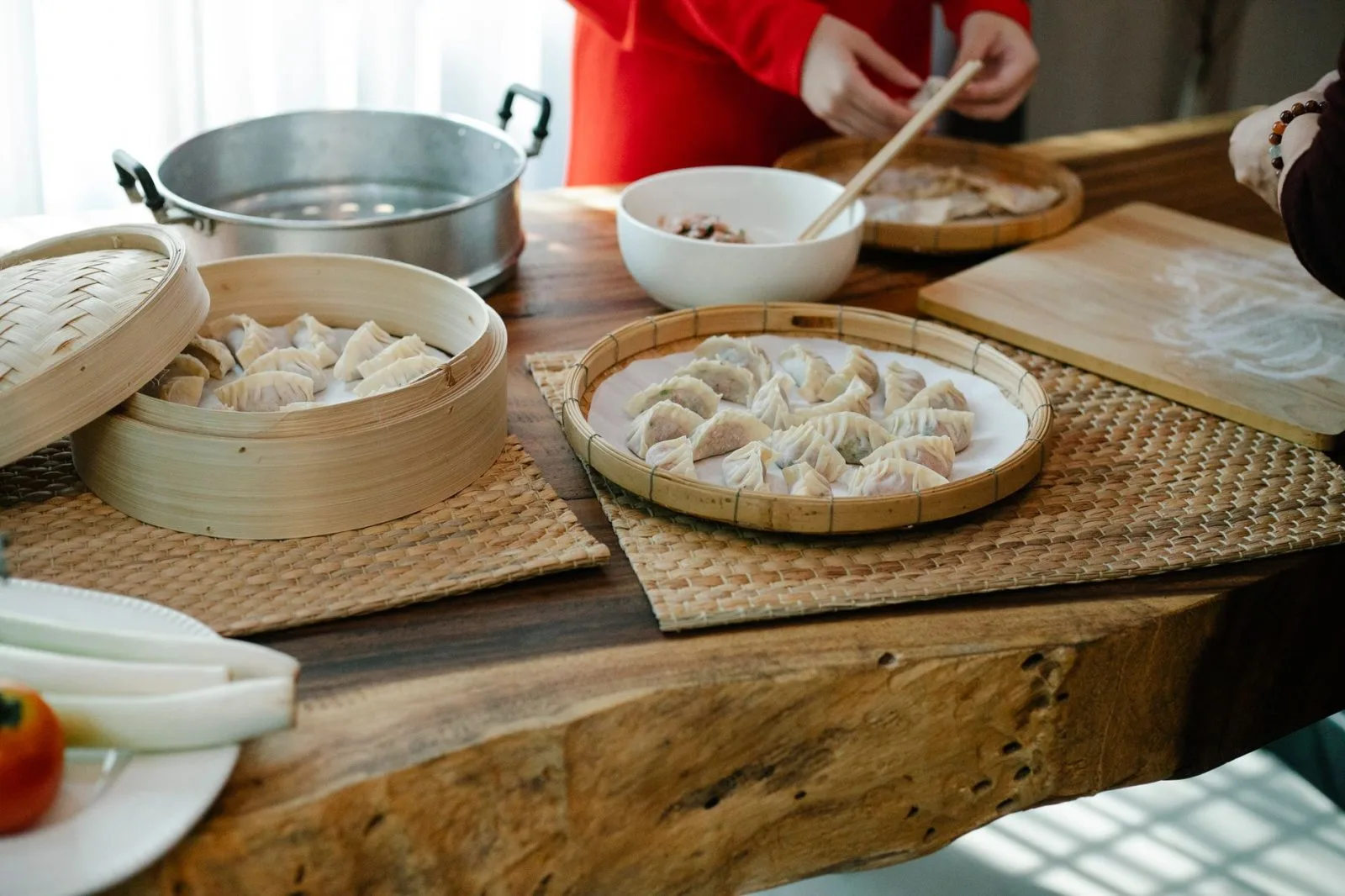
    Sebaris ladu jiaozi berlipat terletak di atas papan kayu yang ditaburi tepung
    Tepi berlipat menutup inti dan memberikan setiap ladu bentuk yang biasa. Angela Roma | Lesen Pexels (https://www.pexels.com/license/)

    Doh, Pengisian dan Lipat

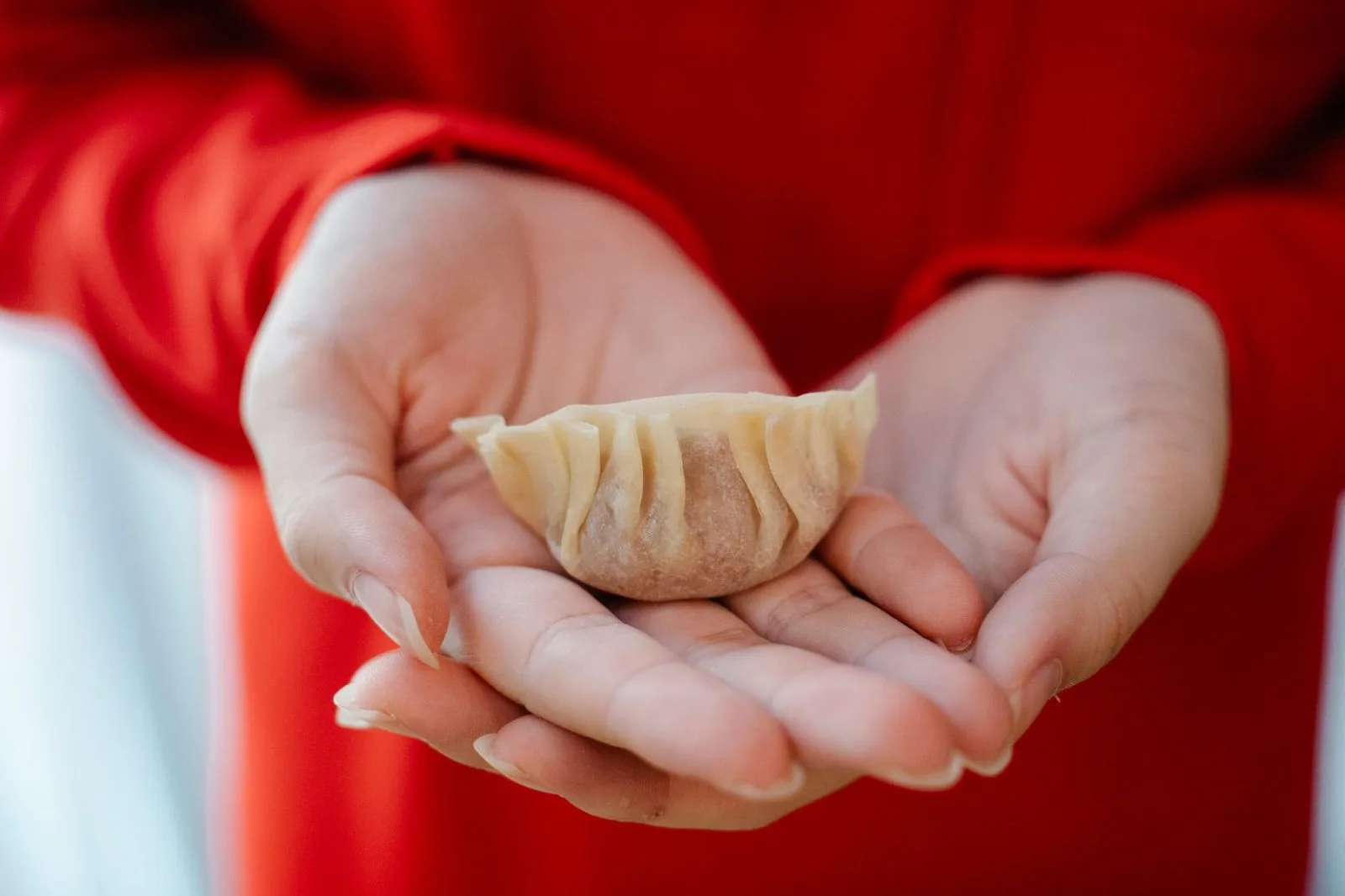
    Doh jiaozi asas menggunakan tepung gandum dan air, direhatkan supaya gluten mengendur dan pembalut boleh digulung nipis tanpa koyak. Sesetengah tukang masak menambah telur atau menggunakan air panas untuk sebahagian tepung bagi menghasilkan tekstur yang lebih lembut. Inti dicincang halus supaya ia masak sepenuhnya: daging babi dengan kubis, daun kucai, atau daun bawang; kambing dengan bawang di barat laut; udang dan telur di kawasan pantai. Tukang masak meletakkan inti di tengah, melipat pembalut, dan menekan lipatan di sepanjang jahitan. Penutupan yang ketat penting kerana merebus membuka doh jika udara masih ada di dalam. Inti vegetarian dengan tauhu, cendawan, atau telur adalah perkara biasa, terutamanya untuk lawatan ke kuil dan tempoh berpuasa.

    Tangan mencubit lipatan di sepanjang tepi ladu mentah
    Lipatan menutup bungkusan; setiap keluarga mungkin memilih lipatan yang berbeza. Angela Roma | Lesen Pexels (https://www.pexels.com/license/)

    Direbus, Dikukus, dan Digoreng

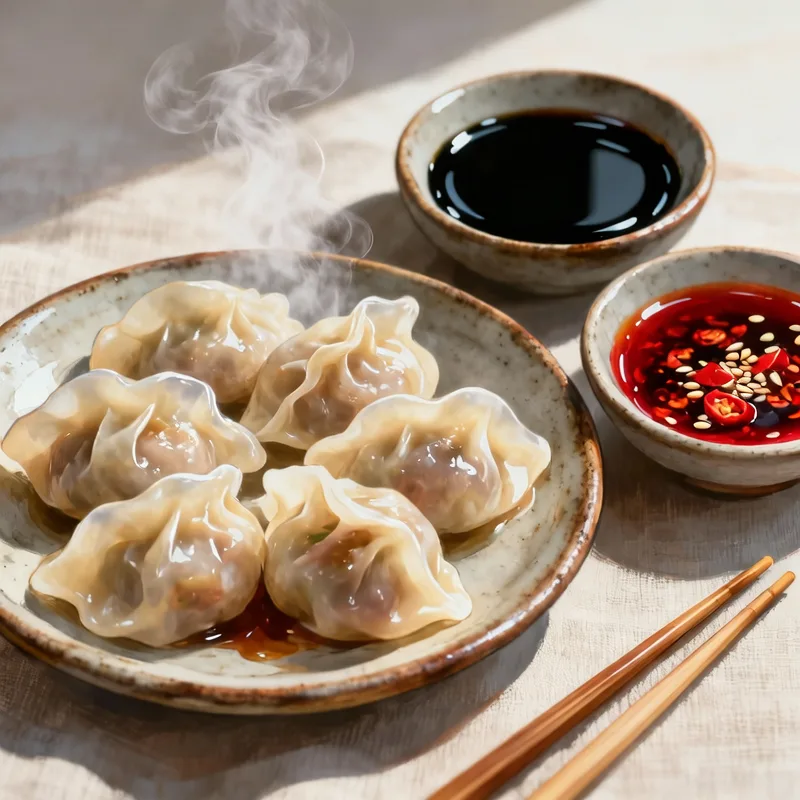
    Kaedah yang paling biasa adalah merebus: ladu dimasukkan ke dalam periuk besar, ditoskan dari bawah, dan dimasak sehingga terapung dan mengembang. Tukang masak utara sering menambah sedikit air sejuk apabila periuk mendidih semula, mengulangi proses tersebut tiga kali untuk kulit yang pejal. Potsticker, atau guotie, digoreng pada satu sisi, kemudian dikukus di bawah penutup dengan sedikit air, meninggalkan dasar yang rangup. Versi selatan dan diaspora termasuk har gow kukus dengan udang dan pembalut kanji gandum lut sinar. Sos pencicah berbeza-beza daripada cuka hitam dan halia hingga kicap dengan minyak cili atau bawang putih. Inti juga berubah: daging babi dan daun kucai mendominasi di Beijing, daging lembu dan kambing muncul dalam komuniti Islam, dan kubis atau cendawan sesuai untuk bandar-bandar pedalaman yang lebih sejuk.

    • Jiaozi rebus untuk Tahun Baru dan solstis musim sejuk
    • Guotie dengan dasar goreng rangup
    • Cuka hitam dan halia sebagai pencicah klasik
    • Inti serantau daging babi, kambing, udang atau sayur-sayuran
    Ladu rebus dihidangkan dengan sedikit cuka dan minyak cili
    Pencicahan cuka dan halia memotong inti daging babi yang pekat. Ilustrasi yang dijana AI · SinoViz

    Membuat Mereka Bersama

    Dumpling merupakan makanan sosial kerana pemasangannya memerlukan masa. Pada Malam Tahun Baru Cina, beberapa generasi mungkin menggulung pembalut, memotong inti, dan melipat berpuluh-puluh atau beratus-ratus bersama-sama; sesetengah dumpling dibentuk seperti syiling atau disembunyikan dengan syiling yang telah dibersihkan sebagai tanda tuah. Makan sering disusun di sekeliling ahli keluarga yang tertua. Lebihan makanan digoreng pada keesokan harinya, dan dumpling beku kini dijual di pasar raya di seluruh China dan luar negara. Versi restoran terdiri daripada rumah-rumah Beijing yang menghidangkan dumpling kambing hinggalah guotie Shanghai dan xiaolongbao berisi sup, yang tergolong dalam keluarga ban kukus yang berkaitan tetapi berbeza.

    Dumpling ialah sekeping kecil organisasi isi rumah: doh, inti, tangan dan sebab untuk berkumpul.

    Sumber & bacaan lanjut

    1. Dumpling — Ensiklopedia Britannica.
    2. Jiaozi — Ensiklopedia Britannica.
    3. Tahun Baru Cina — Ensiklopedia Britannica.
    Lihat di tempatnya

    Ikuti entri ini ke rantau tempat ia berada.

    Terokai mengikut Peta

    Ikuti thread ini

    Layari entri lain yang berkongsi tegnya.

    Layari tag
  • Puisi Tang

    Kronik

    Puisi Tang

    Zaman Kegemilangan Sajak Cina

    Penyair Tang mengubah kraf istana, perjalanan sempadan, dan pemikiran Buddha menjadi puisi pendek yang berkekalan.

    Seksyen
    Kronik
    Wilayah
    Shaanxi
    Era
    sui-tang
    Tag
    Kastam, Sejarah

    Dinasti Tang (618–907) menghasilkan korpus puisi klasik Cina yang paling terkenal. Puisi-puisi telah tersebar dalam manuskrip, antologi, inskripsi, dan persembahan, menghubungkan ibu kota Chang'an dengan pos-pos sempadan dan biara.

    Chang’an dan Penyair Rasmi

    Puisi dalam Dinasti Tang terikat dengan sistem peperiksaan dan kehidupan rasmi. Calon diuji keupayaan mereka untuk menulis sajak yang dikawal selia, dan esei prosa disertakan dengan sajak; kejayaan boleh membawa pelantikan dan peluang untuk mengedarkan karya di kalangan pelanggan. Chang'an, ibu kota berhampiran Xi'an pada masa kini, mempunyai kira-kira sejuta orang pada zaman kegemilangannya, dengan pasar, kuil, dan komuniti asing. Penyair berkhidmat di jawatan jauh, menulis sajak perpisahan, dan menggubahnya pada majlis-majlis awam. Quan Tangshi, yang disusun pada awal abad ke-18 di bawah perintah empayar, memelihara lebih daripada empat puluh lapan ribu puisi oleh lebih dua ribu penulis. Skalanya menunjukkan betapa telitinya sajak ditenun ke dalam kehidupan sastera.

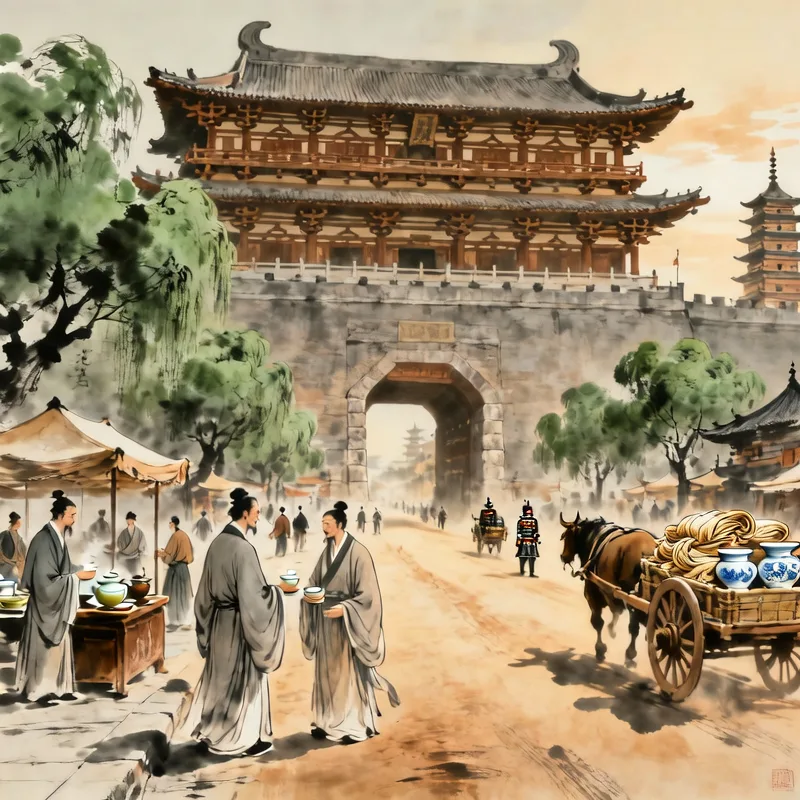
    Sebuah pintu gerbang kota era Tang dan jalan raya yang luas di bekas ibu kota Chang'an
    Para pegawai dan penyair bergerak melalui pasar, kuil, dan pejabat kerajaan di ibu kota. Ilustrasi yang dijana AI · SinoViz

    Peraturan dan Kebebasan dalam Ayat Terkawal

    Penyair Tang berkarya dalam beberapa bentuk. Lüshi, atau sajak terlaras, menggunakan lapan baris lima atau tujuh aksara, dengan corak tonal yang ketat dan paralelisme antara bait tengah. Jueju ialah puisi empat baris, nampaknya kasual tetapi sering dibina berdasarkan putaran pemikiran yang tajam. Bentuk balada yuefu yang lebih lama dan puisi prosa fu kekal digunakan. Du Fu (712–770) menguasai sajak terlaras dan membawa pemerhatian sosial ke dalamnya, menulis tentang rasuah, perang, dan kelaparan serta landskap. Li Bai (701–762) dikenali dengan suara yang lebih bebas dan lebih luas, walaupun puisi terbaiknya juga dibuat dengan teliti. Wang Wei (701–759) menulis puisi landskap padat yang dibentuk oleh Buddhisme Chan.

    Landskap terbuka pergunungan dan kabus menyerupai latar belakang landskap Tang
    Puisi landskap sering menggunakan babak kecil untuk mencadangkan keadaan minda yang lebih besar. Ilustrasi yang dijana AI · SinoViz

    Sempadan, Buangan, dan Selatan

    Beberapa dekad selepas Pemberontakan An Lushan pada tahun 755–763 telah mengubah peta puitis. Du Fu melarikan diri melalui utara China yang dilanda perang dan kemudian tinggal di Chengdu, di mana puisi pondok jerami mencampurkan perincian domestik dengan kesedihan politik. Pegawai yang dibuang negeri ke selatan menulis tentang sungai, haba, dan bahasa yang tidak dikenali. Sempadan itu mengilhami puisi tentang tentera yang berarak, angin gurun, dan isi rumah seorang askar, seperti dalam karya Cen Shen dan Gao Shi. Pengembaraan Li Bai membawanya dari Sichuan ke Yangtze dan utara; legenda kematiannya akibat lemas di sungai selatan diulang tetapi tidak pasti. Pergerakan ini meluaskan subjek puisi klasik dan membawa gaya Tang ke dalam kalangan sastera serantau.

    • Sajak Du Fu tentang perang, kemiskinan, dan kehidupan biasa
    • Perjalanan luas dan lagu minum Li Bai
    • Landskap Wang Wei yang dipengaruhi Chan
    • Puisi sempadan Gao Shi dan Cen Shen
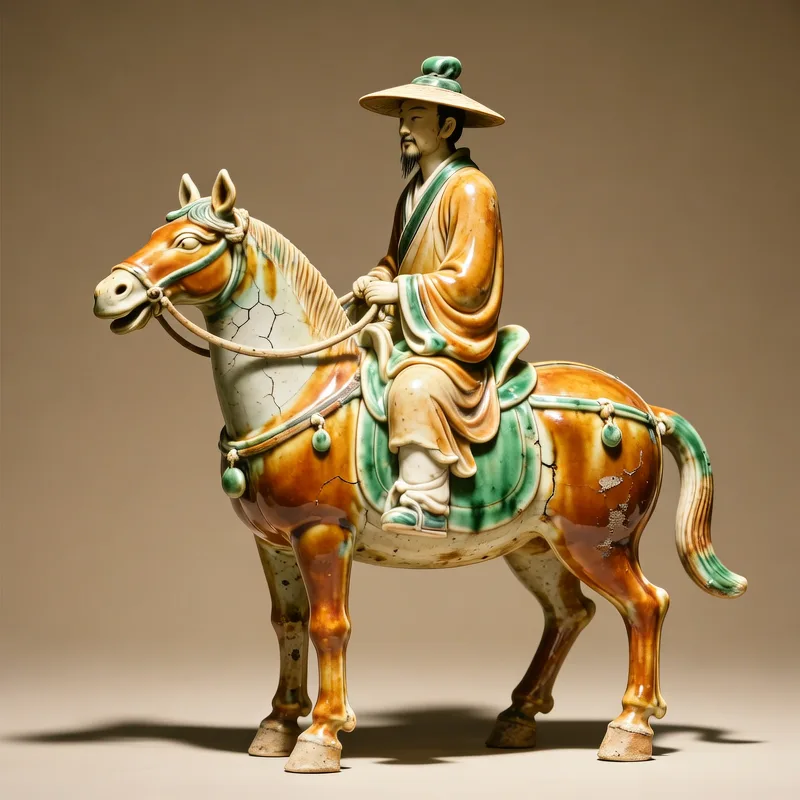
    Patung seramik Dinasti Tang bagi seorang pengembara berkuda dalam perjalanan jauh
    Pengembaraan, pengasingan, dan khidmat tentera telah memberikan puisi Tang banyak subjeknya. Ilustrasi yang dijana AI · SinoViz

    Akhirat Puisi Tang

    Puisi Tang menjadi ingatan budaya bersama. Kanak-kanak sekolah menghafal baris-baris, ahli kaligrafi menyalin puisi, dan penulis lagu berhujah dengan model Tang dan bukannya meninggalkannya. Kanun Tang juga dibentuk oleh antologi: Tangshi Sanbaishou, yang disusun pada abad kelapan belas oleh Sun Zhu, kekal sebagai koleksi pengenalan standard. Di China moden, puisi oleh Li Bai dan Du Fu dibacakan pada majlis-majlis rasmi dan dipetik dalam perbualan biasa. Penterjemah menterjemahkan baris-baris yang dikawal selia ke dalam bahasa lain, walaupun corak nada dan bait-bait selari menentang pemindahan yang tepat. Pengunjung ke Xi'an boleh menghubungkan puisi-puisi tersebut dengan muzium Shaanxi, tembok bandar Tang, dan tapak wad dan pasar Chang'an.

    Sebuah puisi Tang boleh merangkumi politik sesebuah empayar dalam lapan baris, atau seluruh gunung dalam empat baris.

    Sumber & bacaan lanjut

    1. Dinasti Tang — Ensiklopedia Britannica.
    2. Kesusasteraan Cina — Ensiklopedia Britannica.
    3. Puisi Tang — Muzium Seni Metropolitan.

    Lihat di tempatnya

    Ikuti entri ini ke rantau tempat ia berada.

    Terokai mengikut Peta

    Ikuti thread ini

    Layari entri lain yang berkongsi tegnya.

    Layari tag
  • The Grand Canal

    Penerokaan Peta

    The Grand Canal

    An Inland Waterway Across China

    The Grand Canal links northern and southern China through rivers, locks, and warehouse towns.

    Seksyen
    Penerokaan Peta
    Wilayah
    Zhejiang
    Era
    Merentasi zaman
    Tag
    Geography, History, Transport

    The Grand Canal is a system of artificial channels and connected rivers, not one continuous trench. For centuries it moved grain, salt, silk, and imperial correspondence between the Yellow River and the Yangtze delta.

    From Warrior States to Imperial Route

    Canal building began before unification. The state of Wu dug the Han Gou channel in the fifth century BCE to move troops and grain between the Yangtze and the Huai. The Qin and Han maintained regional waterways, but the Sui dynasty (581–618) created the first broadly connected system. Emperor Yang ordered hundreds of thousands of labourers to dig the Tongji Canal, linking Luoyang toward the Yangtze, and the Yongji Canal toward the north. The cost contributed to Sui collapse, yet the route remained useful. The Yuan dynasty (1271–1368) redirected the canal around the Yellow River toward Beijing, and Ming and Qing engineers rebuilt sections with locks and stone banks.

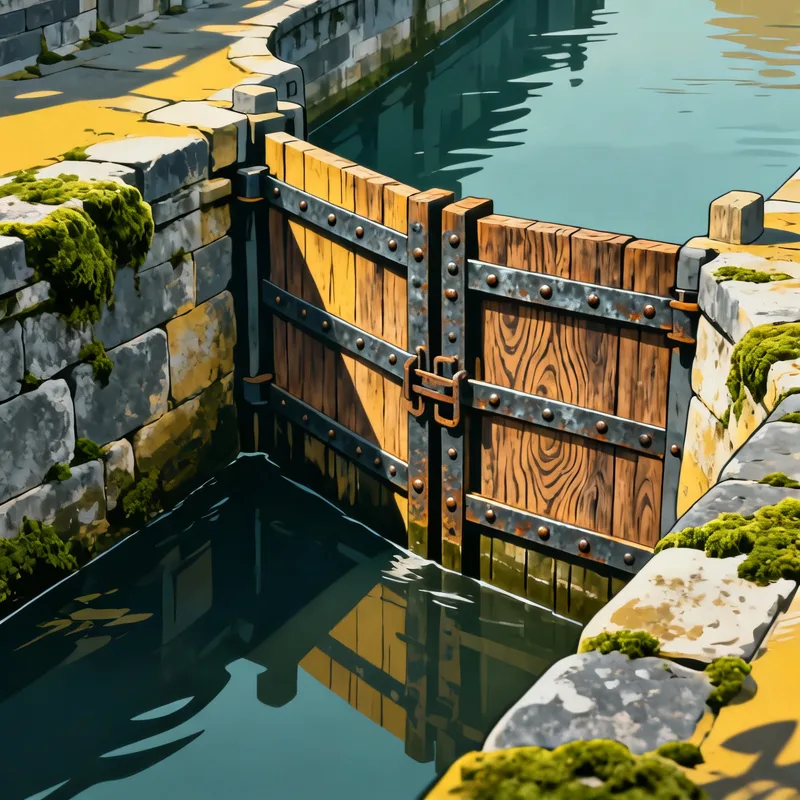
    An ancient canal lock with stone banks and a narrow timber water gate
    Locks allowed boats to cross differences in water level between river basins. Ilustrasi yang dijana AI · SinoViz

    Grain Boats and Market Towns

    The canal’s central purpose was transport. Under the Ming and Qing, tribute grain from the lower Yangtze moved north in huge flotillas of flat-bottomed boats, with relay crews and storage depots at key cities. The annual shipment fed the capital and the northern garrisons. Canal towns grew around wharves, granaries, guild halls, and money lenders: Linqing, Jining, Huai’an, and Yangzhou became exchange points as much as transit stops. Salt from the Huai coast, silk from Suzhou and Hangzhou, porcelain from Jingdezhen, and coal from northern mines moved along the same water. A journey that took weeks by road could be made with far greater bulk by boat.

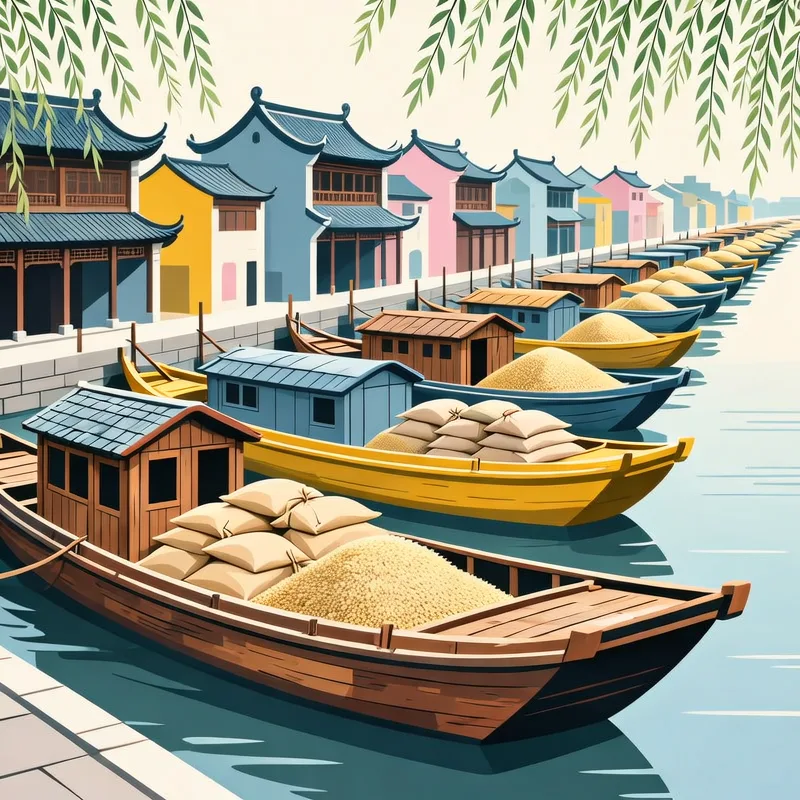
    A long line of flat-bottomed grain boats moored along a canal wharf
    Grain flotillas tied the Yangtze delta to the political capital. Ilustrasi yang dijana AI · SinoViz

    Southern Sections and Historic Cities

    The southern canal runs through the lowlands of Zhejiang and Jiangsu, where bridges, warehouses, and waterside houses still mark older commercial geography. Hangzhou is the southern terminus of the Sui-era system and a gateway to the Qiantang River. Suzhou’s canals were both transport routes and parts of the city’s garden landscape; its humpbacked stone bridges allowed boats to pass while pedestrians crossed. Wuxi and Zhenjiang sit at important junctions, while the Jiangnan section near the Yangtze has been widened and industrialised. UNESCO inscribed the Grand Canal on the World Heritage List in 2014, identifying thirty-one sections and twenty-seven components. The listed property includes canals, locks, bridges, and administrative sites.

    • Sui channels linked Luoyang with the Yangtze
    • Yuan engineers redirected the route toward Beijing
    • Tribute grain moved north in large boat flotillas
    • UNESCO listed thirty-one canal sections in 2014
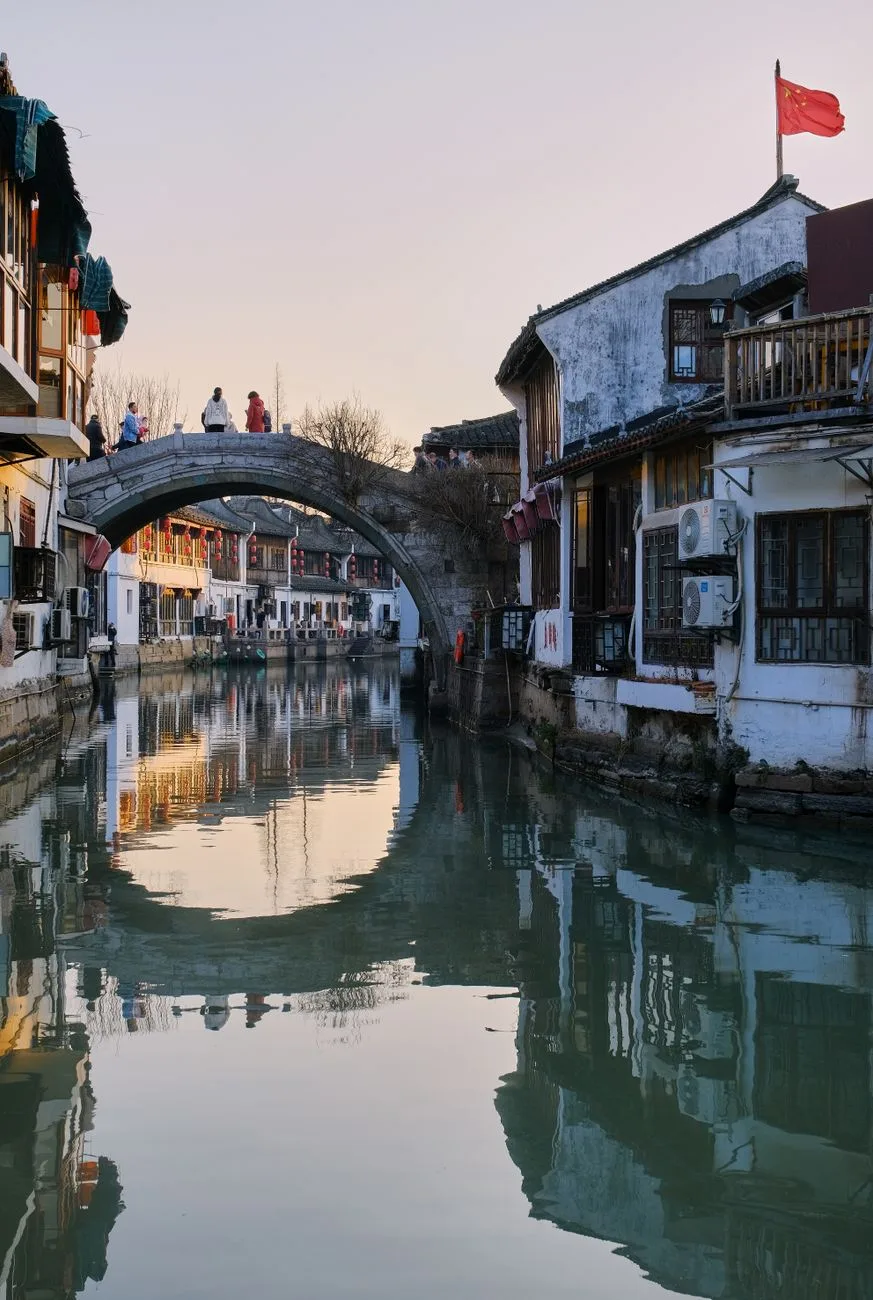
    Stone arch bridges and old waterside houses along a canal in southern China
    In Jiangnan, canal transport and city life developed together. Vind 🌙 | Pexels License (https://www.pexels.com/license/)

    Reading the Canal Today

    Much of the northern canal is no longer navigable end to end; railways and roads took over long-distance freight, and parts were buried or rerouted during the twentieth century. Southern sections remain busy with barges, and several cities operate passenger boats for residents and visitors. A useful route for a first visit is Hangzhou or Suzhou, where canal life is visible beside gardens and markets. Water levels, engineering works, and modern flood control change the scene, so boats and landing stages may shift. The canal’s historical importance lies not in scenic continuity alone but in the way it joined climates, crops, taxes, and cities over more than a thousand years.

    The Grand Canal was less a single road of water than a machine for moving grain, tax, and news.

    Sumber & bacaan lanjut

    1. The Grand Canal — Pusat Warisan Dunia UNESCO.
    2. Terusan Besar — Ensiklopedia Britannica.
    3. Grand Canal of China — Ensiklopedia Sejarah Dunia.

    Lihat di tempatnya

    Ikuti entri ini ke rantau tempat ia berada.

    Terokai mengikut Peta

    Ikuti thread ini

    Layari entri lain yang berkongsi tegnya.

    Layari tag
  • Kerja Perak Miao

    Kehidupan & Cerita Rakyat

    Kerja Perak Miao

    Ornament, Memory, and Festival Dress

    Miao silver ornaments carry family history and local identity in festival dress across southwest China.

    Seksyen
    Kehidupan & Cerita Rakyat
    Wilayah
    Yunnan
    Era
    Merentasi zaman
    Tag
    Customs, Ethnic, Scenic Sites

    Miao silverwork is a family of adornments—headdresses, collars, earrings, and bracelets—made by Miao communities in Guizhou, Yunnan, and neighbouring regions. The pieces are worn most visibly at festivals and weddings.

    A Distributed Craft Tradition

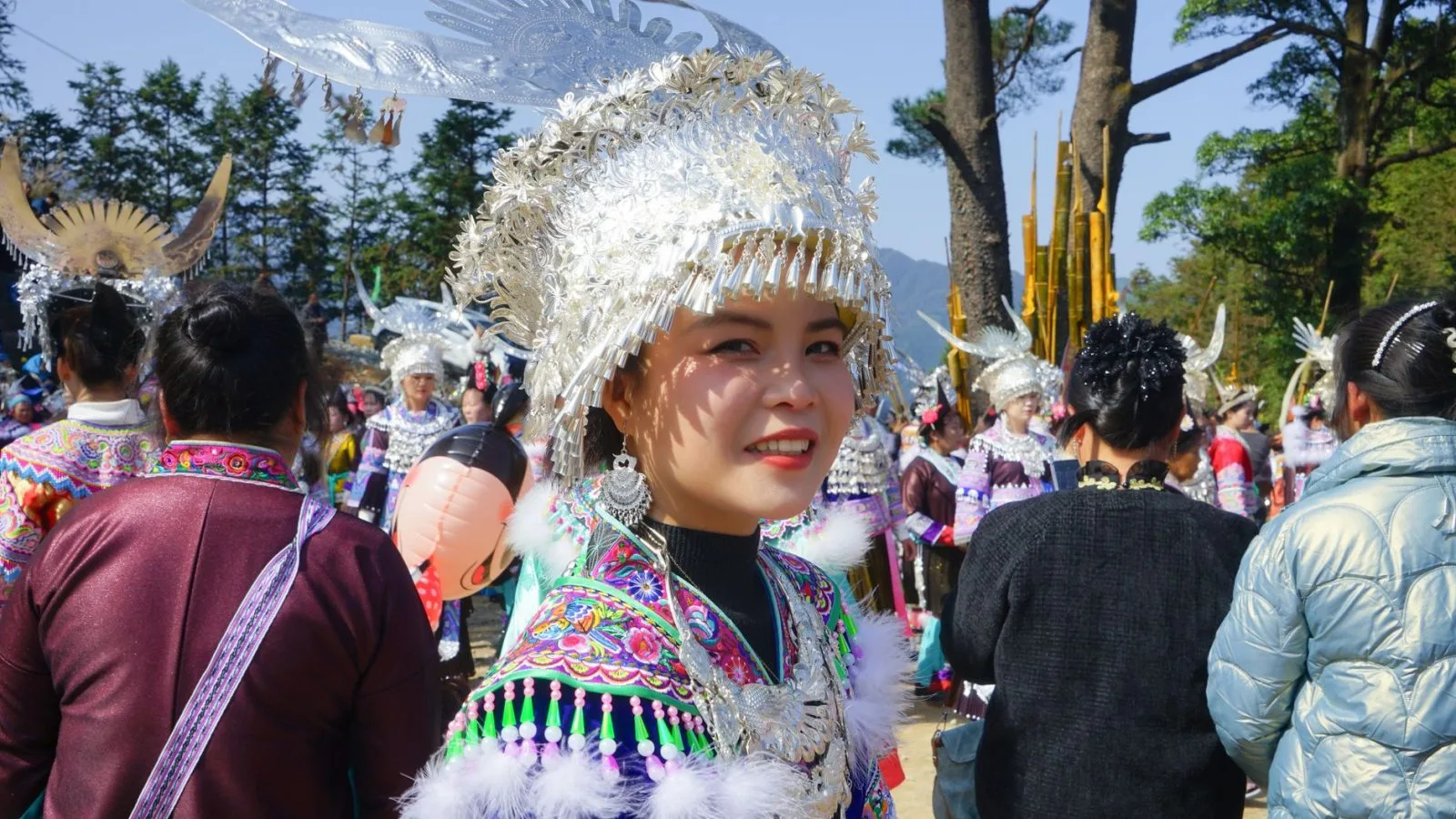
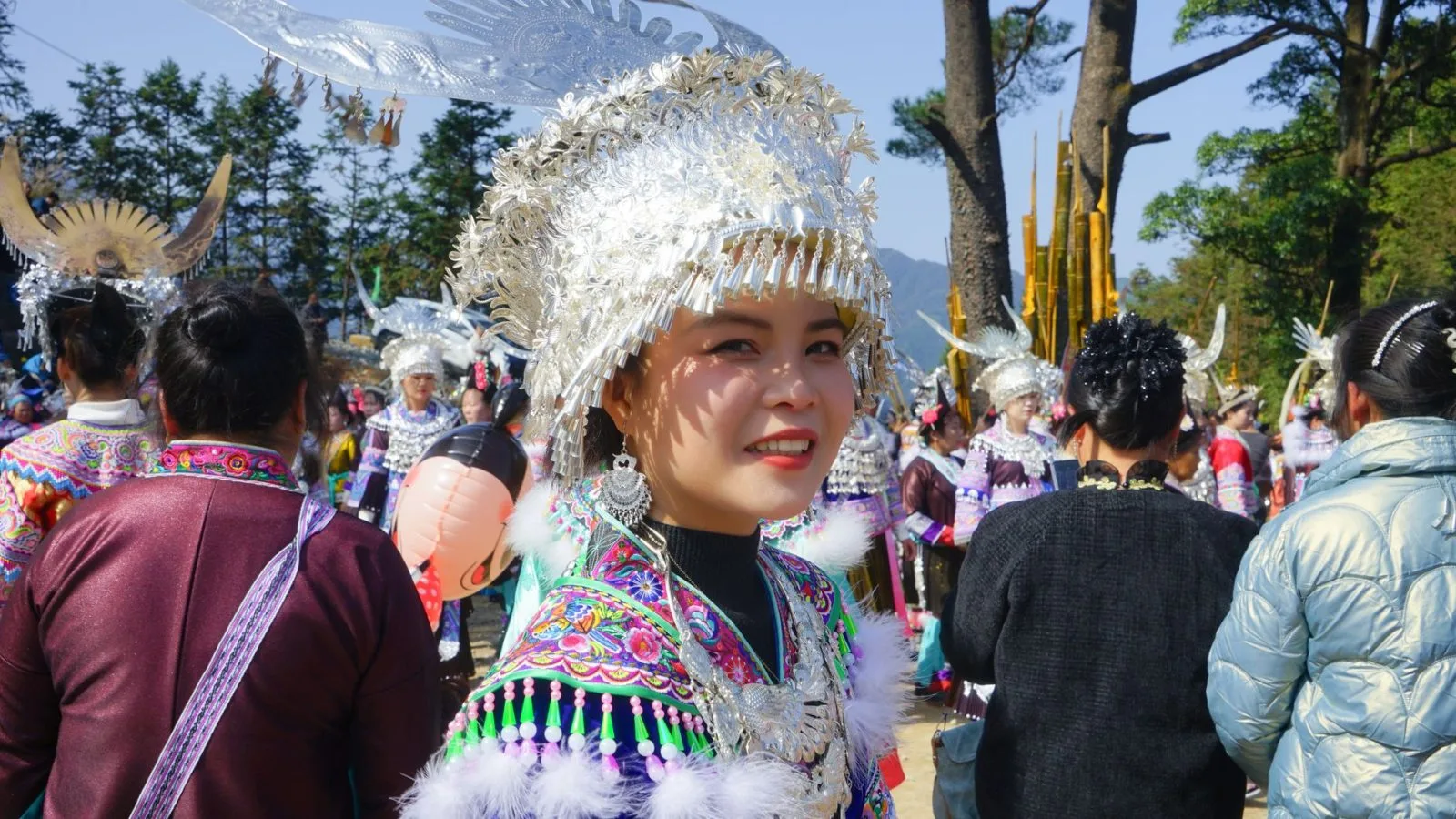
    Miao communities live across Guizhou, Yunnan, Guangxi, Sichuan, and Southeast Asia, and silverwork varies by locality. In Yunnan, Miao villages around Wenshan and Honghe maintain styles that differ from the better-known Guizhou counties of Xijiang and Kaili. Ornaments are made by specialised silversmiths who work in small workshops, often serving several villages. Designs are learned through apprenticeship rather than written patterns: a young smith repeats forms copied from older pieces and festival dress. Motifs may draw on local birds, flowers, insects, and coins, though their meanings are not fixed. Families accumulate ornaments over generations, and a daughter’s festival headdress may represent years of saving.

    A Miao headdress with silver horns, plaques, and hanging ornaments at a festival
    Headdresses combine family heirlooms with pieces made for a specific occasion. Jaqor Q.I. | Pexels License (https://www.pexels.com/license/)

    Sheet, Wire, and Repoussé

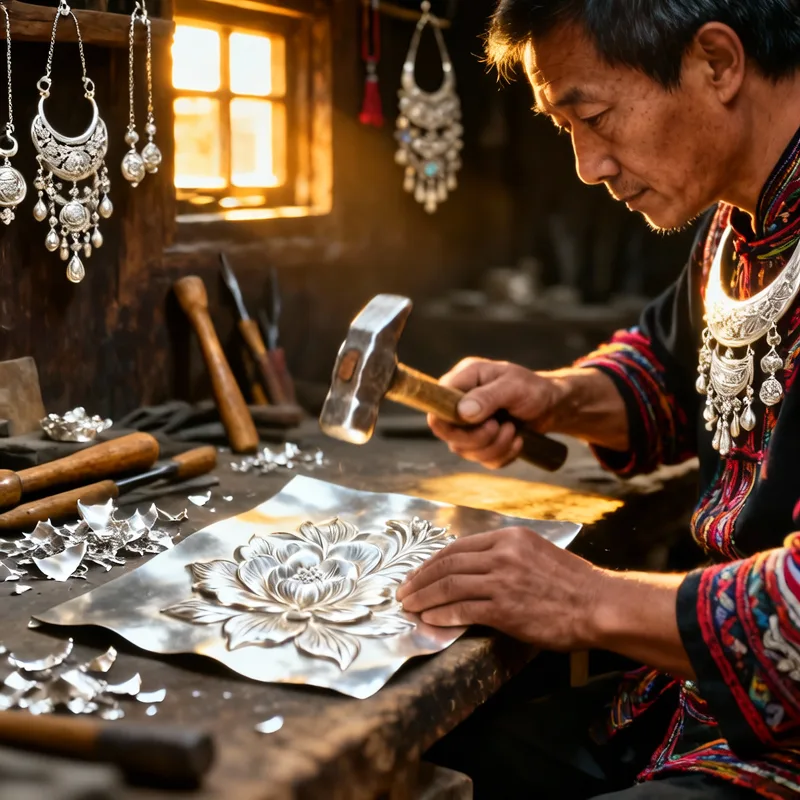
    Much Miao silverwork begins with sheet silver and wire. The smith hammers ingots into thin sheets, cuts strips, and raises patterns from the reverse with repoussé, a technique of punching and chasing to form relief. Horsehair-thin wires are twisted and soldered into filigree, then built into openwork wings, horns, and floral sprays. A large headdress may combine a hammered band, dangling chains, repoussé plaques, and rows of tiny bells that move when the wearer turns. Silver is valued for its colour, workability, and traditional association with protection and prosperity. Many ornaments are hollow to reduce weight, since a full ceremonial headdress can be heavy enough to limit long wear.

    A Miao silversmith hammering a thin silver sheet into a raised floral plaque
    Repoussé raises the design from the back of a thin silver sheet. Ilustrasi yang dijana AI · SinoViz

    Festival Wear and Social Meaning

    Silver ornaments are read as part of an entire costume, not as isolated jewellery. A Miao woman’s festival dress may include a pleated skirt, embroidered jacket, woven belt, and a silver collar shaped like a crescent or a pair of wings. In some communities, the number and form of earrings or neck rings indicate village affiliation or marital status. During the Lunar New Year, harvest celebrations, and the Miao New Year in some areas, women and girls wear family sets while groups sing, dance, and process between villages. The ornaments catch light during movement, making dress a visual part of the performance. Men may wear silver buttons, chains, or small pendants with less ceremonial weight.

    • Repoussé plaques raised from thin silver sheet
    • Twisted wire and openwork filigree
    • Headdresses with horns, chains, and bells
    • Costumes worn for New Year and wedding rituals
    Women in embroidered Miao festival dress wearing heavy silver collars and earrings
    Ornaments are worn with embroidery and weaving as one costume system. Jaqor Q.I. | Pexels License (https://www.pexels.com/license/)

    Markets, Tourism, and Continuity

    Silverwork circulates through village workshops, regional markets, and tourism. Visitors to Miao villages in Yunnan and Guizhou can watch smiths shaping small pieces, though the most important heirlooms are usually not for sale. Reproductions sold as souvenirs range from careful miniatures to inexpensive plated metal, so asking whether a piece is solid silver matters. Museums and cultural centres document older headdresses and collars, but the living context remains local dress. Some communities have revived festival costumes and taught silversmithing to younger people, while migration and wage work change who has time to make and wear them. The craft’s future depends less on novelty than on continued occasions to use it.

    A Miao headdress is worn jewellery and a portable archive of family work at the same time.

    Sumber & bacaan lanjut

    1. Miao people — Ensiklopedia Britannica.
    2. Chinese silver jewellery — Victoria and Albert Museum.
    3. Miao ethnic culture — China Highlights.

    Lihat di tempatnya

    Ikuti entri ini ke rantau tempat ia berada.

    Terokai mengikut Peta

    Ikuti thread ini

    Layari entri lain yang berkongsi tegnya.

    Layari tag
  • Masakan Sichuan

    Kehidupan & Cerita Rakyat

    Masakan Sichuan

    Chilli Oil, Ferment, and the Numbing Pepper

    Sichuan cooking balances chilli heat, Sichuan pepper numbness, fermented bean paste, and rich broth.

    Seksyen
    Kehidupan & Cerita Rakyat
    Wilayah
    Sichuan
    Era
    Merentasi zaman
    Tag
    Customs, Food, Geography

    Sichuan cuisine is known for bold seasoning, but its classic dishes are built on contrast: chilli with Sichuan pepper, hot oil with cool cucumber, or a clear broth beside a fiery one.

    A Basin Pantry and Early Flavours

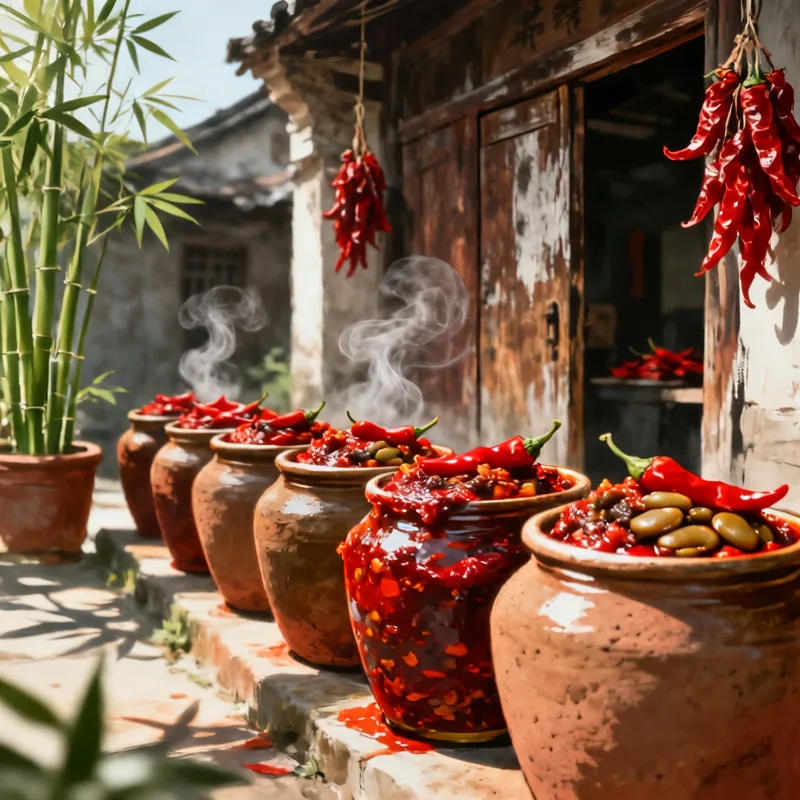
    The Sichuan Basin has fertile fields, rivers, and a humid climate, but its early elite cooking was not defined by chilli. Chilli peppers reached China from the Americas in the sixteenth century and became a Sichuan staple later, especially among ordinary households. Before that, cooks used ginger, garlic, mustard, vinegar, and the distinctive Sichuan pepper, Zanthoxylum simulans, whose husks cause a tingling sensation rather than heat.Fermented bean pastes from the basin towns added depth. Pixian doubanjiang, a broad-bean and chilli paste fermented in Pixian near Chengdu, became a foundation of many red-braised and stir-fried dishes. The province’s food therefore combines older preservation methods with ingredients that arrived through global trade.

    Jars of red chilli and broad-bean paste fermenting outside a Sichuan workshop
    Fermented doubanjiang gives many Sichuan dishes their deep red base. Ilustrasi yang dijana AI · SinoViz

    The Grammar of Heat

    Sichuan cooks distinguish several kinds of chilli heat. Dried chillies are fried in oil until fragrant but not blackened; chilli oil is steeped and aged; chilli bean paste supplies fermented heat; and fresh peppers give a brighter bite. Sichuan peppercorns, often toasted and ground, produce the málà combination of numbness and spice. Official Sichuan cookbooks describe more than twenty recognised flavour profiles, from guaiwei, strange or complex, to yuxiang, fish-fragrant, which uses no fish. Mapo tofu, associated with Chengdu in the nineteenth century, combines soft tofu, minced meat, doubanjiang, chilli oil, and Sichuan pepper. Kung Pao chicken uses dried chillies, peanuts, and a sweet-sour soy sauce.

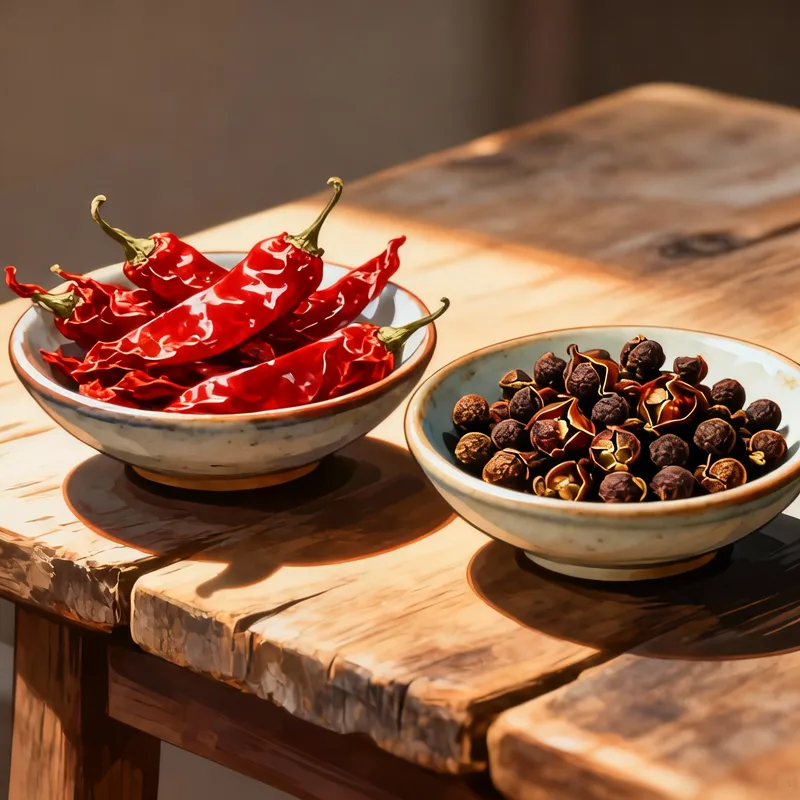
    Dried red chillies and Sichuan peppercorns in separate shallow bowls
    Chilli heat and peppercorn numbness are distinct, and cooks balance them separately. Ilustrasi yang dijana AI · SinoViz

    Hotpot and the Two-Flame Bowl

    Chengdu hotpot is a social meal built around a divided pot. One side may hold a red broth of chilli oil, doubanjiang, beef fat, and spices; the other a clear chicken or mushroom stock. Diners cook thinly sliced beef, tripe, duck blood, fish balls, vegetables, and mushrooms, then dip them in sesame oil, garlic, and chopped herbs. The sesame dip cools the palate and coats the mouth against spice. Chongqing hotpot is often heavier and more direct, traditionally using beef tallow; Chengdu versions are commonly more aromatic and varied. Yibin and other southern cities add their own chilli blends. Restaurants label spice levels, but heat can still be adjusted only by asking.

    • Pixian doubanjiang as a fermented chilli-bean base
    • Málà: chilli heat plus peppercorn numbness
    • Two-flavour hotpot with red and clear broth
    • Sesame oil dip to moderate the heat
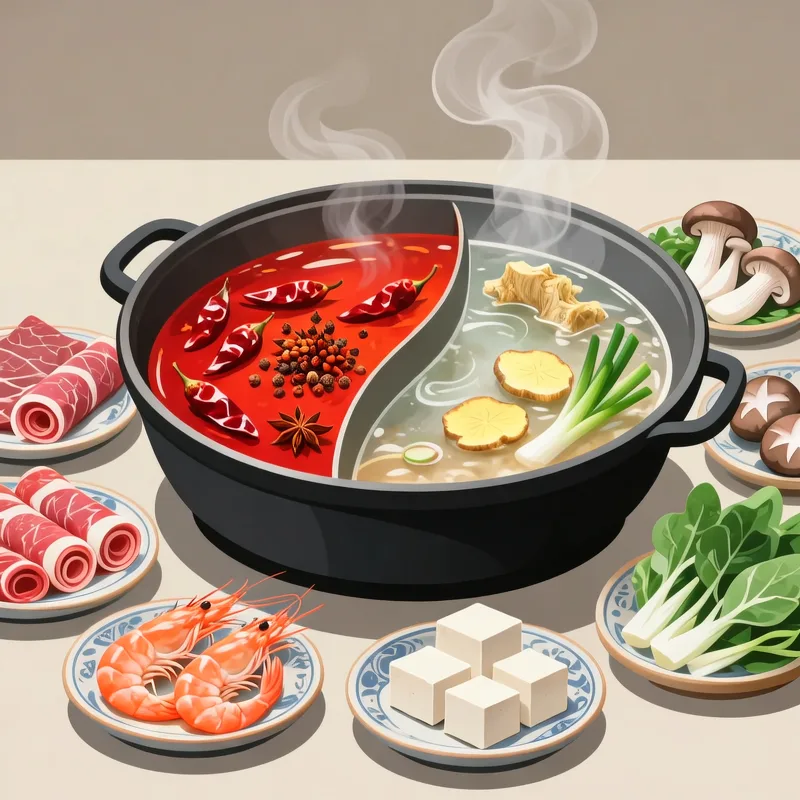
    A divided hotpot with red chilli broth and clear broth surrounded by ingredient plates
    A two-flavour pot lets a table divide heat from clarity. Ilustrasi yang dijana AI · SinoViz

    Beyond the Fiery Stereotype

    Not every Sichuan dish is hot. Sichuan’s most ceremonial dish, Gongbao chicken and the banquet classic ‘sweet and sour’ aside, the cuisine includes clear broths, steamed dishes, and delicate pastry. Zhangcha duck is smoked with tea leaves and camphor before steaming, while boiled pork slices are served in a clear broth with mustard greens. Chengdu’s teahouses and dish shops serve small noodles, sweet-water noodles, and dumplings. The province also includes Tibetan and Yi food traditions in its western highlands, where barley, yak products, and different seasonings dominate. Reading Sichuan cuisine only as heat misses its central achievement: layering aromas, textures, and ferments so that strong flavours remain controlled.

    Sichuan cooking is not simply hot; it is a carefully graded argument between chilli, pepper, oil, and ferment.

    Sumber & bacaan lanjut

    1. Sichuan cuisine — Ensiklopedia Britannica.
    2. Chinese Cuisine — Ensiklopedia Britannica.
    3. Sichuan Food — China Highlights.

    Lihat di tempatnya

    Ikuti entri ini ke rantau tempat ia berada.

    Terokai mengikut Peta

    Ikuti thread ini

    Layari entri lain yang berkongsi tegnya.

    Layari tag