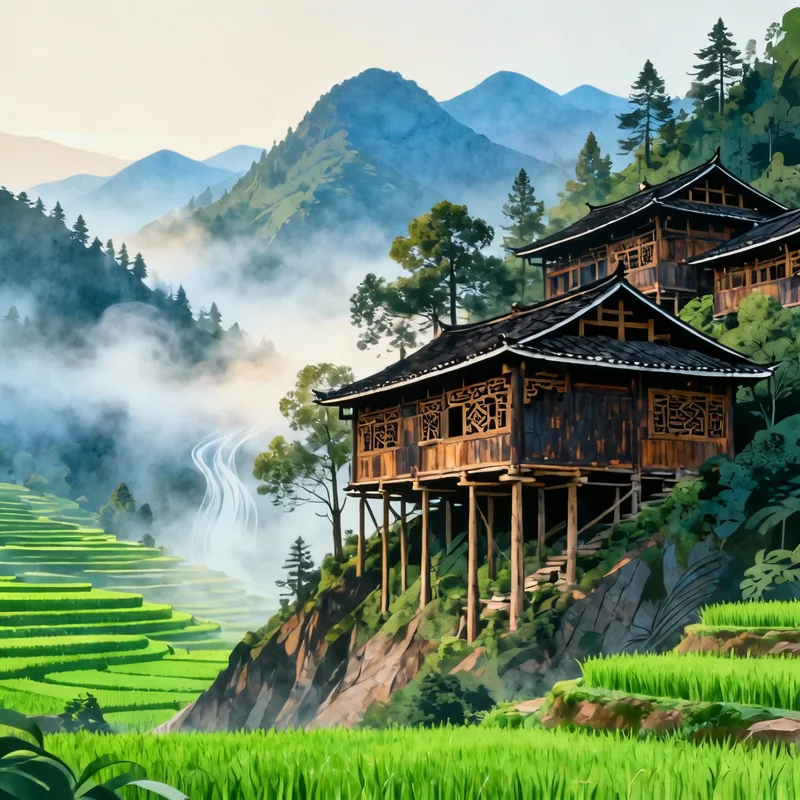
Hunan lies south of the Yangtze’s middle reaches, where rivers, lakes and mountains shaped a cuisine known for heat and aroma. Its landscapes range from Dongting Lake to the sandstone pillars of Zhangjiajie.
Région
Hunan
Coordonnées
28.23°N, 112.94°E
Connu pour
Rivers, spice and mountain towns
Paysage
Hunan is defined by the Xiang River basin, Dongting Lake and mountainous western areas. The province bridges central China’s waterways and the upland cultures of the southwest.
Patrimoine et lieux
Zhangjiajie sandstone pillars
Yueyang Tower
Fenghuang ancient town
Mawangdui Han tombs
Culture et vie quotidienne
Hunan cuisine uses fresh chilli, smoked meats and sour pickles. Miao and Tujia communities in western Hunan contribute festivals, embroidery and stilt-house architecture.
Gansu stretches along the Hexi Corridor, the narrow passage between deserts and mountains that carried Silk Road trade. Its caves, forts and oasis towns preserve the art and logistics of cross-Eurasian exchange.
Région
Gansu
Coordonnées
36.06°N, 103.83°E
Connu pour
Hexi Corridor and Silk Road
Paysage
Gansu is a long corridor of arid basins, mountains and oases. The Yellow River crosses its east, while the Hexi Corridor runs northwest between the Qilian Mountains and the Gobi.
Patrimoine et lieux
Mogao Caves at Dunhuang
Jiayuguan Fort
Maijishan Grottoes
Zhangye Danxia
Culture et vie quotidienne
Gansu blends Han, Hui, Tibetan and Mongol traditions. Noodles, lamb, melon and caravan-town markets reflect its position on historic trade routes.
Les Tujia sont un peuple tibéto-birman des monts Wuling, connu pour ses maisons sur pilotis, ses brocarts tissés et ses danses collectives.
Section
Vie et folklore
Région
Sichuan
Ère
À travers les époques
Étiquettes
Ethnique, coutumes
Bien que répertoriées ici dans la région du Sichuan, la plupart des communautés Tujia se situent à l'est du bassin du Sichuan, dans la chaîne de Wuling. Leur lien historique avec l'ancien État Ba les rattache au vaste univers culturel Bashu du sud-ouest de la Chine.
Gamme et nombres
The 2010 census counted about 8.35 million Tujia, making them one of China’s largest ethnic minorities. Their main settlements stretch across the Wuling Mountains where Hunan, Hubei, Chongqing and Guizhou meet, in counties such as Yongshun and Longshan in Hunan, Shizhu and Pengshui in Chongqing, and Yanhe in Guizhou. Villages occupy stream valleys and limestone slopes, with terraced fields and forest on the higher ground. Their inclusion in the Sichuan region on this site reflects older Bashu connections and modern movement between the basin and its eastern mountains; the densest Tujia population is not in Sichuan province itself.
Tujia villages follow stream valleys and terraced slopes rather than flat basin land. Illustration générée par IA · SinoViz
Language and identity
Tujia belongs to the Tibeto-Burman branch of the Sino-Tibetan family, with its closest affinities often discussed in relation to Naxi and other Qiangic languages. Today only a small number of people, mostly in a few western Hunan villages, speak it fluently; Southwestern Mandarin is the everyday language across most of the region. The name Tujia means native dwellers, and official recognition in the 1950s gave a common label to communities that had long interacted with Han, Miao, Dong and She neighbours. Oral histories preserve memories of the ancient Ba state, which controlled parts of the eastern Sichuan region until the Qin conquest of 316 BCE.
Stilt houses and brocade
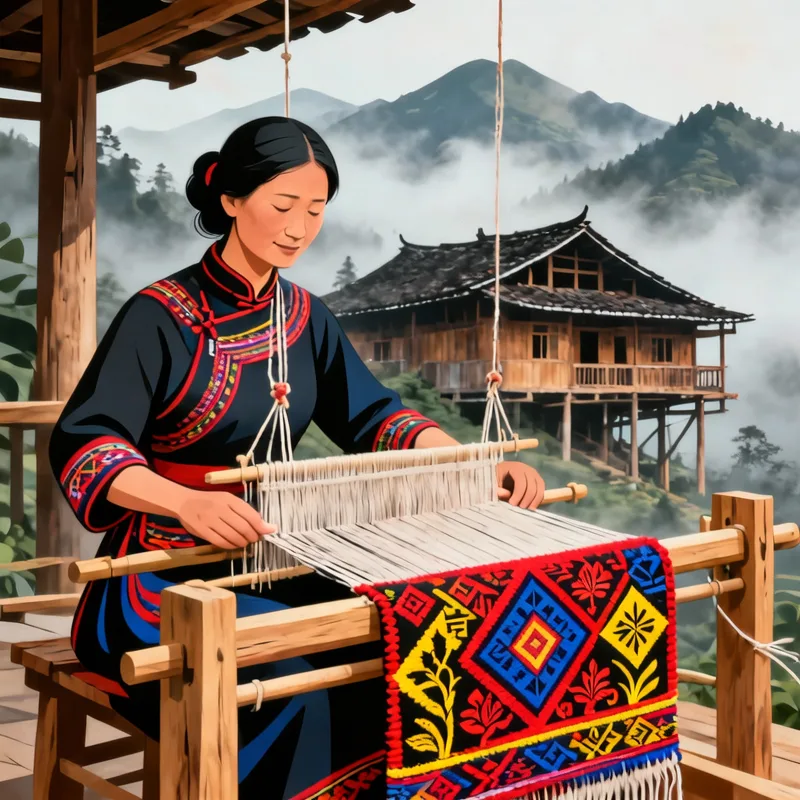
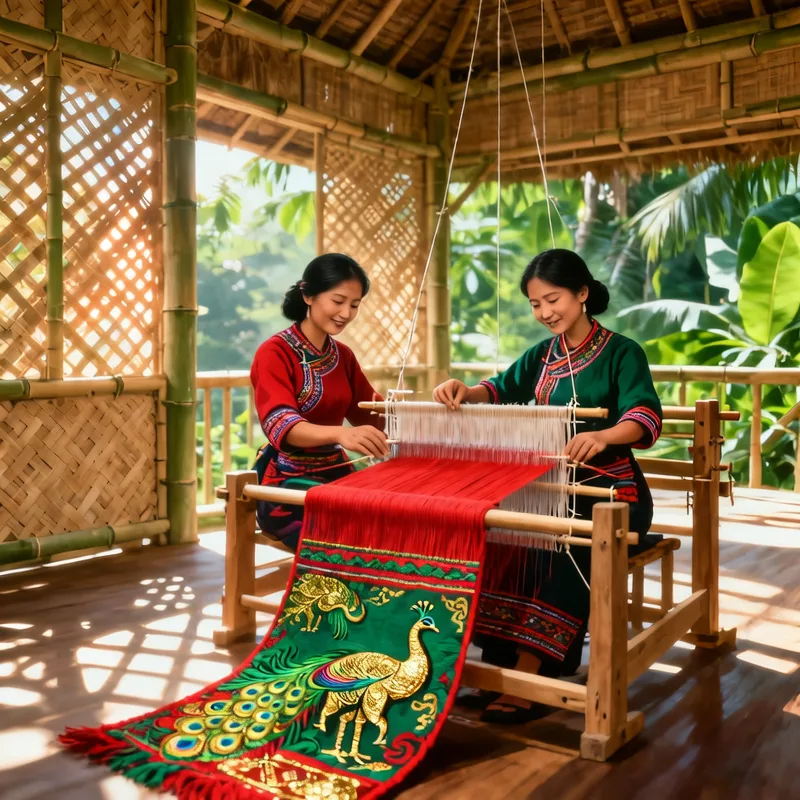
On steep ground, Tujia builders raise diaojiaolou, houses whose upper living floor projects over a lower storey on wooden posts. A covered veranda runs along the front, and the roof is pitched to carry off heavy rain. Interior screens and window frames are carved with floral and geometric patterns. The best-known textile is xilankapu, a colourful brocade woven on a backstrap loom with motifs of flowers, birds, characters from opera and the patterned ta tai hua design. It appears in clothing, bags and wall hangings and is protected as national intangible heritage. Meals often include cured pork, smoked fish, glutinous rice cakes and a tea soup whisked with fried rice and peanuts.
Xilankapu brocade is woven on a backstrap loom and used in dress and household textiles. Illustration générée par IA · SinoViz
Waving dances and new year
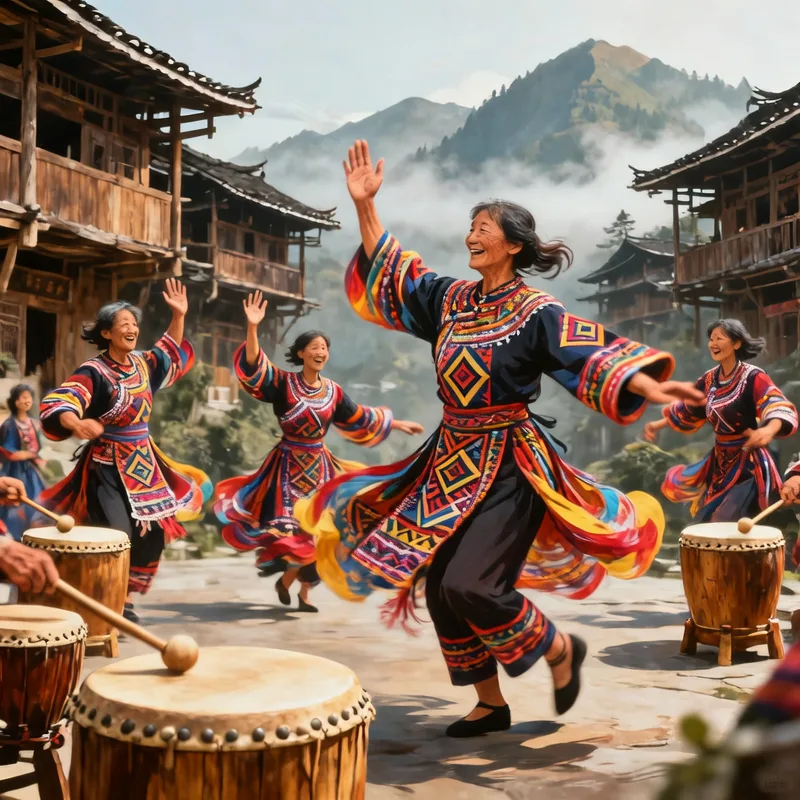
The waving dance, bai shou wu, is performed by lines of dancers who swing their arms in time with drums and gongs. It takes place in a waving hall around the lunar new year and at the Sheba festival, where offerings are made to ancestors and village protectors. Some villages also perform Maogusi, a masked or straw-costumed dance that enacts hunting and farming scenes. Another distinctive custom is gan nian, celebrating the new year a day early, which oral tradition links to ancestors preparing for a military departure. These performances are now taught in schools and cultural centres, so a ritual once tied to a single village hall is seen by wider audiences.
The waving dance brings villagers together in coordinated arm movements and drum rhythms. Illustration générée par IA · SinoViz
In Tujia villages, a woven pattern and a dance step both carry family memory.
Les Coréens d'origine chinoise conservent une vie culturelle coréenne dans le nord-est de la Chine et dans des villes comme Pékin.
Section
Vie et folklore
Région
Pékin
Ère
À travers les époques
Étiquettes
Ethnique, coutumes
Connus en chinois sous le nom de Chaoxianzu, les Coréens d'origine chinoise sont environ 1,8 million. Leurs principaux centres d'implantation se situent le long de la frontière nord-est, mais les districts de Wangjing et de Wudaokou à Pékin sont devenus des quartiers de langue coréenne très visibles.
Migration et quartiers
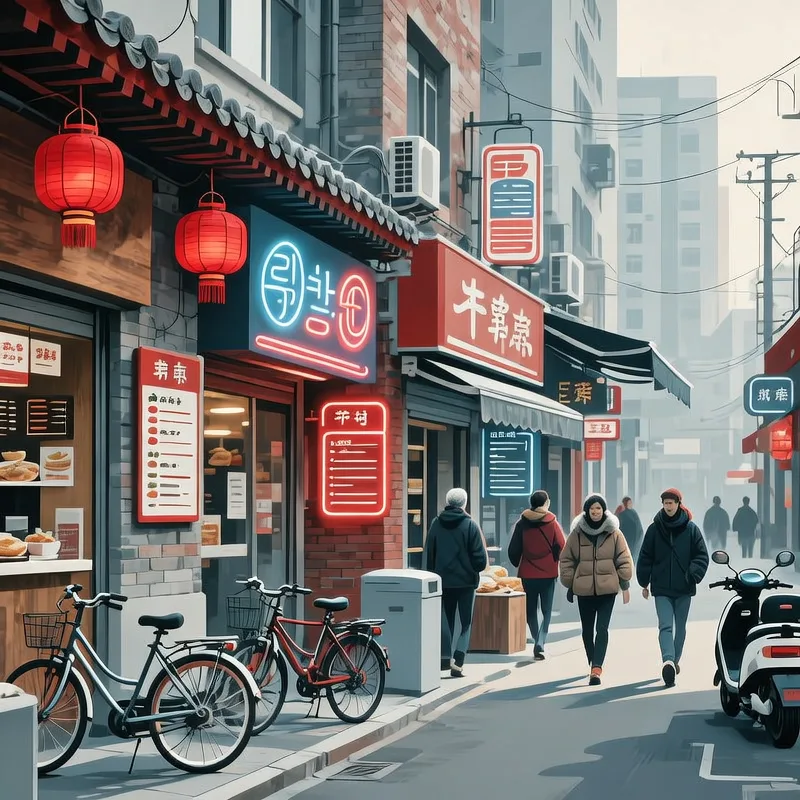
La plupart des familles coréennes chinoises font remonter leur installation en Chine à la fin du XIXe et au début du XXe siècle, période marquée par les difficultés, la conscription et l'annexion de la Corée par le Japon en 1910, qui ont provoqué des migrations massives à travers les fleuves Tumen et Yalu. La préfecture autonome coréenne de Yanbian a été créée dans le Jilin en 1952, et Changbai et Hunchun demeurent des centres importants. La population coréenne de Pékin a connu une croissance rapide après l'établissement des relations diplomatiques entre la Chine et la Corée du Sud en 1992, avec l'arrivée massive d'étudiants, de commerçants et d'ingénieurs. Wudaokou s'est fait connaître pour ses écoles de langues et ses résidences étudiantes, tandis que Wangjing a vu se développer à grande échelle des supermarchés, des restaurants et une signalétique en langue coréenne.
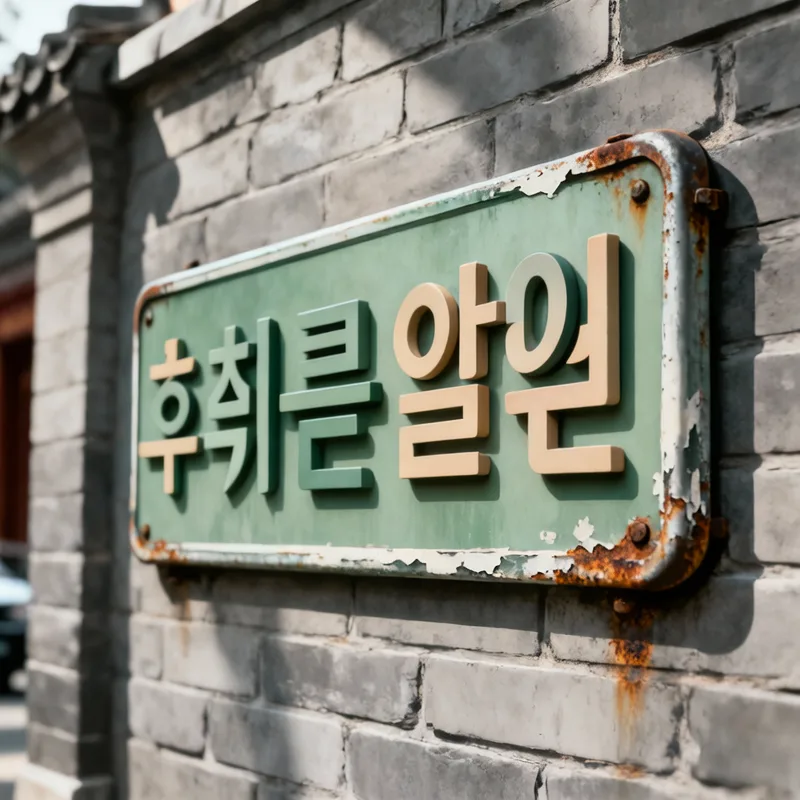
La signalétique coréenne à Wangjing témoigne de plusieurs décennies de migration étudiante et commerciale. Illustration générée par IA · SinoViz
Langue et écriture
Le coréen est une langue coréenne, distincte des langues sino-toungouses parlées ailleurs dans la région. Son alphabet, le hangeul, a été créé au XVe siècle et est aujourd'hui l'écriture courante du chinois coréen ; les caractères chinois, ou hanja, apparaissent dans les textes historiques et certains noms. De nombreux habitants âgés de Yanbian sont bilingues coréen-mandarin, tandis que les jeunes nés en ville utilisent souvent le mandarin à l'école et au travail et le coréen à la maison ou dans les médias locaux. Les journaux, la radio et les offices religieux en coréen contribuent à la pérennité de la langue, et certaines familles inscrivent leurs enfants dans des écoles où le coréen est enseigné en parallèle du programme scolaire national.
Deux systèmes d'écriture caractérisent le bilinguisme quotidien de nombreux foyers coréens d'origine chinoise. Illustration générée par IA · SinoViz
La nourriture et le ménage
La gastronomie coréenne est un élément incontournable de la vie communautaire. Le kimchi, à base de légumes salés et fermentés, est préparé en grande quantité en automne, et sa fabrication et son partage sont reconnus par l'UNESCO comme patrimoine culturel immatériel de la Corée. Les repas quotidiens comprennent du riz, de la soupe, du bibimbap (un mélange de légumes et de pâte de piment), de la viande grillée et du naengmyeon (des nouilles de sarrasin froides). Les maisons traditionnelles étaient équipées d'ondol, un système de chauffage par le sol qui permettait de chauffer les nattes. Certaines maisons rurales conservent encore la table basse et les sièges au sol typiques des hanoks. À Pékin, la vie en appartement a modifié le cadre de vie, mais la cuisine et l'habitude de se réunir autour d'une table commune perdurent.
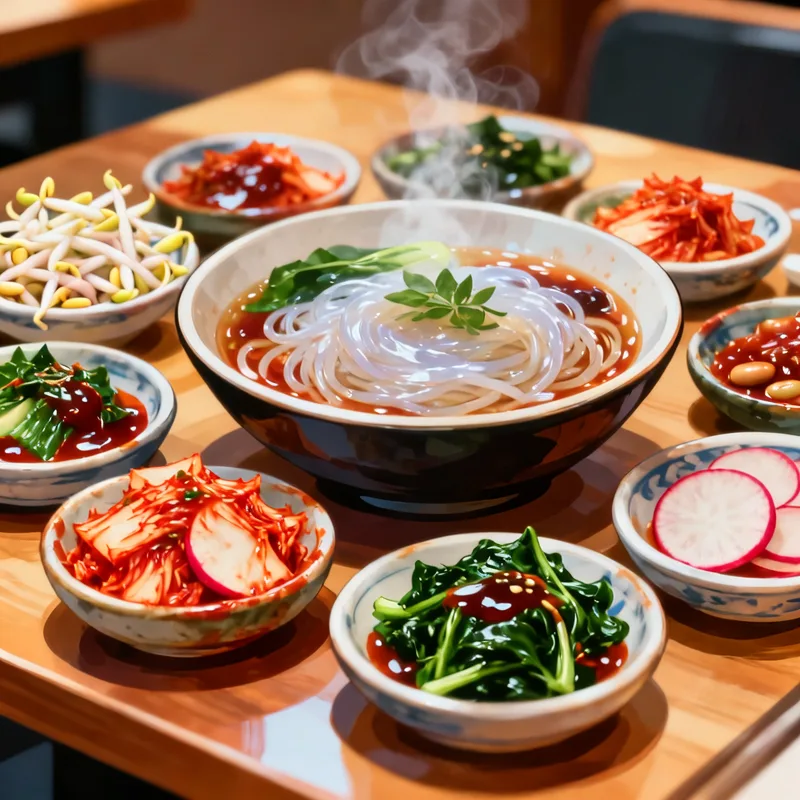
Les accompagnements à partager et les nouilles froides sont des éléments courants des repas sino-coréens. Illustration générée par IA · SinoViz
Festivals et vie communautaire
Les deux principales fêtes familiales sont Seollal, le Nouvel An lunaire, et Chuseok, la fête des récoltes d'automne. À Seollal, les familles dégustent du tteokguk, une soupe de gâteaux de riz tranchés, et les plus jeunes font une révérence solennelle aux aînés. Chuseok est marqué par des visites aux tombes ancestrales et la dégustation de songpyeon, petits gâteaux de riz fourrés aux haricots ou au sésame. Les communautés coréennes chinoises de Pékin se réunissent également pour les mariages, les retrouvailles d'anciens élèves et les associations professionnelles, où le coréen demeure une langue de confiance et un outil de communication essentiel. La vie sociale s'organise autour des restaurants, des agences de voyages et des commerces, loin d'une enclave fermée ; les mêmes rues accueillent des voisins d'origines diverses.
À Pékin, un panneau coréen signale une habitude familiale transmise de génération en génération au-delà des frontières.
The Dong, or Kam, are Kra-Dai-speaking villagers of southwest China known for timber towers, covered bridges and part-singing.
Section
Vie et folklore
Région
Guangxi
Ère
À travers les époques
Étiquettes
Ethnique, coutumes
Dong villages gather around a drum tower and a song hall, where music is learned by ear. Their grand song, sung in parts without instruments, was inscribed on UNESCO’s Representative List of Intangible Cultural Heritage in 2009.
Villages across three provinces
The 2010 census recorded about 2.96 million Dong people, also known as Kam. Most live in the Qiandongnan Miao and Dong Autonomous Prefecture of eastern Guizhou, with others in Xinhuang County in western Hunan and Sanjiang County in northern Guangxi, the area tagged for this entry. Settlements cluster along streams in hilly country, where houses are built close together on timber posts and the ground floor is kept for animals and storage. Villages often form around a clan or a group of related families, and a shared drum tower marks the centre. Neighbouring Miao, Yao and Han communities shape the markets and intermarriage patterns of the region.
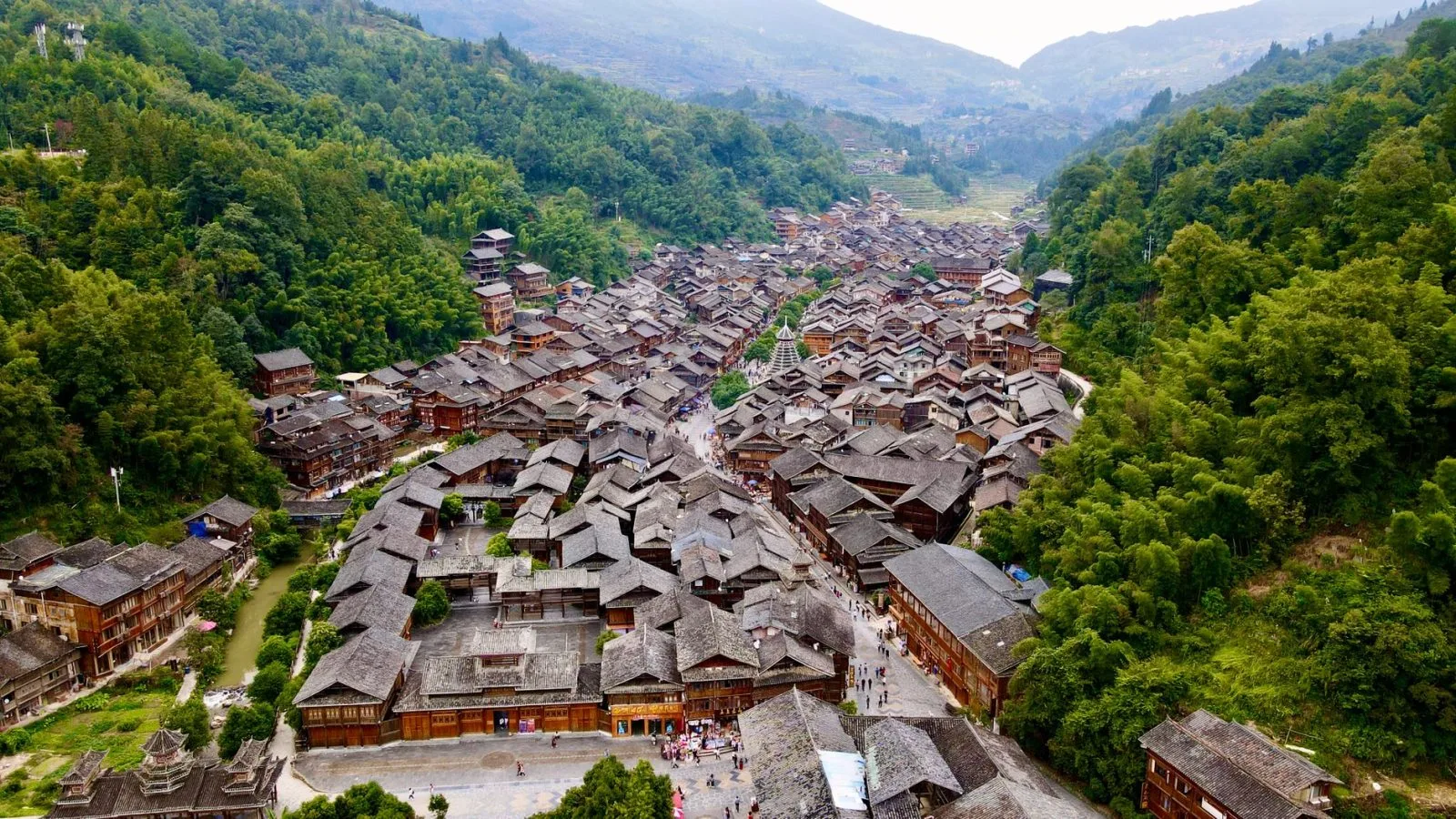
Dong villages are built close together, with a drum tower at the centre. Collins Zhao | Pexels License (https://www.pexels.com/license/)
Language and village rule
The Dong language is also called Kam and belongs to the Kam-Sui branch of the Kra-Dai family, the wider family that includes Dai and Thai. It has tones and a large vocabulary for rice farming, forest work and village ritual. There is no old, widely shared Dong script; Chinese characters have been used for official records, and romanised spelling now helps publish dictionaries and song texts. Village life has long been regulated by compacts known as kuan, agreements on land use, marriage and dispute settlement that are recited at assemblies. Elders and elected heads speak for the village, while the song hall and the drum tower serve as places where young people learn the repertoire and the rules.
Towers and covered bridges
Dong timber building is famous for two structures. The drum tower rises above the rooftops as a layered pagoda with projecting eaves, built from joined timbers and used for meetings, signals and festival gatherings. The wind and rain bridge is a covered crossing with a tiled roof, benches along its length and one or more pavilion towers. The Chengyang Yongji Bridge in Sanjiang, built in the early twentieth century, is a well-known example of this bridge type. Both structures are assembled by local carpenters using mortise and tenon joints rather than metal fasteners, and whole villages contribute labour and timber when one is raised or repaired.
Covered bridges provide shelter, seating and a village landmark in one structure. Illustration générée par IA · SinoViz
Grand song and daily food
The Kam grand song, or dongge, is unaccompanied polyphonic singing led by high voices and answered by a lower drone from the group. It is learned in song halls, where young people sit around a fireplace and rehearse through the winter, and it is performed at weddings, festivals and visits between villages. Dong New Year falls in the eleventh lunar month in many places, with drum tower gatherings and, in some areas, bullfighting. Daily food includes fermented sour fish packed with rice, sour soup, glutinous rice and you cha, a tea whisked with fried rice, peanuts and herbs. These dishes suit a wet upland climate where preservation and shared heating matter.
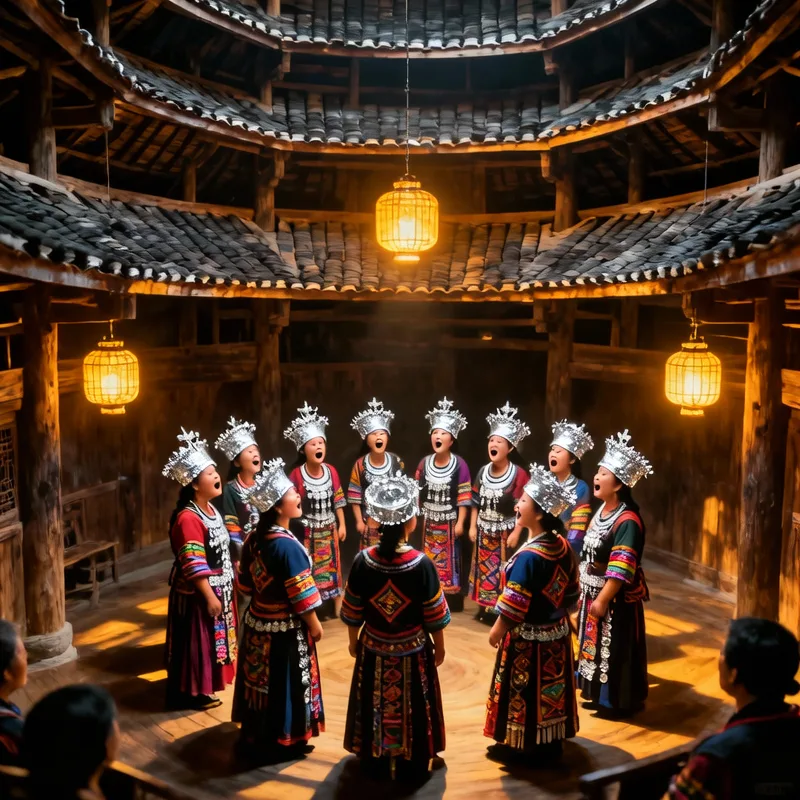
The grand song is learned in song halls and performed at communal gatherings. Illustration générée par IA · SinoViz
In a Dong village, the drum tower is both a landmark and an invitation to gather.
The Manchu are a Tungusic-speaking people whose Qing dynasty left a deep imprint on Beijing’s buildings and court culture.
Section
Vie et folklore
Région
Pékin
Ère
yuan-ming-qing
Étiquettes
Ethnic, History
Manchu identity took shape in the early seventeenth century among Jurchen groups of northeastern China. The Qing dynasty they founded ruled from Beijing between 1644 and 1912, and its material traces remain in the city’s palaces and archives.
From Jurchen to Qing
The Manchu descend from Jurchen communities of the northeast, who earlier founded the Jin dynasty of 1115 to 1234. In 1635 the ruler Hong Taiji adopted the name Manchu for his people, and in 1636 he renamed the state Qing. The dynasty took Beijing in 1644 and ruled China until 1912. Today roughly 10.4 million people identify as Manchu according to the 2010 census, making them one of the largest ethnic minorities. Most live in Liaoning, Hebei, Jilin and Heilongjiang, with substantial populations in Beijing and Tianjin. Migration into the capital after 1644 created banner neighbourhoods whose street names and food shops still register the Qing presence.
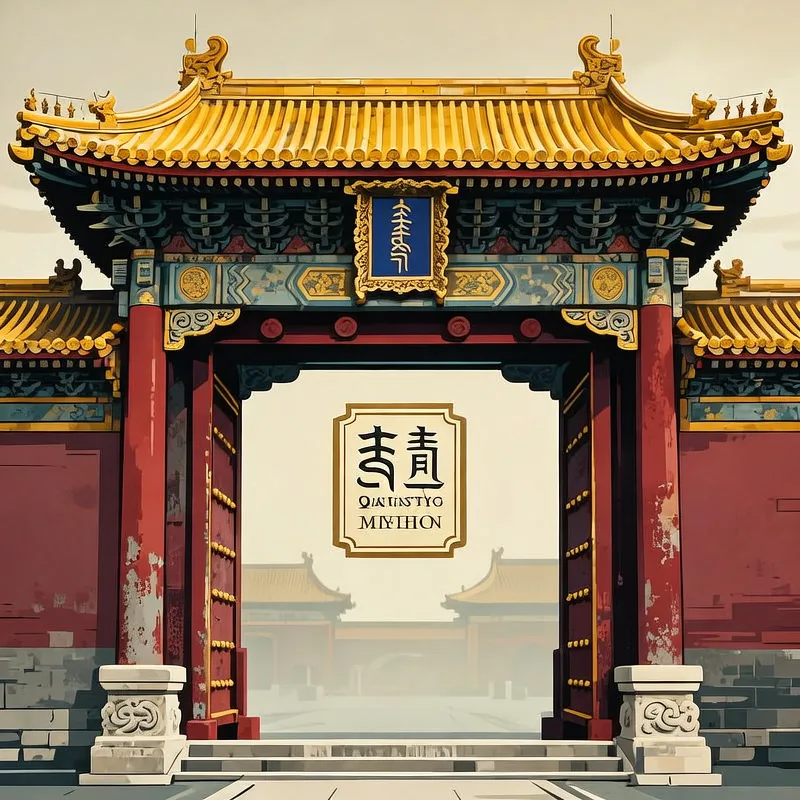
Palace gates in Beijing carry inscriptions in both Manchu and Chinese. Illustration générée par IA · SinoViz
A written language of archives
Manchu is a Tungusic language, related to Xibe and more distantly to Evenki. Its written form was devised in the late sixteenth century by adapting the Mongolian script, and it became the language of Qing military records, imperial edicts and family archives. Thousands of these documents survive in Chinese and foreign collections, and they are consulted for the history of the dynasty and its frontier administration. Few people speak Manchu fluently today, mostly in a handful of northeastern villages, and Mandarin is the normal language of daily life. Even so, Manchu words survive in place names, court titles and the vocabulary of Qing institutions.
Dress, house and food
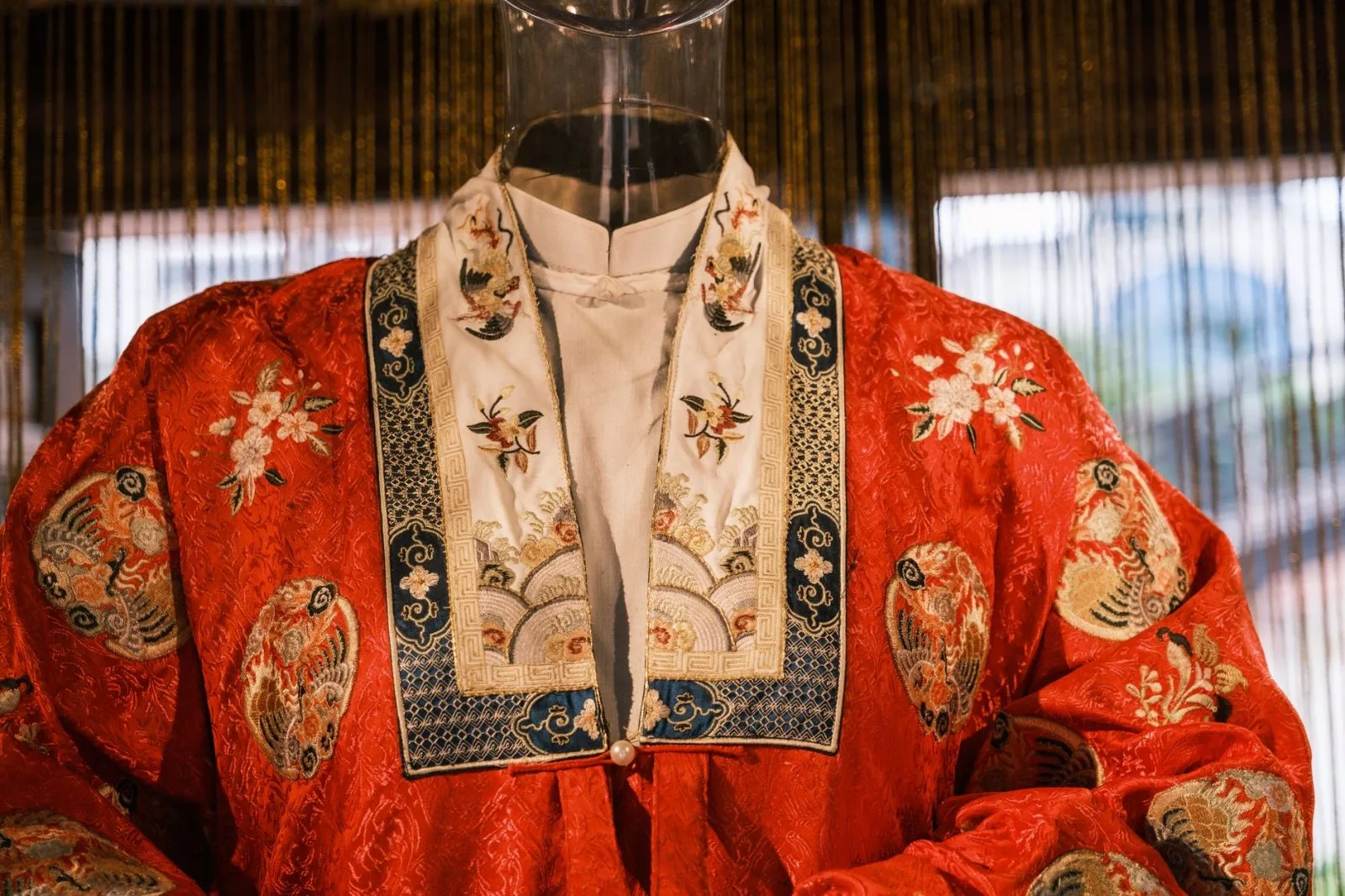
Manchu dress shaped the qipao, the close-fitting robe later worn widely by Han Chinese women and known abroad as the cheongsam. Older garments had horse-hoof cuffs that could be folded back over the hands, and women’s formal dress included a tall flag headdress and shoes with a raised flowerpot sole. Under the Qing, men wore a shaved forehead and a braided queue, a rule enforced until the dynasty’s end. A traditional house was arranged as a pocket room with a heated kang platform along the west wall, where honored guests slept and ancestral tablets were kept. A pole in the courtyard was used in offerings that fed crows, an animal associated with founding legends.
Manchu court dress influenced the qipao and the formal clothing of the Qing elite. TBD Tuyên | Pexels License (https://www.pexels.com/license/)
What remains in Beijing
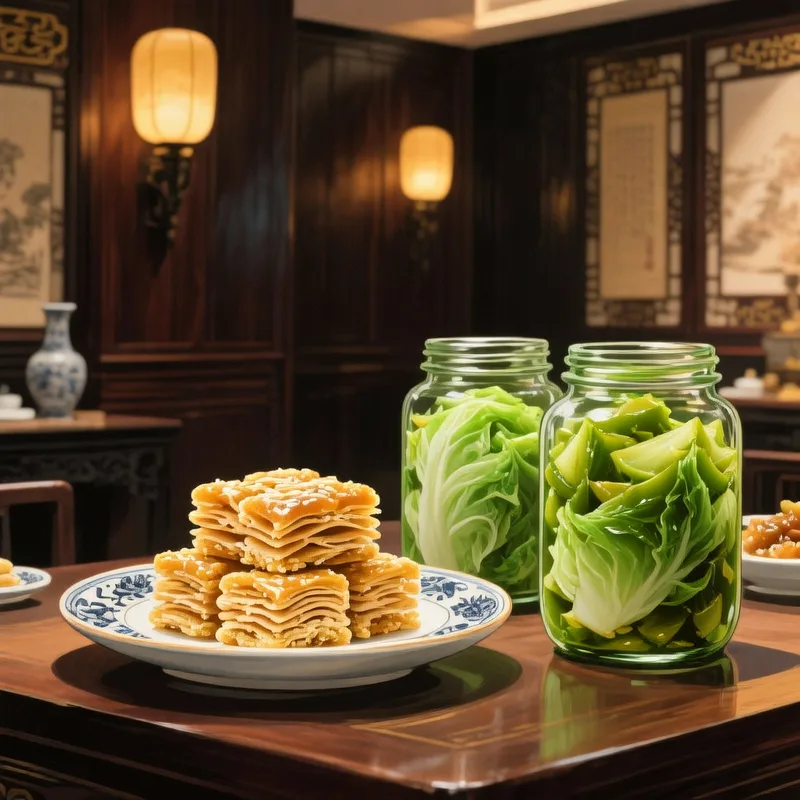
Manchu cuisine survives in Beijing and the northeast through sachima, a sweet pastry made of fried dough and syrup, and through hot pots of pickled cabbage, pork and blood sausage. The elaborate Manchu-Han banquet is a later dining form assembled from court and regional dishes rather than a single unbroken tradition. Paper-cutting, embroidery and painted snuff bottles are among the crafts associated with Manchu households. In Beijing, the most public inheritance is architectural: the Forbidden City’s bilingual plaques, the layout of former banner quarters, and restaurants and museums that explain Qing court life. These traces make the dynasty legible on an ordinary walk through the old city.
Manchu food traditions remain visible in Beijing and northeastern China. Illustration générée par IA · SinoViz
On Beijing’s palace gates, Manchu and Chinese script still share the same lintel.
The Bai are a Sino-Tibetan-speaking people concentrated around Dali, whose courtyard houses and indigo tie-dye define a local visual style.
Section
Vie et folklore
Région
Yunnan
Ère
À travers les époques
Étiquettes
Ethnique, coutumes
Bai towns sit between the Cangshan mountains and Lake Erhai in northwestern Yunnan. Their language is Sino-Tibetan, and their communities carry memories of the Nanzhao and Dali kingdoms that ruled the region before the Mongol conquest of the thirteenth century.
Between Cangshan and Erhai
About 1.9 million Bai people were recorded in China’s 2010 census. Roughly four fifths live in Dali Bai Autonomous Prefecture, with other communities in Kunming, Chuxiong, Lijiang, Baoshan and parts of western Yunnan. Towns and villages cluster on the narrow strip of flat land between Cangshan’s slopes and the shore of Erhai, where irrigation supports rice, beans and dairy farming. The name Bai means white, a reference to the pale plaster that distinguishes local buildings. Because Dali stood on trade routes linking Yunnan with Sichuan and Tibet, Bai towns absorbed goods and techniques from several directions while keeping a strong local vocabulary of form and decoration.
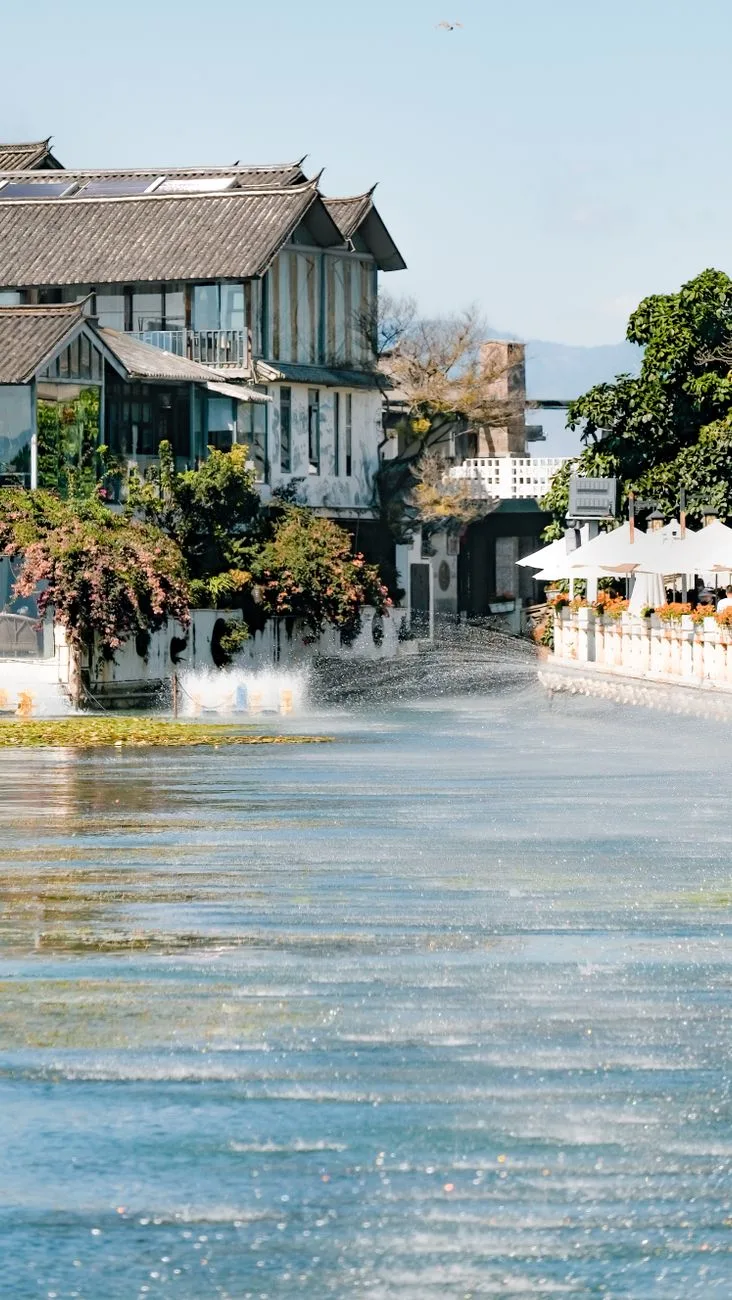
White plaster and dark tile give Dali-area villages their characteristic appearance. Doing Be | Pexels License (https://www.pexels.com/license/)
Language and historical roots
The Bai language belongs to the Sino-Tibetan family, usually placed within Tibeto-Burman, though scholars still debate its exact position because of heavy borrowing from Chinese. There is no widely used traditional Bai script, and Chinese characters have served for writing names, contracts and local records. Bai oral tradition, including creation stories and accounts of kingdom builders, is transmitted in speech and performance. Ancestors of the Bai are associated with the Nanzhao kingdom, which flourished from the eighth to the ninth century, and the Dali kingdom that followed between 937 and 1253. Both left stone inscriptions, Buddhist carvings and fortified sites around the lake.
Courtyards, marble and dye
The standard Bai house follows a layout known as sanfang yizhaobi, three wings arranged around a courtyard facing a freestanding screen wall. Walls are whitewashed, roofs are covered in grey clay tiles, and doorways and windows carry deep carved wooden fretwork. The screen wall is often painted with landscapes or calligraphy, and panels of local marble are set into lintels and table tops. In Zhoucheng and nearby villages, indigo tie-dye produces blue cloth patterned by stitching and binding before dyeing. Bai embroidery, plaster carving and stonework use similar floral and geometric motifs, so the same design vocabulary appears on clothing, furniture and building facades.
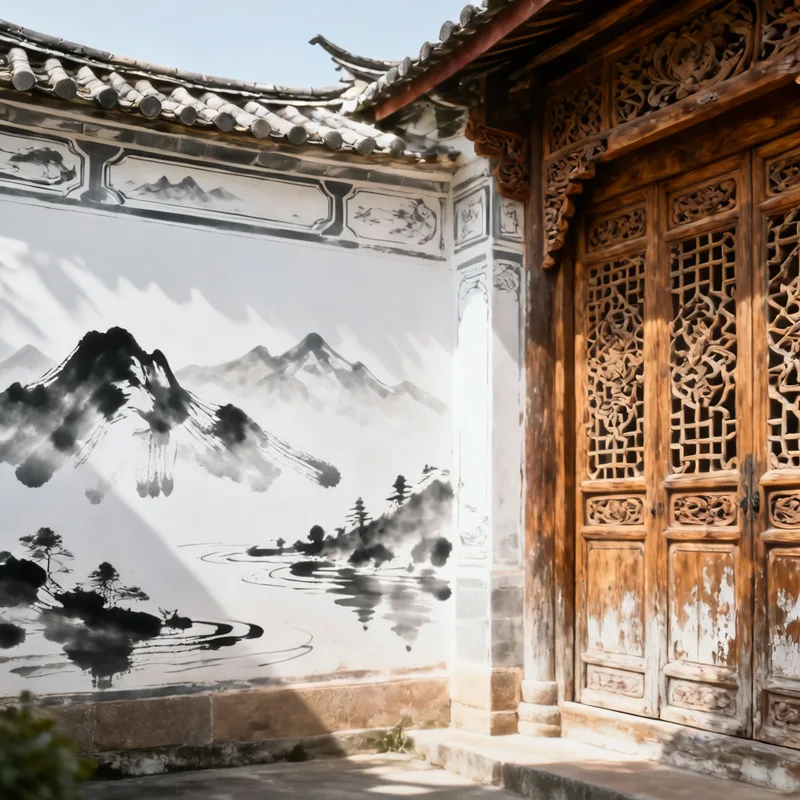
A painted screen wall faces the main wing of a traditional Bai courtyard house. Illustration générée par IA · SinoViz
Tea, markets and festivals
Three-course tea is a Bai hospitality ritual: a bitter first cup brewed from roasted leaves, a sweet second cup with nuts and honey, and a final cup that mixes the two and is said to leave a lasting aftertaste. Local dishes include air-dried milk sheets called rushan, raw pork skin salad, sour fish from Erhai and bean curd cooked with local herbs. The Third Month Fair, held in the lunar third month at Dali, began as a livestock and goods market and now fills the foothills of Cangshan with stalls, horse trading and performances. Raosanling, a pilgrimage and singing gathering, and torch-lighting customs in some villages add other dates to the year.
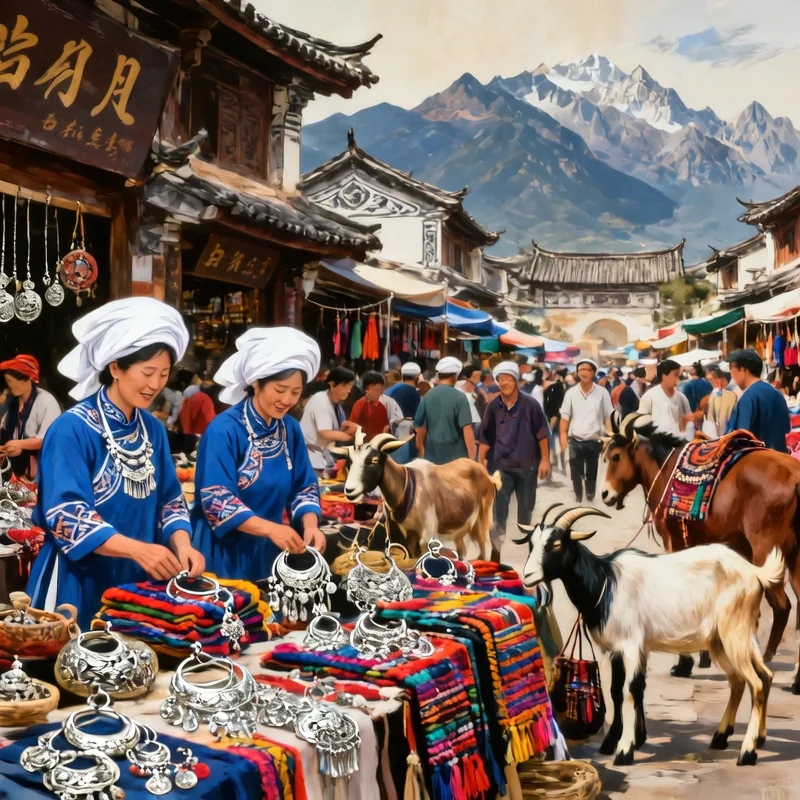
The Third Month Fair grew from a regional market into a major public gathering. Illustration générée par IA · SinoViz
Bai craftsmen treat a house front, a tea cup and a dyed cloth as the same surface for pattern.
The Dai are Tai-speaking Buddhist communities whose villages, temples and water festivals shape the river valleys of southern Yunnan.
Section
Vie et folklore
Région
Yunnan
Ère
À travers les époques
Étiquettes
Ethnique, coutumes
In the lowlands of Xishuangbanna and Dehong, Dai villages sit beside rice fields and Buddhist monasteries. Their language belongs to the Tai branch of the Kra-Dai family, and their festivals follow a calendar shared with communities across mainland Southeast Asia.
Where the valleys are
About 1.16 million Dai people were counted in China’s 2010 census. Most live in the lowlands of southern and western Yunnan, especially the Xishuangbanna Dai Autonomous Prefecture along the Lancang (Mekong) River and the Dehong Dai and Jingpo Autonomous Prefecture near the Myanmar border. Smaller communities extend through Lincang, Pu’er and Honghe. Settlement follows warm river valleys where irrigated rice can be grown year-round, rather than the cooler surrounding hills. This lowland orientation has kept Dai villages in close contact with Shan, Thai and Lao communities across the borders, and it explains why local architecture, food and festival calendars have much in common with mainland Southeast Asia.
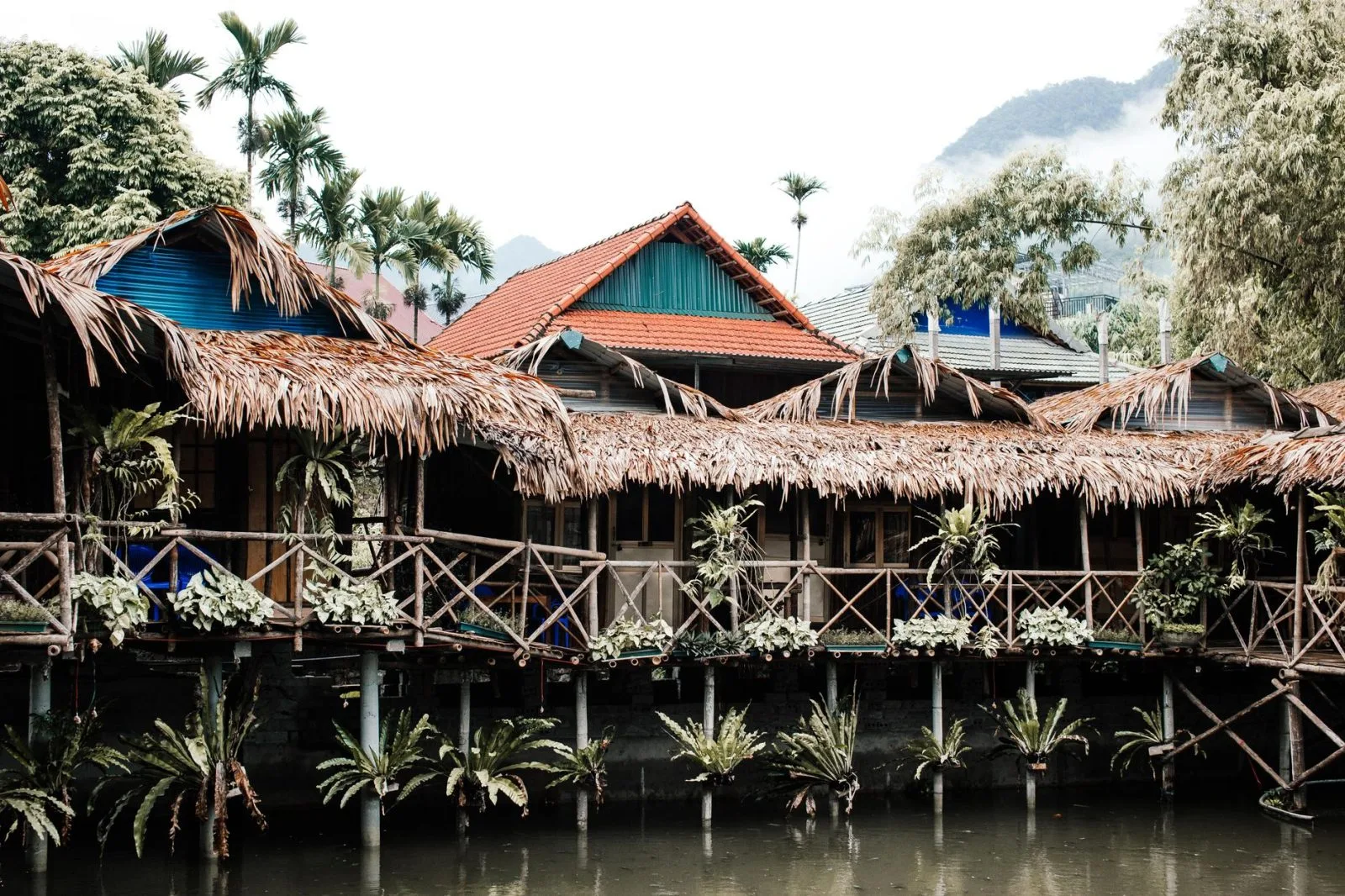
Villages follow the warm river valleys where rice can be grown through the year. Rachel Claire | Pexels License (https://www.pexels.com/license/)
Language, script and the wat
Dai belongs to the Tai branch of the Kra-Dai language family, the same broad family that includes Thai and Lao. Three writing traditions are used in Yunnan: the Xishuangbanna script, the Dehong script and a variant used around Jinping. All derive from older Tai writing systems and were once maintained mainly through monastery education. Theravada Buddhism reached Dai communities through trade and pilgrimage routes over several centuries, and a local wat, or monastery, became the centre of village literacy and ceremony. Boys traditionally spent part of their youth as novices, learning to read scripture and recite chants. Gilded stupas and timber temples with sloping roofs remain the most visible landmarks in the landscape.
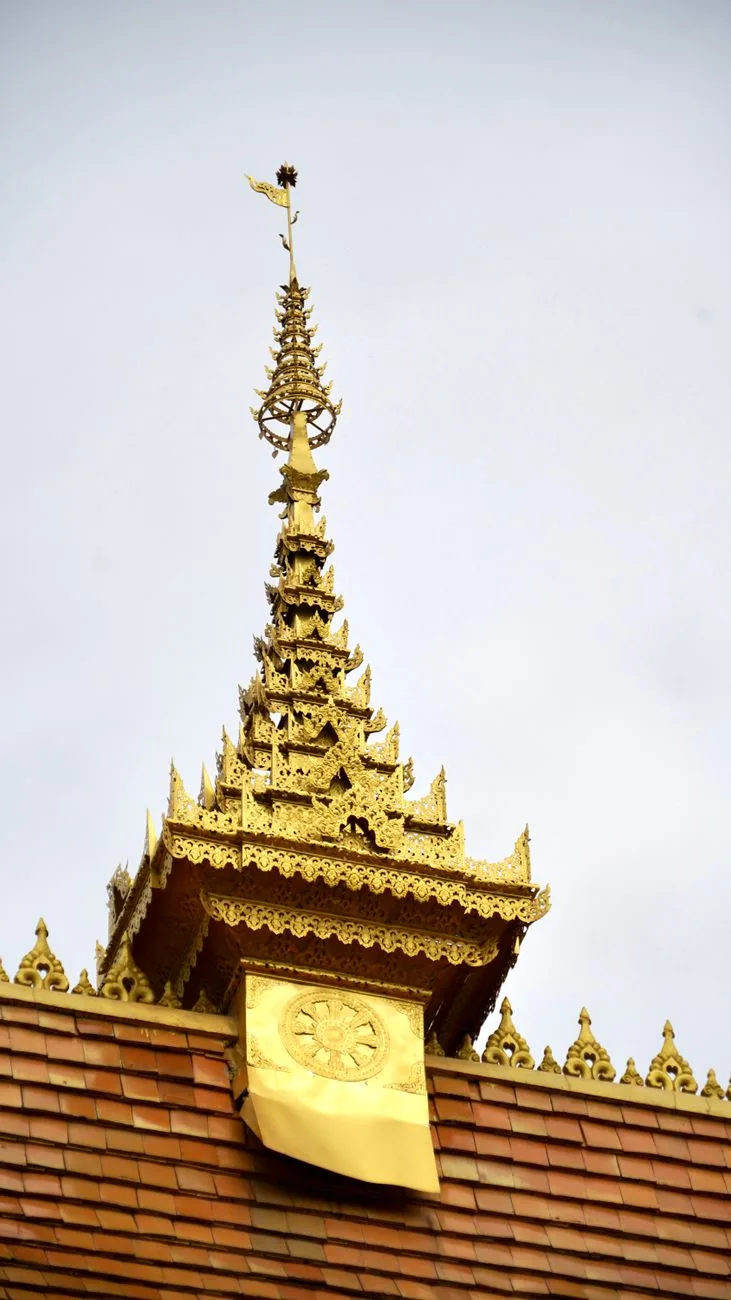
The local wat has long been a centre of reading, ordination and village ceremony. Eric Feng | Pexels License (https://www.pexels.com/license/)
House, cloth and daily food
A traditional Dai house stands on timber or bamboo posts, with the living floor lifted above the ground and a steep roof that sheds heavy monsoon rain. An open veranda serves as a work and sitting space, while the area beneath the house is used for storage and livestock. Household weaving produces cotton and silk cloth, and Dai brocade is known for peacock, elephant and geometric motifs worked in bright threads. Silver ornaments, betel nut and lacquered trays appear in daily and ceremonial exchange. Meals centre on glutinous rice, freshwater fish, sour bamboo shoots and chilli dips, often wrapped in banana leaves. Tea gardens around Xishuangbanna and Pu’er add another crop with a long regional history.
Brocade, silverwork and betel nut are part of everyday household life. Illustration générée par IA · SinoViz
The Water Festival
The Dai new year falls in mid-April and is celebrated as the Water Festival, known locally as Songkran. Water is poured or sprinkled over family, neighbours and visitors as a wish for a clean and abundant year, and the day also includes visits to the monastery, the building of small sand pagodas and boat races on the rivers. In the evenings, peacock and elephant dances are performed with slow, controlled hand movements and bright costumes. These dances are also taught in cultural troupes and schools, alongside Dai opera and folk storytelling. Today the festival draws visitors from other parts of China, while monasteries and village craft workers continue to maintain the language and techniques behind it.
In the Dai lowlands, a monastery, a rice field and a loom keep the same calendar.
Hotpot turns dinner into a shared act of cooking at the table.
Section
Vie et folklore
Région
Sichuan
Ère
À travers les époques
Étiquettes
Nourriture
Hotpot is a meal built around a vessel of simmering broth. Diners lower thin slices of meat, vegetables and offal into the liquid, cook them to the texture they want and dip them in sauce before eating.
One Pot, Many Names
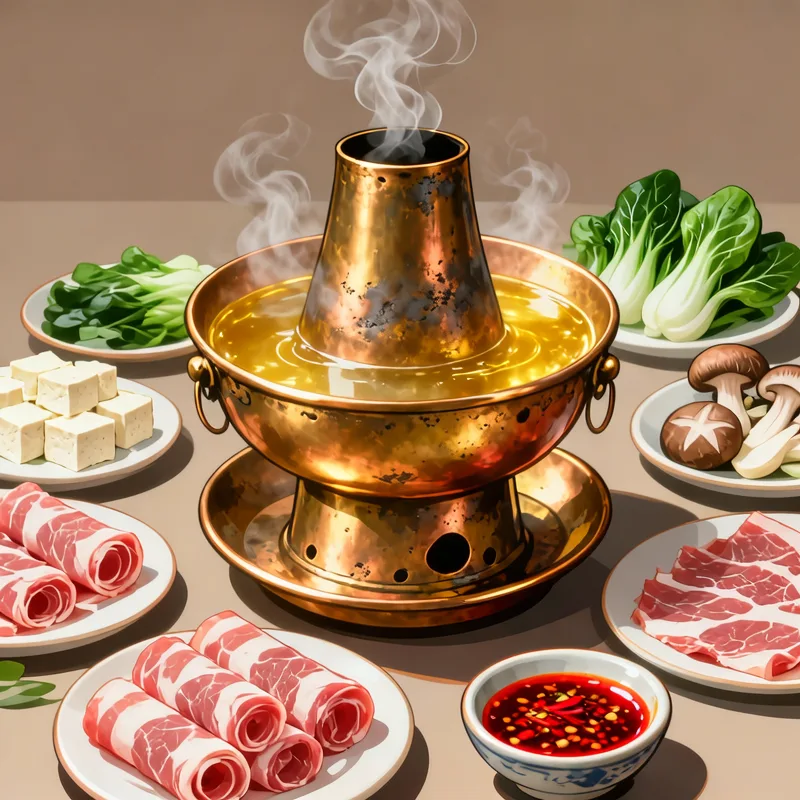
The Chinese term huoguo literally means fire pot. In northern China the classic form is the copper pot with a central chimney, heated by charcoal, in which paper-thin slices of mutton are swished briefly in a clear broth. Beijing’s Donglaishun, founded in 1903, made the mutton dip famous, served with sesame sauce, fermented tofu and chive flower sauce. In Sichuan and Chongqing the pot is filled with a red, oil-floated broth instead. The table method is the same; the flavourings mark the region.
The northern copper pot uses a clear broth; Sichuan versions favour red oil. Illustration générée par IA · SinoViz
The Sichuan Broth
Two sensations define the Sichuan version. Chilli brings capsaicin heat; Sichuan pepper, the husk of a prickly ash, supplies hydroxy-alpha sanshool, which makes the tongue tingle and vibrate. Together they create ma la, numbing spicy. Chilli reached China only after the sixteenth century, arriving from the Americas through maritime trade, so the modern red broth is comparatively recent. Earlier seasonings relied on Sichuan pepper, ginger, fermented beans and the broad-bean chilli paste of Pixian.
A Chongqing lao huoguo, or old hotpot, traditionally starts with beef tallow, dried chillies and paste, browned until the oil turns red. The nine-grid pot divides the surface: the centre boils hardest, the corners simmer gently, and each diner keeps track of their own food. Offal — tripe, duck blood, intestine — was the original cheap fare of dockworkers and boatmen at Chaotianmen. Tripe is cooked by the rule of seven up, eight down, dipped and lifted repeatedly for a few seconds.
Chengdu and the Split Pot
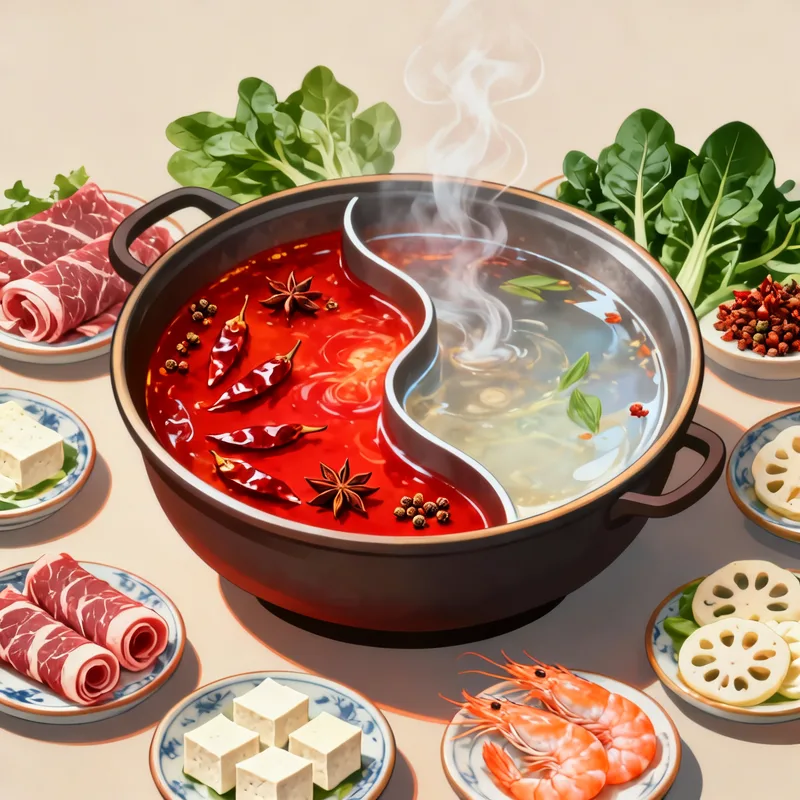
Chengdu style is usually gentler than its Chongqing cousin. Cooks often use vegetable oil rather than beef tallow, add more aromatics and offer a yuanyang pot, a divided vessel with red broth on one side and a clear, mild stock on the other. Diners gather around it in stages: tough items go in first, greens and sliced fish last. Sesame oil mixed with garlic, coriander and scallions cools each bite before it reaches the mouth. The divided pot is a useful invention for a table with mixed tolerances.
The yuanyang pot lets a table share one meal at two heat levels. Illustration générée par IA · SinoViz
How to Eat It
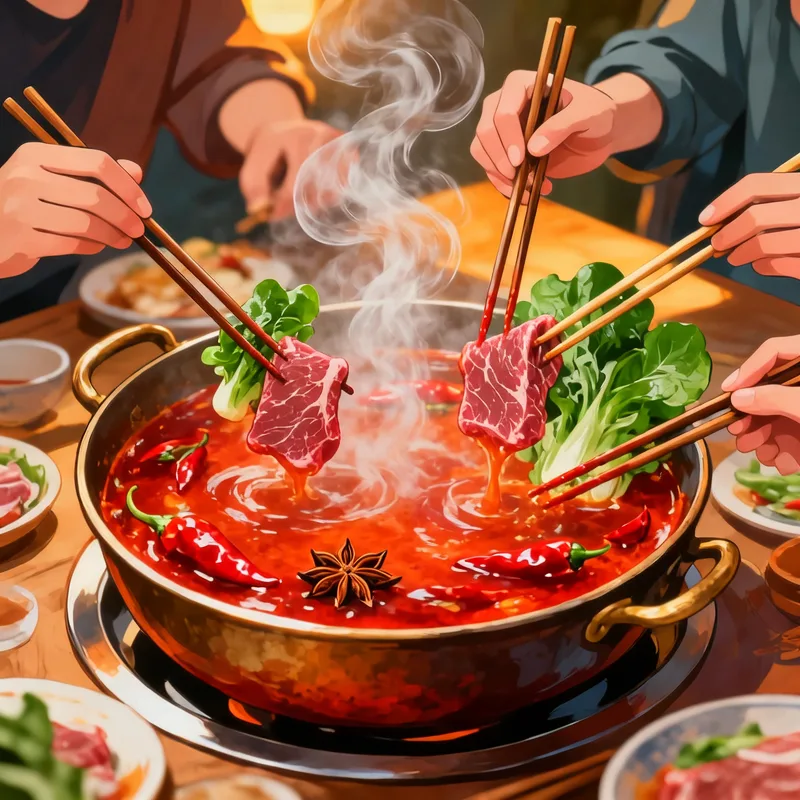
Hotpot has a practical etiquette. Raw and cooked foods need separate chopsticks or serving utensils, and a shared pot requires patience with other diners’ timing. A few rules are widely repeated: do not stir the whole broth, do not fish with your own chopsticks, and let the boil return after adding cold ingredients. The meal is slow by design. As the pot reduces, the broth grows stronger, and the last handful of noodles absorbs everything that has gone before.
The modern restaurant trade carried hotpot far beyond Sichuan. Haidilao, founded in Jiangyou in 1994, turned the meal into a service spectacle with waiting-area snacks and attentive staff; its branches now appear in many countries. Other chains adapted the format to clear broths and individual pots. Yet the social logic has not changed. A pot keeps everyone at the table for an hour, cooking in stages and talking between courses, which is why hotpot spreads easily wherever Chinese communities gather.
The shared pot keeps the meal slow and conversational. Illustration générée par IA · SinoViz
In a hotpot restaurant the meal is not served; it happens, slowly, in the middle of the table.
The eight great cuisines classify Chinese cooking by region, climate and technique.
Section
Vie et folklore
Région
Pékin
Ère
À travers les époques
Étiquettes
Nourriture
Ask a Chinese cook to name the country’s great cuisines and you will hear a list of eight. The scheme is a modern way of sorting older regional traditions, each shaped by climate, staple crops, waterways and trade.
How the List Was Made
An older division recognised four great traditions: Lu in the north, Yue in the south, Chuan in the west and Huaiyang in the east. The more detailed eight-cuisine scheme emerged in the 1980s and is often credited to Wang Shaoquan, a journalist at the People’s Daily. It added Zhe, Min, Xiang and Hui to the original four, giving provinces a more precise place on the culinary map. The categories are conventions, not laws; cooks in Chengdu and Guangzhou have always borrowed from neighbours.
The eight-cuisine scheme groups regional cooking styles by province and climate. Illustration générée par IA · SinoViz
North and East
Lu, or Shandong cuisine, is the classic northern style. Coastal branches favour prawns, scallops and abalone, often quickly stir-fried, while inland cooks around Jinan excel at soups and long braises. Scallions and salt are characteristic seasonings, and steamed bread often replaces rice. Lu cooking shaped the food of the imperial court and of Beijing, where Shandong chefs dominated many restaurants; the capital’s Peking duck belongs to this northern lineage.
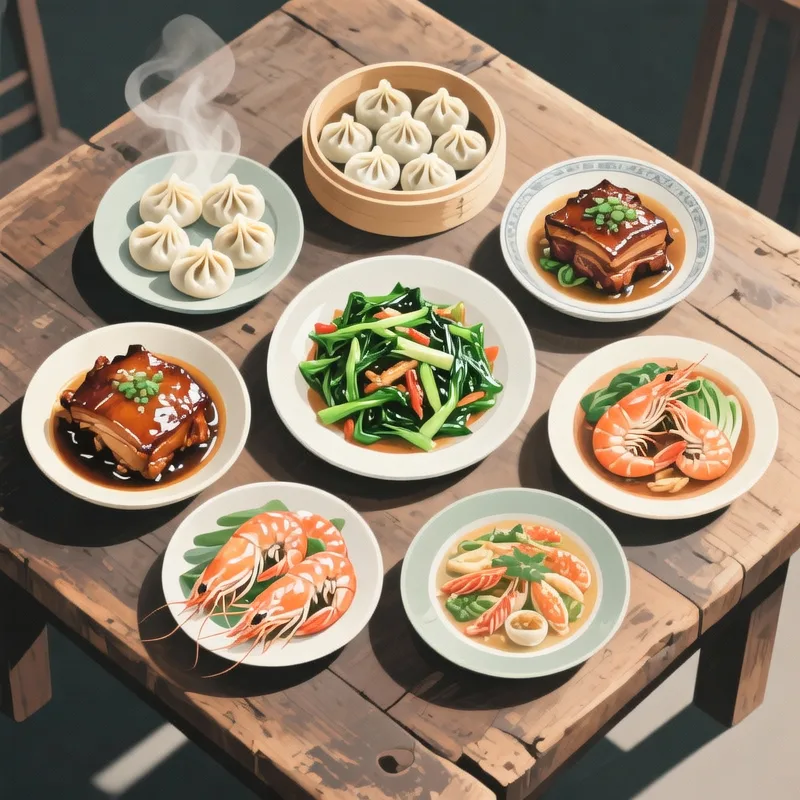
Su, or Jiangsu cuisine, covers the Yangtze delta and Huaiyang region. It favours mild, slightly sweet flavours, careful knife work and serious soups; lotus root, bamboo shoots and water chestnut are common, and xiao long bao soup dumplings are its best-known export. Zhe cuisine, from Zhejiang, is lighter still: Dongpo pork is braised slowly with wine and soy, while West Lake vinegar fish and Longjing shrimp keep the taste of the water and the tea leaves.
South and West
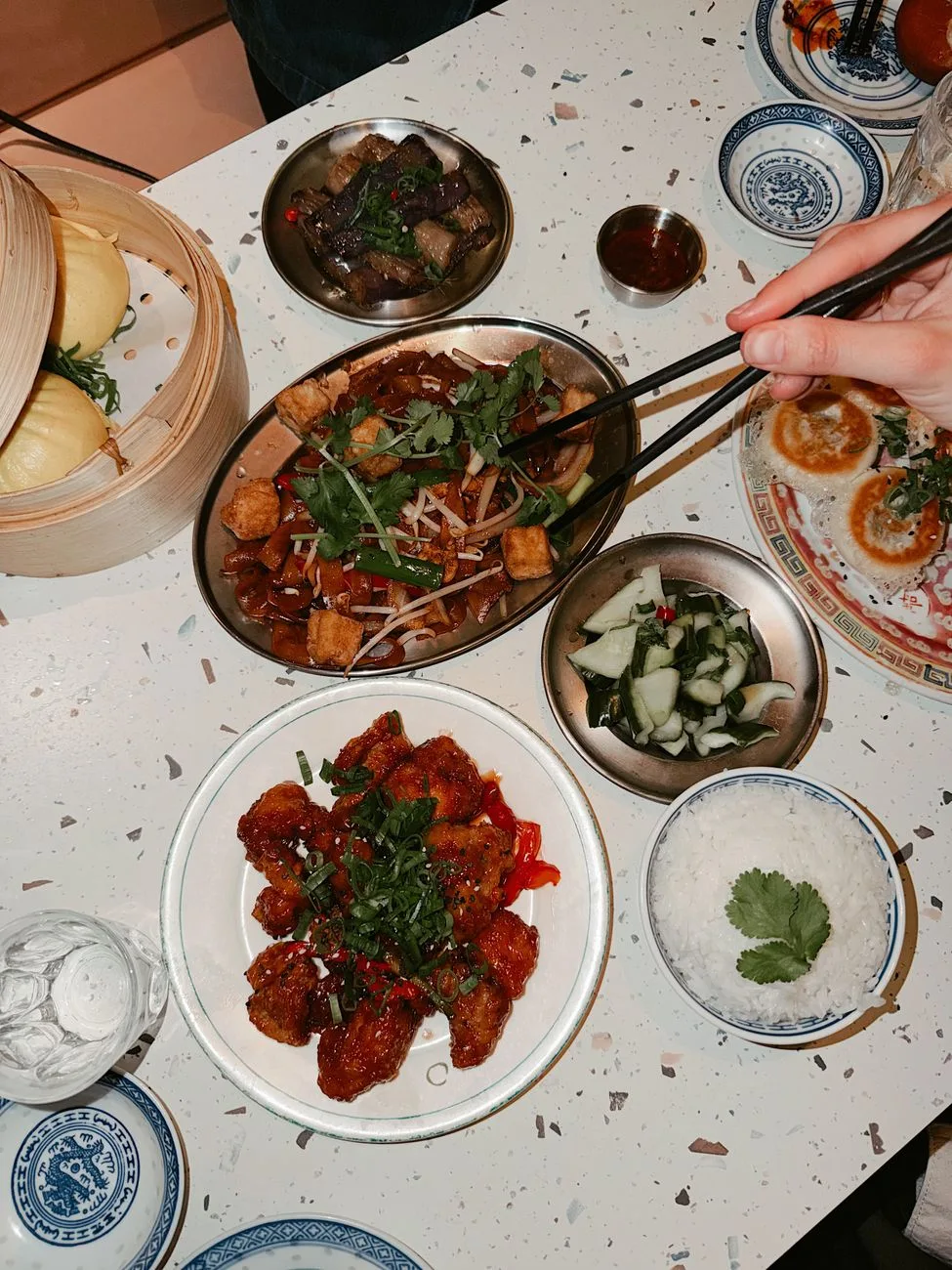
Yue, or Cantonese cuisine, draws on the Pearl River delta and the South China Sea. Freshness governs the kitchen: fish and shellfish are steamed, roast meats are hung in the window, and dim sum is served with tea in a yum cha session. Chuan, or Sichuan cuisine, is defined by ma la, the numbing-spicy pairing of chilli and Sichuan pepper; pixian broad-bean paste gives many dishes their fermented depth. Xiang cooking from Hunan uses chilli without the numbing note, often smoked or pickled, while Hui cuisine from Anhui makes much of mountain ingredients such as bamboo shoots and preserved mandarin fish.
Steam and freshness in the south; chilli and fermentation in the west. Vincent Rivaud | Pexels License (https://www.pexels.com/license/)
Min and the Sea
Min, or Fujian cuisine, is easy to overlook and hard to mistake. Fuzhou cooks are masters of soup and of hongzao, fermented red rice lees that colour and flavour pork, fish and river eels. Buddha jumps over the wall is a layered broth of shark fin, abalone, scallop, mushrooms and ham, named for a monk said to have leapt the wall for a taste. Coastal Fujian adds fish balls, oyster omelets and popiah-style crepes, reflecting a province oriented toward the sea and toward migration.
Lu — Shandong: scallions, seafood, slow soups
Chuan — Sichuan: ma la, chilli oil, broad-bean paste
Yue — Guangdong: dim sum, steaming, roast meats
Min — Fujian: red rice lees and layered soups
Beijing as a Crossroads
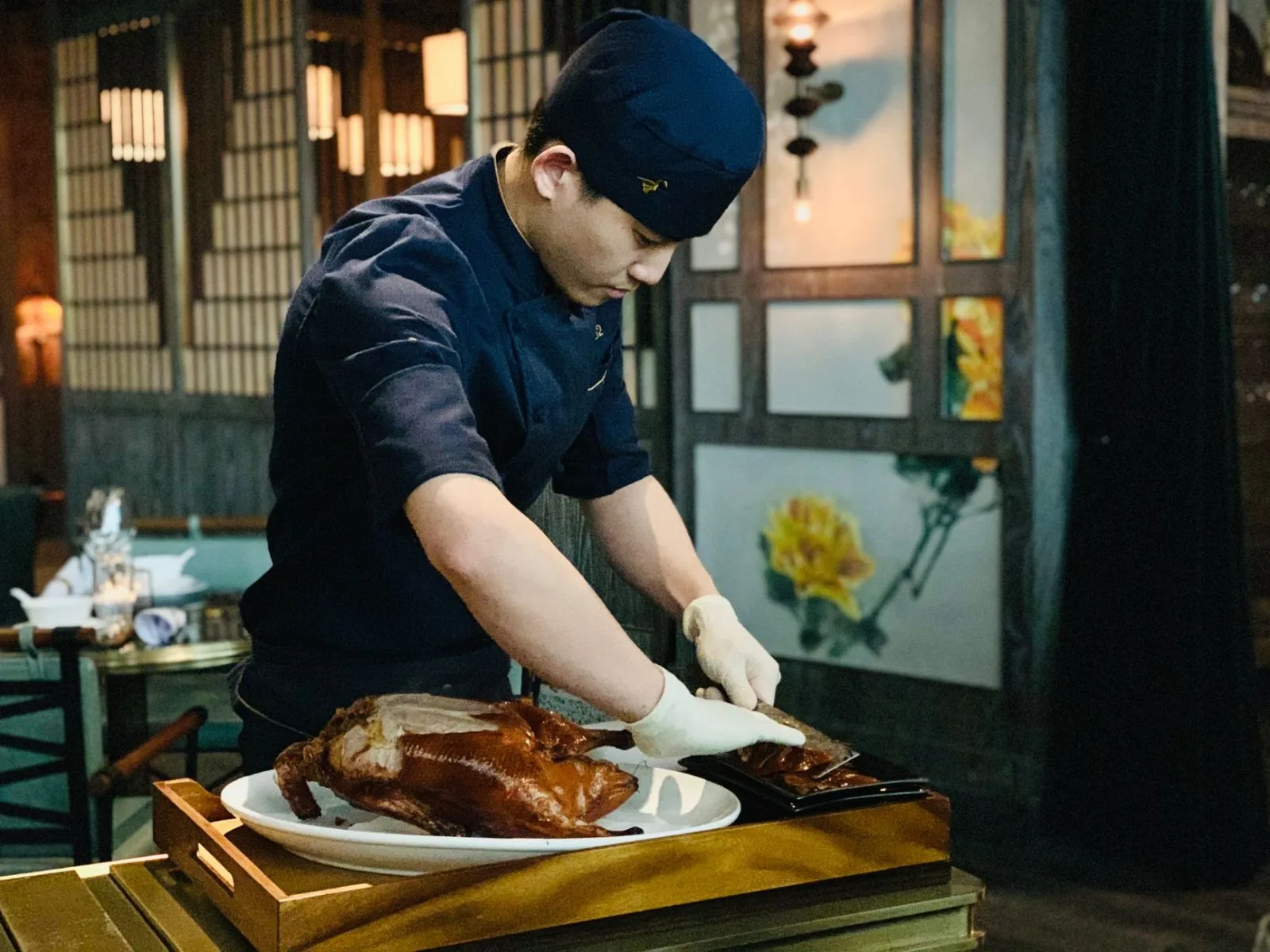
The eight-cuisine map describes provinces, but Beijing has always eaten beyond its own borders. Shandong technique supplied the basis of restaurant cooking, Mongol and Manchu tastes left their mark in mutton dishes and hotpot, and the Qing court staged the elaborate Manchu-Han feast. Bianyifang, founded in 1416, roasted ducks in a closed oven; Quanjude, opened in 1864 by Yang Quanren, popularised the hanging oven and the crisp skin served with pancakes, scallions and sweet bean sauce. A capital city turns regional styles into a shared vocabulary.
Beijing’s roast duck emerged from northern techniques and capital city exchange. MorNa Tang | Pexels License (https://www.pexels.com/license/)
Eight cuisines are a map of climate and trade, written in oil, vinegar and fermented bean paste.