Category: Vita e folklore

  • Cucina Jiangnan

    Vita e folklore

    Cucina Jiangnan

    River Fish, Rice, and Refined Broth

    The cooking of the lower Yangtze favours freshwater fish, seasonal greens, and delicate stocks.

    Sezione
    Vita e folklore
    Regione
    Zhejiang
    Era
    Attraverso le epoche
    Etichette
    Food, Geography

    Jiangnan cooking grew in the wet, rice-growing country south of the Yangtze. Its reputation rests less on spice than on timing: a fish steamed just long enough, a broth cleared and simmered, or a vegetable picked before it toughens.

    A Landscape of Water and Rice

    Jiangnan means the land south of the Yangtze, a region of canals, lakes, and irrigated fields centred on Jiangsu and Zhejiang. From the Song dynasty (960–1279), the lower Yangtze became China’s densest and wealthiest farming region, supported by double-cropping rice, fish ponds, and silk production. Cities such as Hangzhou and Suzhou developed a class of officials, merchants, and literati who recorded dining in essays and cookbooks. Lin An, today’s Hangzhou, was the Southern Song capital after 1127, and its markets sold freshwater fish, crab, bamboo shoots, and lotus root. Local cooking took shape around what the water and nearby fields supplied in season.
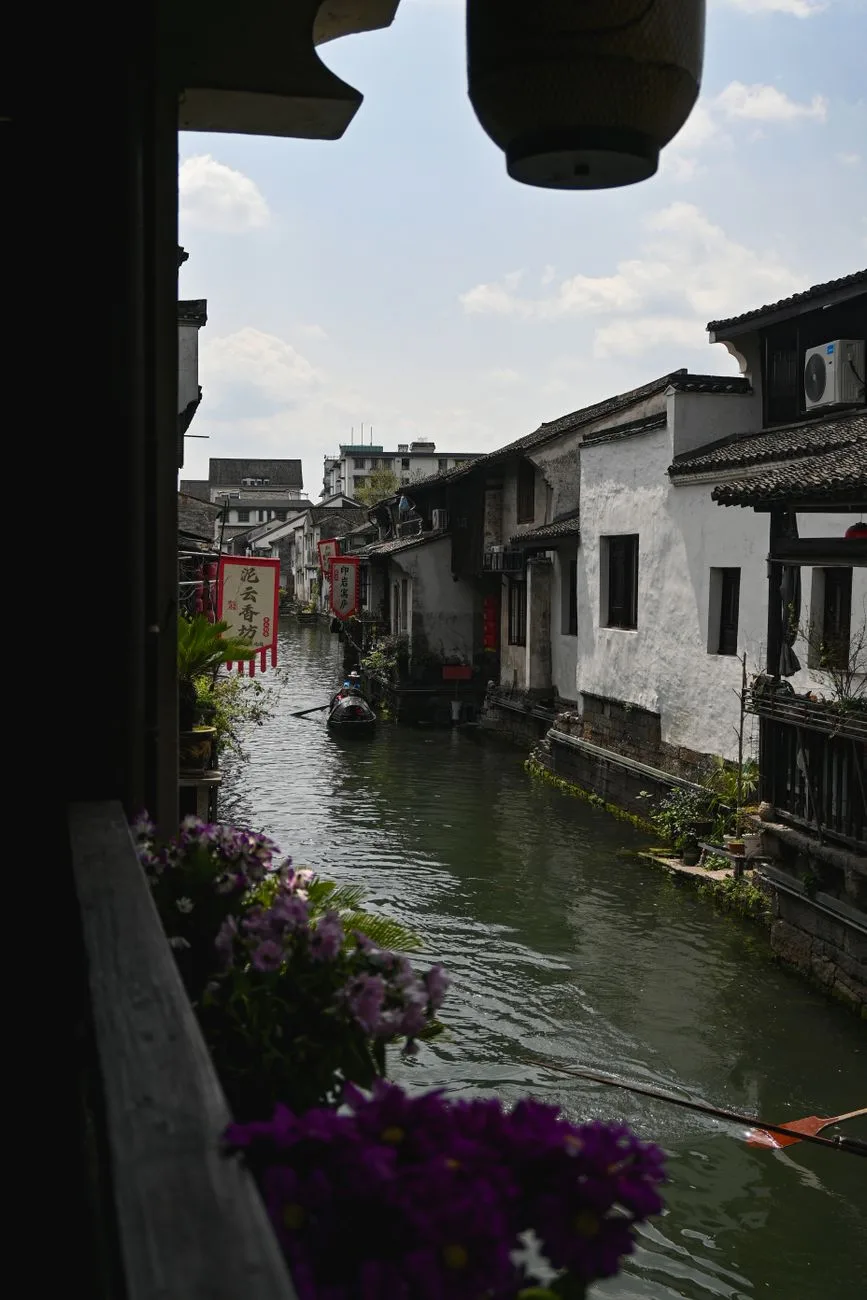
    Canals and rice fields in the Jiangnan countryside near Suzhou
    Canals, fish ponds, and irrigated fields shaped the Jiangnan pantry. 木 灬 | Pexels License (https://www.pexels.com/license/)

    Techniques of Cleanness

    Jiangnan cooks prize the natural flavour of ingredients, so technique often means restraint. Steaming preserves the texture of fish and glutinous rice; quick stir-frying keeps greens crisp; slow simmering turns pork bones and chicken into clear, aromatic broth. Shaoxing in Zhejiang is famous for yellow rice wine, used in marinades and for deglazing a hot wok. Vinegar from Zhenjiang balances sweet and sour dishes. Hangzhou’s famous West Lake vinegar fish uses a fish from the lake, scored and fried, then finished with a sweet-sour sauce. The dish is now a restaurant set piece, but it began as a local preparation of available freshwater fish.
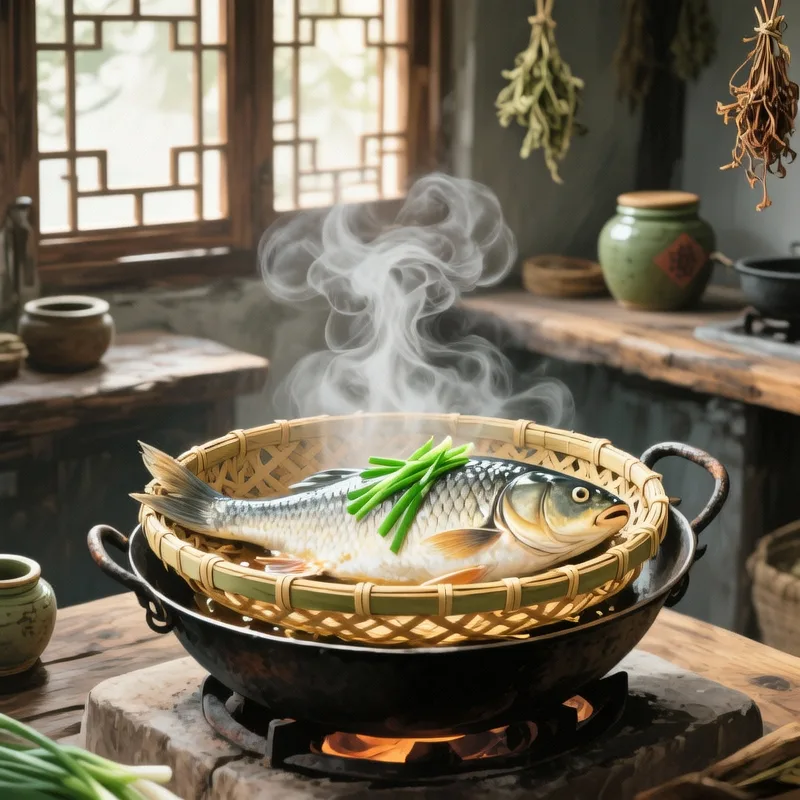
    A whole freshwater fish steaming in a bamboo basket over a wok in a Jiangnan kitchen
    Steaming is a defining Jiangnan technique because it preserves delicate texture. Illustrazione generata dall'intelligenza artificiale · SinoViz

    A Calendar of Local Dishes

    Seasonality gives the cuisine its rhythm. Spring brings bamboo shoots, shepherd’s purse, and the first river shrimp; autumn brings hairy crab from lakes and the slow-growing taihu whitebait. Suzhou’s squirrel-shaped mandarin fish is butterflied, scored, fried, and glazed, while braised pork belly is cooked until fat and lean layers hold together without hardness. Ningbo, on the Zhejiang coast, adds salted and dried seafood, and its tangyuan glutinous-rice balls filled with black sesame are eaten at the Lantern Festival. Shanghai, later and more cosmopolitan, absorbed these traditions into benbang cooking, favouring soy, sugar, and seafood.

    • West Lake vinegar fish from Hangzhou
    • Squirrel-shaped mandarin fish from Suzhou
    • Hairy crab from Taihu lakes in autumn
    • Black-sesame tangyuan for the Lantern Festival
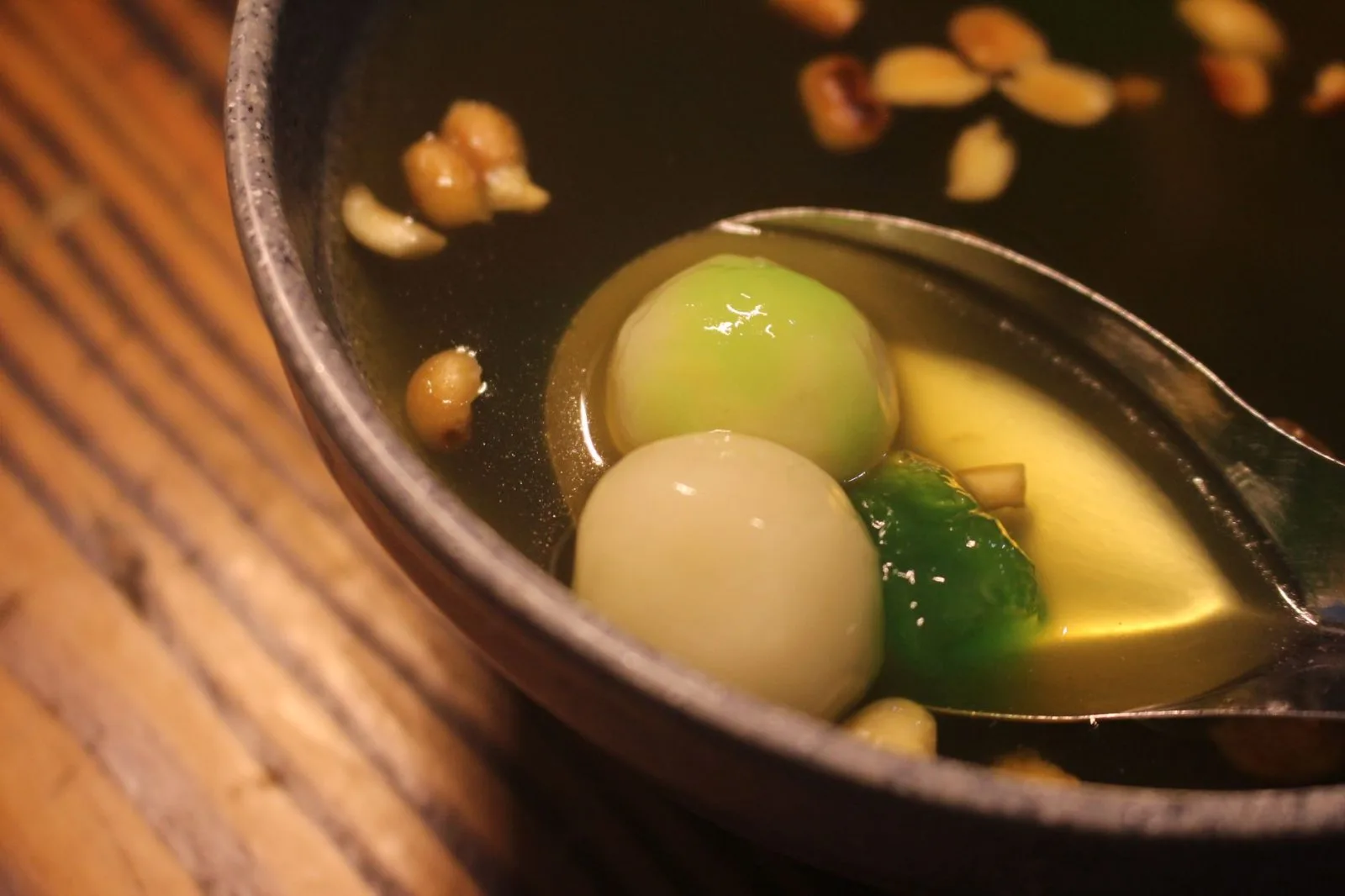
    Small glutinous rice balls with black sesame filling served in a warm bowl
    Tangyuan mark the Lantern Festival across the lower Yangtze. Jauhar Musthofal Qulub | Pexels License (https://www.pexels.com/license/)

    Gardens, Teahouses, and the Table

    Meals in Jiangnan were historically tied to gardens and teahouses, where scholars met over small dishes and wine. The region’s cookbooks, including Yuan Mei’s Suiyuan Shidan of 1792, record recipes alongside comments on market ingredients and household methods. Yuan Mei argued that a cook should understand each ingredient rather than bury it under sauce. That ideal still shapes the region’s public image, even when restaurant versions are elaborate. For a visitor, the useful lesson is to order by season and region: a lake crab in autumn, a bowl of noodles in Suzhou, or a pot of longjing tea near Hangzhou.

    In Jiangnan, the test of a dish is often how little the cook has done to spoil the ingredient.

    Fonti e ulteriori letture

    1. Chinese Regional Cooking — Enciclopedia Britannica.
    2. Hangzhou — Centro del Patrimonio Mondiale dell'UNESCO.
    3. Hangzhou — Enciclopedia Britannica.

    Guardalo al suo posto

    Segui questa voce per raggiungere la regione di appartenenza.

    Esplora tramite mappa
    Segui il filo

    Esplora altre voci che condividono i suoi tag.

    Esplora il tag
  • Cultura del tè

    Vita e folklore

    Cultura del tè

    Leaf, Water, and the Tea Horse Road

    Tea moved from medicinal leaf to daily drink, carrying Fujian methods toward Tibet and the sea.

    Sezione
    Vita e folklore
    Regione
    Fujian
    Era
    Attraverso le epoche
    Etichette
    Customs, Food, Geography

    Tea culture is a history of distilled technique: when to pick, how to wither, how to roll, and how to heat a leaf so that it keeps its character. Fujian became a laboratory for these methods, sending compressed cakes west toward Tibet and scented leaves out through coastal ports.

    From Medicine to Daily Drink

    Tea entered Chinese writing as a medicinal and ritual plant long before it became a household drink. Traditions credit the mythical emperor Shen Nong with discovering it, but the earliest firm evidence comes from Han-period tombs, where archaeologists have identified tea leaves among grave goods. By the third century CE, writers described boiling leaves with ginger and onions; the Tang dynasty (618–907) made tea a scholarly and monastic beverage. Lu Yu’s Cha Jing, written around 760–780, codified growing, picking, roasting, and brewing. Tea cakes were toasted, ground to powder, and whisked with hot water, a preparation later carried to Japan by Buddhist monks.

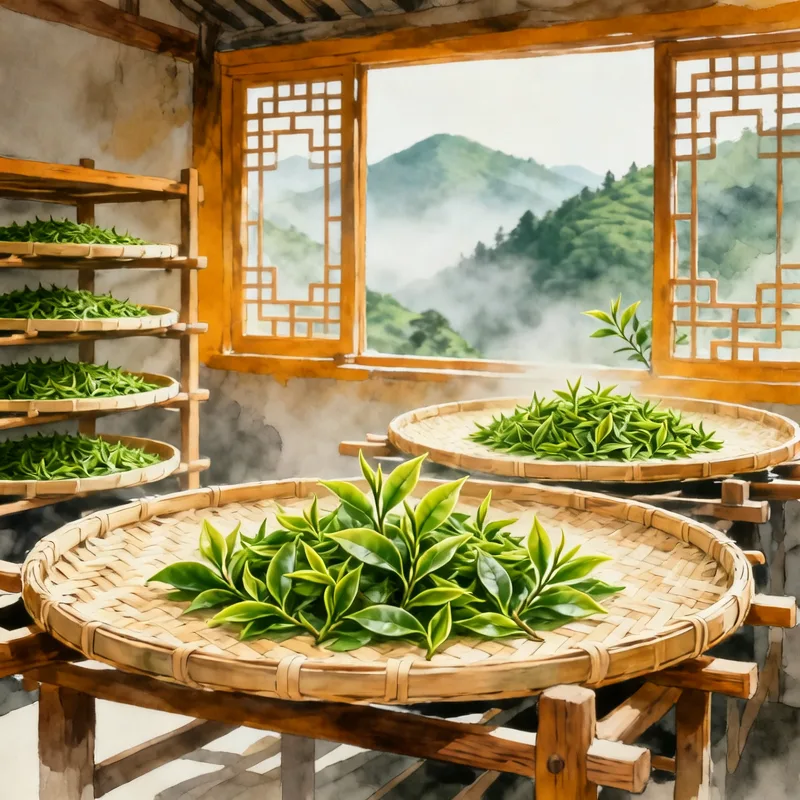
    Fresh tea leaves spread on bamboo trays in a Fujian hillside processing room
    Picking season sets the quality of the leaf before any processing begins. Illustrazione generata dall'intelligenza artificiale · SinoViz

    Fujian’s Craft of Oxidation

    Fujian’s mountainous counties developed styles that depend on controlled oxidation. Wuyi rock tea, grown in the rocky cliffs of the Wuyi range, is often pan-fired, rolled, and roasted until it develops a mineral, toasted character. Tieguanyin from Anxi is shaped into tight pellets that unfurl in the cup. Lapsang souchong from Tongmu resembles black tea in its oxidation, then dries over pine smoke. White teas such as Fuding’s silver-needle style are simply withered and dried, with little rolling or heating. These techniques are local knowledge: the same species, Camellia sinensis, changes through timing, heat, and handling.

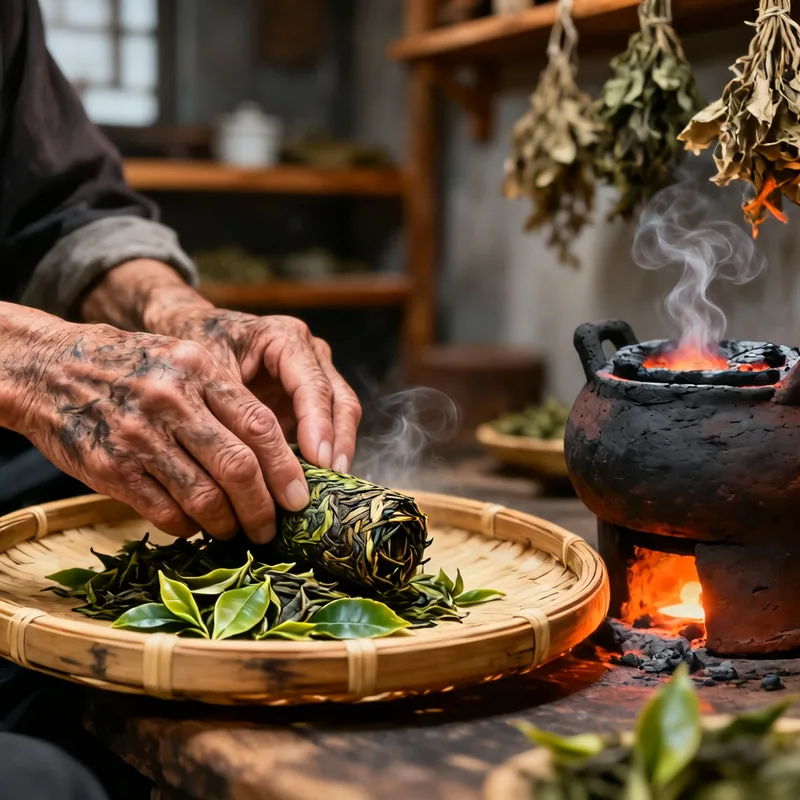
    Tea leaves being rolled by hand on a bamboo tray beside a traditional roasting stove
    Rolling breaks the leaf cells and shapes the flavours that firing will fix. Illustrazione generata dall'intelligenza artificiale · SinoViz

    The Tea Horse Road West

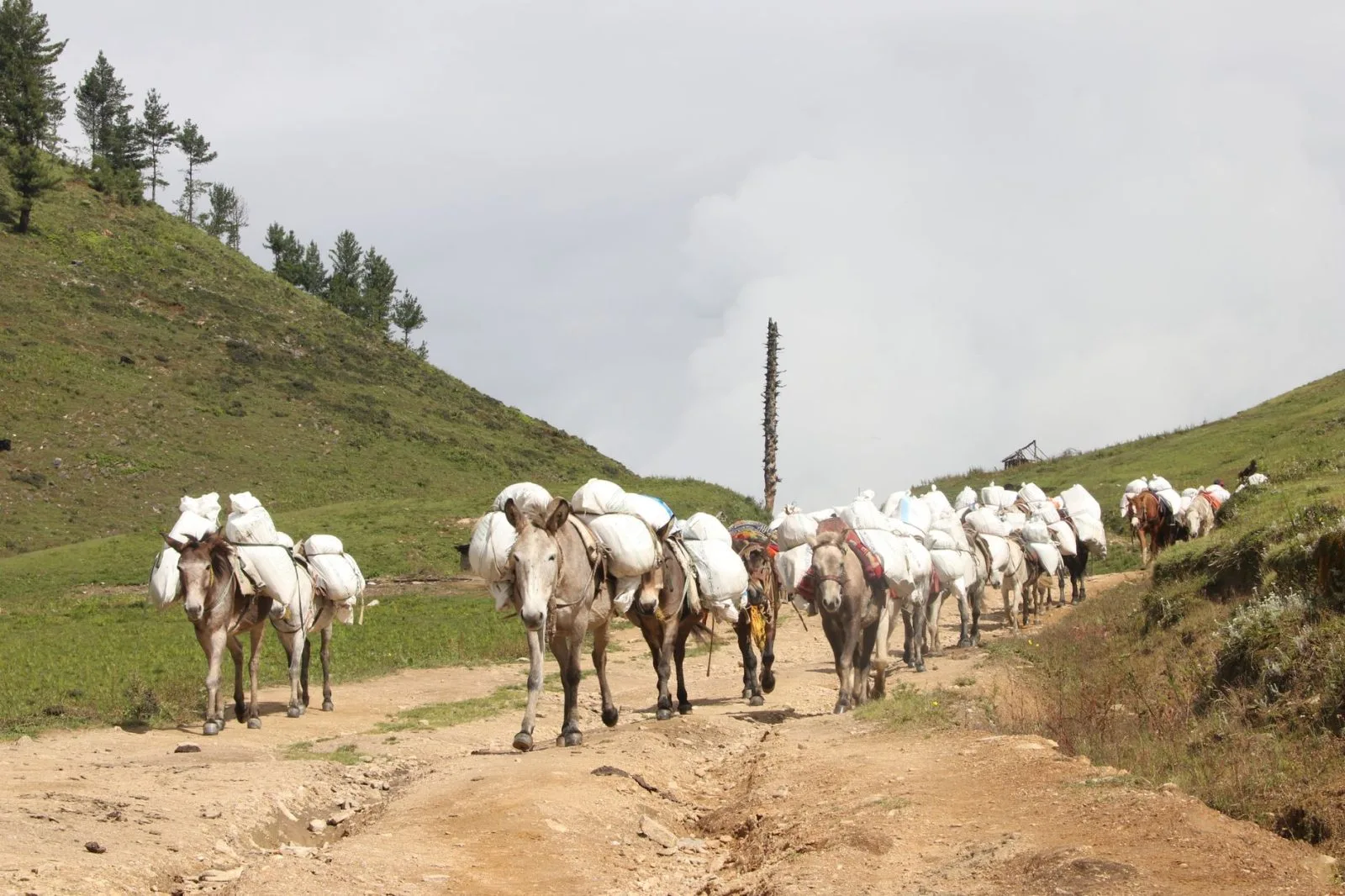
    From at least the Tang period, compressed tea travelled west from Sichuan and Yunnan toward Tibet, where it provided vitamin-rich drink and a medium of exchange in a diet heavy on barley and meat. The Tea Horse Road was a network of footpaths through mountains, not one road: porters and mule caravans crossed passes between Dali, Lijiang, and Tibetan markets. Under the Song, states traded tea for warhorses at frontier markets. Tea bricks were strapped to pack animals, wrapped in bamboo or paper, and sometimes pressed with straw. In Tibetan households, tea was churned with butter and salt into a fuel-rich drink suited to high altitudes.

    • Green, white, oolong, and black styles defined by oxidation
    • Compressed bricks made for pack transport
    • Tea exchanged for Tibetan horses at frontier markets
    • Butter tea brewed from brick tea in highland homes
    A string of pack animals carrying bundled tea bricks along a mountain trail in southwest China
    Tea bricks travelled on foot and mule across the mountain passes toward Tibet. Jeevan Mahat | Pexels License (https://www.pexels.com/license/)

    Ports, Cups, and Living Practice

    Maritime trade carried Fujian tea to Southeast Asia and Europe. In the seventeenth century, ships leaving Xiamen and other ports carried leaf tea, porcelain cups, and teapots; by the nineteenth, British demand had made tea a global commodity. The gongfu cha style, associated with Chaozhou and Fujian, uses small vessels, repeated short infusions, and attention to water temperature. A modern tasting may name a harvest season, a mountain, and a roasting method with the precision once reserved for wine. In villages around Wuyi and Anxi, sorting, pan-firing, and roasting still depend on skilled hands, even where machines perform the early steps.

    A leaf becomes tea only when someone decides when to pick it, how long to wither it, and when to stop the heat.

    Fonti e ulteriori letture

    1. Tea — Enciclopedia Britannica.
    2. The Classic of Tea — World History Encyclopedia.
    3. Tea Horse Road — Enciclopedia Britannica.

    Guardalo al suo posto

    Segui questa voce per raggiungere la regione di appartenenza.

    Esplora tramite mappa
    Segui il filo

    Esplora altre voci che condividono i suoi tag.

    Esplora il tag
  • Festa di primavera

    Vita e folklore

    Festa di primavera

    The new year at home and on the street

    Spring Festival is the Lunar New Year, a fifteen-day season of reunions, red decorations, and public celebration.

    Sezione
    Vita e folklore
    Regione
    Pechino
    Era
    Attraverso le epoche
    Etichette
    Usanze, Cibo

    Chun Jie, the Spring Festival, begins on the first day of the first lunar month and ends with the Lantern Festival on the fifteenth. In Beijing, the old rhythms of household ritual and temple fair sit alongside a modern holiday industry and a week-long public break.

    The Eve and the First Days

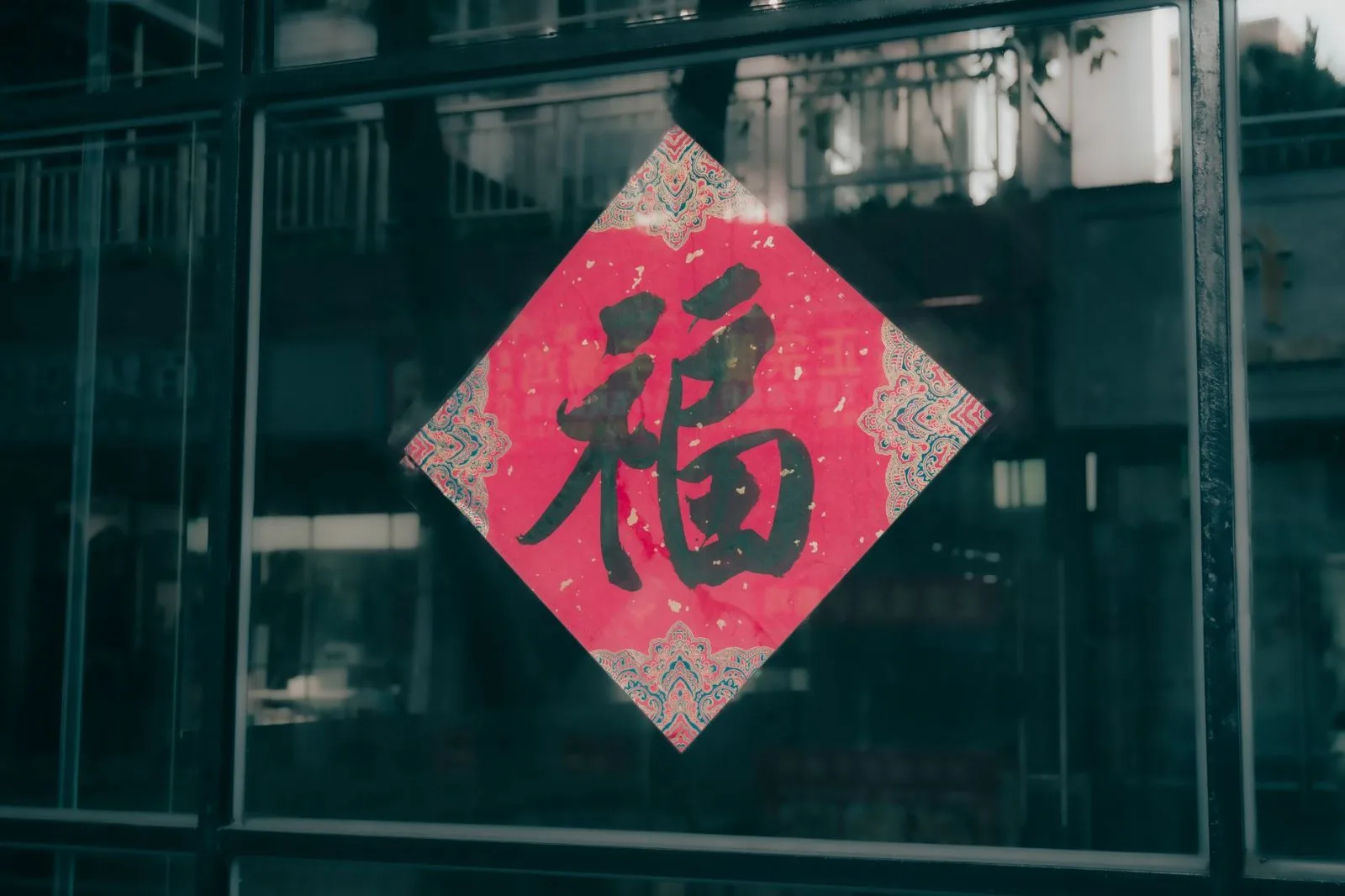
    The preparations begin weeks ahead. Homes are cleaned, debts settled, and red paper couplets pasted around the door, often with the character fu pasted upside down to suggest that good fortune has arrived. New Year’s Eve is the centre of the festival. Families travel home for a long meal that includes jiaozi, dumplings shaped like ancient coins; in northern China they are eaten at midnight. Fish is served because the word for fish sounds like surplus, and a whole fish is often left partly uneaten. Firecrackers once marked the transition, though many urban areas restrict them. After dinner, many families watch the CCTV Spring Festival Gala while red envelopes are handed to children and unmarried younger relatives.

    Red couplets and lanterns decorating a Beijing doorway for Spring Festival
    Red couplets and the character fu mark a household ready for the new year. Matthew Jesús | Pexels License (https://www.pexels.com/license/)

    Visiting and Red Envelopes

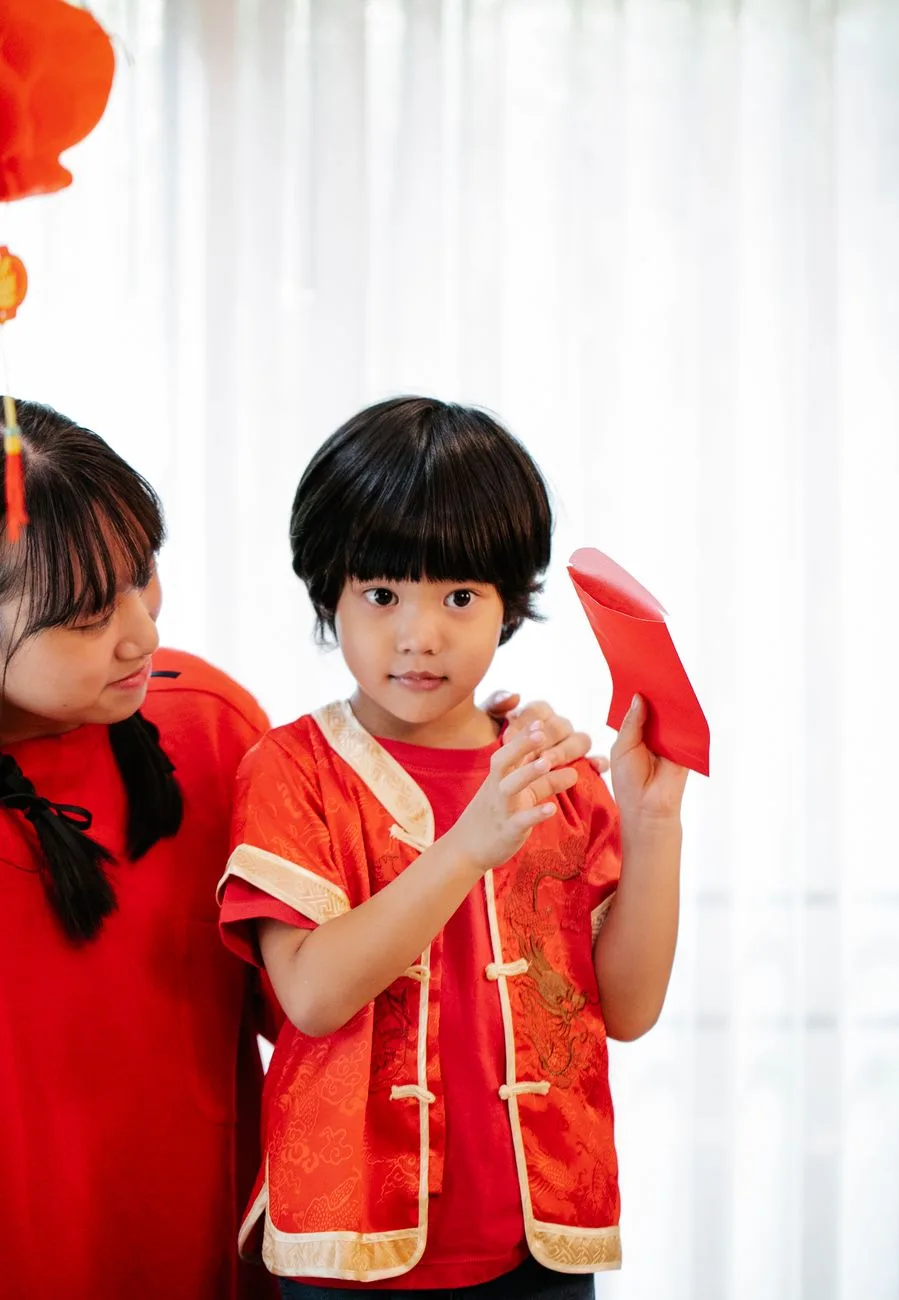
    The first days are for bainian, visits to relatives and neighbours. People call on the oldest family members first, bringing fruit, tea, or sweets, and greet one another with phrases wishing prosperity and health. Hongbao, red envelopes containing cash, pass from married adults to children and younger unmarried relatives; amounts end in even numbers and are accepted with both hands and a thank-you. Hosts offer a tray of snacks, often including candied fruits and melon seeds, before a meal. Visiting over several days is normal, and a phone message has become an accepted substitute for distant friends. Dress is neat rather than formal, and arriving empty-handed is less important than arriving at all. The point of the circuit is to renew the relationships that hold a family network together.

    Red envelopes being handed to a child during a New Year visit
    Hongbao pass from older to younger relatives during the first days of the year. Angela Roma | Licenza Pexels (https://www.pexels.com/license/)

    Beijing Temple Fairs

    Beijing’s miaohui, or temple fairs, turn temple courtyards and parks into markets for the duration of the holiday. The fairs at Ditan, Taoranting, Baiyunguan, and the Summer Palace sell dolls, sugar paintings, paper cuts, and skewered snacks, with opera singers, acrobats, and lion dancers performing in the middle of the crowd. They began as religious gatherings attached to temple festivals and became popular public entertainments; today they are as much a family outing as a religious event. Admission is usually a small fee, and the busiest hours are afternoon. Metro stations near the parks are crowded, so go early and expect a queue for the best-known fairs. The atmosphere is informal: eat while you walk, watch a performance from the edge, and keep an eye on children.

    A crowded Beijing temple fair with red lanterns and market stalls
    Temple fairs bring opera, snacks, and craft stalls to parks and temple courtyards. zimochen | Pexels License (https://www.pexels.com/license/)

    The Fifteenth Day and a Global Holiday

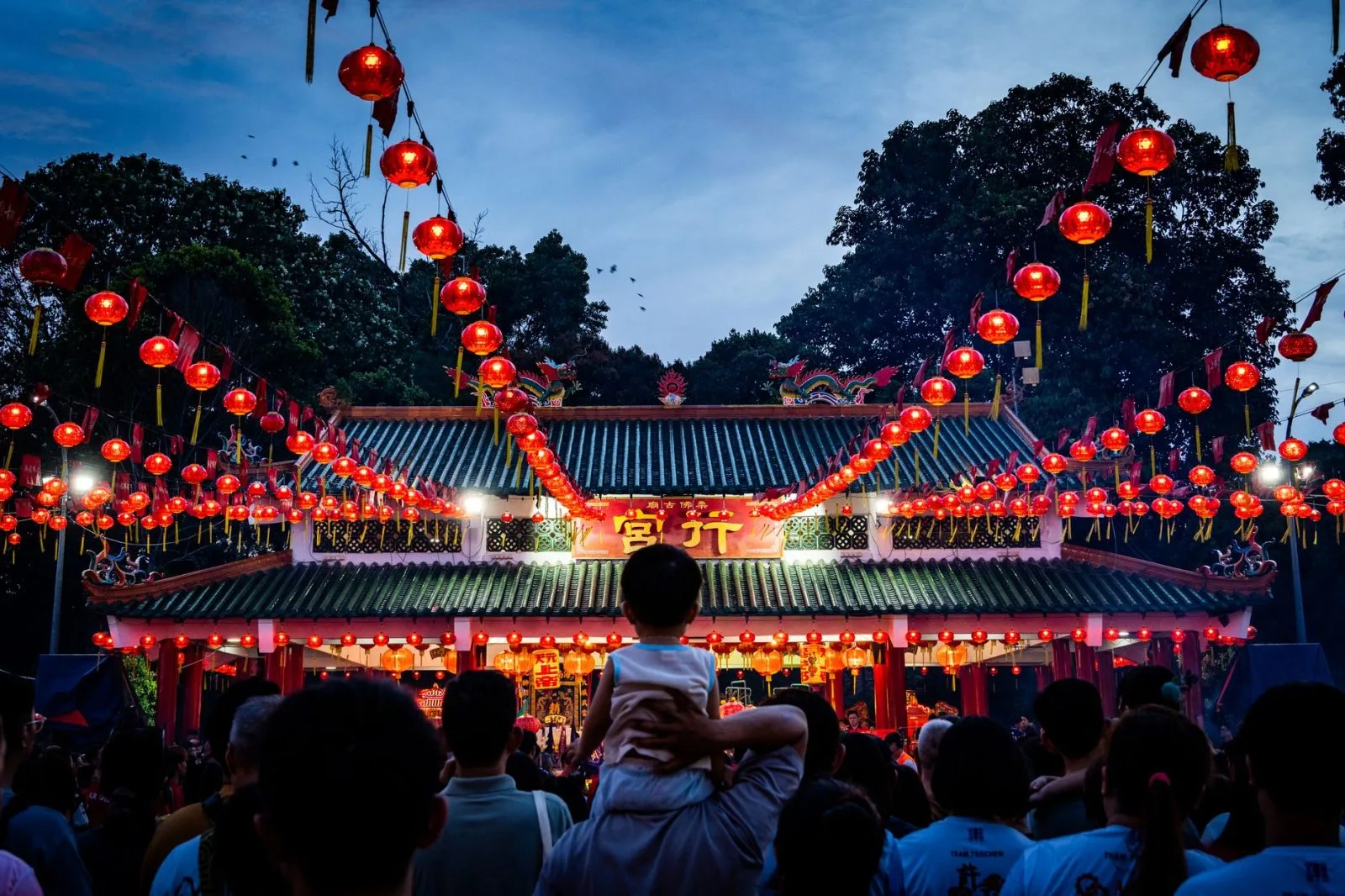
    The festival closes with Yuanxiao, the Lantern Festival, on the fifteenth day of the first lunar month. Streets and parks hang lanterns, families eat sweet rice balls called tangyuan, and lantern riddles invite a guess before the night ends. In Beijing, some neighbourhoods still stage dragon dances and drum processions. The Spring Festival was inscribed on UNESCO’s intangible cultural heritage list in 2024, recognising practices that extend well beyond one city. For visitors, the practical notes are straightforward. The public holiday closes shops and offices for several days, transport is crowded, and prices for flights and hotels rise. Book early, carry cash in small notes for envelopes and market stalls, and accept that some days are better spent with a family invitation than with a museum itinerary.

    Red at the door, fish on the table, and an envelope in the hand mark the year’s first days.

    Fonti e ulteriori letture

    1. Spring festival, social practices of the Chinese people in celebration of traditional new year — Patrimonio culturale immateriale dell'UNESCO.
    2. Capodanno cinese — Enciclopedia Britannica.
    3. Chinese New Year travel and festivals — I punti salienti della Cina.

    Guardalo al suo posto

    Segui questa voce per raggiungere la regione di appartenenza.

    Esplora tramite mappa
    Segui il filo

    Esplora altre voci che condividono i suoi tag.

    Esplora il tag
  • La festa delle lanterne

    Vita e folklore

    La festa delle lanterne

    Lights on the Fifteenth Night

    The fifteenth night of the first lunar month closes the New Year with lanterns and sweet rice balls.

    Sezione
    Vita e folklore
    Regione
    Pechino
    Era
    Attraverso le epoche
    Etichette
    Usanze, Cibo

    The Lantern Festival falls on the fifteenth day of the first lunar month, the first full moon of the year. Lanterns, night markets, riddles, and tangyuan rice balls mark the end of the New Year period.

    Origins in Calendar and Court

    The festival’s date follows the lunar calendar, so its Gregorian date changes each year. Several origins are cited. Emperor Wen of Han is said to have declared a public holiday around 180 BCE after defeating the Lü clan, while the Eastern Han emperor Ming promoted lantern displays in the first century CE as Buddhism spread. Daoist tradition associated the day with the heavenly official who grants blessings. By the Tang dynasty, the festival had become a major urban occasion: court records describe vast lantern displays in Chang’an and Luoyang, and the poet Su Weidao wrote of night markets bright as day. The Tang court relaxed curfew so people could view the lights.

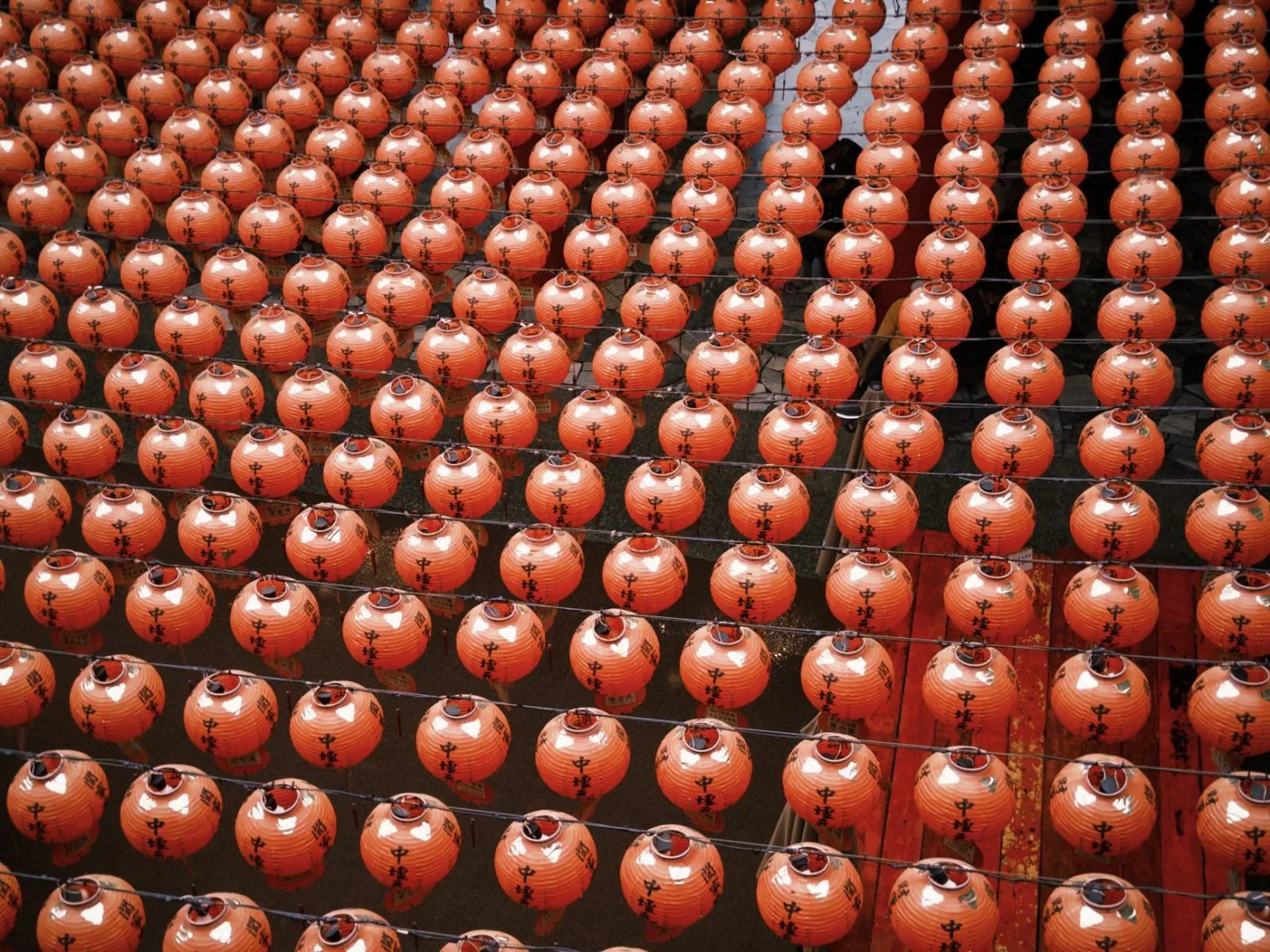
    Rows of illuminated red lanterns hanging along a street during a night festival
    Tang cities relaxed curfew so residents could walk among the lanterns at night. zack ZHUO | Pexels License (https://www.pexels.com/license/)

    Riddles, Lions, and Processions

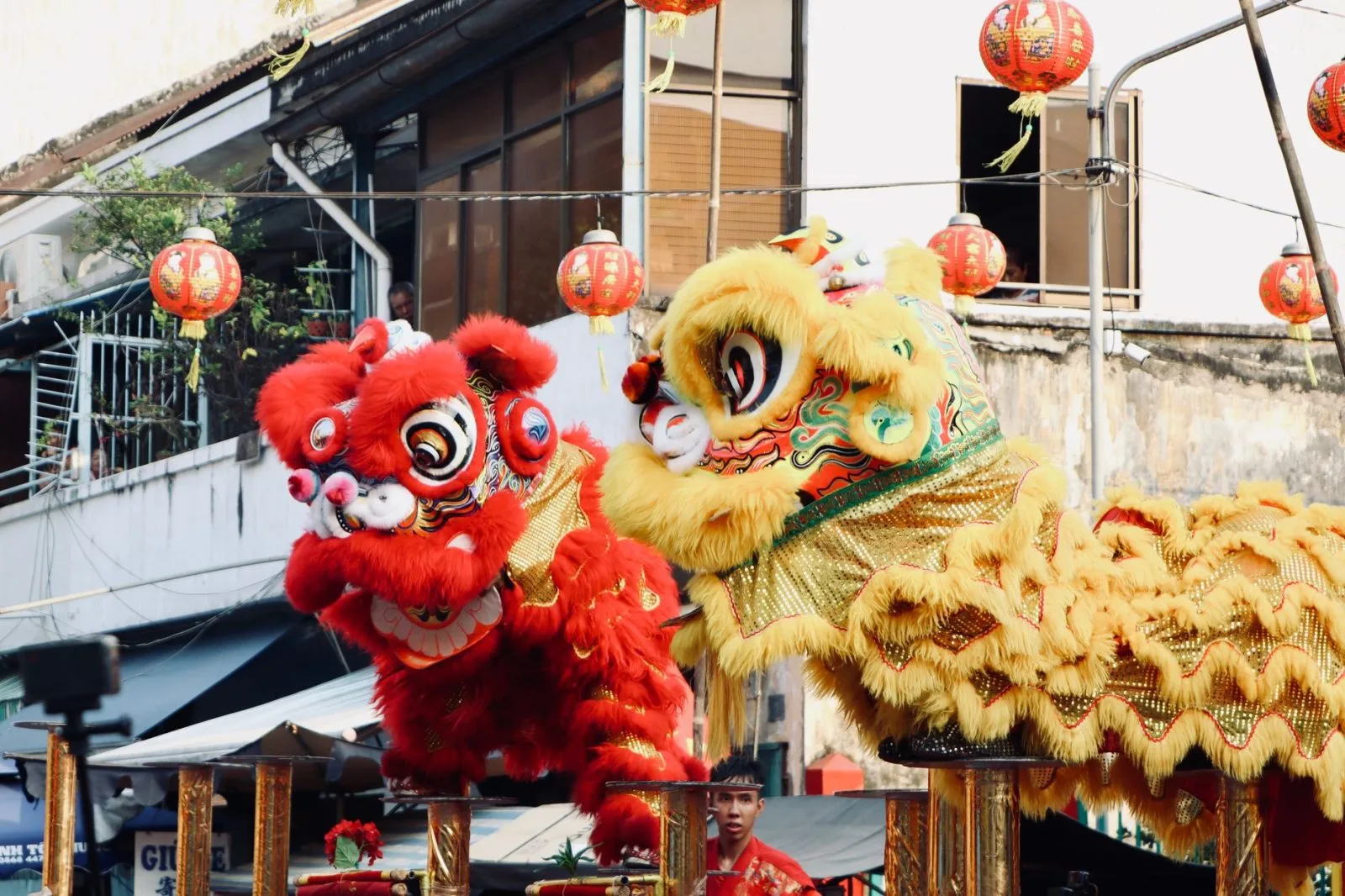
    Lantern riddles are written on slips attached to the lamps; solving one is a small test of wordplay and classical learning. Lion dances, dragon dances, and walking-on-stilts performances draw crowds in the streets, with local troupes competing for space and applause. In some places, people carry lanterns representing animals or characters, and children pull small lanterns on sticks. Beijing’s temple fairs once gathered vendors, performers, and visitors around temple courtyards; today the festival is also marked in parks and commercial districts. Taiwan is known for large lantern festivals and elaborate installations, while Nanjing has long been associated with elaborate lantern craft along the Qinhuai River.

    A lion dance troupe leaping beneath hanging lanterns during a street celebration
    Processions and lion dances turn the festival into a public performance. Pham Huynh Tuan Vy | Pexels License (https://www.pexels.com/license/)

    Tangyuan and the Taste of Reunion

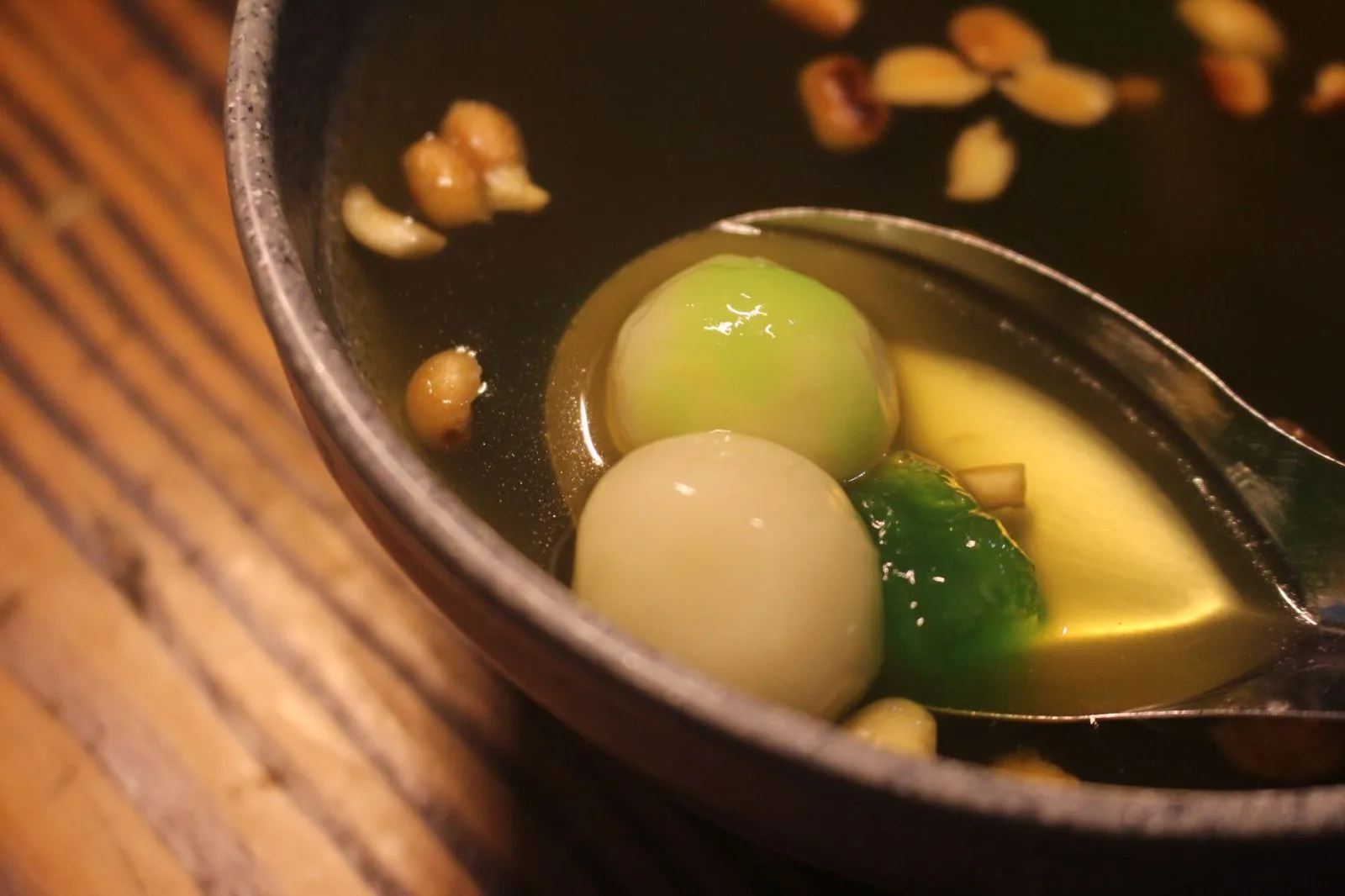
    The festival food is tangyuan in southern China and often yuanxiao in the north, both made from glutinous rice flour around a sweet filling. The names and methods differ: southern cooks wrap a soft dough around filling, while northern cooks may roll moistened filling in dry rice flour in repeated layers. Fillings include black sesame paste, red bean, peanut, and osmanthus sugar. The round shape suggests family unity, and the bowls are shared after the evening’s walk. In Ningbo, black-sesame tangyuan are a local speciality; in Shanghai and Suzhou they are sold from neighbourhood shops. Sweet rice wine and small glutinous balls are also served in some regions.

    • Black sesame, red bean, and peanut fillings
    • Southern wrapped tangyuan and northern rolled yuanxiao
    • Lantern riddles attached to public displays
    • Dragon and lion processions after dark
    A bowl of small white glutinous rice balls in clear sweet soup
    Round rice balls symbolise reunion at the first full moon. Jauhar Musthofal Qulub | Pexels License (https://www.pexels.com/license/)

    The Festival in Modern Cities

    The festival remains a public holiday in mainland China, though the number of days off and the school calendar vary. Major cities install temporary lighting, close some streets to traffic, and run lantern displays in parks and along rivers. Viewing a lantern show often means walking slowly in crowds; in Beijing, the temperature can still be below freezing, so warm layers matter. Photographers should check local rules on tripods and drones. Shopping districts extend the season commercially, but temple fairs and neighbourhood associations keep older practices alive. The date’s movement also means the festival may fall during term time or a working week, changing how families gather.

    The first full moon turns a winter street into a temporary gallery of paper, silk, and light.

    Fonti e ulteriori letture

    1. Festival delle lanterne — Enciclopedia Britannica.
    2. Chinese Lantern Festival — I punti salienti della Cina.
    3. Yuanxiao Festival — World History Encyclopedia.

    Guardalo al suo posto

    Segui questa voce per raggiungere la regione di appartenenza.

    Esplora tramite mappa
    Segui il filo

    Esplora altre voci che condividono i suoi tag.

    Esplora il tag
  • Gnocchi

    Vita e folklore

    Gnocchi

    Casse di grano riempite e rituale invernale

    I ravioli della Cina settentrionale trasformano l'impasto di grano e i ripieni di stagione in un pasto da condividere.

    Sezione
    Vita e folklore
    Regione
    Pechino
    Era
    Attraverso le epoche
    Etichette
    Usanze, Cibo

    I jiaozi sono ravioli ripieni di pasta di grano, cotti tramite bollitura, cottura a vapore o frittura. Nella Cina settentrionale, vengono consumati in occasione del solstizio d'inverno e del Capodanno lunare, quando le famiglie si riuniscono attorno a un tavolo per preparare i jiaozi, piegando ogni raviolo a mano.

    Il grano nella dieta del Nord

    I ravioli sono originari della zona di coltivazione del grano e del miglio della Cina settentrionale, dove la farina di grano divenne un alimento base durante la dinastia Han e le successive. La loro forma è stata paragonata alle antiche monete cinesi, il che ha conferito a questo piatto un posto nel linguaggio del Capodanno cinese: il termine "jiaozi" ha un suono simile a un'espressione che indica lo scambio di tesori. Una tradizione ben nota collega i ravioli al medico Zhang Zhongjing, che si dice preparasse dei fagottini di pasta ripieni per curare le orecchie congelate durante il periodo Han. La storia è difficile da verificare, ma spiega l'usanza di consumarli durante la stagione fredda. Le prove archeologiche relative a cibi di grano ripieni sono più chiare di quelle che attribuiscono a un singolo inventore.

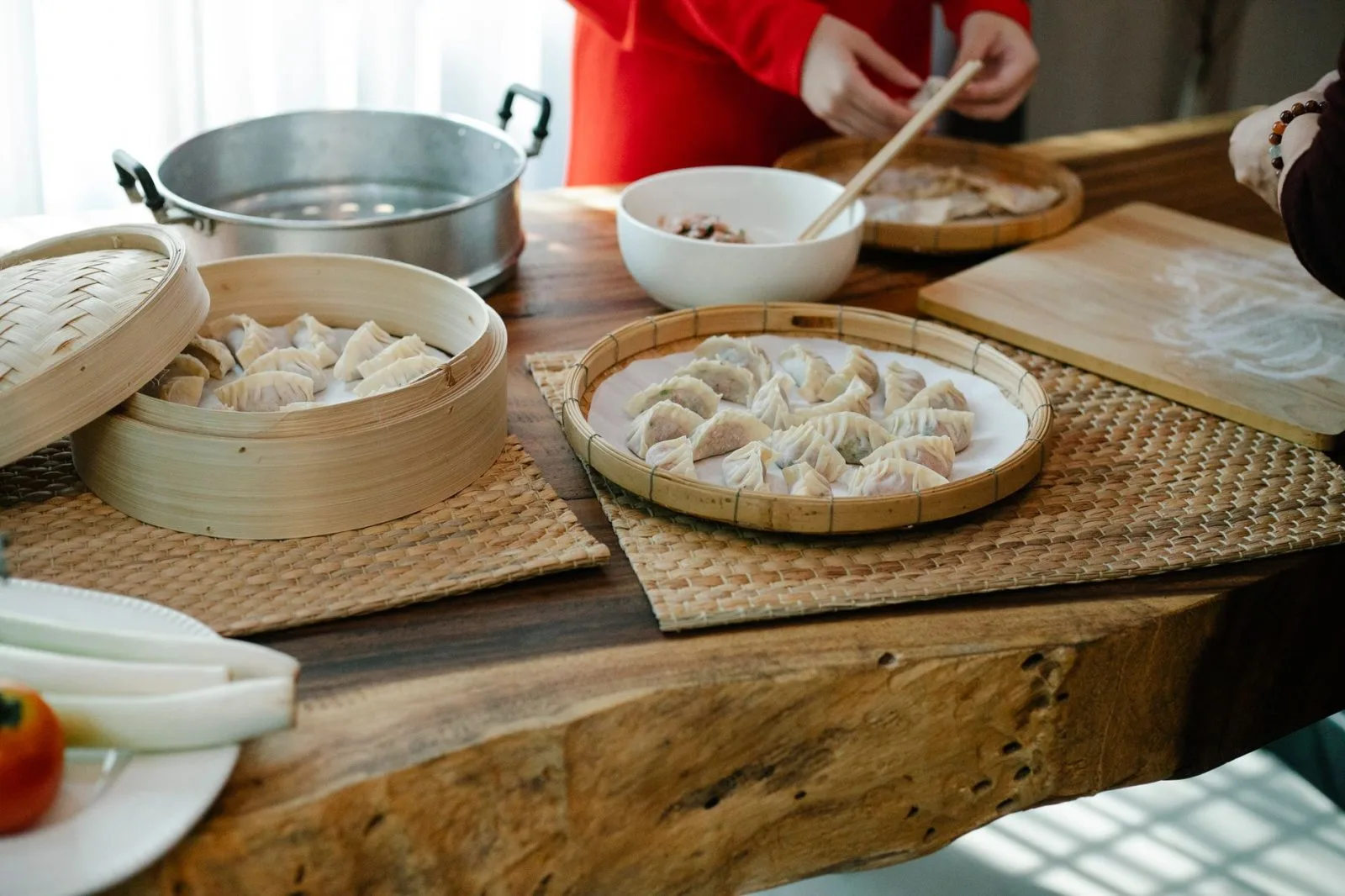
    Una fila di ravioli jiaozi piegati adagiati su un tagliere di legno infarinato.
    Il bordo plissettato sigilla il ripieno e conferisce a ogni raviolo la sua forma caratteristica. Angela Roma | Licenza Pexels (https://www.pexels.com/license/)

    Impasto, ripieno e piega

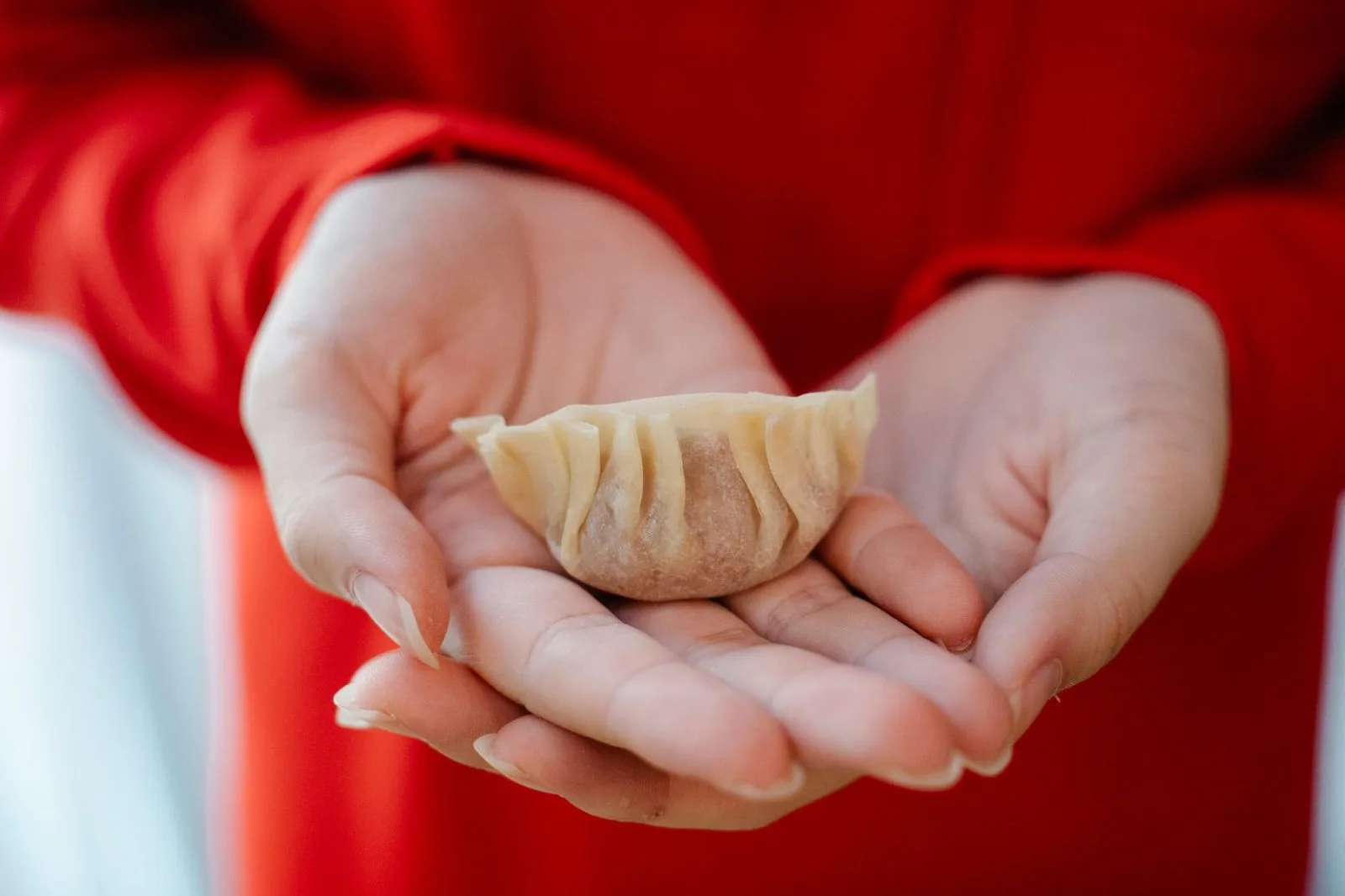
    L'impasto base dei jiaozi si prepara con farina di grano e acqua, lasciate riposare in modo che il glutine si rilassi e la sfoglia possa essere stesa sottilmente senza rompersi. Alcuni cuochi aggiungono un uovo o sostituiscono parte della farina con acqua calda per ottenere un impasto più morbido. Il ripieno viene tritato finemente in modo che cuocia uniformemente: maiale con cavolo, erba cipollina o porri; agnello con cipolla nel nord-ovest; gamberi e uova nelle zone costiere. Il cuoco posiziona il ripieno al centro, piega la sfoglia e preme le pieghe lungo la chiusura. Una chiusura ermetica è fondamentale perché la bollitura fa aprire l'impasto se rimane aria all'interno. Sono comuni i ripieni vegetariani con tofu, funghi o uova, soprattutto in occasione di visite ai templi e periodi di digiuno.

    Mani che pizzicano le pieghe lungo il bordo di un raviolo crudo
    La piegatura sigilla il pacchetto; ogni famiglia può preferire una piega diversa. Angela Roma | Licenza Pexels (https://www.pexels.com/license/)

    Bollito, al vapore e fritto

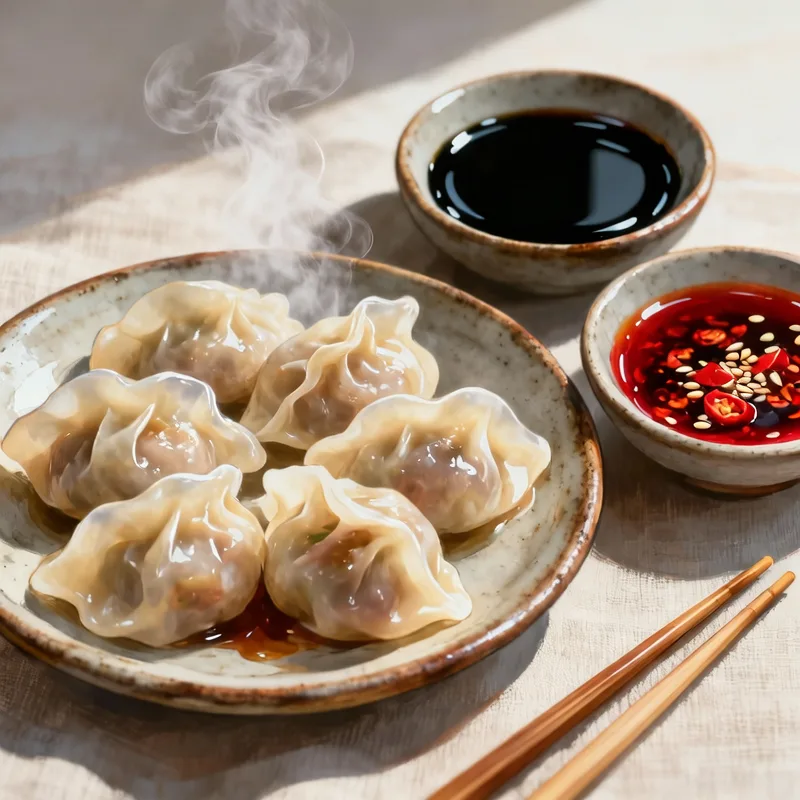
    Il metodo più comune è la bollitura: i ravioli vengono aggiunti a una pentola capiente, spinti dal fondo e cotti finché non vengono a galla e si gonfiano. I cuochi del nord spesso aggiungono un po' di acqua fredda quando l'acqua riprende a bollire, ripetendo il processo tre volte per ottenere una sfoglia croccante. Il raviole, o guotie, viene fritto da un lato, poi cotto al vapore con un coperchio e poca acqua, ottenendo una base croccante. Le versioni del sud e della diaspora includono har gow al vapore con gamberi e sfoglie trasparenti di amido di grano. Le salse di accompagnamento variano dall'aceto nero e zenzero alla salsa di soia con olio al peperoncino o aglio. Anche i ripieni cambiano: maiale ed erba cipollina sono predominanti a Pechino, manzo e agnello compaiono nelle comunità musulmane, mentre cavolo o funghi sono più adatti alle città interne più fredde.

    • Jiaozi bolliti per Capodanno e solstizio d'inverno
    • Guotie con una base fritta croccante
    • Aceto nero e zenzero come salsa classica
    • Ripieni regionali a base di maiale, agnello, gamberetti o verdure.
    Ravioli bolliti serviti con ciotoline di aceto e olio al peperoncino.
    Una salsa a base di aceto e zenzero si sposa perfettamente con i ricchi ripieni di maiale. Illustrazione generata dall'intelligenza artificiale · SinoViz

    Realizzarli insieme

    I ravioli sono un cibo conviviale perché la loro preparazione richiede tempo. Alla vigilia del Capodanno lunare, diverse generazioni possono stendere la pasta, tritare il ripieno e piegare insieme dozzine o centinaia di ravioli; alcuni ravioli hanno la forma di monete o nascondono una moneta pulita come portafortuna. Il pasto viene spesso consumato in presenza dei membri più anziani della famiglia. Gli avanzi vengono fritti il giorno successivo e i ravioli surgelati sono ormai venduti nei supermercati in tutta la Cina e all'estero. Le versioni nei ristoranti spaziano dai locali di Pechino che servono ravioli di agnello ai guotie di Shanghai e agli xiaolongbao ripieni di brodo, che appartengono a una famiglia distinta ma imparentata di panini al vapore.

    Un raviolo è un piccolo esempio di organizzazione domestica: pasta, ripieno, mani e un motivo per riunirsi.

    Fonti e ulteriori letture

    1. Gnocco — Enciclopedia Britannica.
    2. Jiaozi — Enciclopedia Britannica.
    3. Capodanno cinese — Enciclopedia Britannica.

    Guardalo al suo posto

    Segui questa voce per raggiungere la regione di appartenenza.

    Esplora tramite mappa
    Segui il filo

    Esplora altre voci che condividono i suoi tag.

    Esplora il tag
  • Lavorazione dell'argento Miao

    Vita e folklore

    Lavorazione dell'argento Miao

    Ornament, Memory, and Festival Dress

    Miao silver ornaments carry family history and local identity in festival dress across southwest China.

    Sezione
    Vita e folklore
    Regione
    Yunnan
    Era
    Attraverso le epoche
    Etichette
    Customs, Ethnic, Scenic Sites

    Miao silverwork is a family of adornments—headdresses, collars, earrings, and bracelets—made by Miao communities in Guizhou, Yunnan, and neighbouring regions. The pieces are worn most visibly at festivals and weddings.

    A Distributed Craft Tradition

    Miao communities live across Guizhou, Yunnan, Guangxi, Sichuan, and Southeast Asia, and silverwork varies by locality. In Yunnan, Miao villages around Wenshan and Honghe maintain styles that differ from the better-known Guizhou counties of Xijiang and Kaili. Ornaments are made by specialised silversmiths who work in small workshops, often serving several villages. Designs are learned through apprenticeship rather than written patterns: a young smith repeats forms copied from older pieces and festival dress. Motifs may draw on local birds, flowers, insects, and coins, though their meanings are not fixed. Families accumulate ornaments over generations, and a daughter’s festival headdress may represent years of saving.

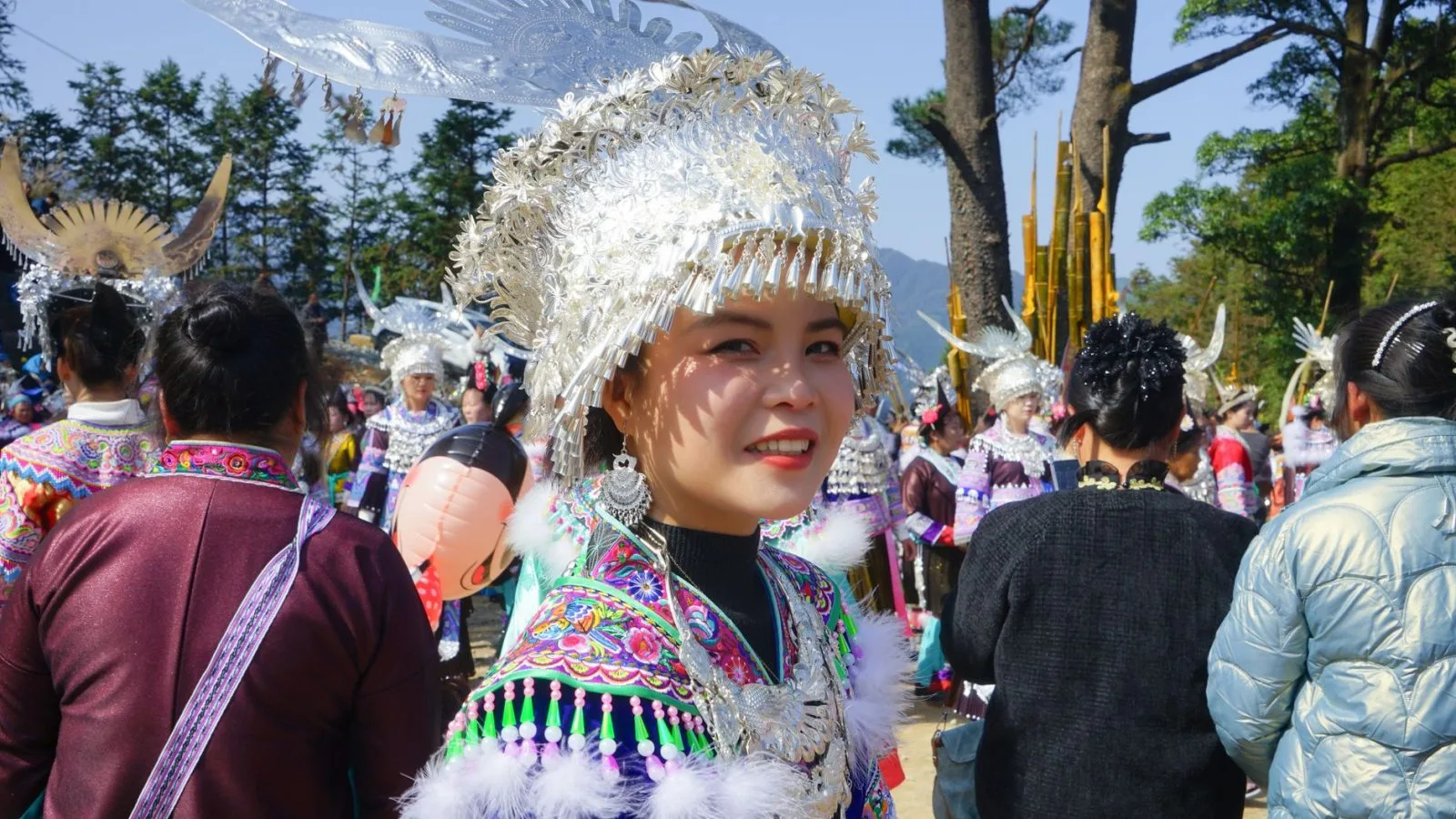
    A Miao headdress with silver horns, plaques, and hanging ornaments at a festival
    Headdresses combine family heirlooms with pieces made for a specific occasion. Jaqor Q.I. | Pexels License (https://www.pexels.com/license/)

    Sheet, Wire, and Repoussé

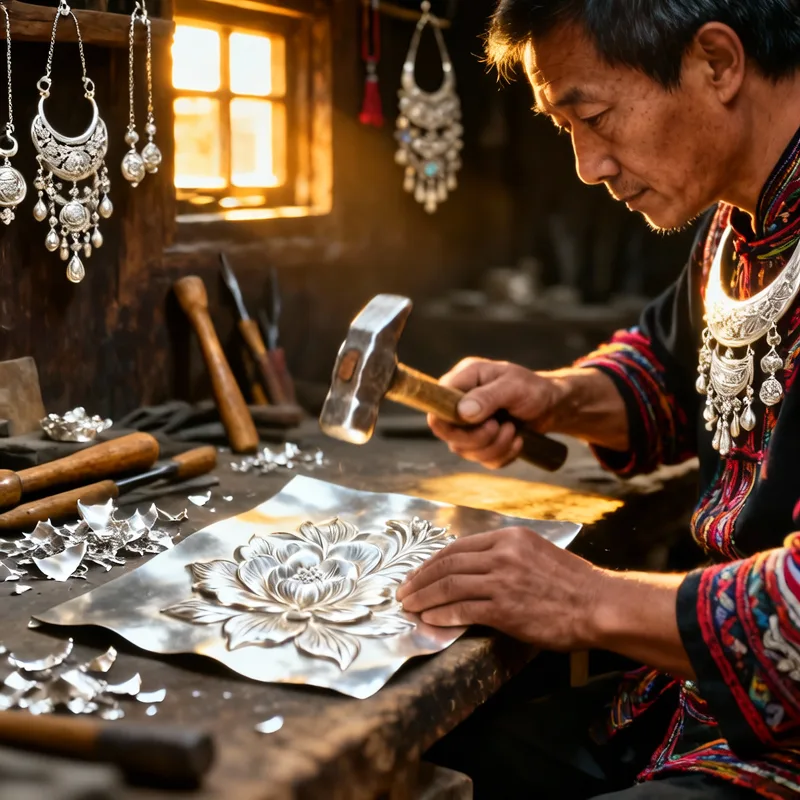
    Much Miao silverwork begins with sheet silver and wire. The smith hammers ingots into thin sheets, cuts strips, and raises patterns from the reverse with repoussé, a technique of punching and chasing to form relief. Horsehair-thin wires are twisted and soldered into filigree, then built into openwork wings, horns, and floral sprays. A large headdress may combine a hammered band, dangling chains, repoussé plaques, and rows of tiny bells that move when the wearer turns. Silver is valued for its colour, workability, and traditional association with protection and prosperity. Many ornaments are hollow to reduce weight, since a full ceremonial headdress can be heavy enough to limit long wear.

    A Miao silversmith hammering a thin silver sheet into a raised floral plaque
    Repoussé raises the design from the back of a thin silver sheet. Illustrazione generata dall'intelligenza artificiale · SinoViz

    Festival Wear and Social Meaning

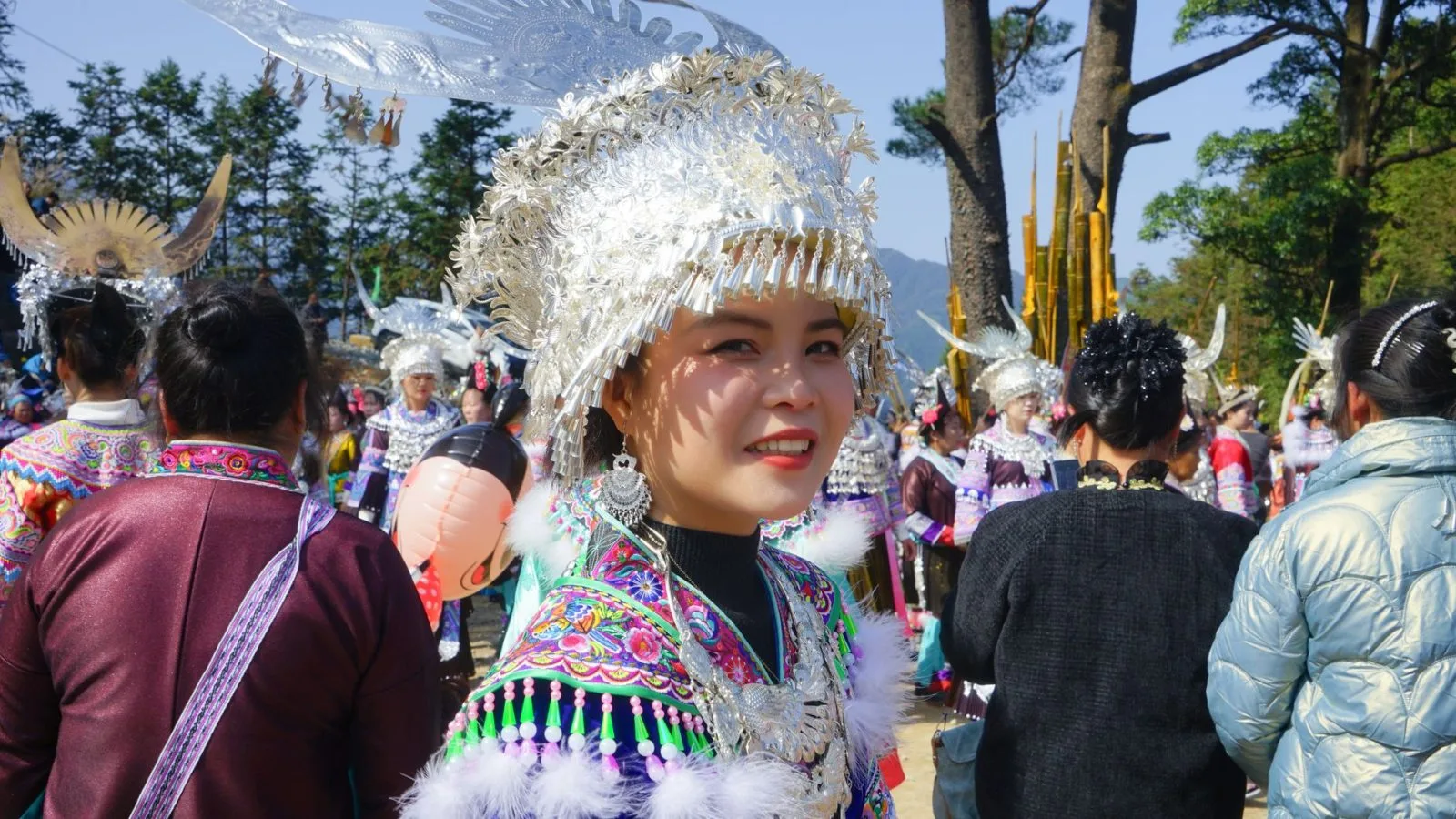
    Silver ornaments are read as part of an entire costume, not as isolated jewellery. A Miao woman’s festival dress may include a pleated skirt, embroidered jacket, woven belt, and a silver collar shaped like a crescent or a pair of wings. In some communities, the number and form of earrings or neck rings indicate village affiliation or marital status. During the Lunar New Year, harvest celebrations, and the Miao New Year in some areas, women and girls wear family sets while groups sing, dance, and process between villages. The ornaments catch light during movement, making dress a visual part of the performance. Men may wear silver buttons, chains, or small pendants with less ceremonial weight.

    • Repoussé plaques raised from thin silver sheet
    • Twisted wire and openwork filigree
    • Headdresses with horns, chains, and bells
    • Costumes worn for New Year and wedding rituals
    Women in embroidered Miao festival dress wearing heavy silver collars and earrings
    Ornaments are worn with embroidery and weaving as one costume system. Jaqor Q.I. | Pexels License (https://www.pexels.com/license/)

    Markets, Tourism, and Continuity

    Silverwork circulates through village workshops, regional markets, and tourism. Visitors to Miao villages in Yunnan and Guizhou can watch smiths shaping small pieces, though the most important heirlooms are usually not for sale. Reproductions sold as souvenirs range from careful miniatures to inexpensive plated metal, so asking whether a piece is solid silver matters. Museums and cultural centres document older headdresses and collars, but the living context remains local dress. Some communities have revived festival costumes and taught silversmithing to younger people, while migration and wage work change who has time to make and wear them. The craft’s future depends less on novelty than on continued occasions to use it.

    A Miao headdress is worn jewellery and a portable archive of family work at the same time.

    Fonti e ulteriori letture

    1. Miao people — Enciclopedia Britannica.
    2. Chinese silver jewellery — Victoria and Albert Museum.
    3. Miao ethnic culture — I punti salienti della Cina.

    Guardalo al suo posto

    Segui questa voce per raggiungere la regione di appartenenza.

    Esplora tramite mappa
    Segui il filo

    Esplora altre voci che condividono i suoi tag.

    Esplora il tag
  • Cucina del Sichuan

    Vita e folklore

    Cucina del Sichuan

    Chilli Oil, Ferment, and the Numbing Pepper

    Sichuan cooking balances chilli heat, Sichuan pepper numbness, fermented bean paste, and rich broth.

    Sezione
    Vita e folklore
    Regione
    Sichuan
    Era
    Attraverso le epoche
    Etichette
    Customs, Food, Geography

    Sichuan cuisine is known for bold seasoning, but its classic dishes are built on contrast: chilli with Sichuan pepper, hot oil with cool cucumber, or a clear broth beside a fiery one.

    A Basin Pantry and Early Flavours

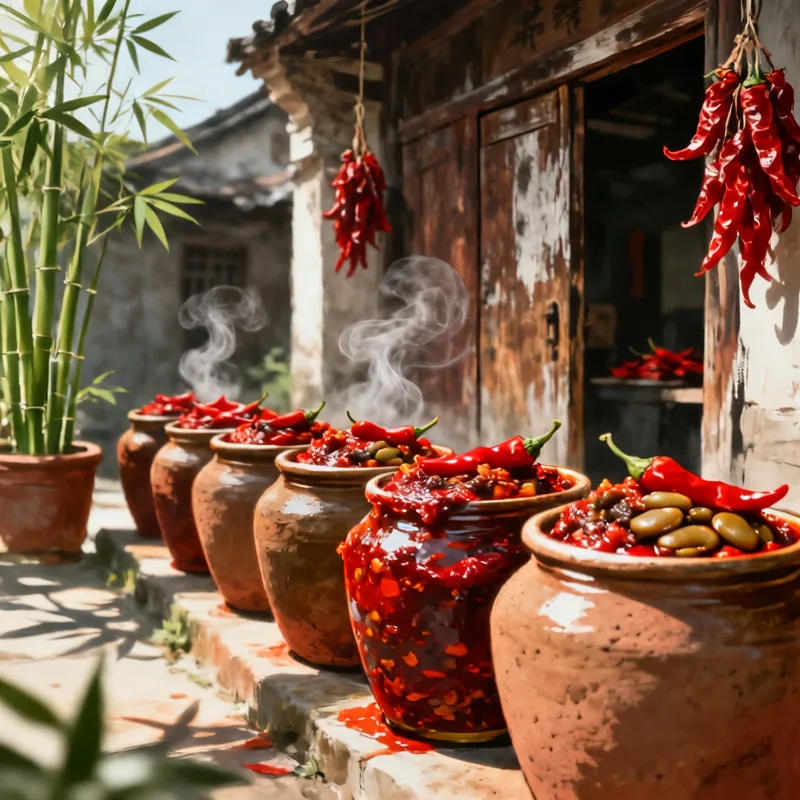
    The Sichuan Basin has fertile fields, rivers, and a humid climate, but its early elite cooking was not defined by chilli. Chilli peppers reached China from the Americas in the sixteenth century and became a Sichuan staple later, especially among ordinary households. Before that, cooks used ginger, garlic, mustard, vinegar, and the distinctive Sichuan pepper, Zanthoxylum simulans, whose husks cause a tingling sensation rather than heat.Fermented bean pastes from the basin towns added depth. Pixian doubanjiang, a broad-bean and chilli paste fermented in Pixian near Chengdu, became a foundation of many red-braised and stir-fried dishes. The province’s food therefore combines older preservation methods with ingredients that arrived through global trade.

    Jars of red chilli and broad-bean paste fermenting outside a Sichuan workshop
    Fermented doubanjiang gives many Sichuan dishes their deep red base. Illustrazione generata dall'intelligenza artificiale · SinoViz

    The Grammar of Heat

    Sichuan cooks distinguish several kinds of chilli heat. Dried chillies are fried in oil until fragrant but not blackened; chilli oil is steeped and aged; chilli bean paste supplies fermented heat; and fresh peppers give a brighter bite. Sichuan peppercorns, often toasted and ground, produce the málà combination of numbness and spice. Official Sichuan cookbooks describe more than twenty recognised flavour profiles, from guaiwei, strange or complex, to yuxiang, fish-fragrant, which uses no fish. Mapo tofu, associated with Chengdu in the nineteenth century, combines soft tofu, minced meat, doubanjiang, chilli oil, and Sichuan pepper. Kung Pao chicken uses dried chillies, peanuts, and a sweet-sour soy sauce.

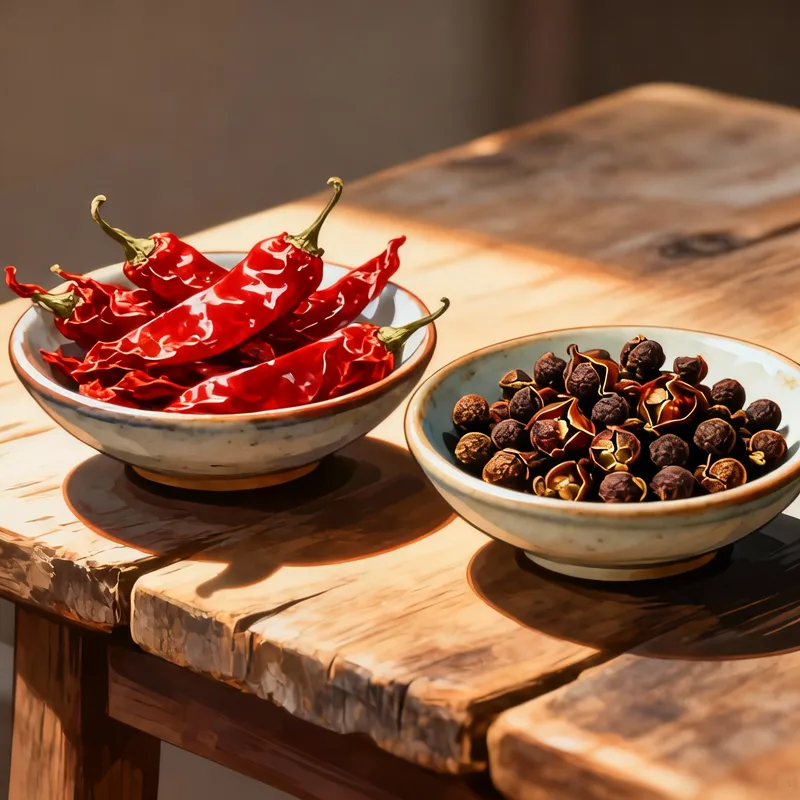
    Dried red chillies and Sichuan peppercorns in separate shallow bowls
    Chilli heat and peppercorn numbness are distinct, and cooks balance them separately. Illustrazione generata dall'intelligenza artificiale · SinoViz

    Hotpot and the Two-Flame Bowl

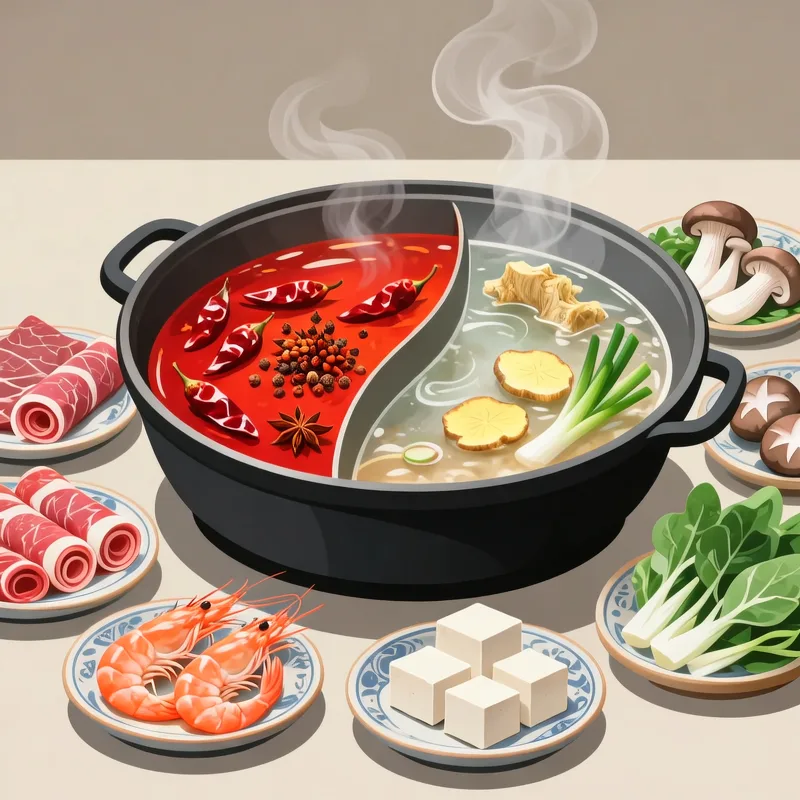
    Chengdu hotpot is a social meal built around a divided pot. One side may hold a red broth of chilli oil, doubanjiang, beef fat, and spices; the other a clear chicken or mushroom stock. Diners cook thinly sliced beef, tripe, duck blood, fish balls, vegetables, and mushrooms, then dip them in sesame oil, garlic, and chopped herbs. The sesame dip cools the palate and coats the mouth against spice. Chongqing hotpot is often heavier and more direct, traditionally using beef tallow; Chengdu versions are commonly more aromatic and varied. Yibin and other southern cities add their own chilli blends. Restaurants label spice levels, but heat can still be adjusted only by asking.

    • Pixian doubanjiang as a fermented chilli-bean base
    • Málà: chilli heat plus peppercorn numbness
    • Two-flavour hotpot with red and clear broth
    • Sesame oil dip to moderate the heat
    A divided hotpot with red chilli broth and clear broth surrounded by ingredient plates
    A two-flavour pot lets a table divide heat from clarity. Illustrazione generata dall'intelligenza artificiale · SinoViz

    Beyond the Fiery Stereotype

    Not every Sichuan dish is hot. Sichuan’s most ceremonial dish, Gongbao chicken and the banquet classic ‘sweet and sour’ aside, the cuisine includes clear broths, steamed dishes, and delicate pastry. Zhangcha duck is smoked with tea leaves and camphor before steaming, while boiled pork slices are served in a clear broth with mustard greens. Chengdu’s teahouses and dish shops serve small noodles, sweet-water noodles, and dumplings. The province also includes Tibetan and Yi food traditions in its western highlands, where barley, yak products, and different seasonings dominate. Reading Sichuan cuisine only as heat misses its central achievement: layering aromas, textures, and ferments so that strong flavours remain controlled.

    Sichuan cooking is not simply hot; it is a carefully graded argument between chilli, pepper, oil, and ferment.

    Fonti e ulteriori letture

    1. Sichuan cuisine — Enciclopedia Britannica.
    2. Chinese Cuisine — Enciclopedia Britannica.
    3. Sichuan Food — I punti salienti della Cina.

    Guardalo al suo posto

    Segui questa voce per raggiungere la regione di appartenenza.

    Esplora tramite mappa
    Segui il filo

    Esplora altre voci che condividono i suoi tag.

    Esplora il tag
  • Zhuang

    Ethnic Community

    Zhuang

    Rice terraces and song festivals

    The Zhuang are China’s largest minority ethnic group. Their culture is closely tied to Guangxi’s karst hills, rice farming, song festivals and distinctive bronze drum traditions.

    Community
    Zhuang
    Population
    Around 19 million, mostly in Guangxi
    Language
    Zhuang (Tai-Kadai)
    01

    Where the community lives

    Most Zhuang people live in Guangxi, with communities also in Yunnan, Guangdong and Guizhou. Karst valleys and river plains shape settlement and agriculture.
    02

    Language and tradition

    Zhuang belongs to the Tai-Kadai family. Folk songs, especially antiphonal singing, are central to social life and courtship.
    03

    Festivals and daily life

    The Sanyuesan festival features singing, coloured eggs and gatherings. Rice, river fish and sour flavours appear in local food traditions.
    04

    Crafts and heritage

    Bronze drums, embroidered balls and indigo-dyed textiles are important cultural symbols. Dong and Zhuang communities also share drum tower and bridge-building traditions in some areas.

    See the region

    Open the map to read the land connected to this community.

    Esplora tramite mappa
  • Mongol

    Ethnic Community

    Mongol

    Steppe heritage and mobile life

    Mongol culture is rooted in the grasslands of northern China. Herding, horses, wrestling, throat singing and the yurt reflect a mobile life shaped by climate and open landscape.

    Community
    Mongol
    Population
    About 6 million; Inner Mongolia and neighbouring provinces
    Language
    Mongolian (Mongolic)
    01

    Where the community lives

    Mongol communities live mainly in Inner Mongolia, with populations in Liaoning, Jilin, Hebei, Xinjiang and Qinghai. Grasslands and steppe cities create different ways of life.
    02

    Language and belief

    Mongolian is written in the traditional vertical script in Inner Mongolia. Tibetan Buddhism and shamanic traditions have both influenced Mongol practice.
    03

    Festivals and daily life

    Naadam features wrestling, horse racing and archery. Dairy products, mutton and milk tea are staples of steppe food culture.
    04

    Crafts and heritage

    Yurt construction, leatherwork, silver ornaments and horse gear show practical design and decoration. Long-song and morin khuur music carry steppe aesthetics.

    See the region

    Open the map to read the land connected to this community.

    Esplora tramite mappa
  • Hui

    Ethnic Community

    Hui

    A Muslim community across China

    Hui communities are found across China, often around mosques and historic trading neighbourhoods. Their culture combines Chinese language and local customs with Islamic religious life.

    Community
    Hui
    Population
    About 11 million, in every province
    Language
    Chinese, with Arabic and Persian liturgical vocabulary
    01

    Where the community lives

    Hui people live throughout China, with notable communities in Ningxia, Gansu, Qinghai, Yunnan and major cities such as Xi’an and Beijing. Mosques often anchor neighbourhood life.
    02

    Language and belief

    Most Hui speak local Chinese dialects. Islam shapes dietary practice, festivals, education and mosque architecture.
    03

    Festivals and daily life

    Eid al-Fitr and Eid al-Adha are major festivals. Halal food culture includes lamb dishes, hand-pulled noodles and local snacks shaped by region.
    04

    Crafts and heritage

    Mosque architecture blends Chinese and Islamic forms. Calligraphy in Arabic and Chinese appears in religious and decorative contexts.

    See the region

    Open the map to read the land connected to this community.

    Esplora tramite mappa