Topic: Maritime Silk Road

  • 해상 실크로드

    지도 탐색

    해상 실크로드

    Ports, Monsoons, and Sea Trade

    The sea routes that linked Fujian’s ports to the Indian Ocean world.

    부분
    지도 탐색
    지역
    푸젠
    연대
    song-liao-jin
    태그
    History, Geography, Transport

    The Maritime Silk Road was a seasonal network of sailing routes between Chinese ports and the Indian Ocean. Fujian’s Quanzhou rose within it during the Song and Yuan dynasties, when customs revenue and shipbuilding made the coast central to the imperial economy.

    Why Trade Moved Seaward

    Maritime links existed in the Han period, but their scale grew under the Tang and Song. Guangzhou handled Persian and Arab ships in the eighth century, and the Tang court appointed a maritime trade commissioner there in 714. The Song dynasty, founded in 960, lost access to parts of the overland routes after the Western Xia took the Hexi Corridor in the eleventh century, and the Jin conquest of northern China in 1127 forced the court south to Hangzhou. Ships could carry porcelain and grain far more cheaply than caravans. Maritime trade offices at Guangzhou, Quanzhou, and Mingzhou collected duties that became an important source of state income.
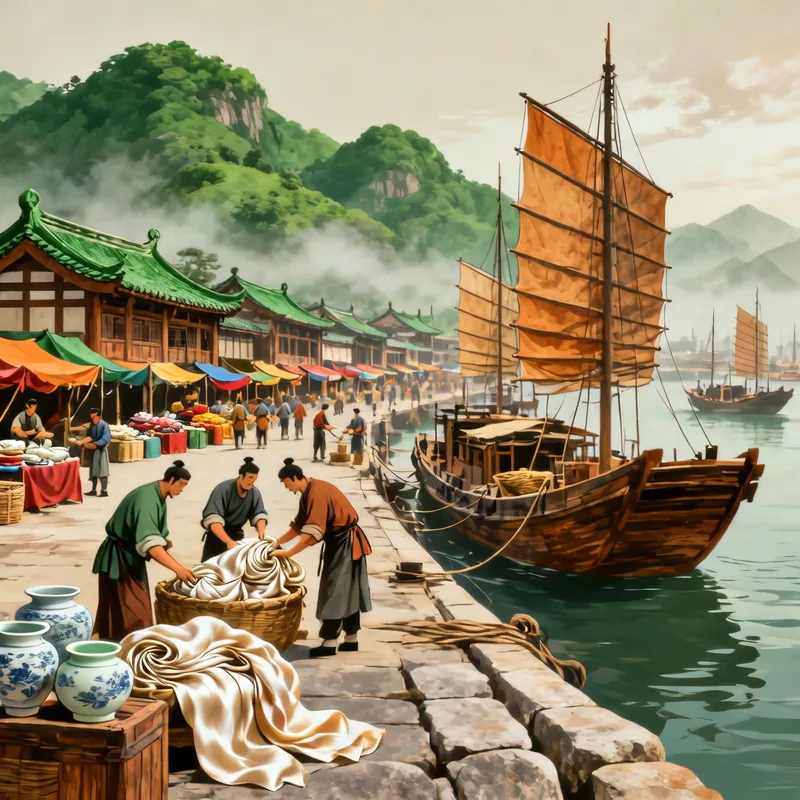
    Wooden sailing ships anchored at a crowded southern Chinese port with hills behind
    Song ports collected customs duties from a growing sea trade. AI 생성 일러스트 · 시노비즈

    Quanzhou and the Fujian Coast

    Quanzhou, known to foreign merchants as Zayton, became one of the busiest ports of the Song and Yuan periods. Its harbour served ships from Arabia, Persia, India, and Southeast Asia, and a Muslim community built the Qingjing Mosque, first erected in 1009 and rebuilt in 1131. Fujian supplied timber, shipwrights, and navigators trained in coastal and ocean sailing. In 1274, a merchant vessel sank near Quanzhou; its excavated hull shows watertight bulkheads, a feature that made Chinese junks unusually resistant to damage. Marco Polo, writing around 1290, called Zayton one of the world’s greatest ports. The city’s multilingual inscription stones record the range of its traders.
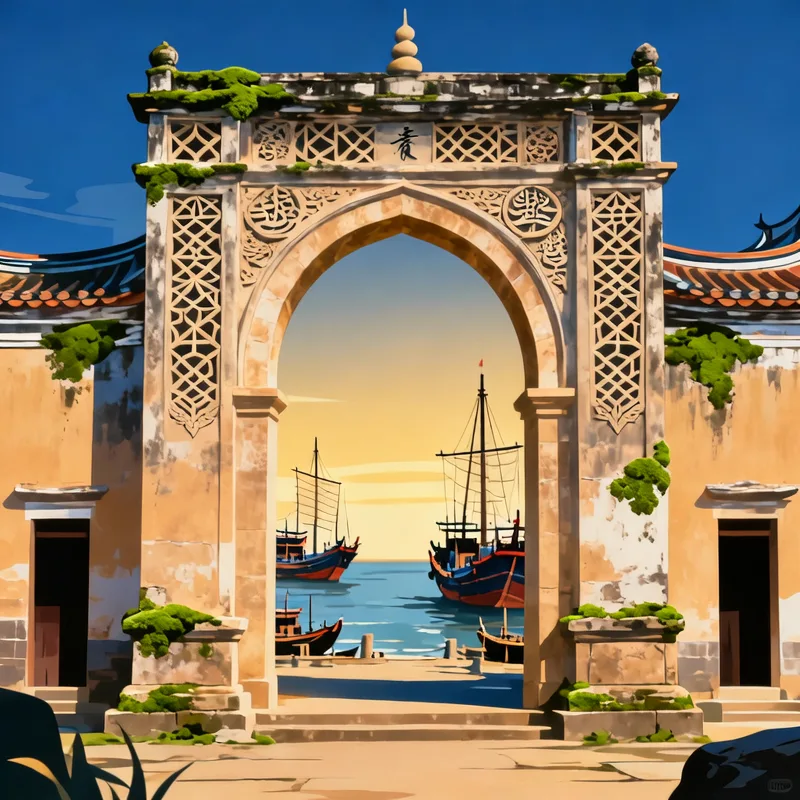
    Stone mosque with an arched gateway in a Fujian port city, a remnant of Quanzhou’s foreign merchants
    Quanzhou’s Qingjing Mosque reflects the port’s long ties with the Indian Ocean. AI 생성 일러스트 · 시노비즈

    Monsoons, Cargo, and Ports of Call

    Sailing followed the wind. Ships left Fujian on the northeast monsoon, usually in late autumn, and returned with the southwest monsoon in summer. Routes ran south past Champa and the Malay Peninsula, through the Strait of Malacca to Srivijaya, then toward Calicut, Hormuz, and Aden. Cargo included Longquan celadon, Jingdezhen porcelain, silk, copper coins, and later tea, exchanged for pepper, spices, ivory, and aromatic woods. Merchants stayed for months while winds changed, marrying locally and establishing trading quarters. Navigators used compass bearings and written route books, but the schedule belonged to the monsoon rather than to the calendar of any court.

    • Quanzhou and Guangzhou in China
    • Champa and Srivijaya in Southeast Asia
    • Calicut on the Malabar Coast
    • Hormuz and Aden at the western end
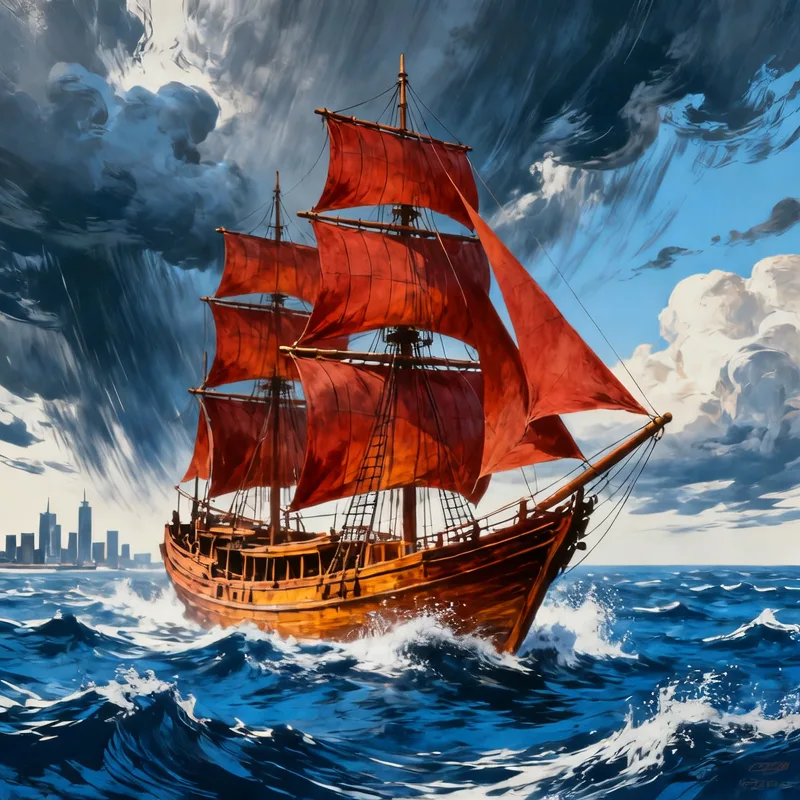
    Chinese junk under full sail crossing a blue sea toward a tropical harbour
    Monsoon winds set the rhythm of voyages between Fujian and the Indian Ocean. AI 생성 일러스트 · 시노비즈

    Mapping a Sea Network

    Sea routes were recorded as sequences of bearings, landmarks, and sailing times rather than as single drawn lines. Compass navigation was in use by the late Song, and later manuals such as Shun Feng Xiang Song, a Ming manuscript copying earlier route books, list courses by compass point and day. These rutters show how captains thought in segments: from a Fujian harbour to a known island, then to a coastal port. The Ming voyages of Zheng He in the early fifteenth century relied on the same coastal knowledge. The maritime silk road is best mapped as a web of seasonal legs, ports, and waiting places.

    The monsoon wrote the timetable, and the port collected the tax.

    참고 자료 및 추가 정보

    1. Quanzhou: Emporium of the World in Song-Yuan China — UNESCO World Heritage Centre.
    2. Silk Roads Programme — UNESCO.
    3. Inventing the Maritime Silk Road — Modern Asian Studies, Cambridge University Press.
    제자리에 있는 모습을 보세요

    이 항목을 따라가면 해당 영역으로 이동할 수 있습니다.

    지도로 탐색하기

    스레드를 따라가세요

    같은 태그를 가진 다른 항목들을 찾아보세요.

    태그를 찾아보세요
  • Zheng He’s Voyages

    연대기

    Zheng He’s Voyages

    Seven Voyages of the Ming Treasure Fleet

    A mid-fifteenth-century fleet that carried Ming diplomacy across the Indian Ocean.

    부분
    연대기
    지역
    푸젠
    연대
    yuan-ming-qing
    태그
    History, Transport

    Between 1405 and 1433, the Ming court sent seven large naval expeditions into the Indian Ocean. Commanded by the eunuch admiral Zheng He, the fleets visited ports from Southeast Asia to East Africa, exchanging gifts and asserting a maritime order.

    A Commander from Yunnan

    Zheng He was born Ma He around 1371 in Kunyang, Yunnan, into a Muslim family with connections to the Mongol administration. Captured as a boy during the Ming conquest of Yunnan, he entered the household of the prince of Yan, later the Yongle Emperor. He took the name Zheng He and rose to become a trusted eunuch official. In 1405, the Yongle Emperor ordered him to lead a fleet to the western oceans. The first voyage carried well over twenty thousand men, and the largest ships were far bigger than contemporary European vessels. Seven expeditions followed over twenty-eight years.

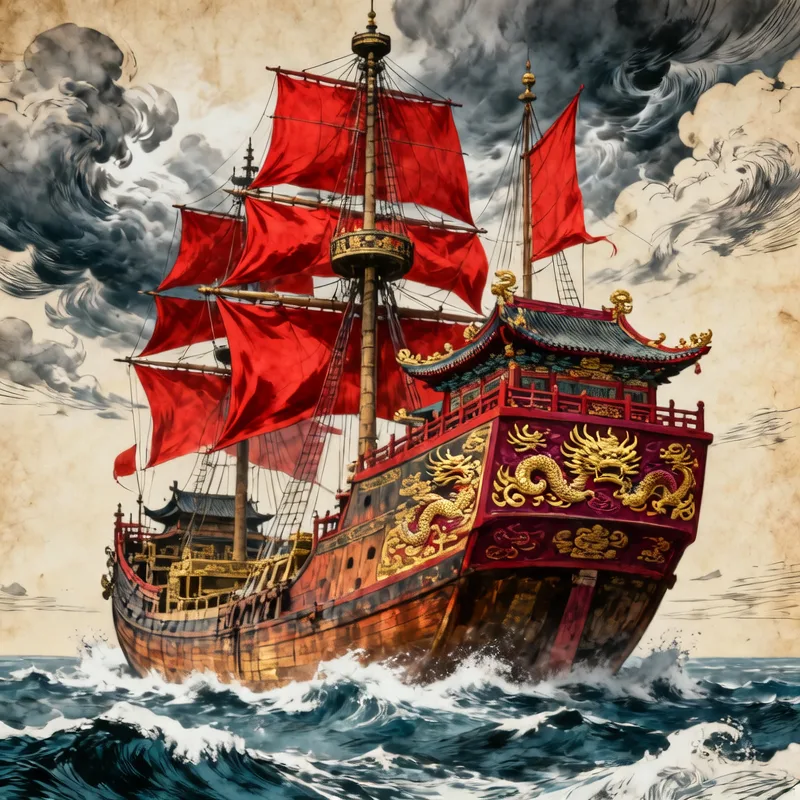
    Large wooden treasure ship with multiple masts and a high stern under sail
    Zheng He’s treasure ships symbolised the Ming court’s reach across the ocean. AI 생성 일러스트 · 시노비즈

    Building and Departing

    The fleets were built and provisioned through a vast state network. Shipyards at Nanjing and in Fujian constructed hulls whose dimensions are debated by historians, while carpenters, sailmakers, and caulkers worked under imperial requisition. Fujian supplied timber, skilled shipwrights, and pilots familiar with the southern seas. Expeditions assembled at Nanjing and at Liujiagang near Suzhou, where a 1431 stone inscription records donations and the distances sailed. From Fujian they rode the northeast monsoon south toward Champa and Java. The 1405 fleet reportedly included more than sixty treasure ships and hundreds of smaller vessels carrying horses, grain, and tribute goods.

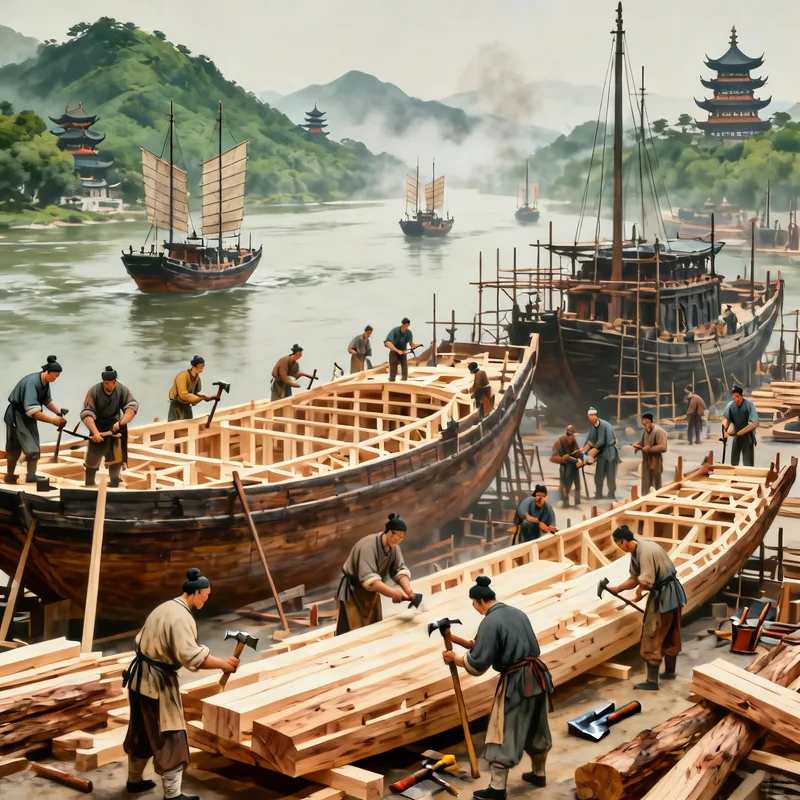
    Busy shipyard on a southeastern Chinese river with timber hulls under construction
    Nanjing and Fujian shipyards supplied the huge Ming fleets. AI 생성 일러스트 · 시노비즈

    Diplomacy Across the Ocean

    Zheng He sailed to Calicut on India’s Malabar Coast, to Hormuz and Aden, and to ports such as Mogadishu and Malindi on the East African coast. The fleets carried silk, porcelain, and gold, and returned with pepper, ivory, incense, gems, and exotic animals, including a giraffe presented as a tribute curiosity. Zheng He also fought pirates in Southeast Asia and installed rulers friendly to Ming interests. Unlike later European voyages, these expeditions did not establish colonies or a permanent overseas empire. They projected the tribute system, under which foreign rulers acknowledged Ming supremacy in exchange for gifts, titles, and protected trade.

    • Calicut on the Malabar Coast
    • Hormuz and Aden at the western end
    • Malacca and Java in Southeast Asia
    • Mogadishu and Malindi in East Africa
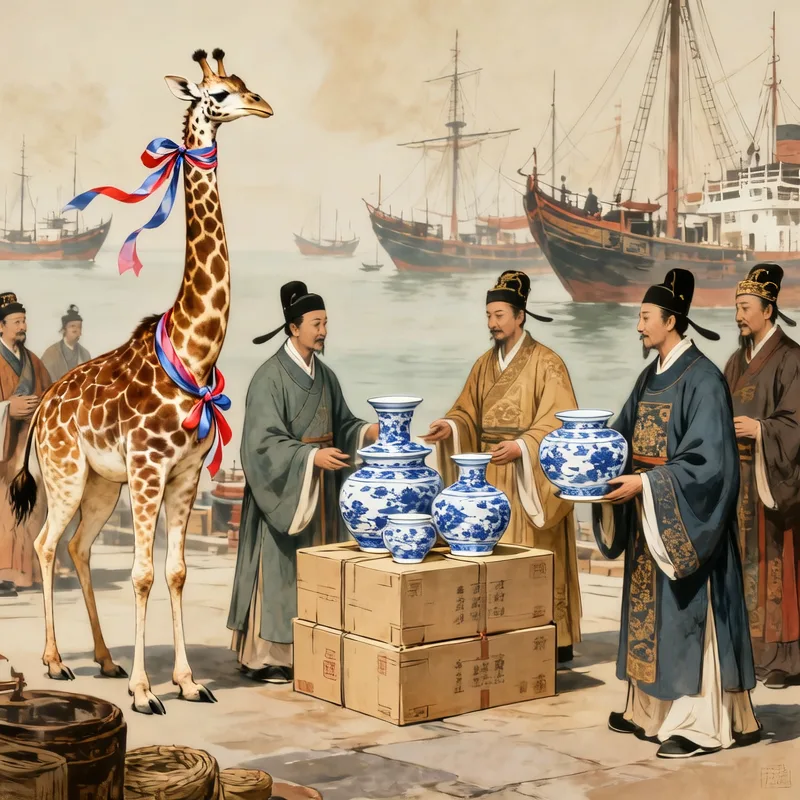
    Foreign envoys presenting a giraffe and ivory at a Ming imperial court audience
    Tribute gifts such as giraffes and ivory embodied the fleet’s diplomatic mission. AI 생성 일러스트 · 시노비즈

    Why the Voyages Stopped

    The expeditions ended after Zheng He died, probably in 1433 during the seventh voyage. His successor, the Hongxi Emperor, had already halted new fleets in 1424, and Confucian ministers argued that the cost drained the treasury while scholar-officials resented the eunuch admiral’s influence. The court shifted resources toward the northern frontier and the Grand Canal. Maritime trade continued through private merchants and the port of Quanzhou, but the state fleet disappeared, and many records were neglected. Centuries later, Chinese historians revisited the voyages as evidence of an earlier age of ocean-going capacity.

    The treasure fleets carried an empire’s courtesy across the ocean, and then sailed no more.

    참고 자료 및 추가 정보

    1. Zheng He — 브리태니커 백과사전.
    2. Quanzhou: Emporium of the World in Song-Yuan China — UNESCO World Heritage Centre.
    3. The Seven Voyages of Zheng He — World History Encyclopedia.

    제자리에 있는 모습을 보세요

    이 항목을 따라가면 해당 영역으로 이동할 수 있습니다.

    지도로 탐색하기

    스레드를 따라가세요

    같은 태그를 가진 다른 항목들을 찾아보세요.

    태그를 찾아보세요
  • 도자기

    삶과 민속

    도자기

    Clay, fire, and the white of Dehua

    Fujian’s kilns turned local clay into porcelain that travelled across the sea and changed how the world pictured China.

    부분
    삶과 민속
    지역
    푸젠
    연대
    시대를 넘어서
    태그
    Customs, History, Scenic Sites

    Porcelain is defined by its body and its firing: a pale, fine clay heated to temperatures that vitrify the material and make it ring when struck. Fujian’s Dehua kilns made a version so white it seemed translucent, known in Europe as blanc de Chine.

    What Makes Porcelain

    Porcelain differs from ordinary pottery in both material and firing. Potters use kaolin, a white clay, mixed with feldspar and quartz, then fire the shaped vessel at roughly 1,200 to 1,400 degrees Celsius. At that temperature the body vitrifies: it becomes dense, non-porous, and slightly translucent at the edges. A glassy glaze is usually applied before firing, bonding to the body rather than sitting on it as a separate layer. Chinese potters had reached this threshold by the Tang and Song periods, and Jingdezhen in Jiangxi became the great production centre. The English word china stuck to the ware because the country was the source of the finest examples. A light tap on a good cup gives a clear ring, a quick test that still works in a shop.

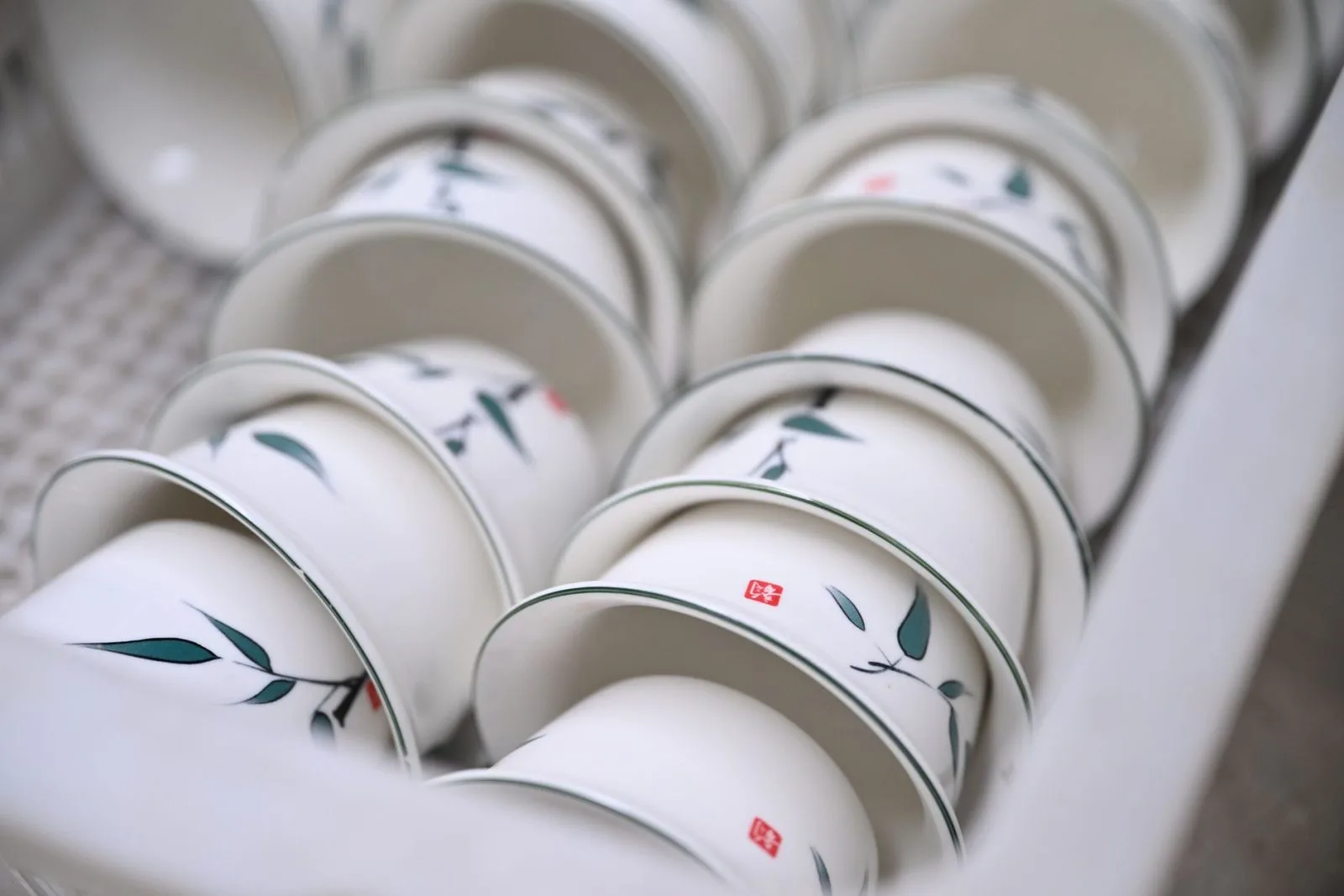
    A porcelain bowl with a pale glaze photographed against light
    True porcelain is fired hot enough to vitrify the body, giving it a hard, resonant wall. lee c | Pexels License (https://www.pexels.com/license/)

    Dehua White

    Dehua, a county in Fujian’s Quanzhou prefecture, developed a white porcelain with a warm, creamy tone. Its clay is low in iron, which lets the glaze fire almost colourless, and its potters mastered figures as well as vessels. From the Ming dynasty onward, Dehua workshops produced small statues of Guanyin, the bodhisattva of compassion, with soft modelling and a smooth, almost waxy surface. European traders called the ware blanc de Chine, and by the seventeenth century it was collected in royal cabinets and copied by potters in Meissen and elsewhere. Tea wares also left the kilns: small cups, gaiwan lids and bowls, and white vessels that showed the colour of tea clearly. Local museums trace the kiln sequence from Song-period celadons through the white wares that made Dehua famous.

    A milky white porcelain figurine of Guanyin from Dehua
    Dehua’s porcelain figures of Guanyin became known in Europe as blanc de Chine. Quý Hoàng | Pexels License (https://www.pexels.com/license/)

    A Port for Porcelain

    Porcelain shaped trade as much as taste. Fujian’s coast faced the South China Sea, and Quanzhou became one of the busiest ports of the Song and Yuan dynasties, a place where merchants, monks, and ship crews exchanged goods and techniques. Archaeologists have recovered Chinese ceramics from ports and shipwrecks across Southeast Asia, the Indian Ocean, and East Africa; the fragments are dated by glaze and shape, making them a record of demand as well as production. UNESCO listed Quanzhou in 2021 as an emporium of the world in Song-Yuan China, with surviving mosques and temples. The export ware was not always the finest court piece. Sturdy bowls and jars packed in straw travelled in bulk, reaching households that never saw the kiln but knew the clay by its colour.

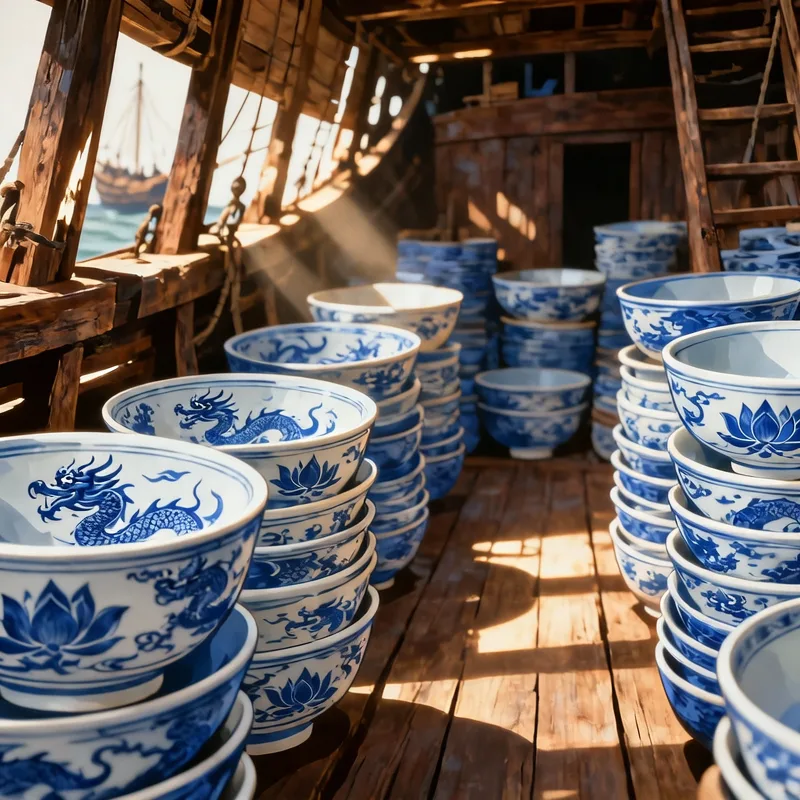
    Blue-and-white porcelain packed as cargo in a ship’s hold
    Quanzhou was a major Song and Yuan port from which Fujian ceramics were shipped abroad. AI 생성 일러스트 · 시노비즈

    Using and Collecting

    Porcelain entered daily ritual as well as trade. A gaiwan, a bowl with a lid and saucer, is used for brewing tea in northern China; the lid controls the leaves and the saucer protects the fingers. White Dehua cups make the colour of a tea liquor easy to judge. Collectors look for a clean foot ring, an even glaze, and a mark painted on the base, though many imitations copy famous reign marks. Visit a kiln museum in Dehua or a ceramic gallery in Quanzhou to see the sequence from raw clay to finished piece. Handling a cup with a saucer and a steady hand is still the simplest way to understand why this material travelled so far.

    A clear ring and a translucent edge tell you what the fire has done.

    참고 자료 및 추가 정보

    1. Chinese Porcelain — The Metropolitan Museum of Art.
    2. Quanzhou: Emporium of the World in Song-Yuan China — UNESCO World Heritage Centre.
    3. Blanc de Chine — 브리태니커 백과사전.

    제자리에 있는 모습을 보세요

    이 항목을 따라가면 해당 영역으로 이동할 수 있습니다.

    지도로 탐색하기

    스레드를 따라가세요

    같은 태그를 가진 다른 항목들을 찾아보세요.

    태그를 찾아보세요
  • Yuan & Ming & Qing

    Era · 1271–1912

    Yuan Ming Qing

    Steppe empire, maritime voyages and the last dynasty

    From Mongol conquest to Ming restoration and Qing expansion, this long period reshaped China’s borders, trade and population. It produced the Forbidden City, great novels, porcelain exports and the final imperial institutions.

    연대
    Yuan Ming Qing
    Years
    1271–1912
    Path
    연대기

    Defining events

    • Yuan unifies China under Mongol rule and expands Eurasian exchange
    • Ming rebuilds the Great Wall and sends Zheng He’s fleets
    • Porcelain, tea and silk become global commodities
    • Qing expands to Xinjiang, Tibet and Mongolia
    • Late Qing faces internal revolt, foreign pressure and reform

    Figures & ideas

    • Zheng He — Admiral of Ming maritime expeditions
    • Kangxi Emperor — Long-reigning Qing ruler of consolidation and scholarship
    • Cao Xueqin — Author associated with Dream of the Red Chamber

    Artifacts & sites

    Follow the era outward

    Read the objects, places and ideas that still carry this period.

    Read the land

    Open the map to see where these events left traces.

    지도로 탐색하기
  • 푸젠

    지역 · 해안, 토루와 차

    푸젠

    푸젠성은 해협을 사이에 두고 대만과 마주 보고 있으며, 바다를 향해 뻗어 있습니다. 산맥은 하카족의 툴루 공동체를 품어주었고, 항구는 해상 무역로를 통해 상인, 이주민, 차를 실어 날랐습니다.

    지역
    푸젠
    좌표
    북위 26.07도, 동경 119.30도
    ~로 알려져 있음
    해안, 툴루, 그리고 차

    풍경

    가파른 언덕들이 험준한 해안선과 만납니다. 강은 바다로 짧은 계곡을 깎아내어 천연 항구를 만들고 내륙 지역 사회를 고립시켜 독특한 건축 양식과 방언을 발전시켰습니다.

    문화유산 및 장소

    • 복건 토루
    • 구랑위
    • 우이산
    • 취안저우 해양 유적지

    문화와 일상생활

    푸젠성은 우롱차, 해산물, 민난 및 하카 문화, 그리고 해양과 관련된 사찰 네트워크로 유명합니다. 이 지역의 역사는 산악 지대와 바다와의 경계가 공존하는 특징을 지니고 있습니다.

    이 지역에서

    다음으로 읽을 이야기

    지도, 연대기, 그리고 일상생활 전반에 걸쳐 이 장소와 관련된 기록들이 있습니다.

    여정을 계속하세요

    이 지역을 여행 가이드와 함께 살펴보거나 시간의 흐름에 따른 이야기를 따라가 보세요.

    여행지를 탐색해 보세요 오픈 크로니클
  • 광시

    Region · Karst and the Li River

    광시

    Guangxi is a landscape of limestone peaks, rivers and terraced hills. Its karst scenery is famous, but the province is equally defined by Zhuang, Dong and Miao communities and their festivals.

    지역
    광시
    좌표
    22.82°N, 108.32°E
    ~로 알려져 있음
    Karst and the Li River

    풍경

    Karst towers rise above the Li River and surrounding plains. Caves, sinkholes and underground rivers shape both the scenery and the agricultural life of the region.

    문화유산 및 장소

    • Li River
    • Longji rice terraces
    • Detian Waterfall
    • Lingqu Canal

    문화와 일상생활

    Guangxi food is sour, fragrant and often river-based. Zhuang song festivals, Dong drum towers and Miao silverwork connect the province’s scenic image to living local traditions.

    이 지역에서

    다음으로 읽을 이야기

    지도, 연대기, 그리고 일상생활 전반에 걸쳐 이 장소와 관련된 기록들이 있습니다.

    여정을 계속하세요

    이 지역을 여행 가이드와 함께 살펴보거나 시간의 흐름에 따른 이야기를 따라가 보세요.

    여행지를 탐색해 보세요 오픈 크로니클
  • 광둥

    Region · The Pearl River and the sea

    광둥

    Guangdong faces the South China Sea and the Pearl River Delta. Its ports, dialects and Cantonese food culture have long connected China to maritime trade and overseas communities.

    지역
    광둥
    좌표
    23.13°N, 113.26°E
    ~로 알려져 있음
    The Pearl River and the sea

    풍경

    A subtropical coast gives way to river plains and northern hills. The delta’s waterways supported agriculture, trade and the dense urban networks that define the region today.

    문화유산 및 장소

    • Kaiping diaolou
    • Danxia landforms
    • Guangzhou old quarters
    • Foshan ancestral halls

    문화와 일상생활

    Cantonese cuisine prizes freshness, seafood and dim sum. Lingnan architecture, opera and clan halls reflect a culture shaped by commerce, migration and humid coastal life.

    이 지역에서

    다음으로 읽을 이야기

    지도, 연대기, 그리고 일상생활 전반에 걸쳐 이 장소와 관련된 기록들이 있습니다.

    여정을 계속하세요

    이 지역을 여행 가이드와 함께 살펴보거나 시간의 흐름에 따른 이야기를 따라가 보세요.

    여행지를 탐색해 보세요 오픈 크로니클