Blog

  • Tang Chang’an

    연대기

    Tang Chang’an

    Cosmopolitan Capital on the Wei River

    The Tang capital whose grid of wards held merchants, monks, and foreign envoys.

    부분
    연대기
    지역
    산시
    연대
    sui-tang
    태그
    History, Scenic Sites

    Chang’an, on the site of modern Xi’an in Shaanxi, was the capital of the Tang dynasty from 618 to 907. Its planned streets and regulated markets made it the eastern anchor of the Silk Roads and a city of unusually visible cultural exchange.

    A City Built on a Grid

    The Tang city followed the plan of Daxing, built for the Sui dynasty in 582, and was renamed Chang’an under the Tang in 618. Its rectangular enclosure covered roughly 84 square kilometres and was divided into the palace city, the imperial city, and 108 residential wards. Eleven north-south avenues crossed fourteen east-west streets, creating a rigid grid that reflected the court’s desire for order. The city wall had twelve gates, with the southern gate leading to the ceremonial avenue. Excavations have revealed the scale of the wards, which enclosed houses, temples, workshops, and narrow internal lanes.
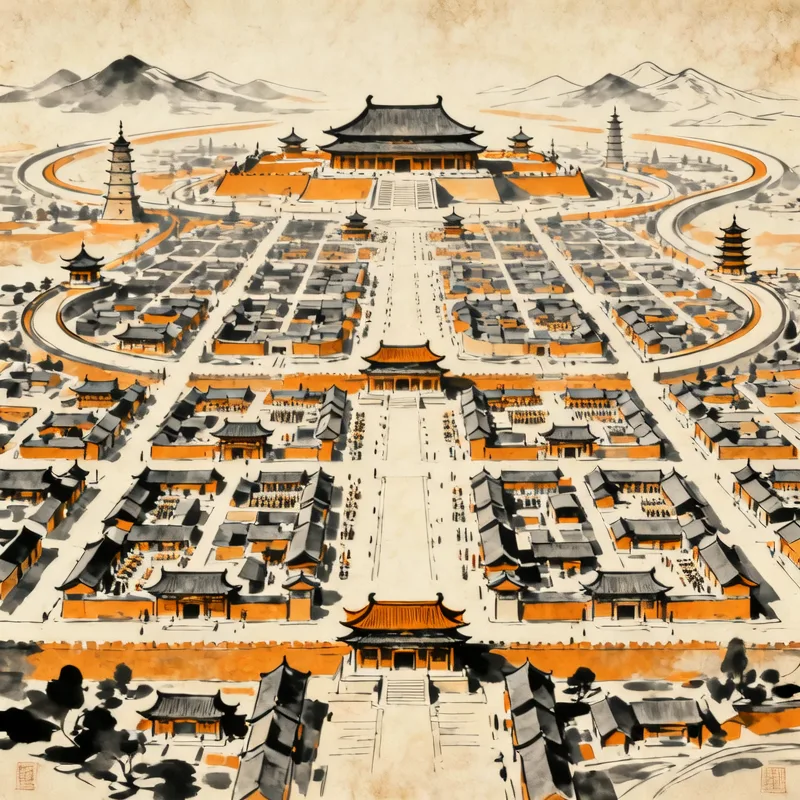
    Aerial reconstruction of a gridded Tang capital with the palace city at the north and ward blocks beyond
    Tang Chang’an organised more than a hundred wards within a vast rectangular wall. AI 생성 일러스트 · 시노비즈

    Markets and Curfew

    Commerce was concentrated in the East Market and West Market, each a walled rectangle of lanes and shops. The West Market served long-distance traders, with Sogdian and Persian merchants, wine shops, money changers, and pawnshops. Officials supervised weights and licensed trades, while a market administration kept order. A night curfew closed the ward gates after the evening drum, so business belonged to daylight hours. A Tang writer records more than two hundred trades in the West Market, from silk dyeing to medicine. This regulated commerce made customs revenue and luxury goods flow steadily into the capital.
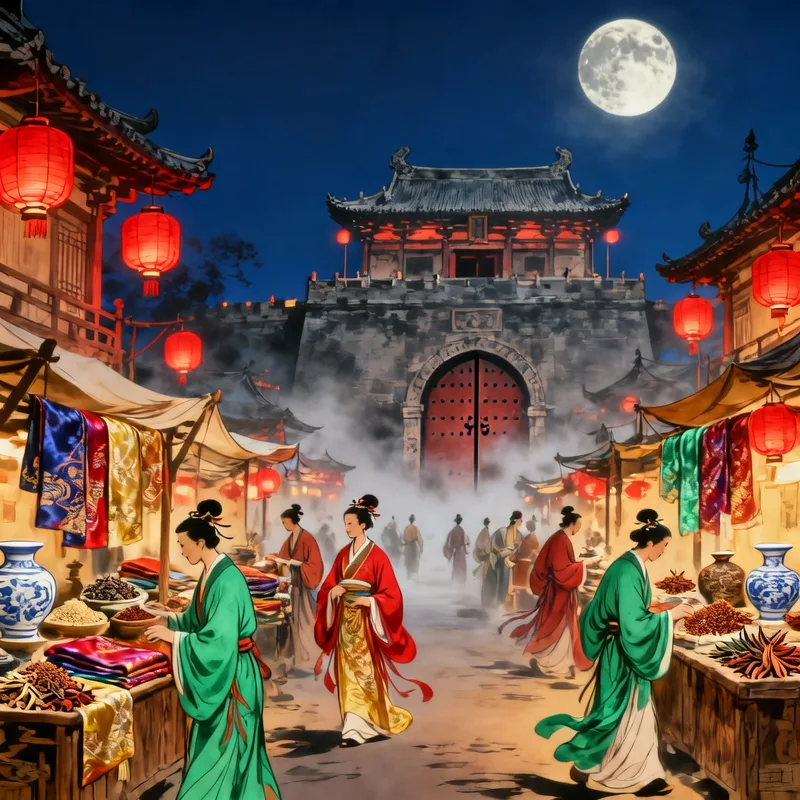
    Reconstructed Tang market lane with awnings, merchants, and stacked goods
    Licensed trades filled the West Market, a hub for long-distance merchants. AI 생성 일러스트 · 시노비즈

    Monks, Envoys, and a Stele

    Chang’an’s religious landscape matched its commercial range. The Buddhist monk Xuanzang returned from India in 645 with scriptures and translated them at the Da Ci’en Temple, completed in 652; the Giant Wild Goose Pagoda still stands nearby. The Nestorian Stele, erected in 781, records the arrival of a Christian missionary in 635 and documents a church that used Chinese Buddhist and Daoist vocabulary. Zoroastrian and Manichaean communities had places of worship, and Arab and Persian traders lived in the western wards. Japanese embassies reached the city between 630 and 894, and Korean students studied at the imperial academy, carrying Tang institutions home.
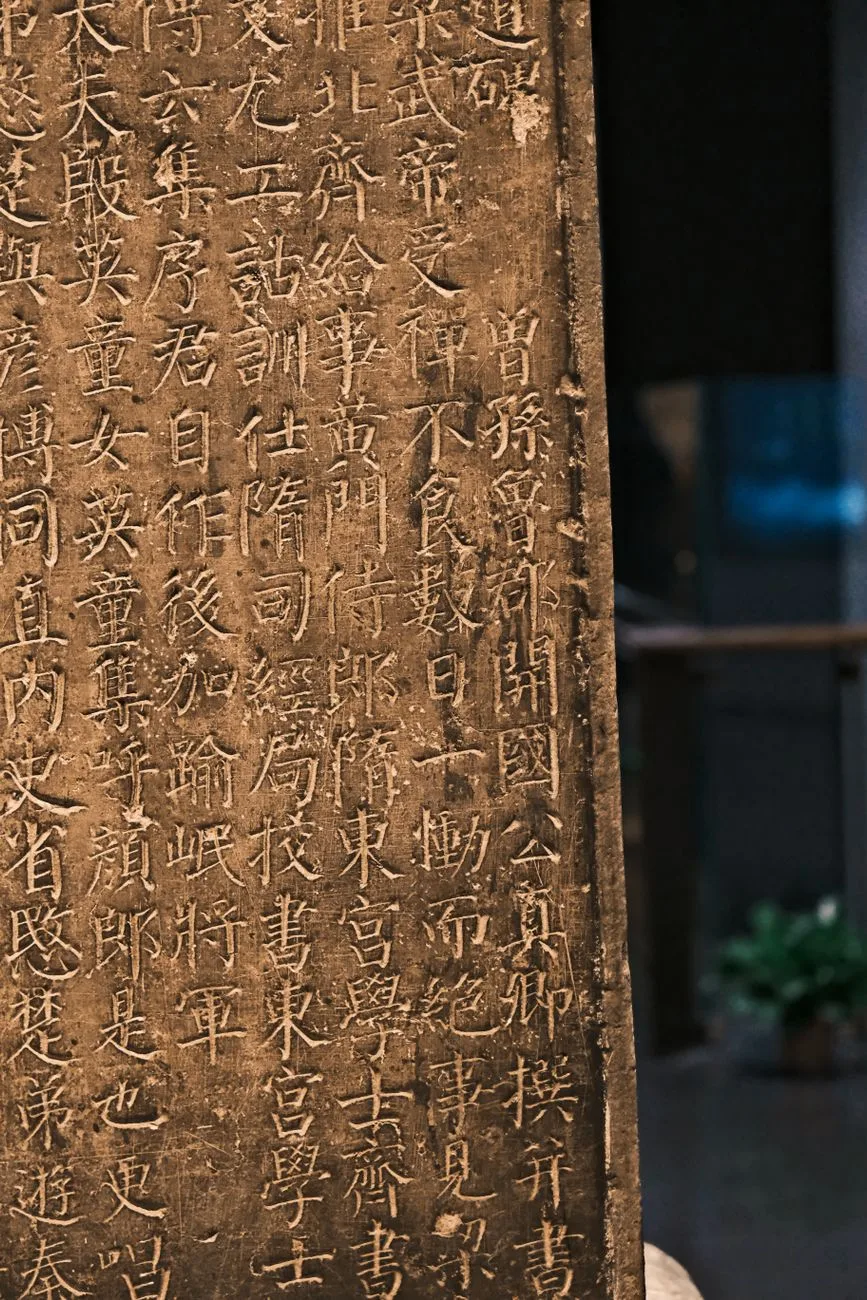
    Stone stele with Chinese and Syriac inscriptions standing beside a Tang temple wall
    The 781 Nestorian Stele records Christianity’s arrival at the Tang court in 635. Lily Lili | Pexels License (https://www.pexels.com/license/)

    After the Tang

    The city’s political role ended abruptly. In 904, the warlord Zhu Wen forced the court to move to Luoyang and ordered much of Chang’an dismantled, so that its timber could be transported east. The Tang fell in 907, and the site never recovered its former extent. Later rulers fortified a smaller city on part of the old ground; the present Xi’an city wall dates from the Ming dynasty. Archaeologists have since mapped the Tang wards and excavated the West Market. The Giant and Small Wild Goose Pagodas remain visible markers of a capital that once connected the Wei River to the Indian Ocean.

    In Tang Chang’an, the ward gate, the market licence, and the foreign monk belonged to the same system.

    참고 자료 및 추가 정보

    1. Silk Roads: the Routes Network of Chang’an-Tianshan Corridor — UNESCO World Heritage Centre.
    2. Chang’an — 브리태니커 백과사전.
    3. Chang’an — World History Encyclopedia.

    제자리에 있는 모습을 보세요

    이 항목을 따라가면 해당 영역으로 이동할 수 있습니다.

    지도로 탐색하기

    스레드를 따라가세요

    같은 태그를 가진 다른 항목들을 찾아보세요.

    태그를 찾아보세요
  • 실크로드

    연대기

    실크로드

    Caravan Routes Across Inner Asia

    Overland trade routes that tied Chang’an to the Mediterranean through Central Asian oases.

    부분
    연대기
    지역
    신장
    연대
    qin-han
    태그
    History, Geography

    The Silk Road was a network of caravan paths, not a single highway. Its Chinese section ran from Chang’an through the Hexi Corridor into Xinjiang, where oasis towns supplied water, fodder, and translators to merchants crossing the Taklamakan Desert.

    Zhang Qian Opens the Route

    The route enters Chinese records through an embassy. In 138 BCE, Emperor Wu of Han sent Zhang Qian west to seek an alliance with the Yuezhi against the Xiongnu. Zhang was captured by the Xiongnu and held for about ten years, but he escaped, reached the Yuezhi in Bactria, and returned in 126 BCE with reports of cities, markets, and horses far to the west. Sima Qian preserved his account in the Shiji, written around 100 BCE. A second mission followed in 119 BCE. These reports gave the Han court both geographical knowledge and a strategic reason to secure the corridor.

    Caravan track leaving the Hexi Corridor toward the oases of the Tarim Basin
    Han envoys followed the Hexi Corridor into the Tarim Basin in the second century BCE. AI 생성 일러스트 · 시노비즈

    Oasis Cities of the Tarim

    Travel across the Taklamakan followed its northern and southern rims, where mountain meltwater formed oases. Kashgar, Khotan, Yarkand, Kuqa, Karashahr, and Turpan grew into trading towns with irrigated fields, caravanserais, and multilingual populations. Sogdian merchants from Samarkand and Bukhara dominated much of the long-distance carrying trade between the fourth and eighth centuries, while local rulers taxed caravans and protected water points. Dunhuang, at the eastern edge of the desert, became the gateway where goods, envoys, and monks were recorded. The cave complex at Mogao, begun in 366 CE, preserves this mixture of languages and faiths.

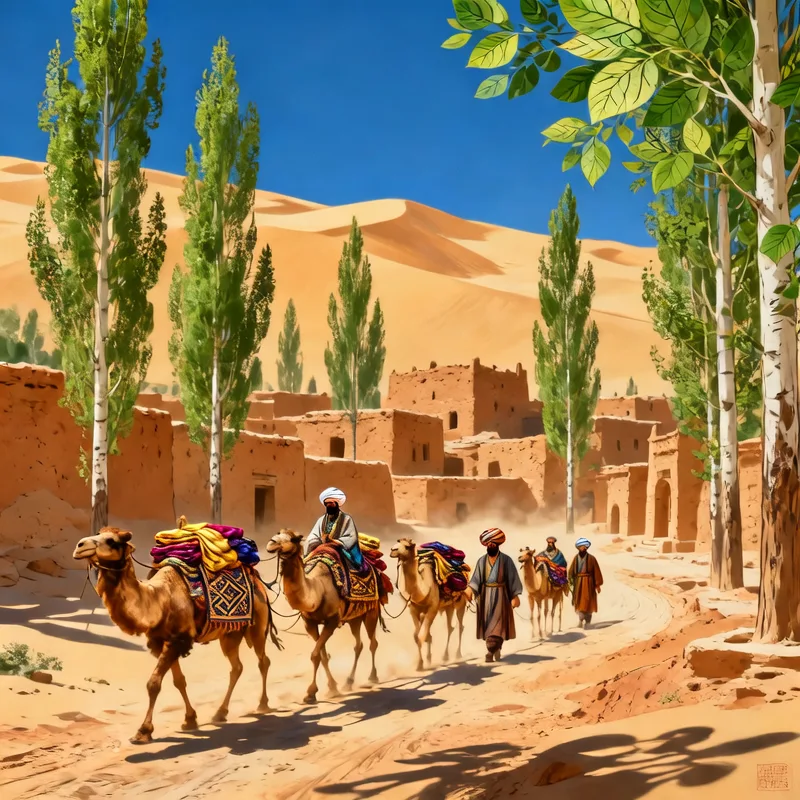
    Mud-brick oasis town and poplar groves at the edge of a Central Asian desert
    Tarim Basin oases supplied water and fodder to caravans crossing the desert rims. AI 생성 일러스트 · 시노비즈

    What Actually Travelled

    Silk gave the network its name, but caravans carried far more. Chinese silk, lacquer, and later paper moved west; Central Asian horses, jade, glassware, spices, and cotton moved east. Ideas travelled with the goods. Buddhism reached the Han capital by the first century CE, and monks such as Kumarajiva, who arrived at Chang’an in 401, translated Indian scriptures into Chinese. Technologies including papermaking and gunpowder eventually spread west, while grape growing and new musical instruments came east. The routes changed course with the politics of each dynasty, so the phrase Silk Road describes a shifting system rather than a fixed path.

    • Silk and paper moving west from China
    • Horses, jade, and glass moving east
    • Buddhist monks and translated scriptures
    • Sogdian merchants and caravanserais
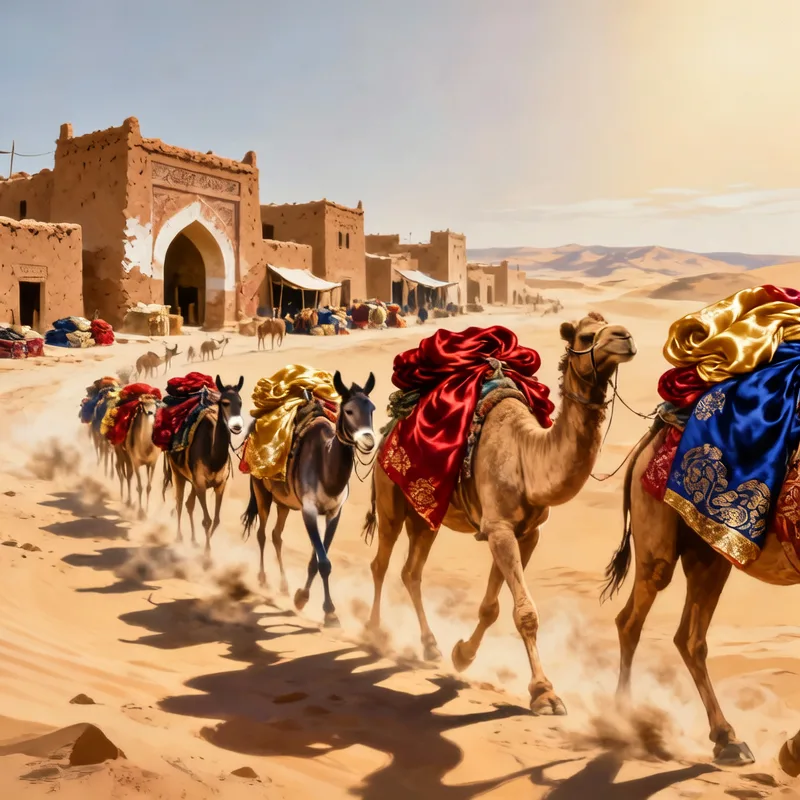
    Caravan of pack animals loaded with silk bundles approaching a desert trading town
    Caravans carried silk, horses, glass, and religious ideas in both directions. AI 생성 일러스트 · 시노비즈

    Decline and Afterlife

    Overland trade did not end abruptly. It declined as maritime routes expanded under the Tang and especially the Song, when ships could carry bulky porcelain and tea more cheaply than pack animals. The fragmentation of Central Asian politics after the Tang collapse in 907 and the rise of new powers farther east redirected traffic. Khara-Khoto and other desert towns continued to operate under the Western Xia in the eleventh and twelfth centuries. In the twentieth century, archaeologists working at Dunhuang and Turpan recovered manuscripts and objects that revealed how varied the traffic had been. Today the name Silk Road is used for both the historical network and modern investment projects.

    The Silk Road was held together by water points, translators, and credit as much as by silk.

    참고 자료 및 추가 정보

    1. Silk Roads: the Routes Network of Chang’an-Tianshan Corridor — UNESCO World Heritage Centre.
    2. Silk Road — 브리태니커 백과사전.
    3. 실크로드 — World History Encyclopedia.
    제자리에 있는 모습을 보세요

    이 항목을 따라가면 해당 영역으로 이동할 수 있습니다.

    지도로 탐색하기

    스레드를 따라가세요

    같은 태그를 가진 다른 항목들을 찾아보세요.

    태그를 찾아보세요
  • Zheng He’s Voyages

    연대기

    Zheng He’s Voyages

    Seven Voyages of the Ming Treasure Fleet

    A mid-fifteenth-century fleet that carried Ming diplomacy across the Indian Ocean.

    부분
    연대기
    지역
    푸젠
    연대
    yuan-ming-qing
    태그
    History, Transport

    Between 1405 and 1433, the Ming court sent seven large naval expeditions into the Indian Ocean. Commanded by the eunuch admiral Zheng He, the fleets visited ports from Southeast Asia to East Africa, exchanging gifts and asserting a maritime order.

    A Commander from Yunnan

    Zheng He was born Ma He around 1371 in Kunyang, Yunnan, into a Muslim family with connections to the Mongol administration. Captured as a boy during the Ming conquest of Yunnan, he entered the household of the prince of Yan, later the Yongle Emperor. He took the name Zheng He and rose to become a trusted eunuch official. In 1405, the Yongle Emperor ordered him to lead a fleet to the western oceans. The first voyage carried well over twenty thousand men, and the largest ships were far bigger than contemporary European vessels. Seven expeditions followed over twenty-eight years.

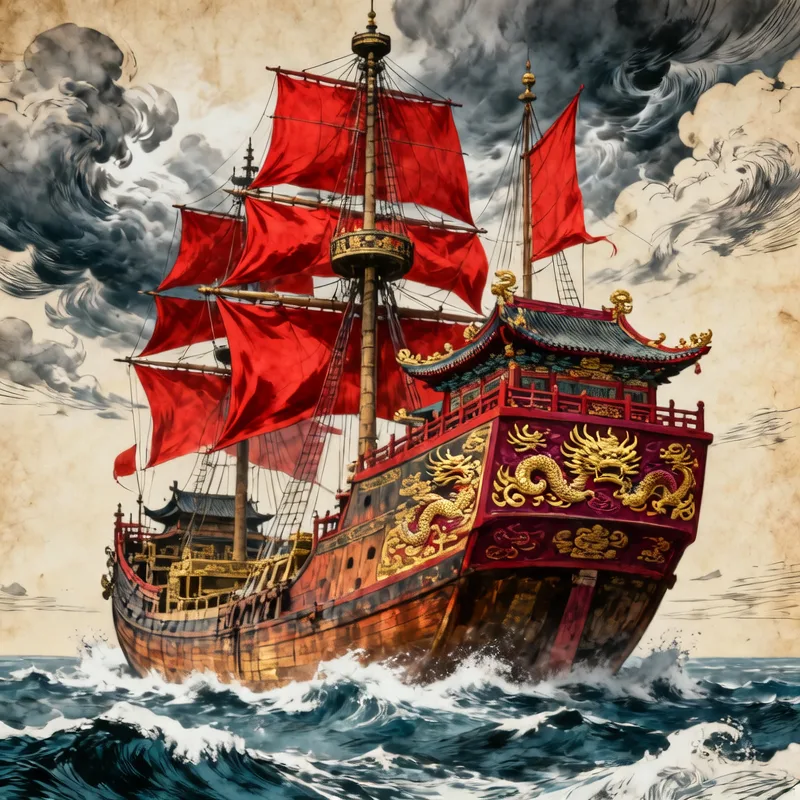
    Large wooden treasure ship with multiple masts and a high stern under sail
    Zheng He’s treasure ships symbolised the Ming court’s reach across the ocean. AI 생성 일러스트 · 시노비즈

    Building and Departing

    The fleets were built and provisioned through a vast state network. Shipyards at Nanjing and in Fujian constructed hulls whose dimensions are debated by historians, while carpenters, sailmakers, and caulkers worked under imperial requisition. Fujian supplied timber, skilled shipwrights, and pilots familiar with the southern seas. Expeditions assembled at Nanjing and at Liujiagang near Suzhou, where a 1431 stone inscription records donations and the distances sailed. From Fujian they rode the northeast monsoon south toward Champa and Java. The 1405 fleet reportedly included more than sixty treasure ships and hundreds of smaller vessels carrying horses, grain, and tribute goods.

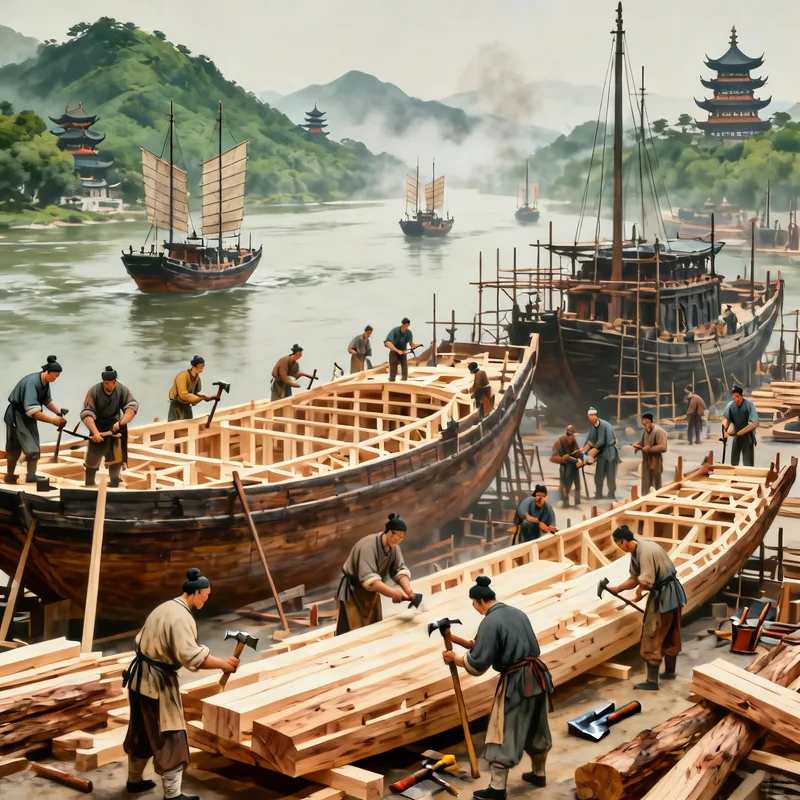
    Busy shipyard on a southeastern Chinese river with timber hulls under construction
    Nanjing and Fujian shipyards supplied the huge Ming fleets. AI 생성 일러스트 · 시노비즈

    Diplomacy Across the Ocean

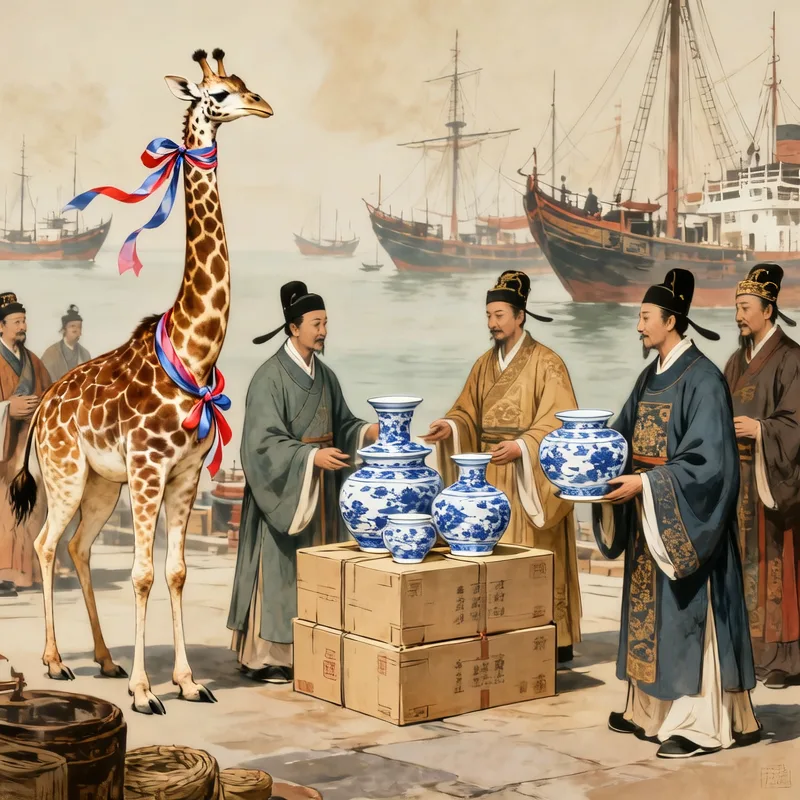
    Zheng He sailed to Calicut on India’s Malabar Coast, to Hormuz and Aden, and to ports such as Mogadishu and Malindi on the East African coast. The fleets carried silk, porcelain, and gold, and returned with pepper, ivory, incense, gems, and exotic animals, including a giraffe presented as a tribute curiosity. Zheng He also fought pirates in Southeast Asia and installed rulers friendly to Ming interests. Unlike later European voyages, these expeditions did not establish colonies or a permanent overseas empire. They projected the tribute system, under which foreign rulers acknowledged Ming supremacy in exchange for gifts, titles, and protected trade.

    • Calicut on the Malabar Coast
    • Hormuz and Aden at the western end
    • Malacca and Java in Southeast Asia
    • Mogadishu and Malindi in East Africa
    Foreign envoys presenting a giraffe and ivory at a Ming imperial court audience
    Tribute gifts such as giraffes and ivory embodied the fleet’s diplomatic mission. AI 생성 일러스트 · 시노비즈

    Why the Voyages Stopped

    The expeditions ended after Zheng He died, probably in 1433 during the seventh voyage. His successor, the Hongxi Emperor, had already halted new fleets in 1424, and Confucian ministers argued that the cost drained the treasury while scholar-officials resented the eunuch admiral’s influence. The court shifted resources toward the northern frontier and the Grand Canal. Maritime trade continued through private merchants and the port of Quanzhou, but the state fleet disappeared, and many records were neglected. Centuries later, Chinese historians revisited the voyages as evidence of an earlier age of ocean-going capacity.

    The treasure fleets carried an empire’s courtesy across the ocean, and then sailed no more.

    참고 자료 및 추가 정보

    1. Zheng He — 브리태니커 백과사전.
    2. Quanzhou: Emporium of the World in Song-Yuan China — UNESCO World Heritage Centre.
    3. The Seven Voyages of Zheng He — World History Encyclopedia.
    제자리에 있는 모습을 보세요

    이 항목을 따라가면 해당 영역으로 이동할 수 있습니다.

    지도로 탐색하기

    스레드를 따라가세요

    같은 태그를 가진 다른 항목들을 찾아보세요.

    태그를 찾아보세요
  • Confucius and the Analects

    연대기

    Confucius and the Analects

    A Teacher’s Words in Twenty Books

    The sayings of Confucius and the ritual tradition that grew around them.

    부분
    연대기
    지역
    베이징
    연대
    three-dynasties
    태그
    History, Customs

    Confucius lived in a fractured Zhou world and taught that good government began with personal conduct. His conversations, collected in the Analects, became one of the most widely read texts in East Asia and eventually a foundation of state ritual and examination culture.

    Life in the State of Lu

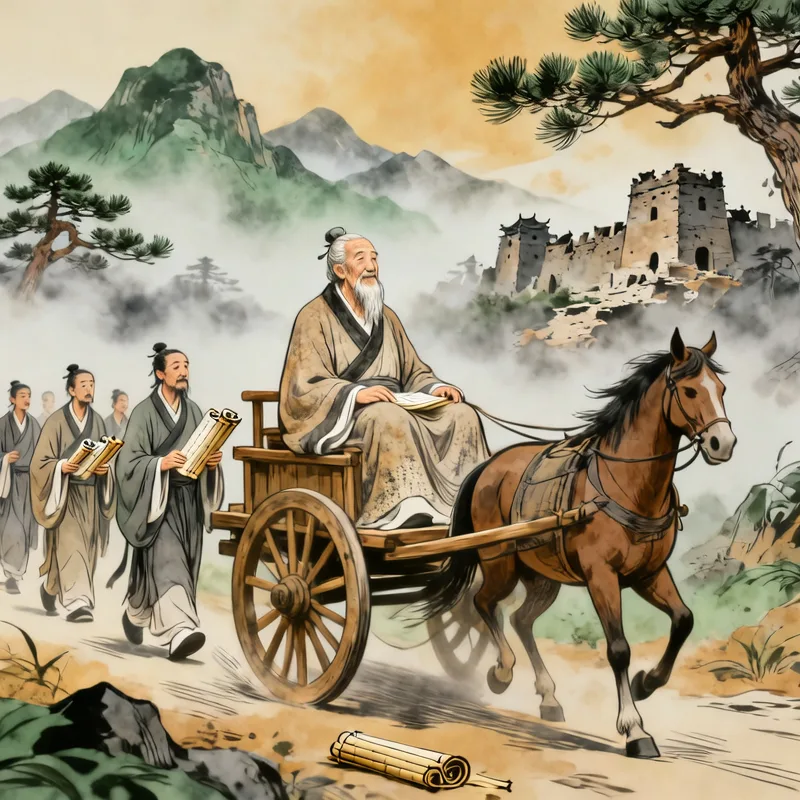
    Confucius, whose family name was Kong and personal name Qiu, was born in 551 BCE at Qufu in the state of Lu, in present-day Shandong. His father died when he was young, and he later worked as a keeper of granaries and herds before becoming known as a teacher. Around 497 BCE he left Lu after a political dispute and spent roughly fourteen years travelling through neighbouring states, advising rulers and gathering disciples. He returned to Lu around 484 BCE and died in 479 BCE. The Spring and Autumn era in which he lived saw the Zhou king’s authority eroded by powerful regional lords.

    Illustration of Confucius travelling with disciples through a hilly landscape
    Confucius spent about fourteen years seeking rulers willing to adopt his teaching. AI 생성 일러스트 · 시노비즈

    How the Analects Took Shape

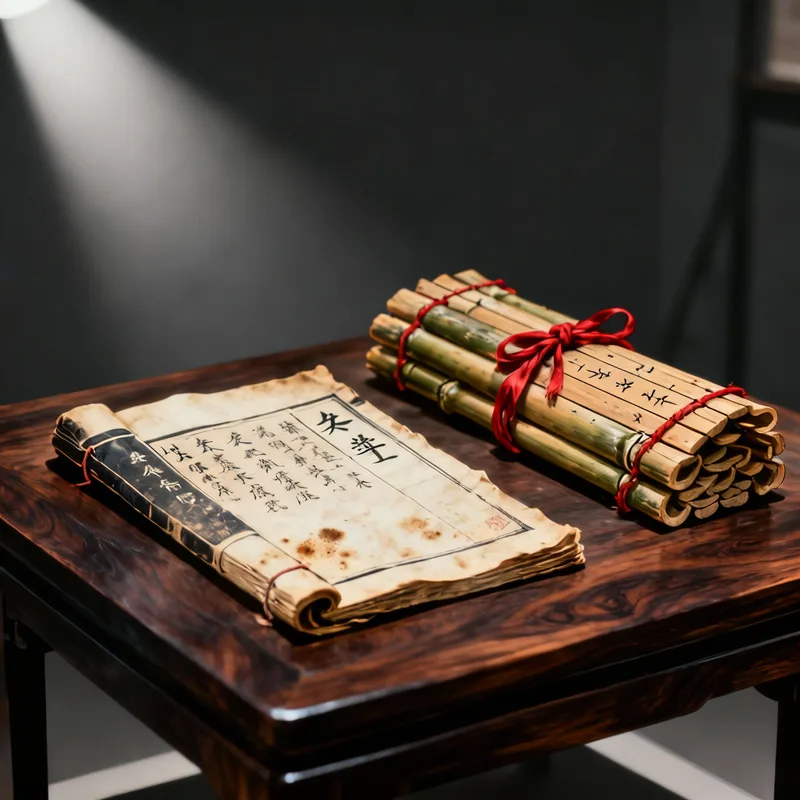
    The Analects, or Lunyu, is not a book written by Confucius himself. It is a compilation of sayings, questions, and short scenes, traditionally arranged in twenty chapters. Disciples and later followers transmitted the material orally before it reached its received form, probably during the fourth and third centuries BCE. Passages typically begin with "The Master said," followed by terse maxims on learning, ritual, and government. The Latin title Analects means "selected sayings." Because the text layers different generations of memory, it presents a teacher in conversation rather than a single systematic doctrine, which is part of its enduring appeal.

    Open page of a Chinese woodblock edition of the Analects with vertical columns of characters
    The Analects gathers sayings transmitted by disciples over several generations. AI 생성 일러스트 · 시노비즈

    From Qufu to Beijing

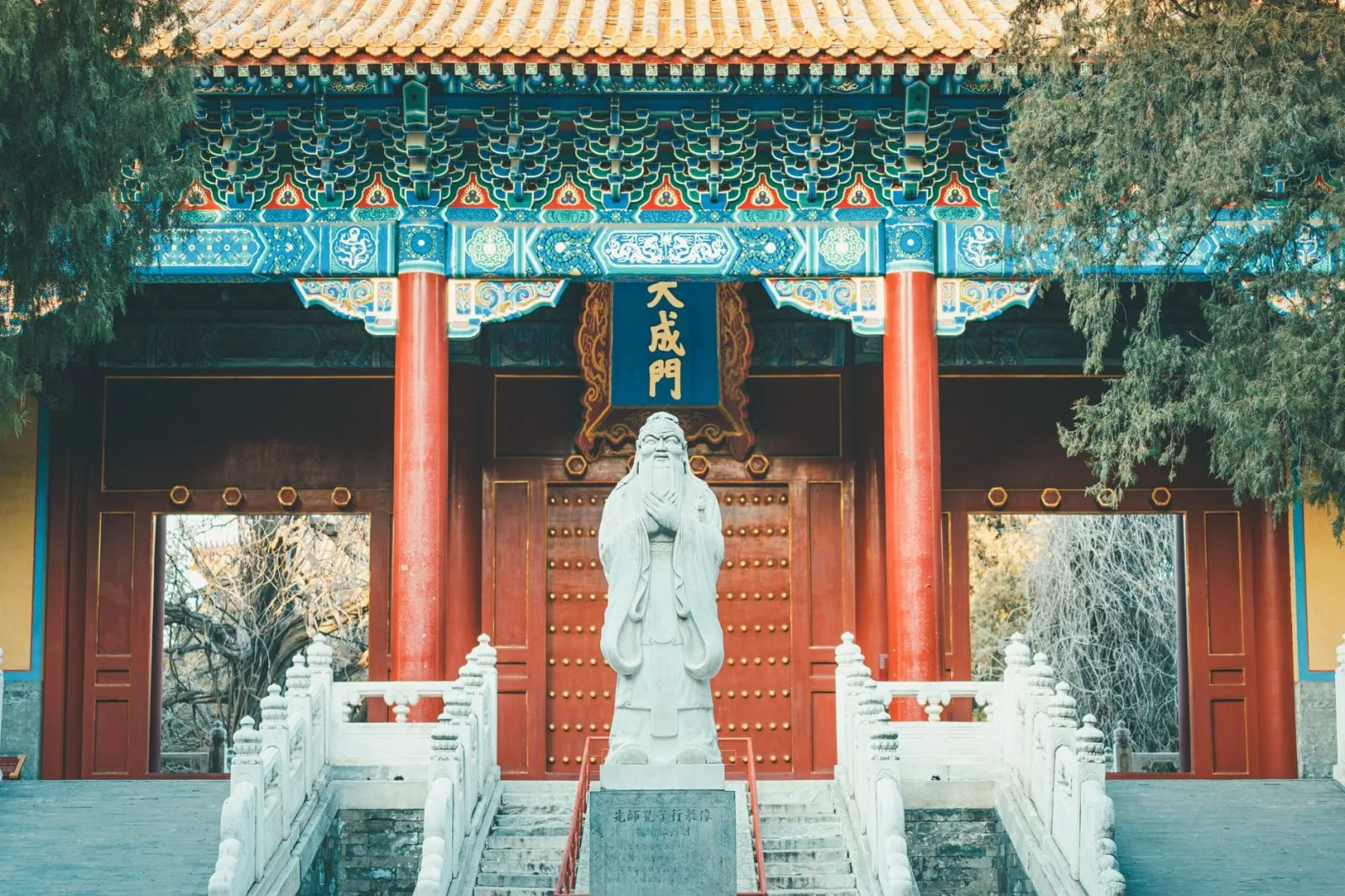
    Confucius was honoured regionally in his lifetime and officially after his death. In 134 BCE, Emperor Wu of Han adopted the recommendation of Dong Zhongshu to elevate Confucian learning at court, and the imperial academy was founded in 124 BCE. The state cult spread: a temple at Qufu grew around the Kong family mansion and cemetery, and rulers performed sacrifices to the sage. In Beijing, a Temple of Confucius was built in 1302 under the Yuan dynasty and rebuilt under the Ming and Qing. It stood beside the Imperial College, linking the veneration of the teacher to the training of officials.

    Courtyard of a red-walled Confucian temple with a bronze incense burner and cypress trees
    Beijing’s Temple of Confucius, first built in 1302, joined worship to official education. zhang kaiyv | Pexels License (https://www.pexels.com/license/)

    The Teaching in Practice

    The central terms are ren, often translated as humaneness, and li, ritual propriety. Confucius treated them as habits formed through practice: respect for elders, careful speech, and attention to the duties of one’s position. The famous negative formulation of reciprocity, "What you do not want done to yourself, do not do to others," appears in the Analects. The text also insists that rulers set the moral tone, comparing their virtue to wind that bends the grass. Later readers in Korea, Japan, and Vietnam adapted the same vocabulary, while Neo-Confucian thinkers of the Song dynasty built a more systematic philosophy from it.

    What you do not want done to yourself, do not do to others. — Confucius, Analects 15.24

    참고 자료 및 추가 정보

    1. Confucius — 브리태니커 백과사전.
    2. Confucius — Stanford Encyclopedia of Philosophy.
    3. Temple and Cemetery of Confucius and the Kong Family Mansion in Qufu — UNESCO World Heritage Centre.

    제자리에 있는 모습을 보세요

    이 항목을 따라가면 해당 영역으로 이동할 수 있습니다.

    지도로 탐색하기

    스레드를 따라가세요

    같은 태그를 가진 다른 항목들을 찾아보세요.

    태그를 찾아보세요
  • 진나라 통일

    연대기

    진나라 통일

    One Empire, One Script, One Standard

    The conquests and reforms that created China’s first centralised empire.

    부분
    연대기
    지역
    산시
    연대
    qin-han
    태그
    역사

    In 221 BCE, the king of Qin took the title First Emperor and ended centuries of interstate rivalry. The dynasty he founded lasted only fifteen years, yet its administrative methods shaped every later Chinese state.

    The Warring States Background

    The Qin state grew powerful in the Wei River valley, in modern Shaanxi, because of reforms carried out by the minister Shang Yang from 356 BCE. He reorganised landholding, rewarded agricultural output and military merit, registered households for taxation and conscription, and imposed a strict legal code. These measures gave Qin a disciplined army and a reliable grain supply. Its rivals, including Chu, Zhao, Wei, Han, Yan, and Qi, held out with varying success through the fourth and third centuries BCE. The walled capital Xianyang became the base from which Qin kings directed a long series of campaigns.

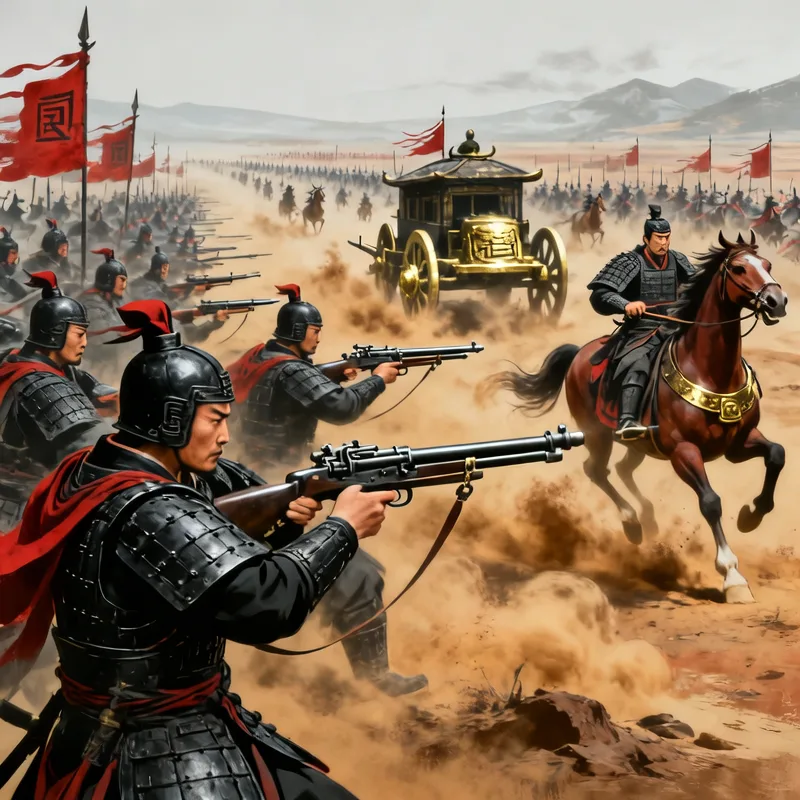
    Reconstructed Warring States crossbow formation advancing toward a walled city
    Shang Yang’s reforms turned Qin into the most disciplined of the seven states. AI 생성 일러스트 · 시노비즈

    The Campaigns of 230–221 BCE

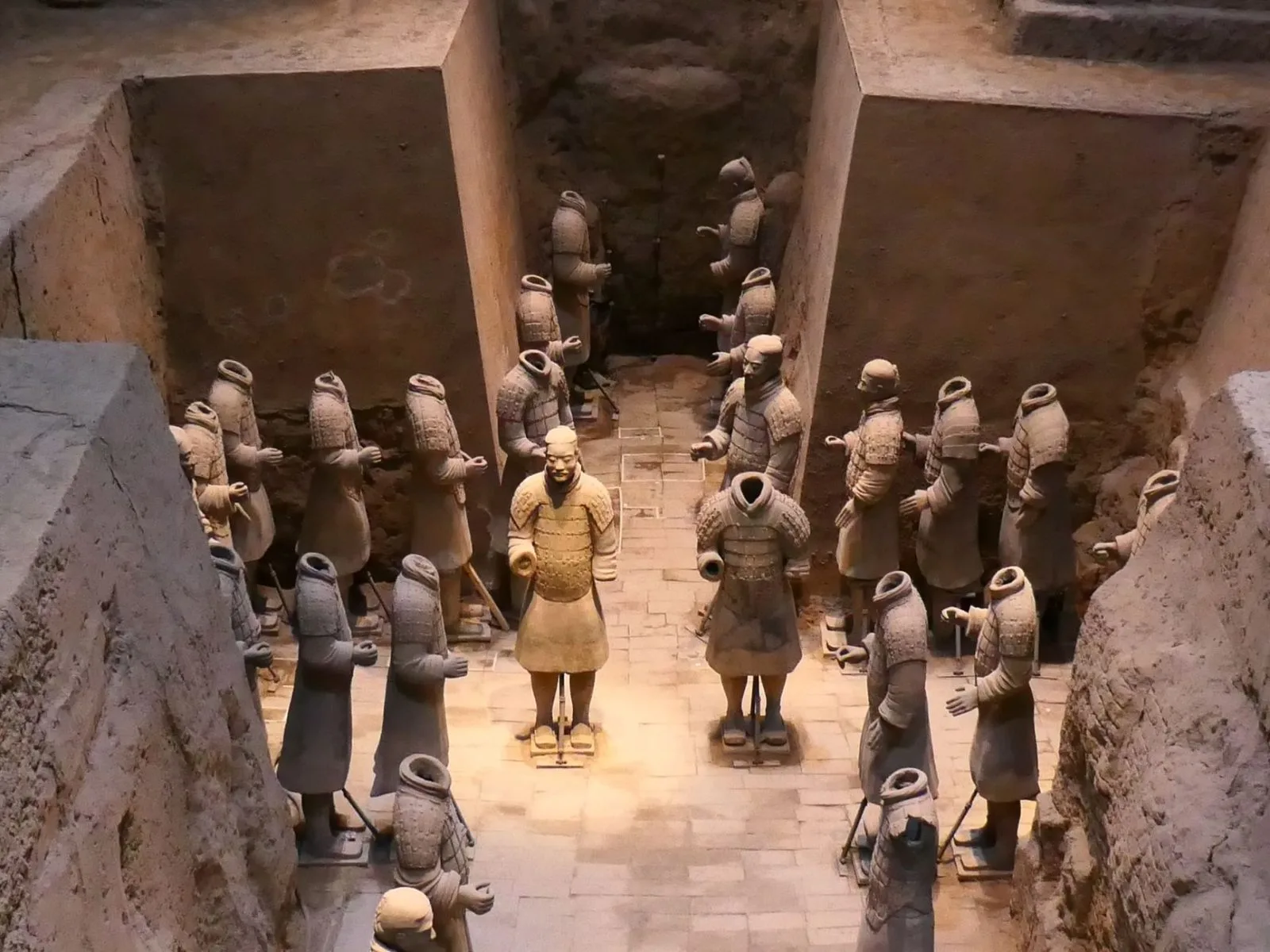
    Between 230 and 221 BCE, Qin armies conquered the six remaining states in sequence: Han, Zhao, Wei, Chu, Yan, and Qi. The king, Ying Zheng, had come to the throne in 246 BCE and, after victory, adopted the title Qin Shi Huang, First Emperor of Qin. His chancellor Li Si argued against restoring feudal fiefs for the royal family and generals, warning that they would become independent rivals. The emperor accepted the argument and divided the empire into commanderies governed by appointed officials. A famous debate at court in 221 BCE thus settled the shape of imperial rule for centuries.

    Terracotta army rank and file standing in formation in a pit near Xi’an
    The First Emperor’s burial army reflects the military power behind unification. nana liu | Pexels License (https://www.pexels.com/license/)

    Standards as an Instrument of Rule

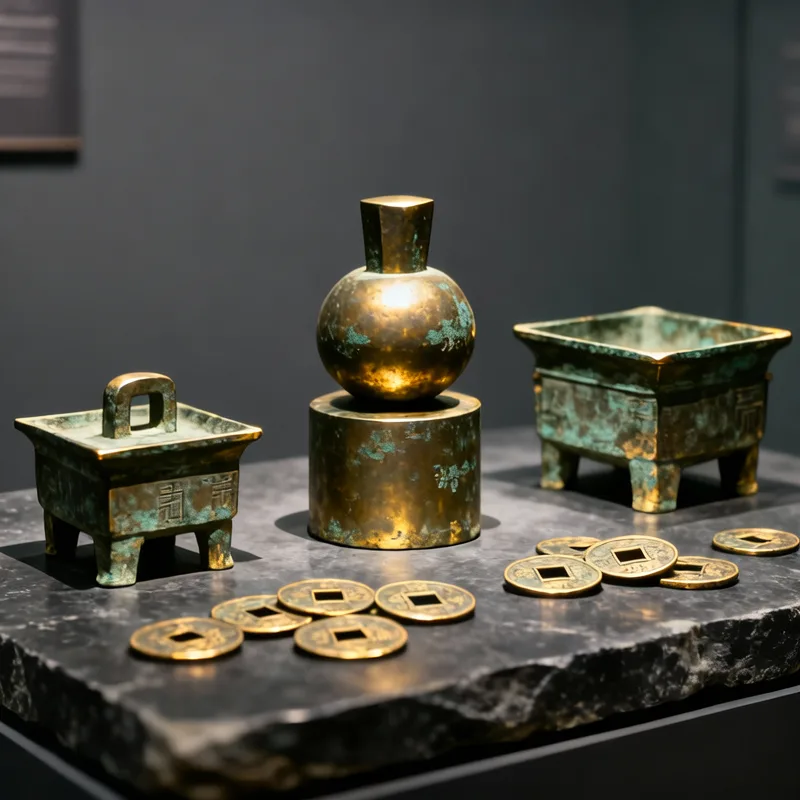
    Unification required practical uniformity. The Qin court standardised weights and measures, the round copper banliang coin, and the small seal script, a simplified writing system that officials could use across regions with different spoken languages. Carts were built to a common axle width so that ruts on imperial roads would match, and a network of highways and canals linked the capital to the provinces. Decrees were carved on stone and distributed. These policies lowered the costs of taxation, transport, and legal administration. They also made central authority visible in daily transactions, from market weights to the shape of a written character.

    Bronze measuring vessel and round copper coin of the Qin dynasty in a museum case
    Standard measures and coinage made an empire administratively legible. AI 생성 일러스트 · 시노비즈

    The Cost of Uniformity

    The same government that standardised script also demanded heavy labour and enforced ideological conformity. Hundreds of thousands of convicts and conscripts worked on the emperor’s mausoleum near Mount Li, the frontier walls, and the Epang Palace. In 213 BCE, Li Si urged the burning of historical records and privately held books outside approved technical works; the following year, hundreds of scholars were reportedly executed at Xianyang. When the emperor died in 210 BCE, the succession was contested and revolts began in 209 BCE under Chen Sheng and Wu Guang. The dynasty fell in 206 BCE, but the Qin framework survived.

    The Qin won the empire with armies and kept it with writing, weights, and roads.

    참고 자료 및 추가 정보

    1. Qin dynasty — 브리태니커 백과사전.
    2. Mausoleum of the First Qin Emperor — UNESCO World Heritage Centre.
    3. Qin Dynasty — World History Encyclopedia.
    제자리에 있는 모습을 보세요

    이 항목을 따라가면 해당 영역으로 이동할 수 있습니다.

    지도로 탐색하기

    스레드를 따라가세요

    같은 태그를 가진 다른 항목들을 찾아보세요.

    태그를 찾아보세요
  • 만리장성

    연대기

    만리장성

    Frontier Walls Across Two Millennia

    A chain of fortifications built by successive dynasties to control the steppe frontier.

    부분
    연대기
    지역
    베이징
    연대
    qin-han
    태그
    History, Geography, Scenic Sites

    The Great Wall is not one wall but a series of defensive systems raised at different times by different states. Their surviving masonry, from northwest Beijing to the Gobi, records two thousand years of contest and exchange between farming settlements and the Inner Asian steppe.

    Walls Before the First Emperor

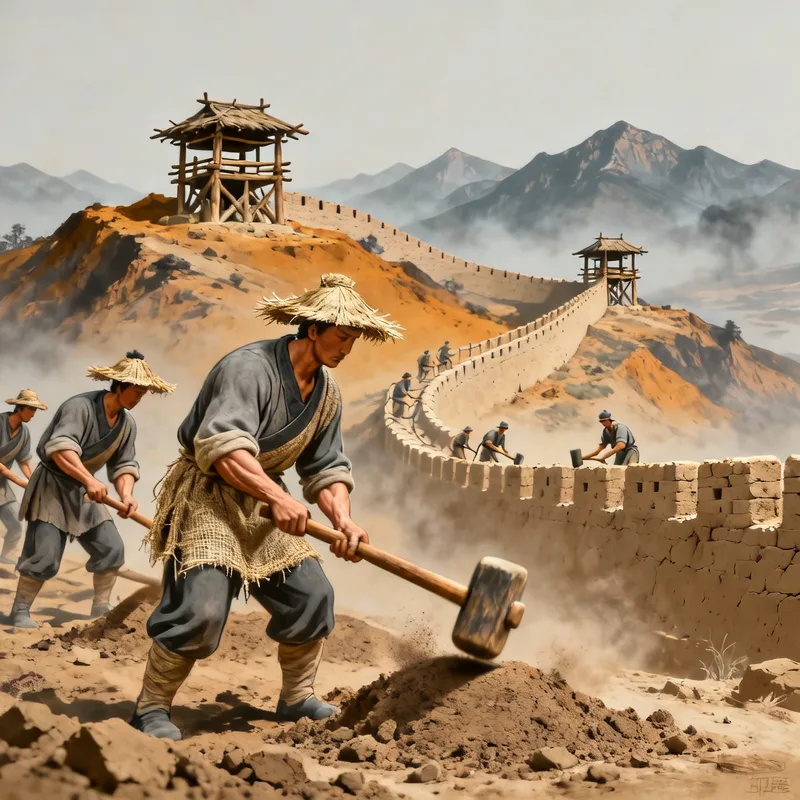
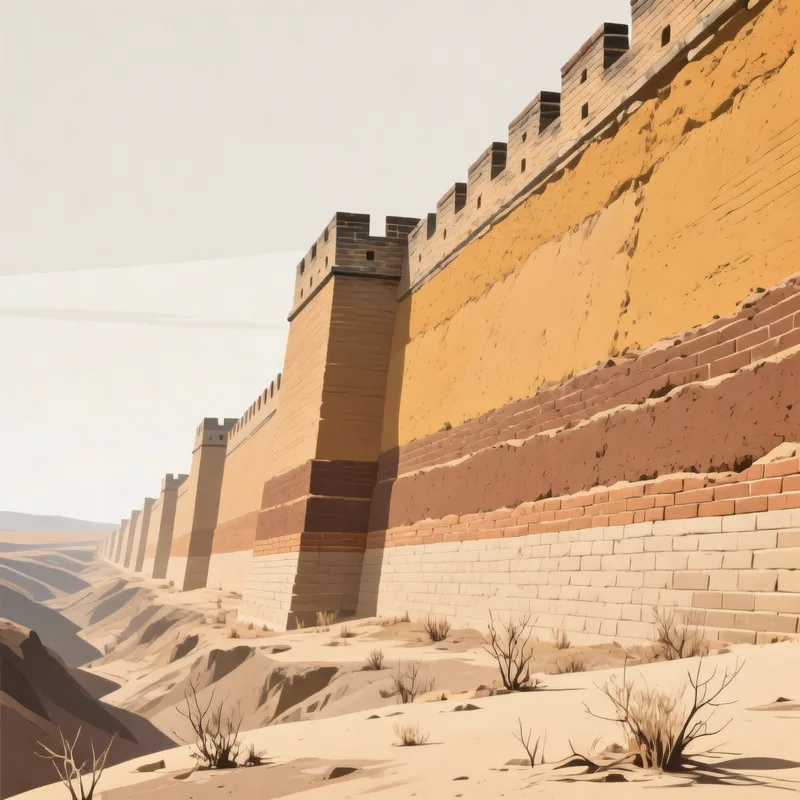
    Wall building began long before the Qin dynasty. During the Warring States period (475–221 BCE), the states of Qin, Zhao, and Yan raised earthen ramparts along their northern and western frontiers to check Xiongnu raiders and to mark contested pasture. These were not isolated lines: they were linked to watchtowers, garrison posts, and river barriers that could slow cavalry and give farmers time to shelter. Some sections were built of tamped earth, layered and hammered into a dense wall that could stand for centuries in the dry northwest. The First Emperor later joined and extended this existing network rather than inventing the idea of a frontier wall from nothing.

    Layered rammed-earth wall of an early northern frontier rampart rising above a dry valley
    Early walls were tamped earth, not the brick masonry familiar from Ming sections. AI 생성 일러스트 · 시노비즈

    The Qin Link, 221–206 BCE

    After unifying China in 221 BCE, Qin Shi Huang ordered the general Meng Tian to connect the northern walls into a single defensive front. Reports in the Shiji describe a force of hundreds of thousands of soldiers and convict labourers working from Lintao in present-day Gansu to Liaodong in the northeast, a distance later described as ten thousand li. The aim was strategic: to push the Xiongnu north of the Yellow River loop and to protect the new commanderies planted in conquered territory. The work was expensive and unpopular, and the Qin collapsed in 209–206 BCE, but the frontier idea outlived the dynasty.

    Reconstructed Qin-era frontier wall with watchtowers crossing a loess plateau
    Meng Tian’s campaign joined older walls into a frontier stretching from Gansu to Liaodong. AI 생성 일러스트 · 시노비즈

    The Ming Wall We See Today

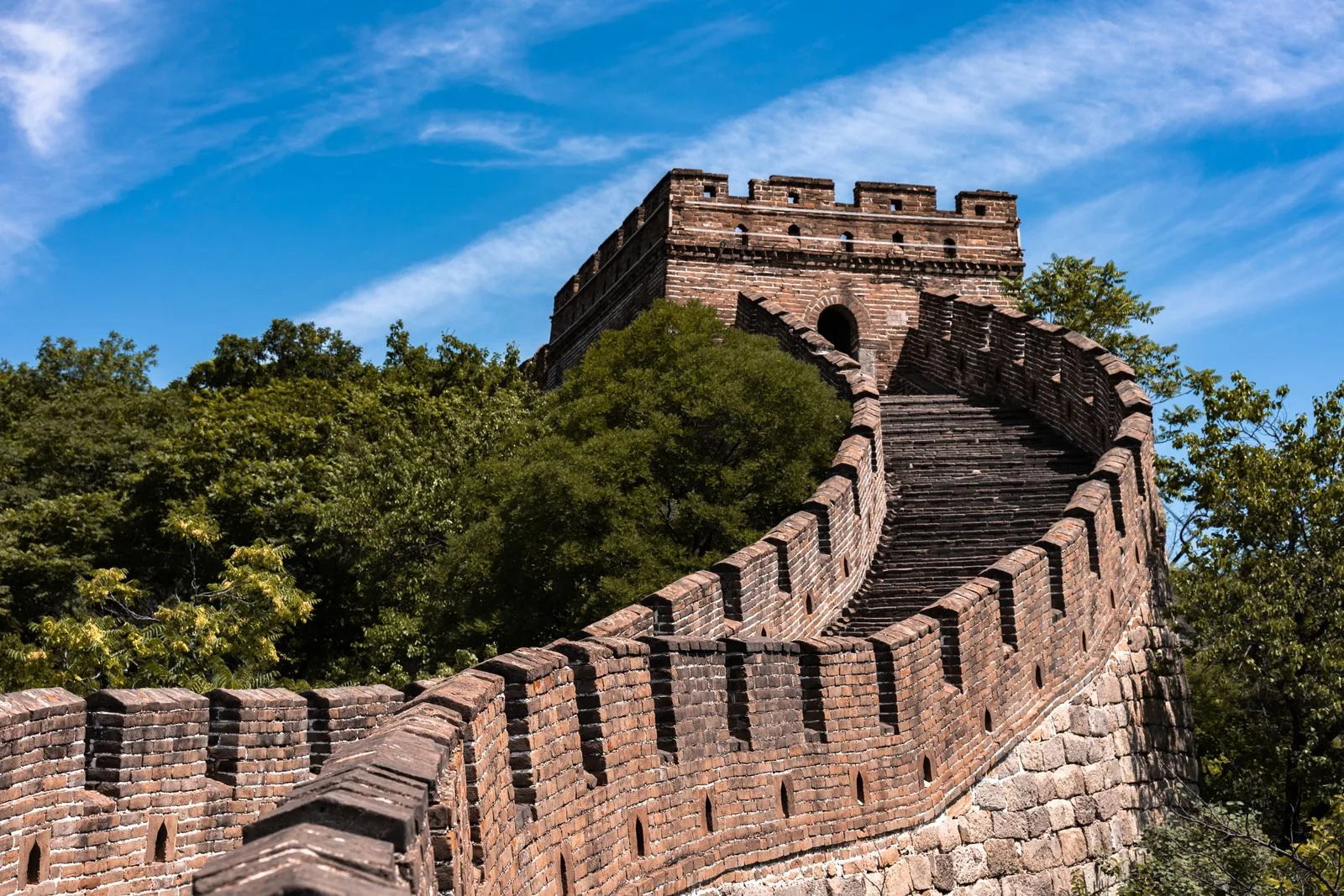
    Most visible masonry belongs to the Ming dynasty (1368–1644), which rebuilt the wall after the Mongol Yuan retreated north. Beginning in the late fourteenth century, Ming engineers faced sections with brick and stone, added hollow watchtowers and beacon platforms, and anchored the line at Jiayuguan in Gansu and Liaodong in the northeast. The best-preserved stretches near Beijing, including Badaling, Mutianyu, and Jinshanling, date from this period. UNESCO inscribed the Great Wall on the World Heritage List in 1987, describing its full length at 8,851.8 kilometres. What visitors walk today is therefore a late imperial rebuilding of a much older frontier idea.

    Brick-faced Ming wall with crenellations and a watchtower winding over a green ridge near Beijing
    Ming brickwork near Beijing is the wall most visitors see today. Mehmet Yasin Kabaklı | Pexels License (https://www.pexels.com/license/)

    A System of Control and Contact

    The wall worked as a system rather than a solid barrier. Beacon towers passed smoke and fire signals along the line, while garrison towns and passes regulated movement. Trade was not stopped: frontier markets exchanged grain, tea, and silk for horses and furs, and officials issued passes to authorised caravans. The ruined walls of the fourth-century Tuoba Wei and the earthworks of the Jin dynasty show that steppe peoples also built walls against one another. To read the Great Wall only as a dividing line is to miss its second function, which was to organise contact on terms the state could tax and police.

    The wall was never a single line on a map; it was a frontier regime made of stone, signal fire, and paperwork.

    참고 자료 및 추가 정보

    1. 만리장성 — UNESCO World Heritage Centre.
    2. Great Wall of China — 브리태니커 백과사전.
    3. The Great Wall of China — World History Encyclopedia.
    제자리에 있는 모습을 보세요

    이 항목을 따라가면 해당 영역으로 이동할 수 있습니다.

    지도로 탐색하기

    스레드를 따라가세요

    같은 태그를 가진 다른 항목들을 찾아보세요.

    태그를 찾아보세요
  • Ride-Hailing

    여행 가이드

    Ride-Hailing

    Booking a car in Beijing

    A ride-hailing app can be the easiest way across Beijing, if you set it up before you leave the hotel.

    부분
    여행 가이드
    지역
    베이징
    연대
    modern-china
    태그
    수송

    Beijing’s streets are too large for spontaneous waving on most days. Ride-hailing apps match passengers with licensed drivers in minutes, but the system assumes a Chinese phone number, a local payment method, and a tolerance for pickup points that are not always at the curb.

    Setting Up the App

    DiDi Chuxing is the dominant platform; Uber exited China in 2016 after selling its operations to DiDi. The app works in English on some account settings, though many driver-facing screens and messages remain in Chinese. Register with a phone number that can receive short messages, then add a payment method before trying to book. Foreign visitors often have better luck linking an international Visa or Mastercard than relying on a local bank card, but Alipay and WeChat Pay are the most dependable wallets. If your home app does not support Chinese numbers, install DiDi directly, allow location access, and enter your destination in Chinese characters or save the hotel address as a shortcut.

    A smartphone showing a ride-hailing map with a car approaching
    Set the language and payment method before you need a ride; street corners are usually clearer pickup points. AI 생성 일러스트 · 시노비즈

    Booking and Meeting the Driver

    Enter the destination, choose a service level such as Express or a larger car, and confirm the fare estimate before requesting. Prices rise with traffic and demand, and a short trip during a rainstorm can cost far more than the same journey at noon. Once a driver accepts, the app shows a name, photo, licence plate, and estimated arrival. Wait at the pin you set, not a block away, and match the plate and car model before opening the door. If the driver calls, a simple address or your hotel name in Chinese helps. Cancellations are common in crowded districts; wait a minute for a new match rather than accepting an unlicensed car offered at the curb. Share the trip in the app if someone at home is waiting.

    A car with a green licence plate waiting at a Beijing street corner
    Check the plate, model, and driver before getting in; new-energy cars are common in Beijing’s fleet. Cheng Shi Song | Pexels License (https://www.pexels.com/license/)

    Airports, Stations, and Pickup Rules

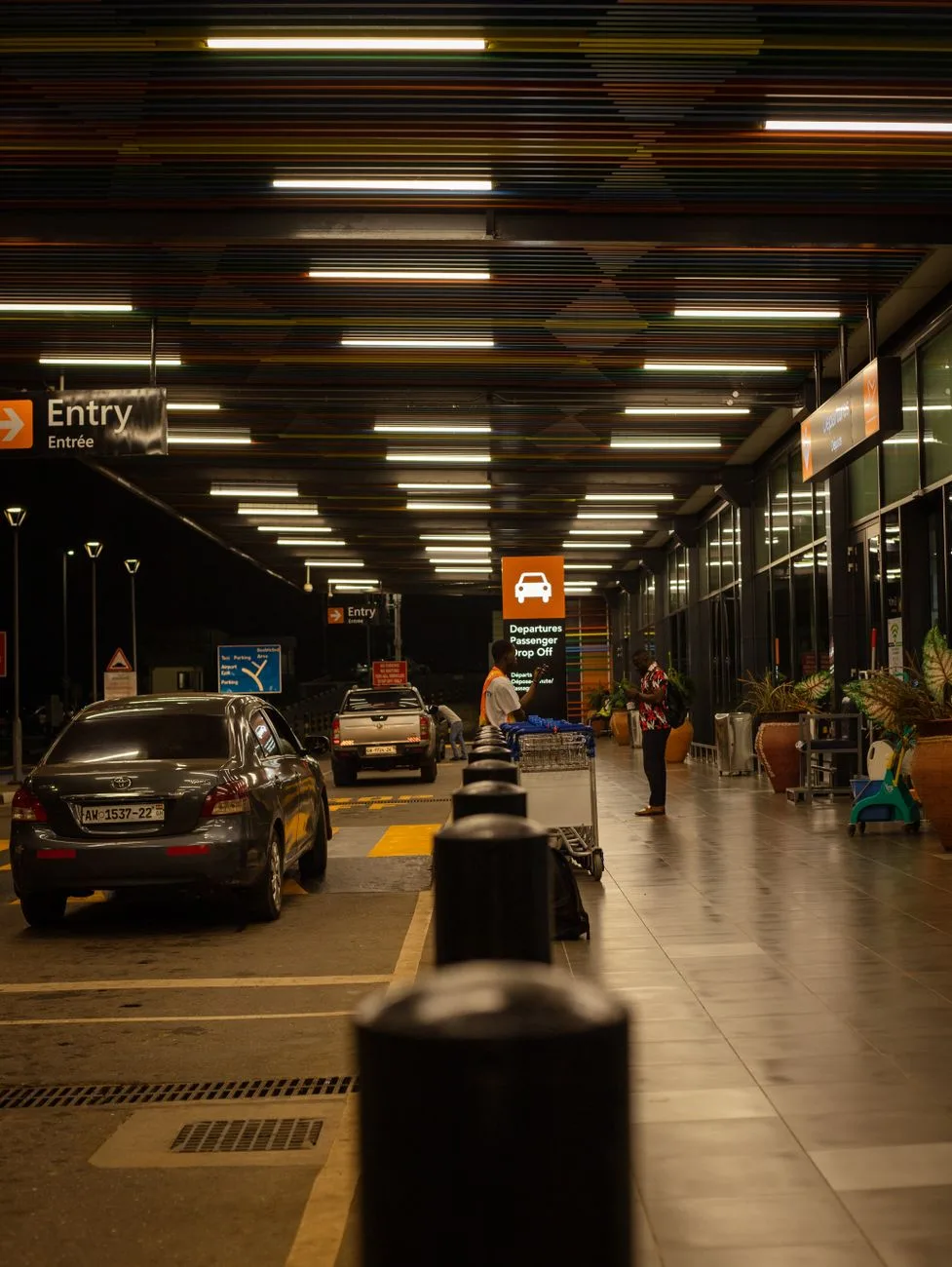
    Beijing Capital and Beijing Daxing airports, along with the main railway stations, have designated ride-hailing zones rather than free curbside pickup. Follow signs to the DiDi or ride-hailing area and confirm the exact gate or zone in the app before you walk outside; drivers cannot wait in traffic lanes. At a station, walking a few hundred metres to a cross street often produces a faster match than trying to leave the forecourt. Expect a short queue at the exit of a sports event or a shopping mall. The app may ask you to walk to a brighter, safer spot, which speeds up matching. Keep the trip short and the conversation simple; most drivers prefer a quiet ride, and a thank-you in Mandarin is appreciated.

    A signed ride-hailing pickup zone outside a Beijing transport hub
    Airports and major stations direct ride-hailing cars to numbered or zoned pickup areas. Xlenz Creatives | Pexels License (https://www.pexels.com/license/)

    Payment, Safety, and Alternatives

    The fare is usually deducted automatically when the ride ends; tips are not expected and the app may not offer a tipping option. Keep the receipt in the app if you need an expense record. Check that the driver follows the route shown, and use the safety button to share your location if something feels wrong. Taxis remain a useful fallback: yellow-and-black or blue-and-white sedans can be flagged on main roads, and hotel doormen can write a destination in Chinese. Subway travel is faster across the centre at rush hour, while a bike-share works for the last kilometre. If the app will not accept your card, ask the hotel concierge to book a car or use the official taxi queue outside a major hub.

    Wait at the pin, check the plate, and keep the passport or address ready in Chinese.

    참고 자료 및 추가 정보

    1. DiDi Global — DiDi.
    2. Beijing city guide — Beijing Municipal Government.
    3. Beijing taxi and transport — China Highlights.

    제자리에 있는 모습을 보세요

    이 항목을 따라가면 해당 영역으로 이동할 수 있습니다.

    지도로 탐색하기

    스레드를 따라가세요

    같은 태그를 가진 다른 항목들을 찾아보세요.

    태그를 찾아보세요
  • Dining Etiquette

    여행 가이드

    Dining Etiquette

    The round table, read closely

    Chinese dining etiquette turns a shared meal into a lesson in hierarchy, generosity, and restraint.

    부분
    여행 가이드
    지역
    베이징
    연대
    시대를 넘어서
    태그
    관습, 음식

    At a Chinese banquet the food arrives in the middle of the table, and the social rules arrive with it. Knowing where to sit, when to lift your chopsticks, and how to answer a toast will do more for a Beijing dinner than any display of appetite.

    Taking Your Seat

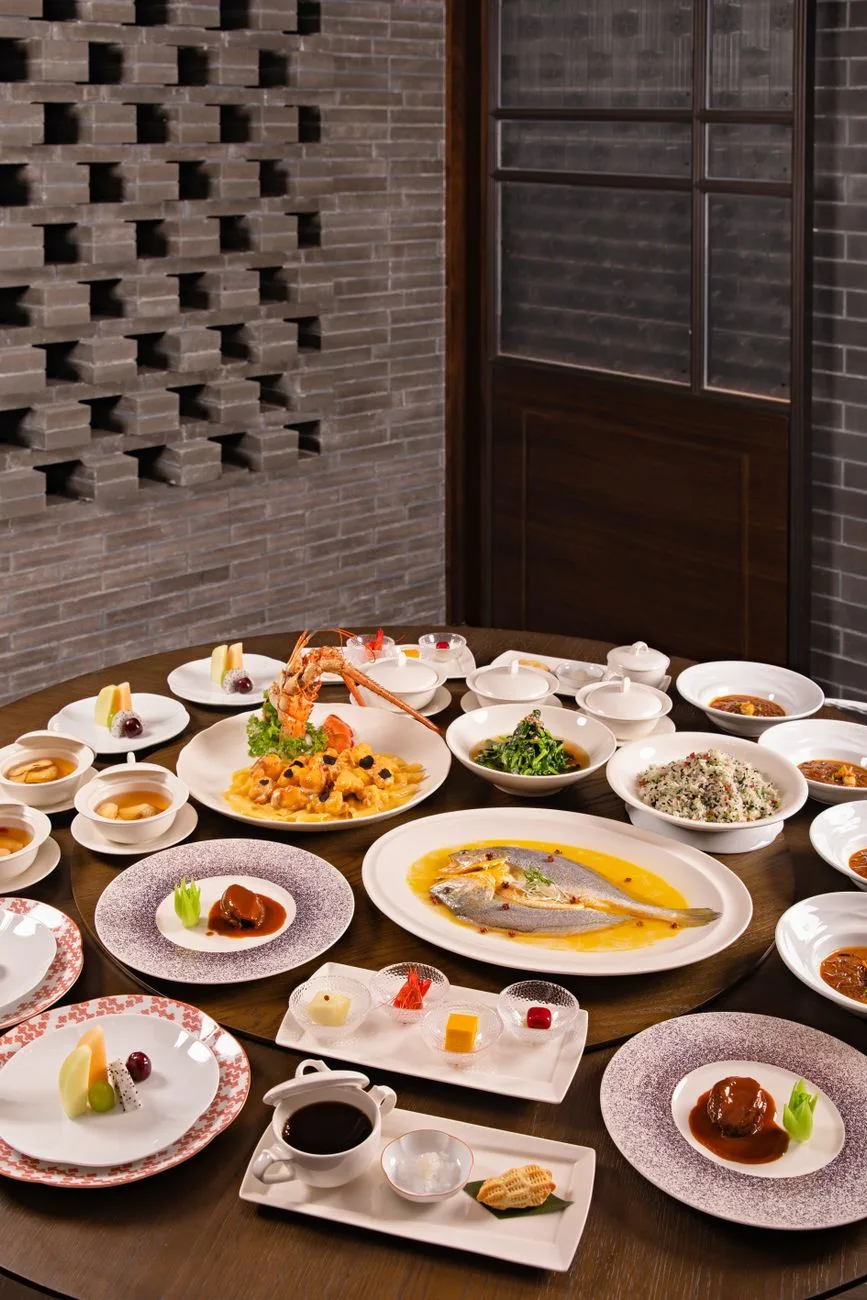
    The host usually decides where everyone sits, so wait to be shown to a chair instead of choosing one. At a round table the place facing the door, or the one furthest from it in some rooms, is the seat of honour and is offered to the eldest person or the senior guest. Guests of similar rank then alternate around the table. A lazy Susan in the middle makes every dish reachable; give it a gentle turn rather than spinning it past someone mid-reach. Serving others first is a small, noticed courtesy, especially topping up tea. When the host lifts chopsticks or says the meal has begun, start eating. Beginning early can suggest you were waiting for the food, not the company.

    Round dining table with a lazy Susan and place settings
    At a round table, the seat facing the door is usually reserved for the guest of honour. Change C.C | Pexels License (https://www.pexels.com/license/)

    Chopstick Rules

    Chopstick manners carry more weight than most table errors. Never stand a pair upright in a bowl of rice: the image resembles incense offered to the dead. Do not tap a bowl with chopsticks, point with them, spear food, or wave them while talking. Passing food from your chopsticks to someone else’s also echoes funeral rites, so set the piece on a shared plate instead. When you pause, lay the pair across your bowl or on a rest. It is acceptable to lift a small rice bowl toward your mouth, and slurping noodles is not rude. If you are unsure, watch the host. A guest who handles chopsticks carefully and takes modest portions will rarely cause offence, even if the finer points of the table are new.

    A pair of wooden chopsticks resting on a ceramic rest
    Chopsticks planted upright in rice resemble incense burned for the dead. Sylwester Ficek | Pexels License (https://www.pexels.com/license/)

    Toasts, Tea, and the Bill

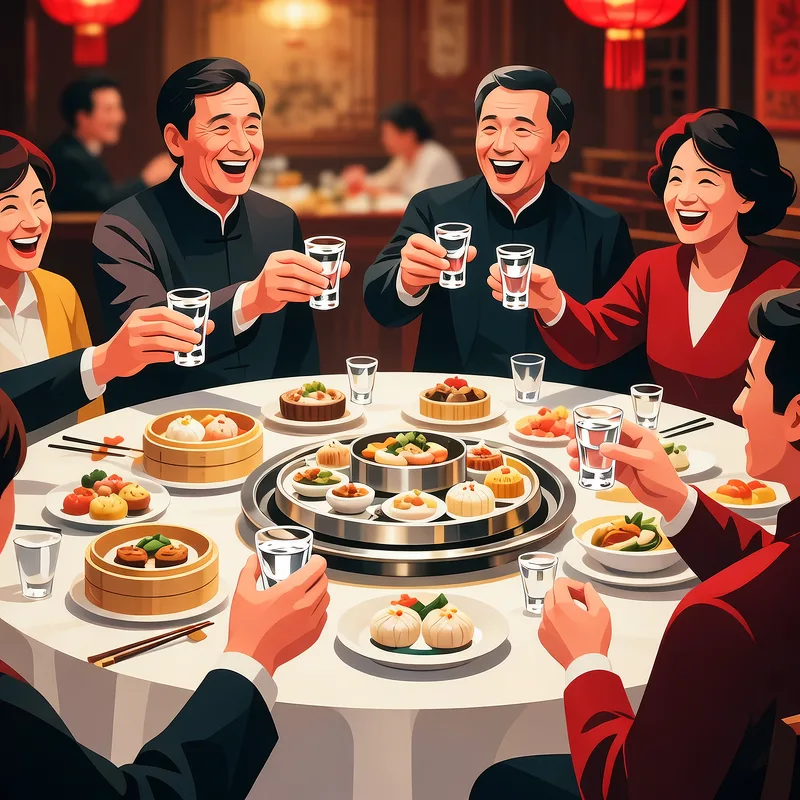
    Drinks are social glue. Beer and baijiu, a strong grain spirit, appear at many banquets alongside tea. When someone proposes a toast, stand, raise your glass with both hands if the person is senior, and touch rims slightly below theirs. Ganbei means dry the glass, but a small sip is acceptable if you do not drink; explain it early and stick to it. Never pour your own tea without offering the pot to neighbours first. Dishes are shared, but the host may serve a prized piece to a guest as a compliment. Leave a little food on your plate to signal that you are full, and do not scrape the last grains from a communal dish. The host normally pays; a brief offer to split the bill is enough.

    Diners raising small glasses of baijiu at a banquet
    A ganbei toast means dry the glass; sip if you prefer, but rise with the group. AI 생성 일러스트 · 시노비즈

    Eating Out in Beijing

    Beijing’s dining rooms range from sidewalk dumpling shops to formal banquet halls, and the rules loosen as the setting becomes casual. In a neighbourhood restaurant, order for the table, share dishes, and expect a metal teapot and a stack of small bowls rather than individual plated courses. Payment usually happens at a counter; scan the QR code at the table to order or pay through Alipay or WeChat Pay, and ask for an English bill if needed. Tipping is not customary, though a round-up at a hotel restaurant is fine. Spicy dishes are common in some regional cuisines but not in classic Beijing cooking, where roast duck, noodles, and dumplings dominate. If a dish arrives whole, wait for the host to turn it or take the first portion.

    Watch the host, accept the toast, and leave a little on the plate.

    참고 자료 및 추가 정보

    1. Chinese Table Manners and Dining Etiquette — China Highlights.
    2. Chopsticks — 브리태니커 백과사전.
    3. Chinese Culture: Food and Drink — Cultural Atlas, SBS.

    제자리에 있는 모습을 보세요

    이 항목을 따라가면 해당 영역으로 이동할 수 있습니다.

    지도로 탐색하기

    스레드를 따라가세요

    같은 태그를 가진 다른 항목들을 찾아보세요.

    태그를 찾아보세요
  • 사원 예절

    여행 가이드

    사원 예절

    Entering a Tibetan Buddhist sanctuary

    In a Tibetan Buddhist temple, the way you walk, look, and photograph is part of the practice, not just good manners.

    부분
    여행 가이드
    지역
    Xizang (Tibet)
    연대
    시대를 넘어서
    태그
    Customs, Scenic Sites

    On the plateau, a monastery is a working religious community as well as a historic building. Visitors to Lhasa’s Jokhang or the great monasteries around it enter a space where centuries of worship continue each day, and courtesy means making yourself unobtrusive.

    Before the Threshold

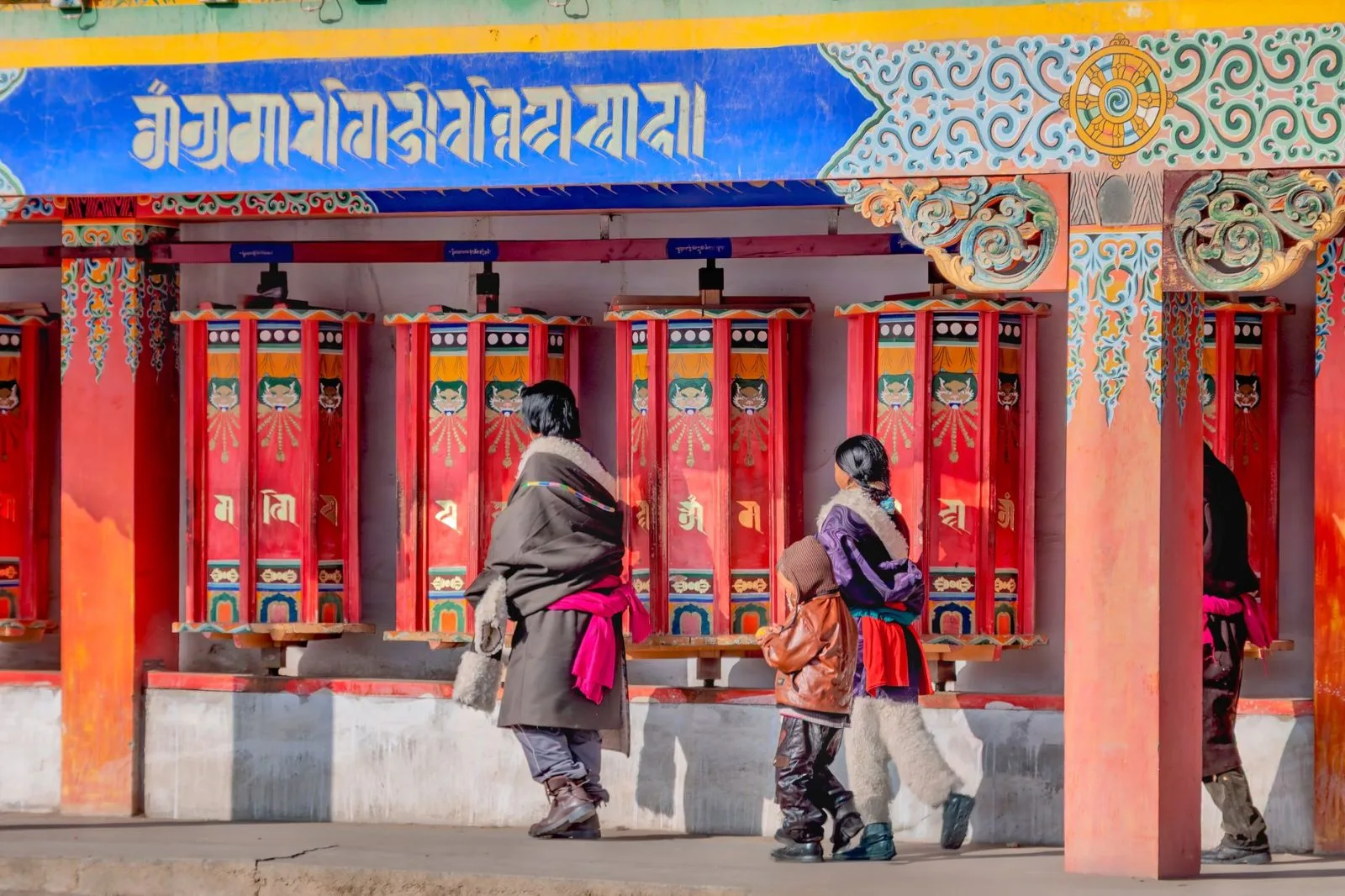
    Approach a temple calmly and dress with coverage: shoulders and knees covered, no shorts, and shoes removed before entering a prayer hall. Many monasteries ask visitors to leave hats and sunglasses outside as well. Walk clockwise around a stupa, a prayer-wheel corridor, or a temple courtyard, matching the direction of pilgrims who may be prostrating at every step. Do not step over a threshold or over a person’s outstretched hands; lift your feet and go around. Speaking softly is enough. A monk or nun may be in retreat, tea may be poured for the community, and a ceremony may be under way in a side chapel. If a door is ajar and people are chanting, wait rather than look in.

    Pilgrims walking clockwise around a temple courtyard in Tibet
    Circumambulation runs clockwise in Tibetan Buddhism; follow the crowd rather than cutting across. Man Fong Wong | Pexels License (https://www.pexels.com/license/)

    Inside the Prayer Hall

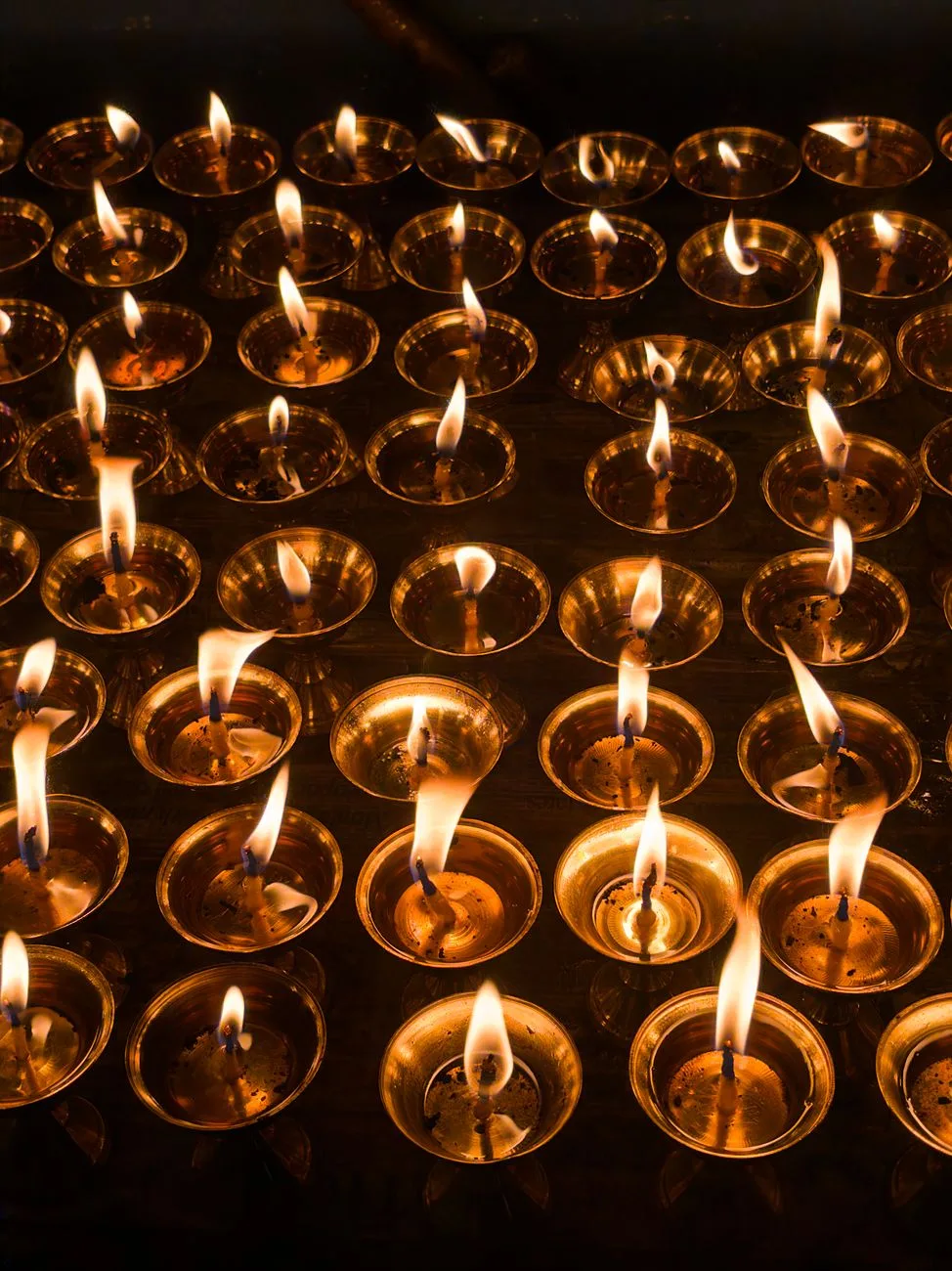
    Once inside, keep your hands to yourself. Statues, thangkas, and ritual objects are not props; touching them, pointing at them with one finger, or turning your back on an altar to pose for a photograph marks you as careless. Offerings are made with both hands: a khata scarf laid across the palms, a small amount of money, or the lighting of a butter lamp. If you do not wish to make an offering, simply stand aside and let others pass. Do not photograph inside halls unless a sign or a monk explicitly allows it; flash and camera clicks interrupt the room. When a pilgrim prostrates, give them room and never step over the mat. Photos of monks should be asked for, not assumed.

    Butter lamps glowing before a gilded statue in a Tibetan temple
    Butter lamps are offerings; keep a respectful distance from altars and statues. Sonam Phuntsok | Pexels License (https://www.pexels.com/license/)

    Festivals and Crowds

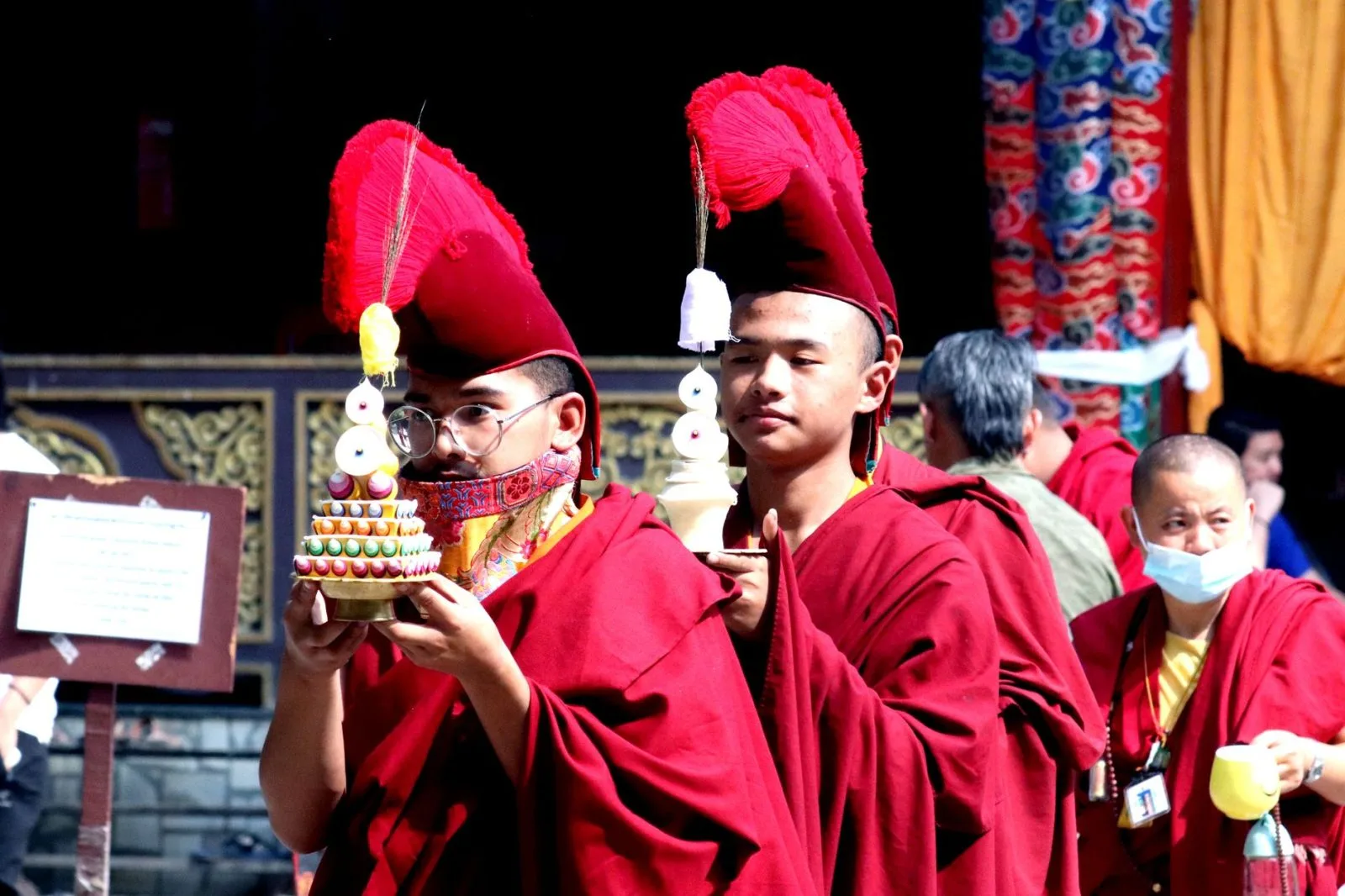
    Tibetan Buddhist festivals such as Losar, the New Year, or the Saga Dawa month bring thousands of worshippers to monasteries. Processions, masked cham dances, and the unfurling of a giant thangka at Drepung or Sera can draw crowds long before sunrise. Arrive early, carry water, and expect to stand for hours. Keep to the edges of the courtyard so that pilgrims moving toward the altar can pass. Queueing is not always formal; a loose line forms naturally at a doorway or a blessing, and pushing will be noticed. Photography restrictions usually tighten during ceremonies. A visitor who watches quietly, follows the direction of circumambulation, and accepts that part of the ritual will be unfamiliar will be welcomed more readily than one who demands explanations.

    Monks in maroon robes assembling for a temple ceremony
    During festivals, monastery courtyards fill before dawn; arrive early and keep to the edges. Karma Samten | Pexels License (https://www.pexels.com/license/)

    Practicalities on the Plateau

    Most monastery visits in the Xizang Autonomous Region begin in Lhasa, where permits and altitude shape the schedule as much as opening hours. The Jokhang, Potala Palace, and the great monasteries of Drepung and Sera sit at roughly 3,650 metres, so move slowly for the first day or two and drink water often. Many sites require advance reservation and a passport check at the gate; the Potala Palace limits daily visitors and issues timed tickets. Small notes are useful for offerings and entrance fees. Do not fly a drone near a monastery, and avoid loud phone calls on a rooftop or in a courtyard. Etiquette here is simple: move with the congregation, keep your hands off what is sacred, and let worship come first.

    Follow the direction of the pilgrims, and let the ritual come before the photograph.

    참고 자료 및 추가 정보

    1. Historic Ensemble of the Potala Palace, Lhasa — UNESCO World Heritage Centre.
    2. Tibetan Buddhism — 브리태니커 백과사전.
    3. Tibet monastery etiquette — Tibet Travel.

    제자리에 있는 모습을 보세요

    이 항목을 따라가면 해당 영역으로 이동할 수 있습니다.

    지도로 탐색하기

    스레드를 따라가세요

    같은 태그를 가진 다른 항목들을 찾아보세요.

    태그를 찾아보세요
  • Gift Giving

    여행 가이드

    Gift Giving

    Tokens, taboos, and the gift of face

    Gift giving in Beijing turns a private gesture into a readable social signal, where timing, wrapping, and refusal all carry meaning.

    부분
    여행 가이드
    지역
    베이징
    연대
    시대를 넘어서
    태그
    세관

    A gift in China is rarely just an object. It is a small public statement about respect, hierarchy, and the relationship you hope to build, especially in a city like Beijing where formal courtesies still shape everyday encounters.

    The Grammar of Reciprocity

    Gift giving sits inside the older idea of guanxi, the network of reciprocal obligations that turns acquaintances into reliable contacts. A present acknowledges a relationship rather than creating one from nothing, and it is usually given at a defined moment: a first visit to a home, a business meeting after terms are settled, a wedding, a birth, or a return from travel. Beijing hosts often decline a generous offer two or three times before accepting, a ritual that lets both sides display modesty without really refusing. Visitors who treat the first no as final can break the rhythm. Reciprocity matters more than price; a forgotten gift is remembered longer than a cheap one.

    Choosing What to Bring

    Practical choices travel well. A tin of good tea, a basket of fruit, a bottle of liquor, or something distinctive from your home region all read as thoughtful without embarrassing the host. Colour does the heavy lifting: red and gold suggest luck and celebration, while white and black wrapping carry associations with mourning and are best avoided. Counts matter too. Even numbers are favoured at weddings and festivals, while the number four sounds like the word for death and is quietly sidestepped. Never give a clock, since the phrase for giving a clock echoes attending a funeral; pears, umbrellas, sharp objects, and white chrysanthemums carry similar unwanted meanings. When in doubt, a neatly wrapped food item with the price tag removed is safest.

    Red-wrapped gifts and tea boxes arranged on a table
    Red and gold wrapping signals celebration; the object inside is secondary to the gesture. RDNE Stock project | Pexels License (https://www.pexels.com/license/)

    The Moment of Giving

    Hand the gift over with both hands, or with the right hand supported at the left forearm if the package is small; a one-handed toss looks careless. Present it after the greeting and a few minutes of conversation rather than at the threshold, and describe it modestly as a small token or something you happened to bring. Do not press the recipient to open it immediately. In many Chinese settings gifts are set aside and opened later, which protects everyone from visible reactions. When you receive a gift, accept with both hands, say thank you, and put it somewhere respectful rather than dropping it beside your chair. A brief note or a later message acknowledging the gesture is appreciated.

    Two hands offering a wrapped package across a table
    Offer and receive with both hands; polite refusal is part of the exchange. Antoni Shkraba | Pexels License (https://www.pexels.com/license/)

    Money, Red Envelopes, and Business

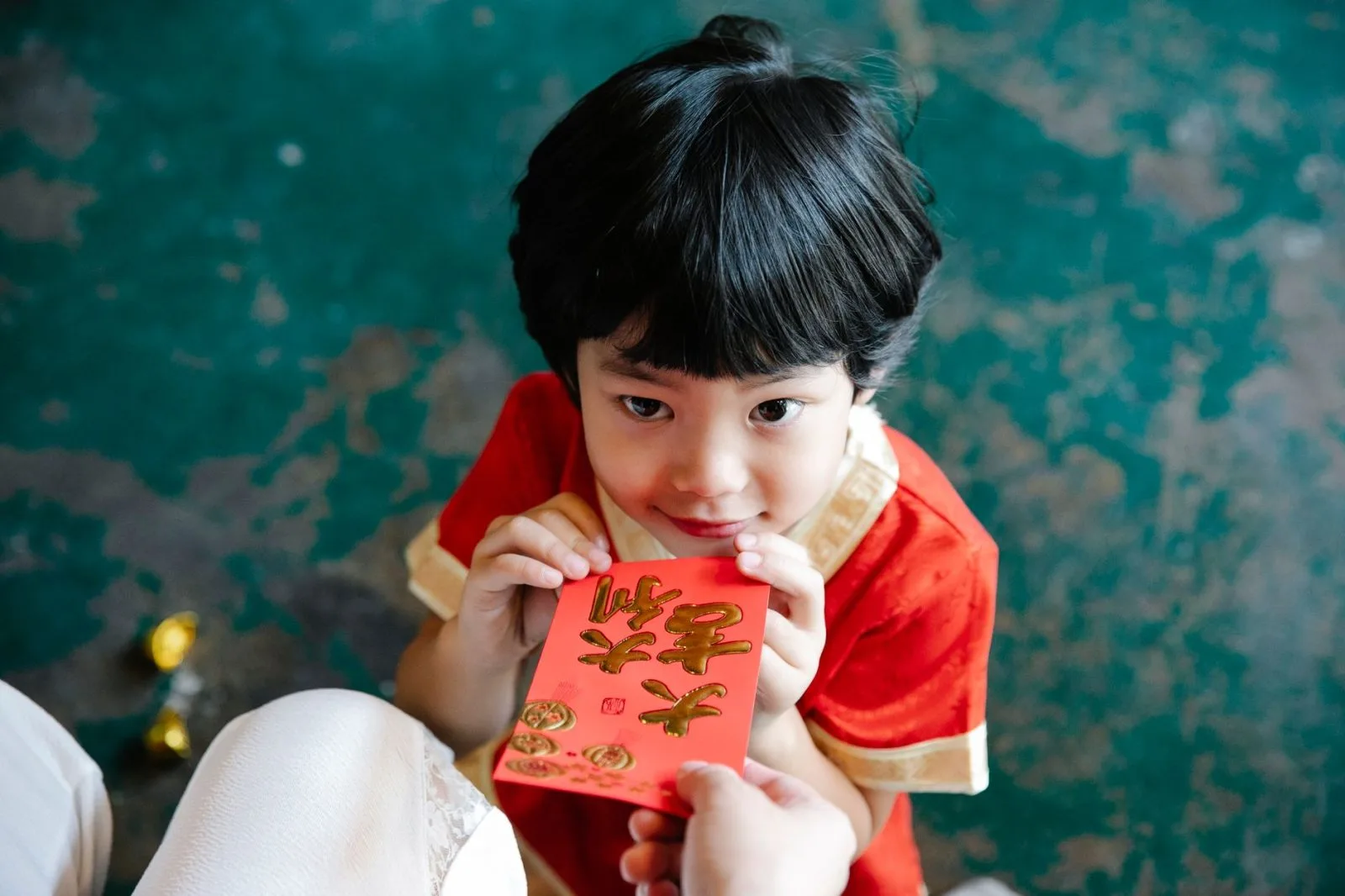
    Cash has its own rules. Hongbao, red paper envelopes with gold lettering, are given at weddings, births, and Lunar New Year; the amount should end in an even digit, and notes should be crisp. At a wedding the envelope is usually dropped in a reception basket, while at New Year it may be pressed into a child’s hand or sent through a phone app. In business settings, keep gifts modest and symbolic. Expensive items can look like an attempt to buy a decision and may be refused on principle or by rule. A company logo item, a book, or a regional speciality from your own city signals the relationship without creating a debt. Check the host organisation’s policy before offering anything of value.

    A red envelope with gold characters held between fingers
    Hongbao are given with both hands at weddings, birthdays, and New Year. 안젤라 로마 | 펙셀 라이선스 (https://www.pexels.com/license/)
    Give with both hands, mention modesty, and let the recipient decide when to open it.

    참고 자료 및 추가 정보

    1. Chinese Culture: Customs and Etiquette — Cultural Atlas, SBS.
    2. Chinese Gift Giving Etiquette — China Highlights.
    3. China Business Customs — U.S. Department of Commerce.

    제자리에 있는 모습을 보세요

    이 항목을 따라가면 해당 영역으로 이동할 수 있습니다.

    지도로 탐색하기

    스레드를 따라가세요

    같은 태그를 가진 다른 항목들을 찾아보세요.

    태그를 찾아보세요