Category: 연대기

  • The Imperial Examinations

    연대기

    The Imperial Examinations

    The Classics as a Road to Office

    A competitive system that selected officials by examination for thirteen centuries.

    부분
    연대기
    지역
    베이징
    연대
    song-liao-jin
    태그
    History, Customs

    For roughly thirteen hundred years, entry to China’s civil service ran through written examinations on the Confucian classics. The system began in the Sui dynasty, matured under the Song, and was abolished in 1905, shaping education, family strategy, and political culture.

    From Recommendation to Examination

    Earlier dynasties selected officials mainly by recommendation. The Han court, from 134 BCE, asked local authorities to submit candidates recommended for filial piety and integrity, while the imperial academy founded in 124 BCE tested classical learning. A decisive change came in 605 CE, when the Sui emperor Yang established examinations that allowed candidates to enter government through demonstrated knowledge rather than patronage alone. The Tang dynasty expanded the system, adding the jinshi degree, which tested literary composition and policy, and the mingjing degree, which tested command of the classics. Wu Zetian, who ruled from 690 to 705, broadened recruitment through examinations.
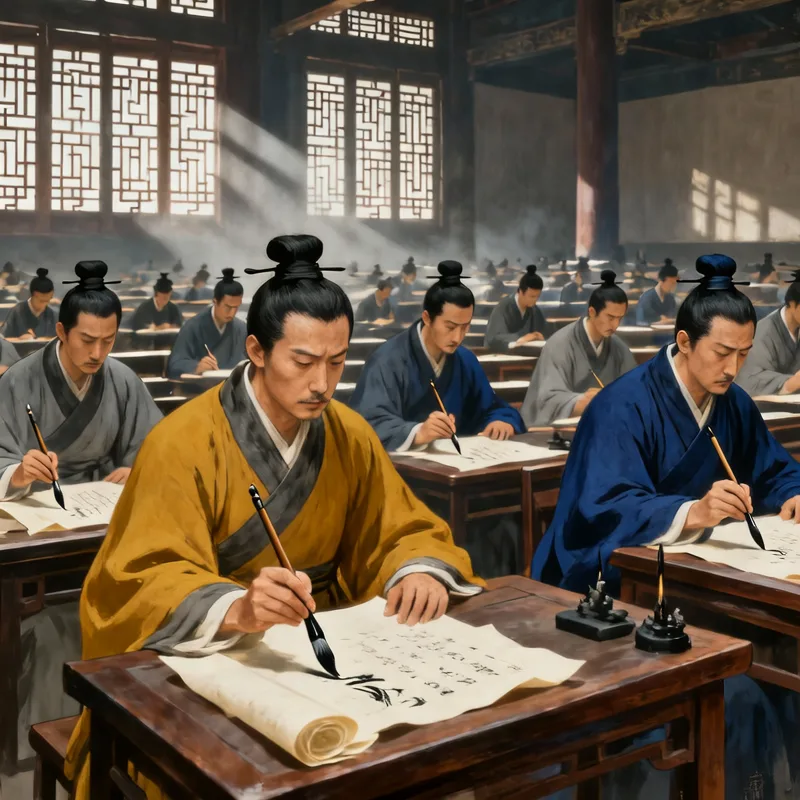
    Candidates writing at desks in a broad examination hall
    Examinations replaced birth and patronage with tested classical learning. AI 생성 일러스트 · 시노비즈

    The Song Examination Machine

    Under the Song dynasty, examinations became the main route to official career. The court settled on a three-year cycle and admitted far more candidates than the Tang had; successful jinshi could number in the hundreds every cycle. In 1057, Ouyang Xiu presided over an examination that favoured direct classical prose over ornate style and helped launch the careers of Su Shi and Su Zhe. Reforms associated with Wang Anshi in the 1070s shifted emphasis toward policy and institutional knowledge. Preparation required years of memorisation, and schools, private tutors, and printing presses grew around the demand. Success brought rank, salary, and local prestige.
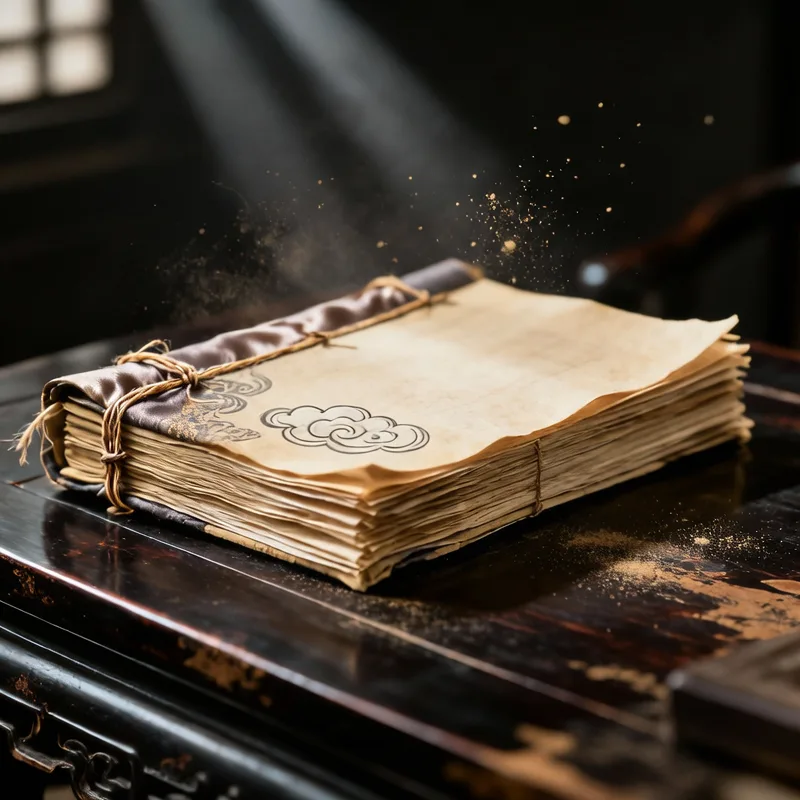
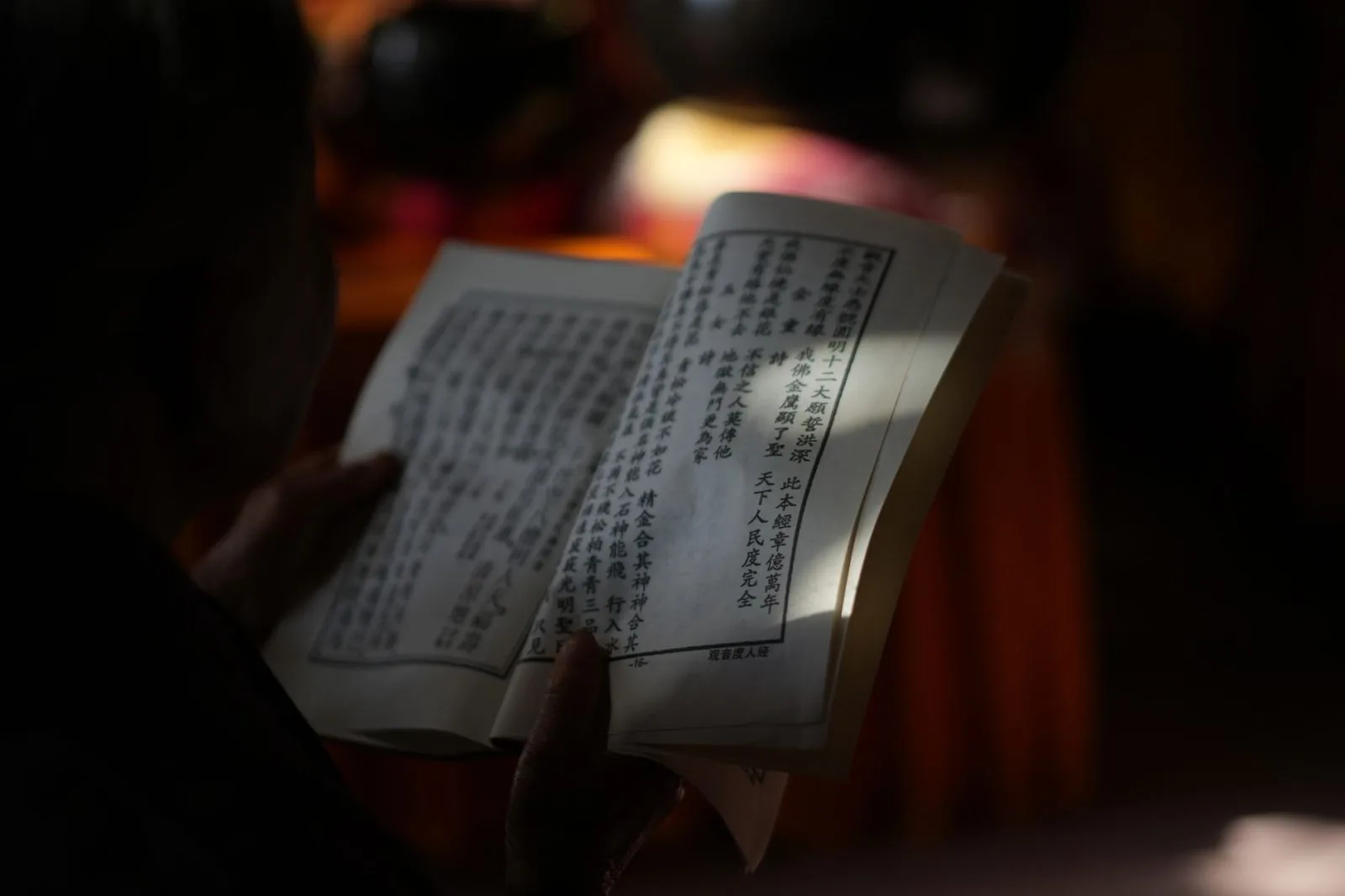
    Printed collection of model examination essays bound into a paper volume
    Printed model essays fed the preparation industry around the examinations. AI 생성 일러스트 · 시노비즈

    Beijing and the Palace Examination

    The system continued under the Yuan, Ming, and Qing, with changes in curriculum and quotas. The Yuan resumed examinations in 1315 and assigned places by ethnic category. From the Ming period, the eight-legged essay imposed a rigid structure of paired phrases on answers to classical quotations; the format was formalised in the late fifteenth century. In Beijing, the Imperial College stood beside the Temple of Confucius, and the highest round, the palace examination, was held within the imperial palace under the Qing. The Examination Hall in the city tested thousands of candidates in tiny cells. The system was abolished by imperial edict in 1905.
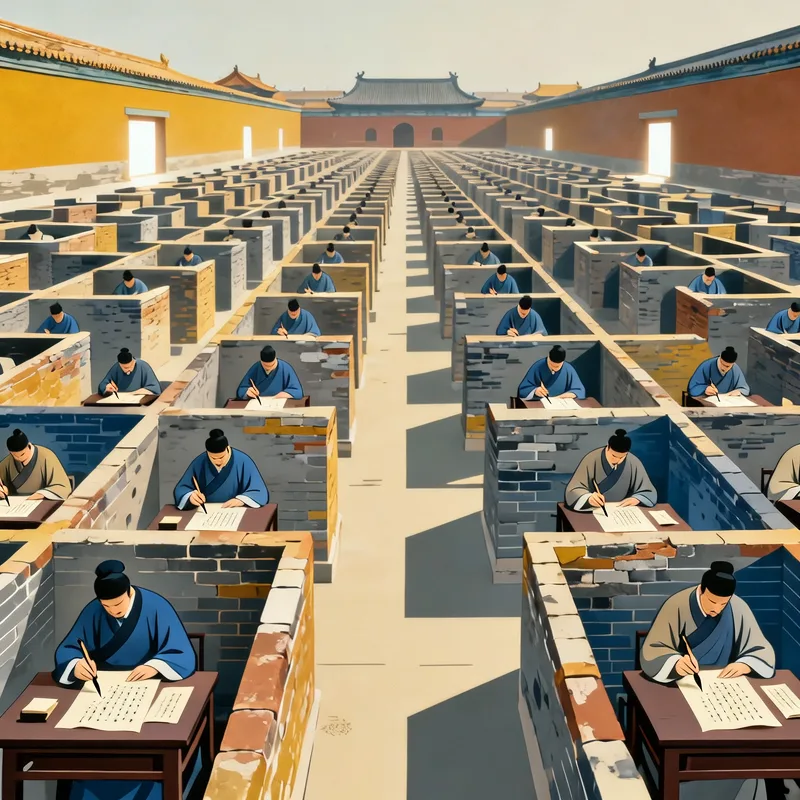
    Row of small brick examination cells with a seated candidate writing by lamplight
    Beijing’s Examination Hall confined thousands of candidates in individual cells. AI 생성 일러스트 · 시노비즈

    The Social Effects

    The examinations promised that talent could rise, but the odds were narrow. Most candidates failed, and preparing for the tests demanded leisure that farming families rarely had. Wealthy lineages built schools and endowed study estates, so success often repeated within families. The curriculum also set intellectual boundaries: from the Yuan onward, Zhu Xi’s Neo-Confucian commentaries defined acceptable interpretations of the classics. Cheating, impersonation, and bribery were persistent problems, met with strict searches and regulation. Even so, the exams created a shared literary culture across a vast empire and made the ideal of government by educated merit a durable political claim.

    The examination cell was small, but the text inside it defined the terms of public life.

    참고 자료 및 추가 정보

    1. Chinese examination system — 브리태니커 백과사전.
    2. The Civil Service Examinations of Imperial China — World History Encyclopedia.
    3. Beijing Central Axis: A Building Ensemble Exhibiting the Ideal Order of the Chinese Capital — UNESCO World Heritage Centre.
    제자리에 있는 모습을 보세요

    이 항목을 따라가면 해당 영역으로 이동할 수 있습니다.

    지도로 탐색하기

    스레드를 따라가세요

    같은 태그를 가진 다른 항목들을 찾아보세요.

    태그를 찾아보세요
  • Printing in the Song Dynasty

    연대기

    Printing in the Song Dynasty

    Woodblocks, Paper, and a Printed Public

    How Song publishers turned copying by hand into a large book industry.

    부분
    연대기
    지역
    저장성
    연대
    song-liao-jin
    태그
    역사

    Printing with carved wooden blocks was centuries old when the Song dynasty began in 960. Under the Song, the technique moved from Buddhist sutras and official classics into commercial publishing, schools, and government offices.

    From Sutra to State Classic

    Woodblock printing required a craftsman to carve mirror-image text into a plank, ink the surface, and press paper against it. The method was already used for Buddhist texts by the seventh century; the Diamond Sutra printed in 868 is the earliest dated surviving example. During the Five Dynasties, the minister Feng Dao organised the printing of the Nine Classics between 932 and 953, giving officials a standard text. The Song court continued this work, printing classical commentaries, histories, and medical manuals. In 1023, the government also issued the jiaozi, a paper banknote in Sichuan, showing how printing and paper currency developed together.

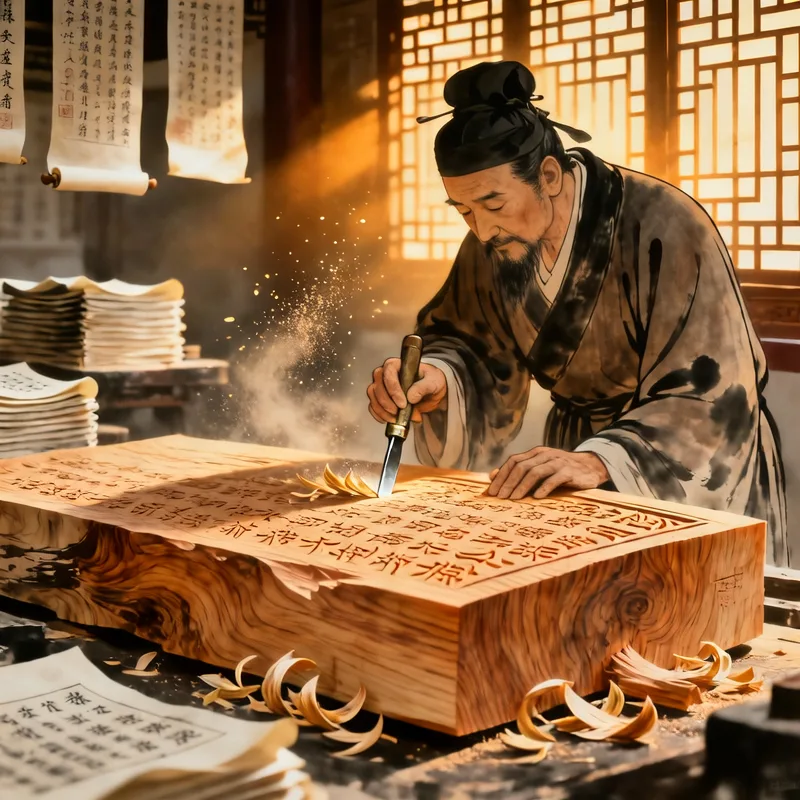
    Carved wooden printing block covered with mirror-image Chinese characters and ink
    A carved block could print many sheets before the wood wore out. AI 생성 일러스트 · 시노비즈

    The Zhejiang Book Trade

    After the Jin conquest of northern China in 1127, the Song court moved south to Hangzhou, in modern Zhejiang. The city became the centre of a dense publishing industry. Imperial agencies printed editions for schools and examinations, while private workshops and bookshops produced anthologies, medical recipes, Buddhist and Daoist texts, and collections of poetry. Hangzhou, Shaoxing, and Ningbo had access to bamboo, mulberry, and other papermaking materials, along with skilled carvers and ink makers. Colophons in surviving books name workshops and dates, allowing historians to reconstruct a trade in which a single edition could be reprinted many times. Song editions remain prized for their paper and calligraphy.

    Song-style bookshop with stacks of folded paper volumes and a block printer at work
    Southern Song Hangzhou supported imperial, private, and commercial printing houses. jack zhang | Pexels License (https://www.pexels.com/license/)

    Movable Type and Its Limits

    Printing with movable type was attempted in the eleventh century. The essayist Shen Kuo recorded in Dream Pool Essays, written around 1086 to 1093, that an artisan named Bi Sheng had cut individual Chinese characters from clay around 1040 and arranged them on an iron plate for printing. The account is the first known description of the technique. Movable type never displaced woodblocks in China on a large scale: the language required thousands of characters, and a carved block could be stored and reprinted cheaply for texts with steady demand. Wooden and metal type appeared later, including in Korea and, centuries afterward, in Europe.

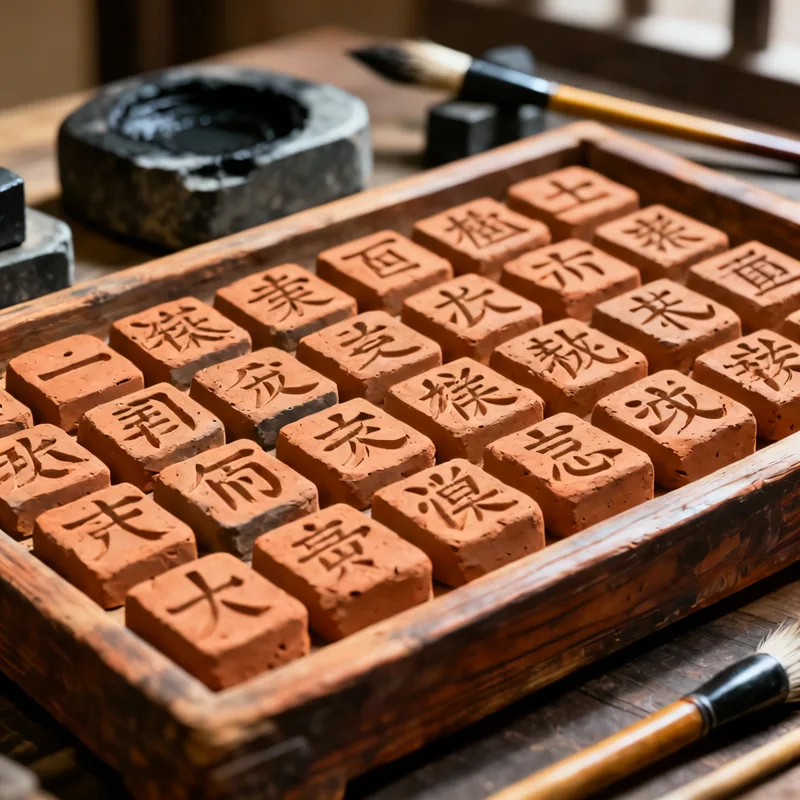
    Tray of small individual clay type pieces arranged in rows of Chinese characters
    Bi Sheng’s clay type, described around 1090, anticipated later movable-type systems. AI 생성 일러스트 · 시노비즈

    What Print Changed

    Cheaper books widened the circle of readers. Candidates for the civil service examinations could buy commentaries and model essays, and the state used printed texts to standardise the learning required for office. Neo-Confucian writers such as Zhu Xi, who died in 1200, saw their commentaries circulated through printing networks. Printers also served households: almanacs, primers, medical handbooks, and vernacular stories reached buyers beyond the scholarly elite. Printing did not create mass literacy, but it changed the economics of copy and preservation. Many ancient works survive today because Song editors carved them into blocks and their descendants reprinted them for generations.

    A carved block was a small machine for memory: it kept a text stable while copies multiplied.

    참고 자료 및 추가 정보

    1. Chinese engraved block printing technique 유네스코 무형문화유산.
    2. Movable type — 브리태니커 백과사전.
    3. The Diamond Sutra — British Library.

    제자리에 있는 모습을 보세요

    이 항목을 따라가면 해당 영역으로 이동할 수 있습니다.

    지도로 탐색하기

    스레드를 따라가세요

    같은 태그를 가진 다른 항목들을 찾아보세요.

    태그를 찾아보세요
  • The Han Dynasty

    연대기

    The Han Dynasty

    Four Centuries of an Imperial Order

    The dynasty that settled the Qin framework and extended it across Inner Asia.

    부분
    연대기
    지역
    산시
    연대
    qin-han
    태그
    역사

    The Han dynasty ruled from 202 BCE to 220 CE, with a brief interruption between 9 and 23 CE. It established the pattern of a Confucian-minded bureaucracy governing a large agrarian empire, and its name still marks the majority ethnic group and the written script.

    Two Capitals

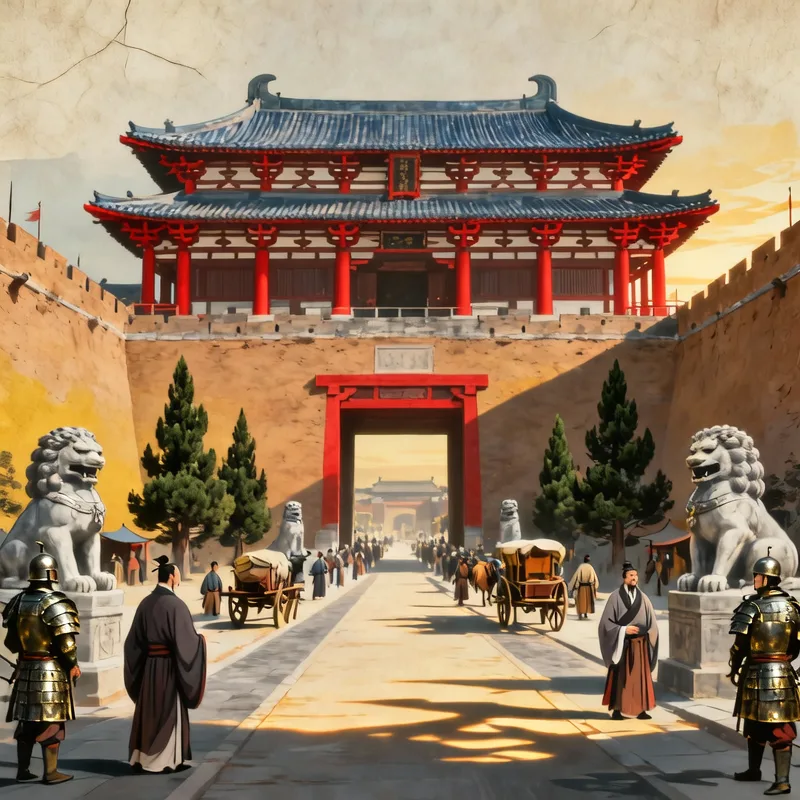
    Liu Bang, a former Qin officer and rebel leader, defeated his rival Xiang Yu and founded the Han dynasty in 202 BCE, taking the title Emperor Gaozu. He established his capital at Chang’an, near modern Xi’an in Shaanxi, where the Han built walls, palaces, markets, and an imperial arsenal. In 9 CE, the minister Wang Mang seized the throne and founded the short-lived Xin dynasty. Liu Xiu, a descendant of the Han house, restored the dynasty in 25 CE and ruled from Luoyang. Historians call these periods Western Han and Eastern Han. The dynasty ended in 220 CE, when Cao Pi forced the last emperor to abdicate.

    Reconstructed Han capital gate with tiled roofs and a broad imperial avenue
    Western Han rulers governed from Chang’an, in modern Shaanxi, until 9 CE. AI 생성 일러스트 · 시노비즈

    Governing with Classics and Counties

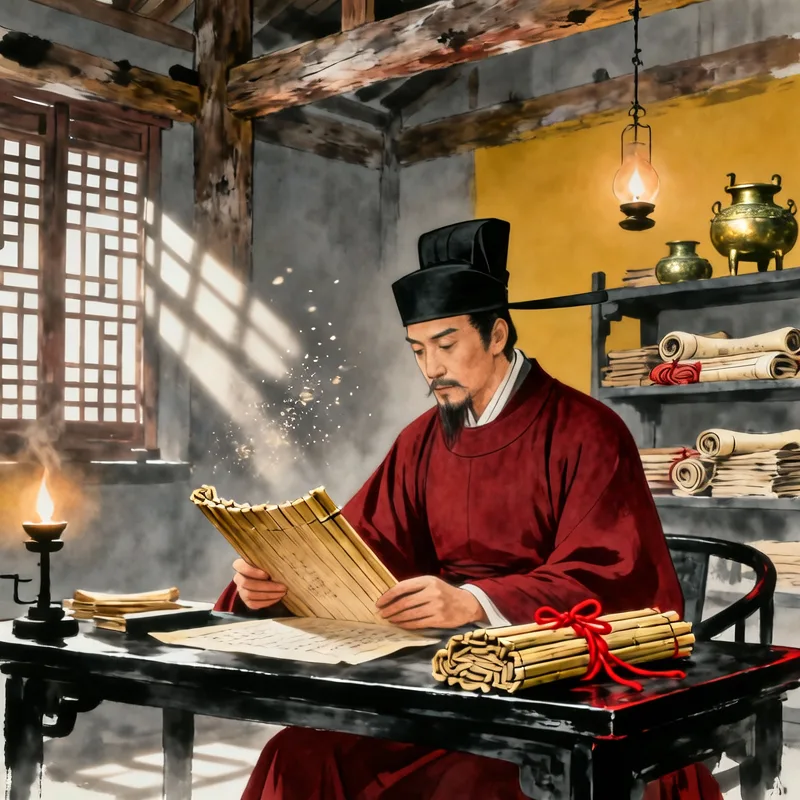
    The Han kept Qin commanderies and counties but softened the image of rule. Emperor Wu, reigning from 141 to 87 BCE, adopted the proposals of Dong Zhongshu, who urged the court to exalt Confucian learning while retaining legal sanctions. The imperial academy, founded in 124 BCE, trained students in the classics and supplied officials. Local recommendation systems identified candidates considered morally upright, though powerful families often dominated them. The empire was divided into provinces supervised by inspectors, and revenues came from land taxes, poll taxes, and state monopolies on salt and iron. Granaries helped stabilise grain prices in bad harvests.

    Han official in a wide-sleeved robe reading a bamboo-slip document at a desk
    Classical learning became a route into the Han bureaucracy. AI 생성 일러스트 · 시노비즈

    Wudi and the Frontiers

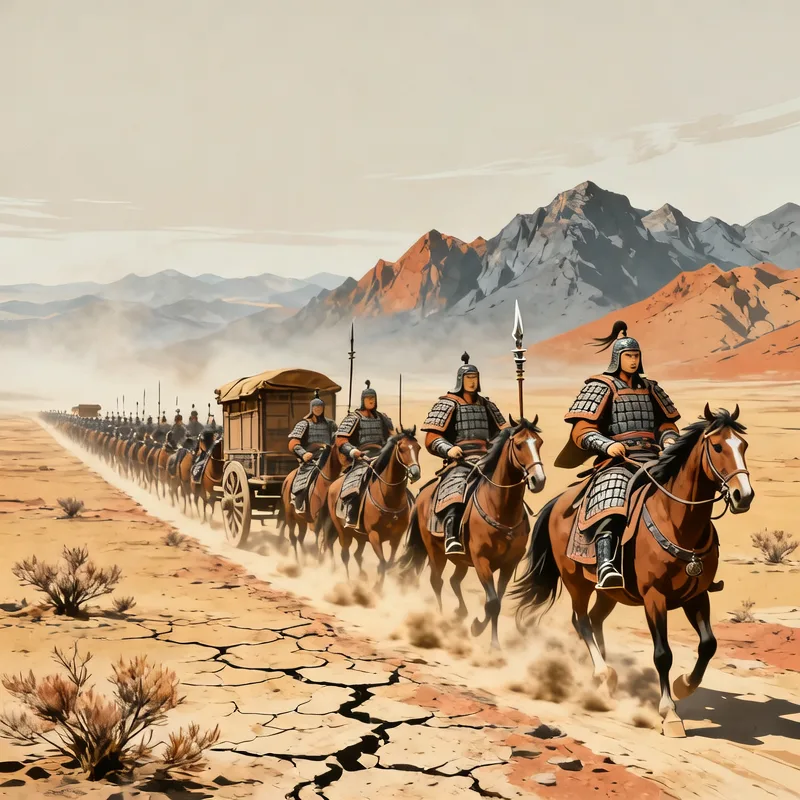
    Emperor Wu turned outward. He sent Zhang Qian west in 138 BCE to find allies against the Xiongnu confederation, and later campaigns pushed Han control into the Hexi Corridor and the Tarim Basin. In 60 BCE, the court created the Protectorate of the Western Regions to oversee the oasis states. Han armies also took northern Korea in 108 BCE, and campaigns reached into the south. These wars cost heavily, and the emperor’s late years saw revolts and a retreat from expansion. Nevertheless, the routes opened under Wudi linked Chang’an to Central Asian markets, and silk became a diplomatic and commercial export.

    Han cavalry and horse train crossing a dry northwestern frontier pass
    Campaigns against the Xiongnu opened the Hexi Corridor to Han trade. AI 생성 일러스트 · 시노비즈

    Foundations of Daily Life

    Han agriculture benefited from iron ploughs, ox-drawn equipment, and irrigation works, which supported a population counted at roughly 57 million in the census of 2 CE. Silk weaving, lacquerware, and pottery reached high technical standards, and Chang’an’s markets sold goods from the frontiers alongside local produce. Papermaking was known by the first centuries BCE and was improved by Cai Lun around 105 CE, when he presented a refined method to the court. The dynasty’s long duration made its institutions a model: later states copied its capital planning, bureaucratic ranks, and classical curriculum, and the name Han came to describe a people as well as a regime.

    The Han turned conquest into administration, and administration into a lasting cultural identity.

    참고 자료 및 추가 정보

    1. Han dynasty — 브리태니커 백과사전.
    2. Silk Roads: the Routes Network of Chang’an-Tianshan Corridor — UNESCO World Heritage Centre.
    3. Han Dynasty — World History Encyclopedia.

    제자리에 있는 모습을 보세요

    이 항목을 따라가면 해당 영역으로 이동할 수 있습니다.

    지도로 탐색하기

    스레드를 따라가세요

    같은 태그를 가진 다른 항목들을 찾아보세요.

    태그를 찾아보세요
  • Tang Chang’an

    연대기

    Tang Chang’an

    Cosmopolitan Capital on the Wei River

    The Tang capital whose grid of wards held merchants, monks, and foreign envoys.

    부분
    연대기
    지역
    산시
    연대
    sui-tang
    태그
    History, Scenic Sites

    Chang’an, on the site of modern Xi’an in Shaanxi, was the capital of the Tang dynasty from 618 to 907. Its planned streets and regulated markets made it the eastern anchor of the Silk Roads and a city of unusually visible cultural exchange.

    A City Built on a Grid

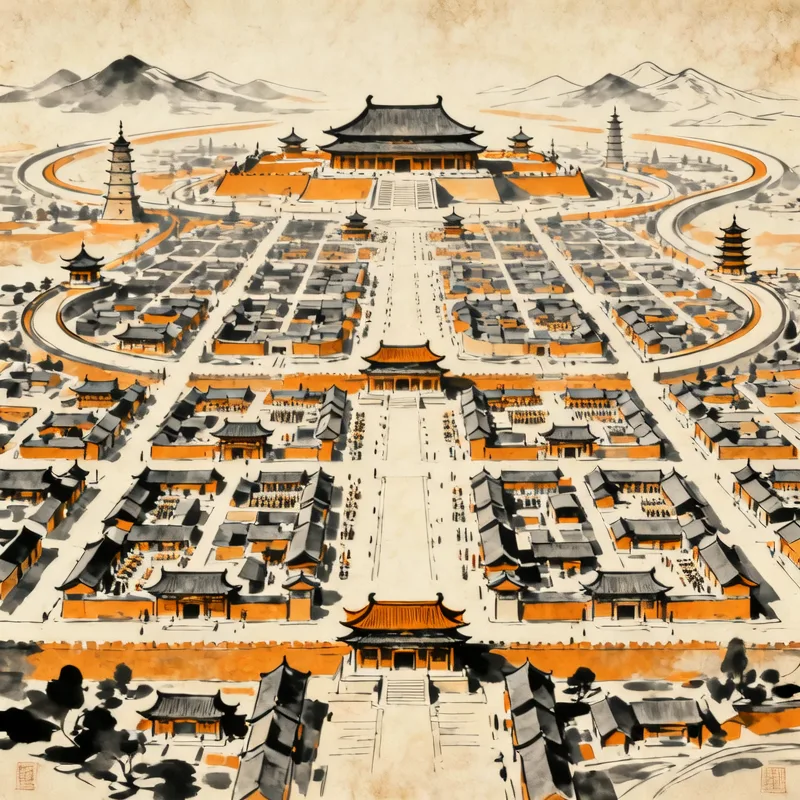
    The Tang city followed the plan of Daxing, built for the Sui dynasty in 582, and was renamed Chang’an under the Tang in 618. Its rectangular enclosure covered roughly 84 square kilometres and was divided into the palace city, the imperial city, and 108 residential wards. Eleven north-south avenues crossed fourteen east-west streets, creating a rigid grid that reflected the court’s desire for order. The city wall had twelve gates, with the southern gate leading to the ceremonial avenue. Excavations have revealed the scale of the wards, which enclosed houses, temples, workshops, and narrow internal lanes.

    Aerial reconstruction of a gridded Tang capital with the palace city at the north and ward blocks beyond
    Tang Chang’an organised more than a hundred wards within a vast rectangular wall. AI 생성 일러스트 · 시노비즈

    Markets and Curfew

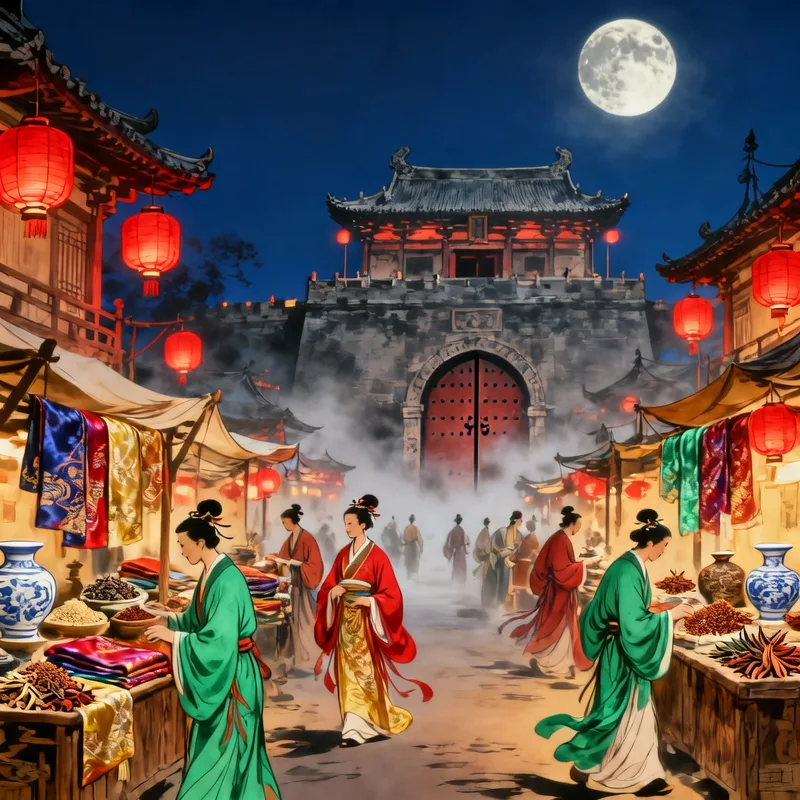
    Commerce was concentrated in the East Market and West Market, each a walled rectangle of lanes and shops. The West Market served long-distance traders, with Sogdian and Persian merchants, wine shops, money changers, and pawnshops. Officials supervised weights and licensed trades, while a market administration kept order. A night curfew closed the ward gates after the evening drum, so business belonged to daylight hours. A Tang writer records more than two hundred trades in the West Market, from silk dyeing to medicine. This regulated commerce made customs revenue and luxury goods flow steadily into the capital.

    Reconstructed Tang market lane with awnings, merchants, and stacked goods
    Licensed trades filled the West Market, a hub for long-distance merchants. AI 생성 일러스트 · 시노비즈

    Monks, Envoys, and a Stele

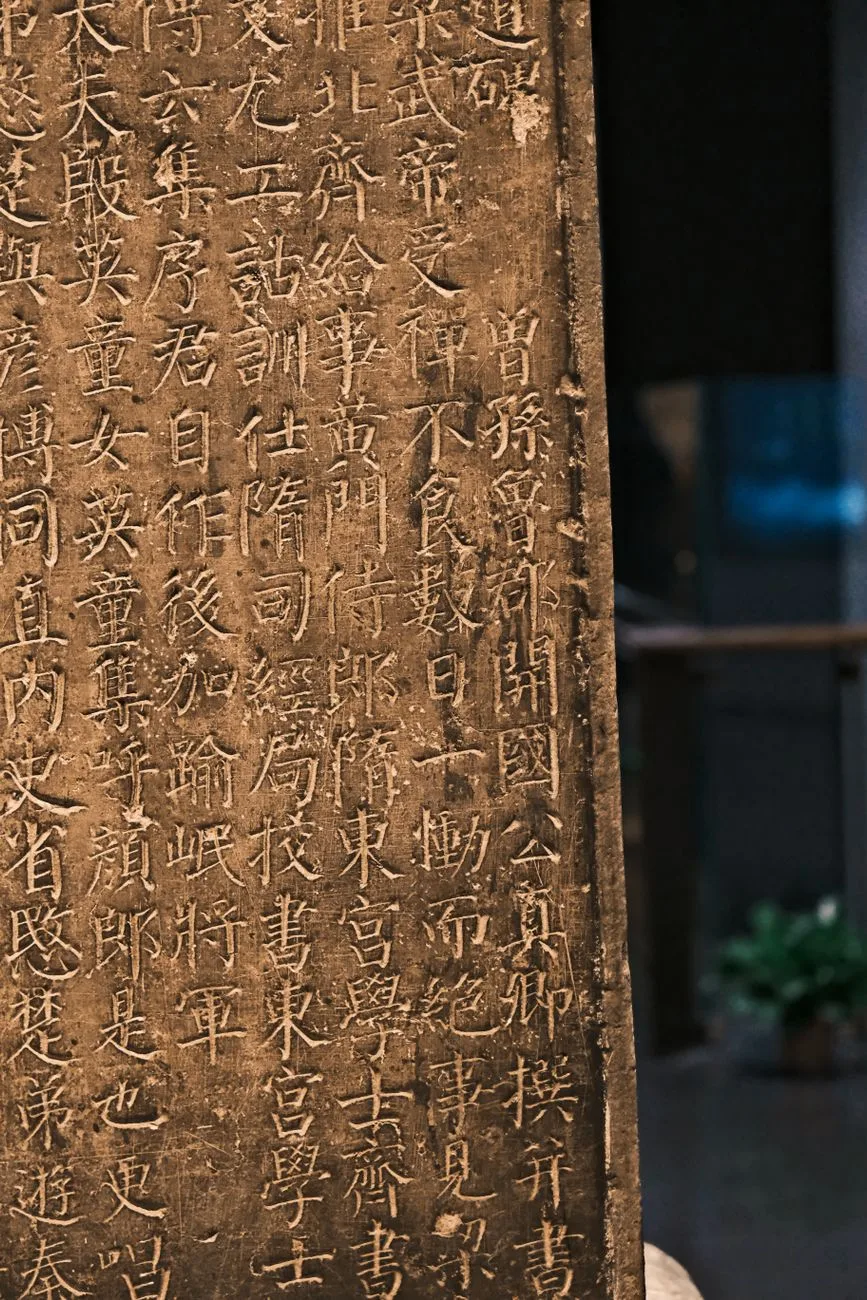
    Chang’an’s religious landscape matched its commercial range. The Buddhist monk Xuanzang returned from India in 645 with scriptures and translated them at the Da Ci’en Temple, completed in 652; the Giant Wild Goose Pagoda still stands nearby. The Nestorian Stele, erected in 781, records the arrival of a Christian missionary in 635 and documents a church that used Chinese Buddhist and Daoist vocabulary. Zoroastrian and Manichaean communities had places of worship, and Arab and Persian traders lived in the western wards. Japanese embassies reached the city between 630 and 894, and Korean students studied at the imperial academy, carrying Tang institutions home.

    Stone stele with Chinese and Syriac inscriptions standing beside a Tang temple wall
    The 781 Nestorian Stele records Christianity’s arrival at the Tang court in 635. Lily Lili | Pexels License (https://www.pexels.com/license/)

    After the Tang

    The city’s political role ended abruptly. In 904, the warlord Zhu Wen forced the court to move to Luoyang and ordered much of Chang’an dismantled, so that its timber could be transported east. The Tang fell in 907, and the site never recovered its former extent. Later rulers fortified a smaller city on part of the old ground; the present Xi’an city wall dates from the Ming dynasty. Archaeologists have since mapped the Tang wards and excavated the West Market. The Giant and Small Wild Goose Pagodas remain visible markers of a capital that once connected the Wei River to the Indian Ocean.

    In Tang Chang’an, the ward gate, the market licence, and the foreign monk belonged to the same system.

    참고 자료 및 추가 정보

    1. Silk Roads: the Routes Network of Chang’an-Tianshan Corridor — UNESCO World Heritage Centre.
    2. Chang’an — 브리태니커 백과사전.
    3. Chang’an — World History Encyclopedia.

    제자리에 있는 모습을 보세요

    이 항목을 따라가면 해당 영역으로 이동할 수 있습니다.

    지도로 탐색하기

    스레드를 따라가세요

    같은 태그를 가진 다른 항목들을 찾아보세요.

    태그를 찾아보세요
  • 실크로드

    연대기

    실크로드

    Caravan Routes Across Inner Asia

    Overland trade routes that tied Chang’an to the Mediterranean through Central Asian oases.

    부분
    연대기
    지역
    신장
    연대
    qin-han
    태그
    History, Geography

    The Silk Road was a network of caravan paths, not a single highway. Its Chinese section ran from Chang’an through the Hexi Corridor into Xinjiang, where oasis towns supplied water, fodder, and translators to merchants crossing the Taklamakan Desert.

    Zhang Qian Opens the Route

    The route enters Chinese records through an embassy. In 138 BCE, Emperor Wu of Han sent Zhang Qian west to seek an alliance with the Yuezhi against the Xiongnu. Zhang was captured by the Xiongnu and held for about ten years, but he escaped, reached the Yuezhi in Bactria, and returned in 126 BCE with reports of cities, markets, and horses far to the west. Sima Qian preserved his account in the Shiji, written around 100 BCE. A second mission followed in 119 BCE. These reports gave the Han court both geographical knowledge and a strategic reason to secure the corridor.

    Caravan track leaving the Hexi Corridor toward the oases of the Tarim Basin
    Han envoys followed the Hexi Corridor into the Tarim Basin in the second century BCE. AI 생성 일러스트 · 시노비즈

    Oasis Cities of the Tarim

    Travel across the Taklamakan followed its northern and southern rims, where mountain meltwater formed oases. Kashgar, Khotan, Yarkand, Kuqa, Karashahr, and Turpan grew into trading towns with irrigated fields, caravanserais, and multilingual populations. Sogdian merchants from Samarkand and Bukhara dominated much of the long-distance carrying trade between the fourth and eighth centuries, while local rulers taxed caravans and protected water points. Dunhuang, at the eastern edge of the desert, became the gateway where goods, envoys, and monks were recorded. The cave complex at Mogao, begun in 366 CE, preserves this mixture of languages and faiths.

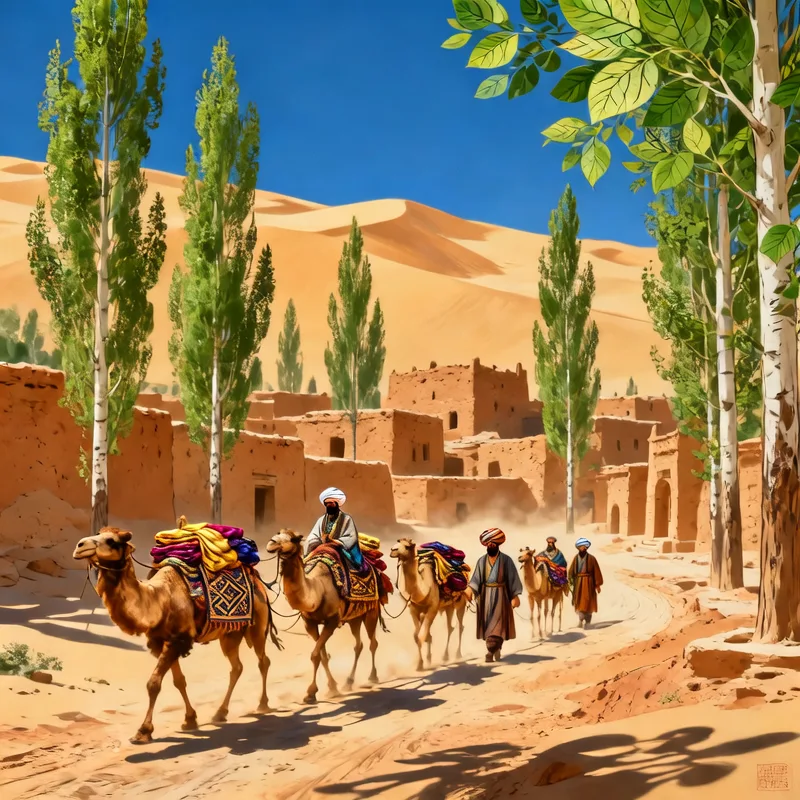
    Mud-brick oasis town and poplar groves at the edge of a Central Asian desert
    Tarim Basin oases supplied water and fodder to caravans crossing the desert rims. AI 생성 일러스트 · 시노비즈

    What Actually Travelled

    Silk gave the network its name, but caravans carried far more. Chinese silk, lacquer, and later paper moved west; Central Asian horses, jade, glassware, spices, and cotton moved east. Ideas travelled with the goods. Buddhism reached the Han capital by the first century CE, and monks such as Kumarajiva, who arrived at Chang’an in 401, translated Indian scriptures into Chinese. Technologies including papermaking and gunpowder eventually spread west, while grape growing and new musical instruments came east. The routes changed course with the politics of each dynasty, so the phrase Silk Road describes a shifting system rather than a fixed path.

    • Silk and paper moving west from China
    • Horses, jade, and glass moving east
    • Buddhist monks and translated scriptures
    • Sogdian merchants and caravanserais
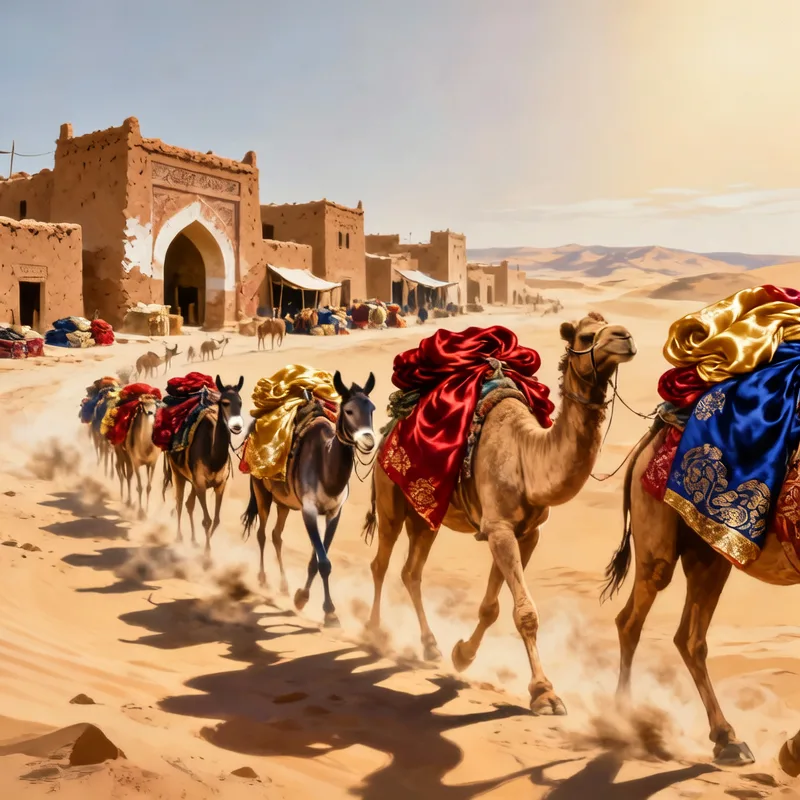
    Caravan of pack animals loaded with silk bundles approaching a desert trading town
    Caravans carried silk, horses, glass, and religious ideas in both directions. AI 생성 일러스트 · 시노비즈

    Decline and Afterlife

    Overland trade did not end abruptly. It declined as maritime routes expanded under the Tang and especially the Song, when ships could carry bulky porcelain and tea more cheaply than pack animals. The fragmentation of Central Asian politics after the Tang collapse in 907 and the rise of new powers farther east redirected traffic. Khara-Khoto and other desert towns continued to operate under the Western Xia in the eleventh and twelfth centuries. In the twentieth century, archaeologists working at Dunhuang and Turpan recovered manuscripts and objects that revealed how varied the traffic had been. Today the name Silk Road is used for both the historical network and modern investment projects.

    The Silk Road was held together by water points, translators, and credit as much as by silk.

    참고 자료 및 추가 정보

    1. Silk Roads: the Routes Network of Chang’an-Tianshan Corridor — UNESCO World Heritage Centre.

    2. Silk Road — 브리태니커 백과사전.
    3. 실크로드 — World History Encyclopedia.

    제자리에 있는 모습을 보세요

    이 항목을 따라가면 해당 영역으로 이동할 수 있습니다.

    지도로 탐색하기

    스레드를 따라가세요

    같은 태그를 가진 다른 항목들을 찾아보세요.

    태그를 찾아보세요
  • Zheng He’s Voyages

    연대기

    Zheng He’s Voyages

    Seven Voyages of the Ming Treasure Fleet

    A mid-fifteenth-century fleet that carried Ming diplomacy across the Indian Ocean.

    부분
    연대기
    지역
    푸젠
    연대
    yuan-ming-qing
    태그
    History, Transport

    Between 1405 and 1433, the Ming court sent seven large naval expeditions into the Indian Ocean. Commanded by the eunuch admiral Zheng He, the fleets visited ports from Southeast Asia to East Africa, exchanging gifts and asserting a maritime order.

    A Commander from Yunnan

    Zheng He was born Ma He around 1371 in Kunyang, Yunnan, into a Muslim family with connections to the Mongol administration. Captured as a boy during the Ming conquest of Yunnan, he entered the household of the prince of Yan, later the Yongle Emperor. He took the name Zheng He and rose to become a trusted eunuch official. In 1405, the Yongle Emperor ordered him to lead a fleet to the western oceans. The first voyage carried well over twenty thousand men, and the largest ships were far bigger than contemporary European vessels. Seven expeditions followed over twenty-eight years.

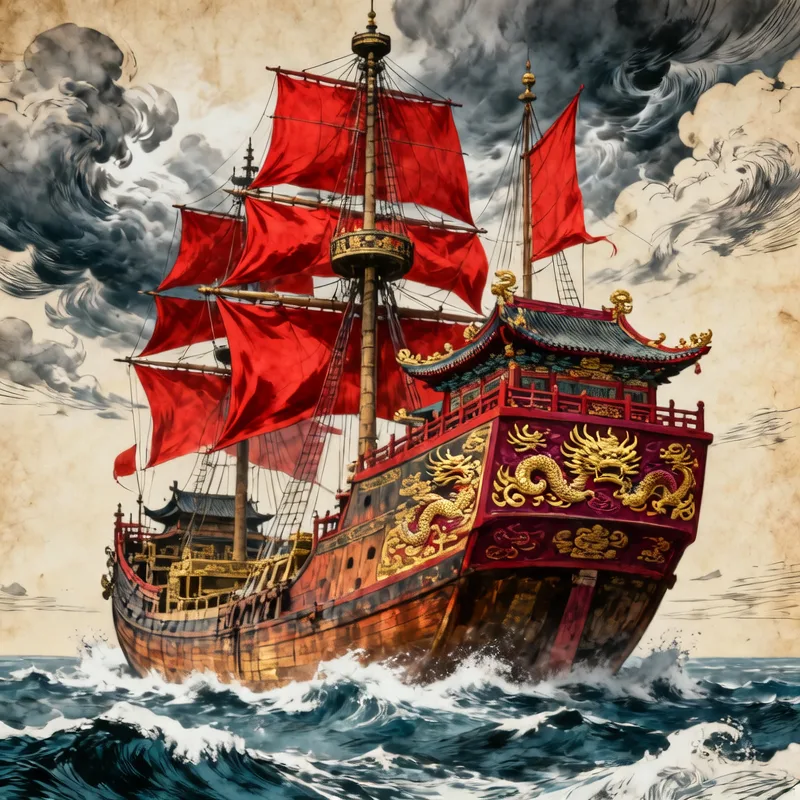
    Large wooden treasure ship with multiple masts and a high stern under sail
    Zheng He’s treasure ships symbolised the Ming court’s reach across the ocean. AI 생성 일러스트 · 시노비즈

    Building and Departing

    The fleets were built and provisioned through a vast state network. Shipyards at Nanjing and in Fujian constructed hulls whose dimensions are debated by historians, while carpenters, sailmakers, and caulkers worked under imperial requisition. Fujian supplied timber, skilled shipwrights, and pilots familiar with the southern seas. Expeditions assembled at Nanjing and at Liujiagang near Suzhou, where a 1431 stone inscription records donations and the distances sailed. From Fujian they rode the northeast monsoon south toward Champa and Java. The 1405 fleet reportedly included more than sixty treasure ships and hundreds of smaller vessels carrying horses, grain, and tribute goods.

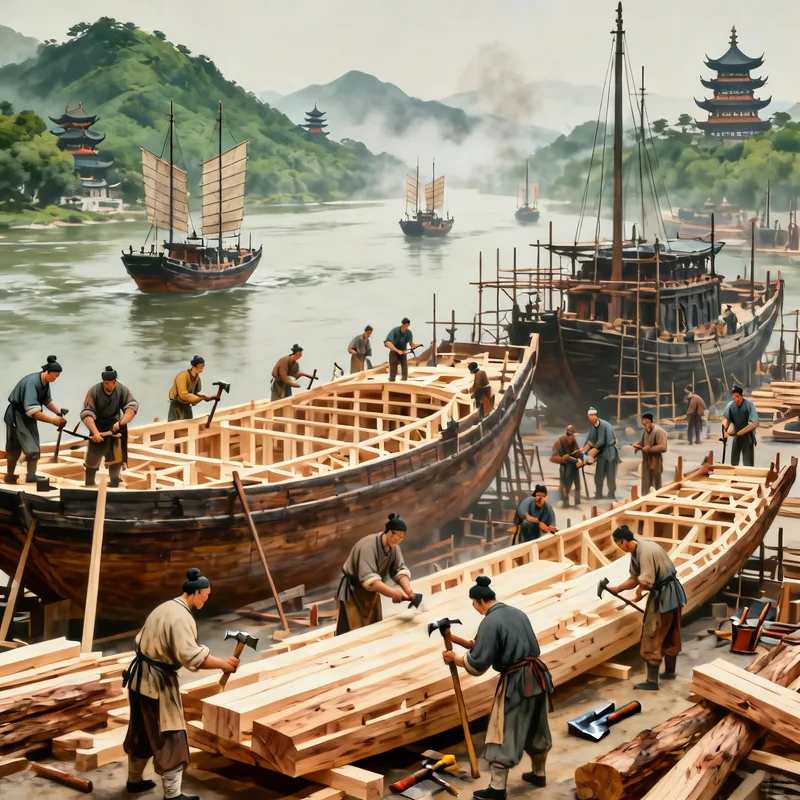
    Busy shipyard on a southeastern Chinese river with timber hulls under construction
    Nanjing and Fujian shipyards supplied the huge Ming fleets. AI 생성 일러스트 · 시노비즈

    Diplomacy Across the Ocean

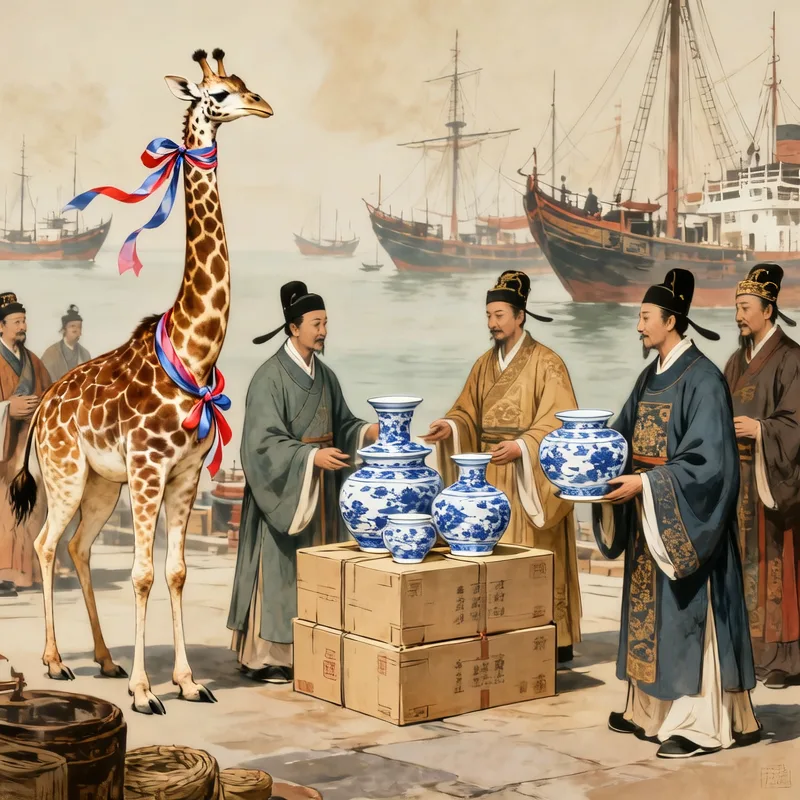
    Zheng He sailed to Calicut on India’s Malabar Coast, to Hormuz and Aden, and to ports such as Mogadishu and Malindi on the East African coast. The fleets carried silk, porcelain, and gold, and returned with pepper, ivory, incense, gems, and exotic animals, including a giraffe presented as a tribute curiosity. Zheng He also fought pirates in Southeast Asia and installed rulers friendly to Ming interests. Unlike later European voyages, these expeditions did not establish colonies or a permanent overseas empire. They projected the tribute system, under which foreign rulers acknowledged Ming supremacy in exchange for gifts, titles, and protected trade.

    • Calicut on the Malabar Coast
    • Hormuz and Aden at the western end
    • Malacca and Java in Southeast Asia
    • Mogadishu and Malindi in East Africa
    Foreign envoys presenting a giraffe and ivory at a Ming imperial court audience
    Tribute gifts such as giraffes and ivory embodied the fleet’s diplomatic mission. AI 생성 일러스트 · 시노비즈

    Why the Voyages Stopped

    The expeditions ended after Zheng He died, probably in 1433 during the seventh voyage. His successor, the Hongxi Emperor, had already halted new fleets in 1424, and Confucian ministers argued that the cost drained the treasury while scholar-officials resented the eunuch admiral’s influence. The court shifted resources toward the northern frontier and the Grand Canal. Maritime trade continued through private merchants and the port of Quanzhou, but the state fleet disappeared, and many records were neglected. Centuries later, Chinese historians revisited the voyages as evidence of an earlier age of ocean-going capacity.

    The treasure fleets carried an empire’s courtesy across the ocean, and then sailed no more.

    참고 자료 및 추가 정보

    1. Zheng He — 브리태니커 백과사전.
    2. Quanzhou: Emporium of the World in Song-Yuan China — UNESCO World Heritage Centre.
    3. The Seven Voyages of Zheng He — World History Encyclopedia.

    제자리에 있는 모습을 보세요

    이 항목을 따라가면 해당 영역으로 이동할 수 있습니다.

    지도로 탐색하기

    스레드를 따라가세요

    같은 태그를 가진 다른 항목들을 찾아보세요.

    태그를 찾아보세요
  • Confucius and the Analects

    연대기

    Confucius and the Analects

    A Teacher’s Words in Twenty Books

    The sayings of Confucius and the ritual tradition that grew around them.

    부분
    연대기
    지역
    베이징
    연대
    three-dynasties
    태그
    History, Customs

    Confucius lived in a fractured Zhou world and taught that good government began with personal conduct. His conversations, collected in the Analects, became one of the most widely read texts in East Asia and eventually a foundation of state ritual and examination culture.

    Life in the State of Lu

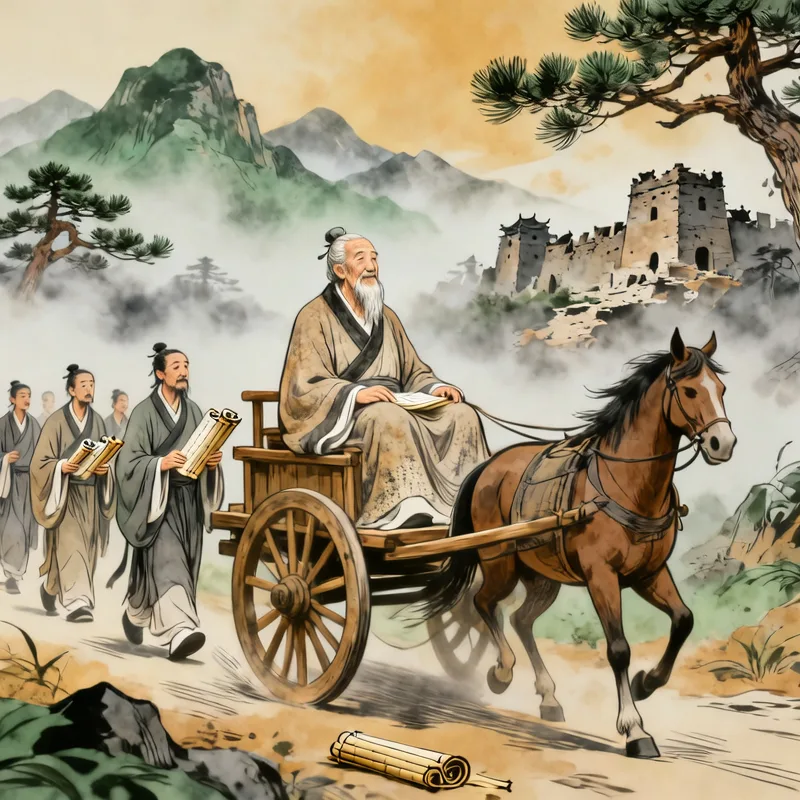
    Confucius, whose family name was Kong and personal name Qiu, was born in 551 BCE at Qufu in the state of Lu, in present-day Shandong. His father died when he was young, and he later worked as a keeper of granaries and herds before becoming known as a teacher. Around 497 BCE he left Lu after a political dispute and spent roughly fourteen years travelling through neighbouring states, advising rulers and gathering disciples. He returned to Lu around 484 BCE and died in 479 BCE. The Spring and Autumn era in which he lived saw the Zhou king’s authority eroded by powerful regional lords.

    Illustration of Confucius travelling with disciples through a hilly landscape
    Confucius spent about fourteen years seeking rulers willing to adopt his teaching. AI 생성 일러스트 · 시노비즈

    How the Analects Took Shape

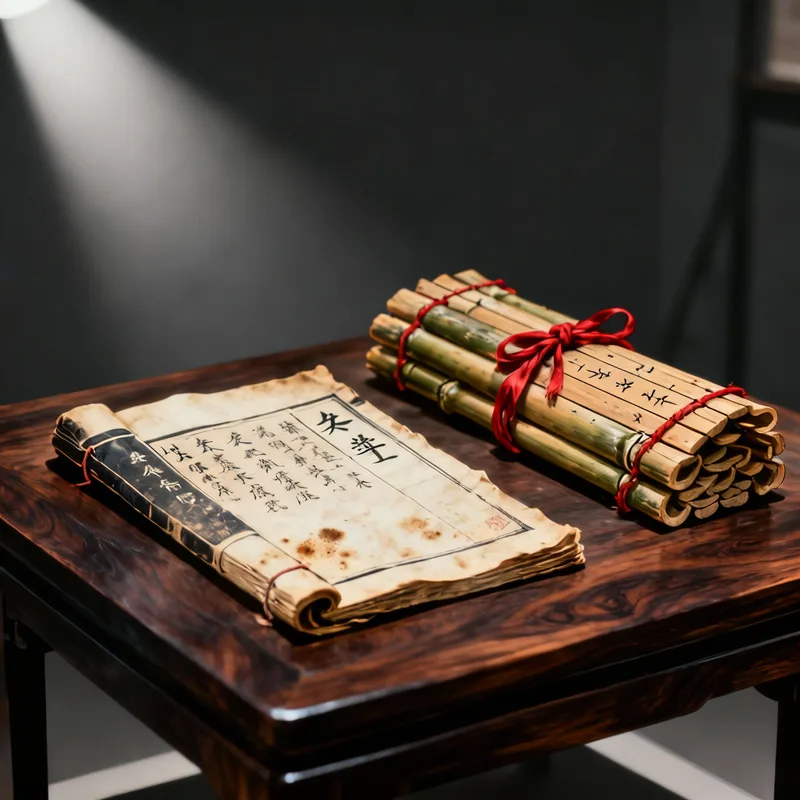
    The Analects, or Lunyu, is not a book written by Confucius himself. It is a compilation of sayings, questions, and short scenes, traditionally arranged in twenty chapters. Disciples and later followers transmitted the material orally before it reached its received form, probably during the fourth and third centuries BCE. Passages typically begin with "The Master said," followed by terse maxims on learning, ritual, and government. The Latin title Analects means "selected sayings." Because the text layers different generations of memory, it presents a teacher in conversation rather than a single systematic doctrine, which is part of its enduring appeal.

    Open page of a Chinese woodblock edition of the Analects with vertical columns of characters
    The Analects gathers sayings transmitted by disciples over several generations. AI 생성 일러스트 · 시노비즈

    From Qufu to Beijing

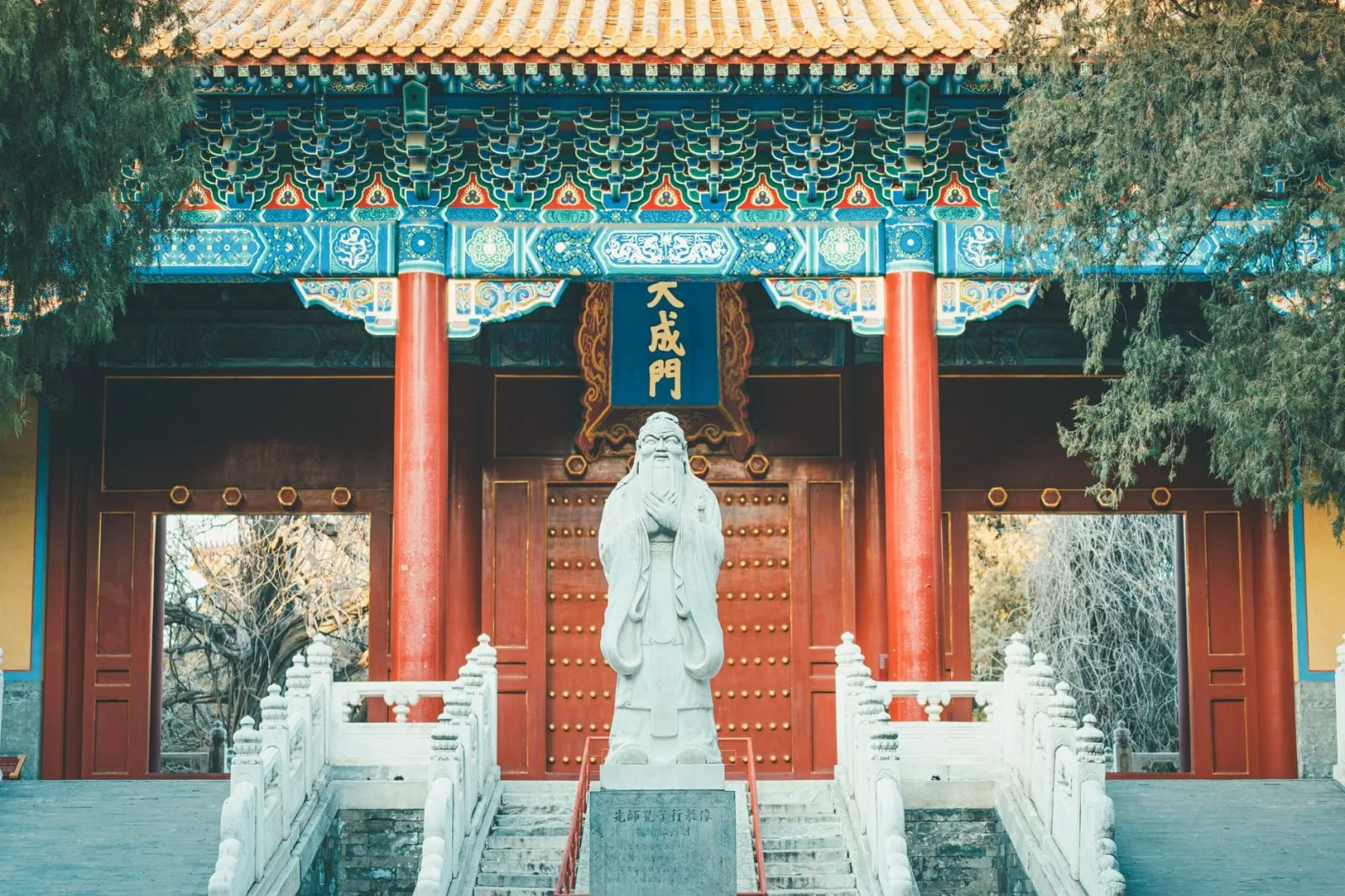
    Confucius was honoured regionally in his lifetime and officially after his death. In 134 BCE, Emperor Wu of Han adopted the recommendation of Dong Zhongshu to elevate Confucian learning at court, and the imperial academy was founded in 124 BCE. The state cult spread: a temple at Qufu grew around the Kong family mansion and cemetery, and rulers performed sacrifices to the sage. In Beijing, a Temple of Confucius was built in 1302 under the Yuan dynasty and rebuilt under the Ming and Qing. It stood beside the Imperial College, linking the veneration of the teacher to the training of officials.

    Courtyard of a red-walled Confucian temple with a bronze incense burner and cypress trees
    Beijing’s Temple of Confucius, first built in 1302, joined worship to official education. zhang kaiyv | Pexels License (https://www.pexels.com/license/)

    The Teaching in Practice

    The central terms are ren, often translated as humaneness, and li, ritual propriety. Confucius treated them as habits formed through practice: respect for elders, careful speech, and attention to the duties of one’s position. The famous negative formulation of reciprocity, "What you do not want done to yourself, do not do to others," appears in the Analects. The text also insists that rulers set the moral tone, comparing their virtue to wind that bends the grass. Later readers in Korea, Japan, and Vietnam adapted the same vocabulary, while Neo-Confucian thinkers of the Song dynasty built a more systematic philosophy from it.

    What you do not want done to yourself, do not do to others. — Confucius, Analects 15.24

    참고 자료 및 추가 정보

    1. Confucius — 브리태니커 백과사전.
    2. Confucius — Stanford Encyclopedia of Philosophy.
    3. Temple and Cemetery of Confucius and the Kong Family Mansion in Qufu — UNESCO World Heritage Centre.
    제자리에 있는 모습을 보세요

    이 항목을 따라가면 해당 영역으로 이동할 수 있습니다.

    지도로 탐색하기

    스레드를 따라가세요

    같은 태그를 가진 다른 항목들을 찾아보세요.

    태그를 찾아보세요
  • 진나라 통일

    연대기

    진나라 통일

    One Empire, One Script, One Standard

    The conquests and reforms that created China’s first centralised empire.

    부분
    연대기
    지역
    산시
    연대
    qin-han
    태그
    역사

    In 221 BCE, the king of Qin took the title First Emperor and ended centuries of interstate rivalry. The dynasty he founded lasted only fifteen years, yet its administrative methods shaped every later Chinese state.

    The Warring States Background

    The Qin state grew powerful in the Wei River valley, in modern Shaanxi, because of reforms carried out by the minister Shang Yang from 356 BCE. He reorganised landholding, rewarded agricultural output and military merit, registered households for taxation and conscription, and imposed a strict legal code. These measures gave Qin a disciplined army and a reliable grain supply. Its rivals, including Chu, Zhao, Wei, Han, Yan, and Qi, held out with varying success through the fourth and third centuries BCE. The walled capital Xianyang became the base from which Qin kings directed a long series of campaigns.

    Reconstructed Warring States crossbow formation advancing toward a walled city
    Shang Yang’s reforms turned Qin into the most disciplined of the seven states. AI 생성 일러스트 · 시노비즈

    The Campaigns of 230–221 BCE

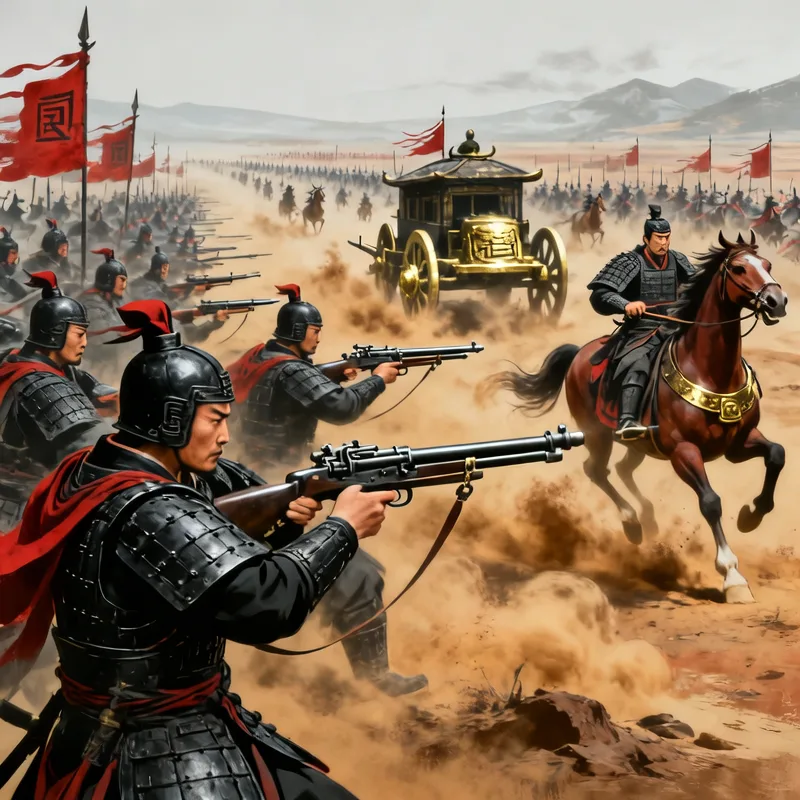
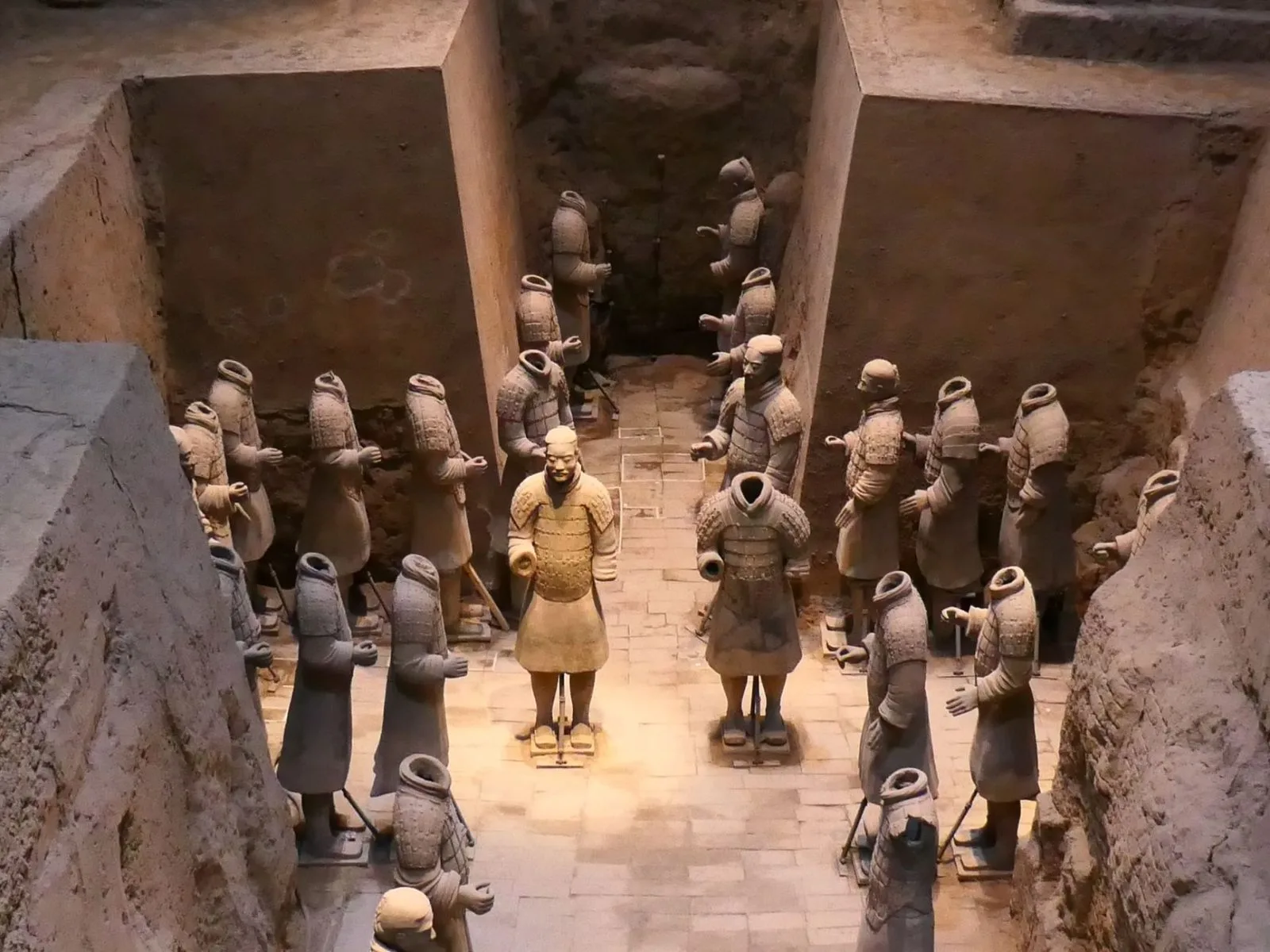
    Between 230 and 221 BCE, Qin armies conquered the six remaining states in sequence: Han, Zhao, Wei, Chu, Yan, and Qi. The king, Ying Zheng, had come to the throne in 246 BCE and, after victory, adopted the title Qin Shi Huang, First Emperor of Qin. His chancellor Li Si argued against restoring feudal fiefs for the royal family and generals, warning that they would become independent rivals. The emperor accepted the argument and divided the empire into commanderies governed by appointed officials. A famous debate at court in 221 BCE thus settled the shape of imperial rule for centuries.

    Terracotta army rank and file standing in formation in a pit near Xi’an
    The First Emperor’s burial army reflects the military power behind unification. nana liu | Pexels License (https://www.pexels.com/license/)

    Standards as an Instrument of Rule

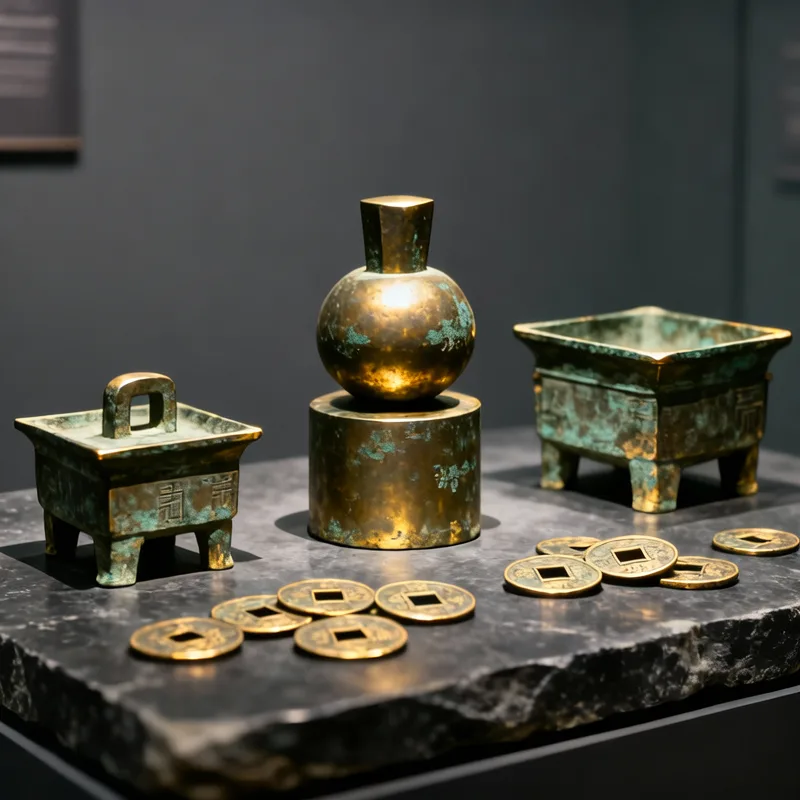
    Unification required practical uniformity. The Qin court standardised weights and measures, the round copper banliang coin, and the small seal script, a simplified writing system that officials could use across regions with different spoken languages. Carts were built to a common axle width so that ruts on imperial roads would match, and a network of highways and canals linked the capital to the provinces. Decrees were carved on stone and distributed. These policies lowered the costs of taxation, transport, and legal administration. They also made central authority visible in daily transactions, from market weights to the shape of a written character.

    Bronze measuring vessel and round copper coin of the Qin dynasty in a museum case
    Standard measures and coinage made an empire administratively legible. AI 생성 일러스트 · 시노비즈

    The Cost of Uniformity

    The same government that standardised script also demanded heavy labour and enforced ideological conformity. Hundreds of thousands of convicts and conscripts worked on the emperor’s mausoleum near Mount Li, the frontier walls, and the Epang Palace. In 213 BCE, Li Si urged the burning of historical records and privately held books outside approved technical works; the following year, hundreds of scholars were reportedly executed at Xianyang. When the emperor died in 210 BCE, the succession was contested and revolts began in 209 BCE under Chen Sheng and Wu Guang. The dynasty fell in 206 BCE, but the Qin framework survived.

    The Qin won the empire with armies and kept it with writing, weights, and roads.

    참고 자료 및 추가 정보

    1. Qin dynasty — 브리태니커 백과사전.
    2. Mausoleum of the First Qin Emperor — UNESCO World Heritage Centre.
    3. Qin Dynasty — World History Encyclopedia.

    제자리에 있는 모습을 보세요

    이 항목을 따라가면 해당 영역으로 이동할 수 있습니다.

    지도로 탐색하기

    스레드를 따라가세요

    같은 태그를 가진 다른 항목들을 찾아보세요.

    태그를 찾아보세요
  • 만리장성

    연대기

    만리장성

    Frontier Walls Across Two Millennia

    A chain of fortifications built by successive dynasties to control the steppe frontier.

    부분
    연대기
    지역
    베이징
    연대
    qin-han
    태그
    History, Geography, Scenic Sites

    The Great Wall is not one wall but a series of defensive systems raised at different times by different states. Their surviving masonry, from northwest Beijing to the Gobi, records two thousand years of contest and exchange between farming settlements and the Inner Asian steppe.

    Walls Before the First Emperor

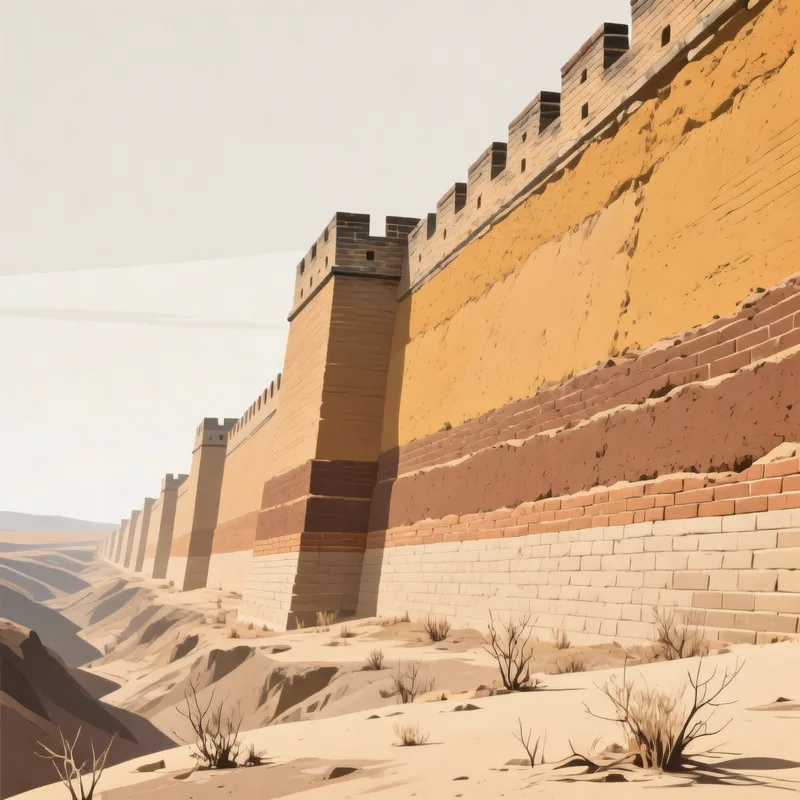
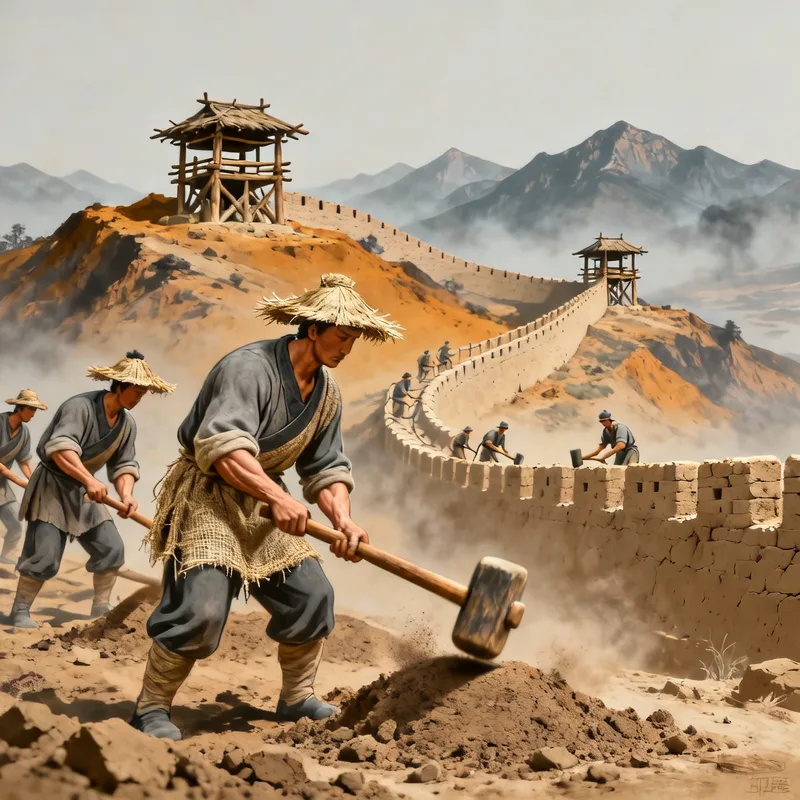
    Wall building began long before the Qin dynasty. During the Warring States period (475–221 BCE), the states of Qin, Zhao, and Yan raised earthen ramparts along their northern and western frontiers to check Xiongnu raiders and to mark contested pasture. These were not isolated lines: they were linked to watchtowers, garrison posts, and river barriers that could slow cavalry and give farmers time to shelter. Some sections were built of tamped earth, layered and hammered into a dense wall that could stand for centuries in the dry northwest. The First Emperor later joined and extended this existing network rather than inventing the idea of a frontier wall from nothing.

    Layered rammed-earth wall of an early northern frontier rampart rising above a dry valley
    Early walls were tamped earth, not the brick masonry familiar from Ming sections. AI 생성 일러스트 · 시노비즈

    The Qin Link, 221–206 BCE

    After unifying China in 221 BCE, Qin Shi Huang ordered the general Meng Tian to connect the northern walls into a single defensive front. Reports in the Shiji describe a force of hundreds of thousands of soldiers and convict labourers working from Lintao in present-day Gansu to Liaodong in the northeast, a distance later described as ten thousand li. The aim was strategic: to push the Xiongnu north of the Yellow River loop and to protect the new commanderies planted in conquered territory. The work was expensive and unpopular, and the Qin collapsed in 209–206 BCE, but the frontier idea outlived the dynasty.

    Reconstructed Qin-era frontier wall with watchtowers crossing a loess plateau
    Meng Tian’s campaign joined older walls into a frontier stretching from Gansu to Liaodong. AI 생성 일러스트 · 시노비즈

    The Ming Wall We See Today

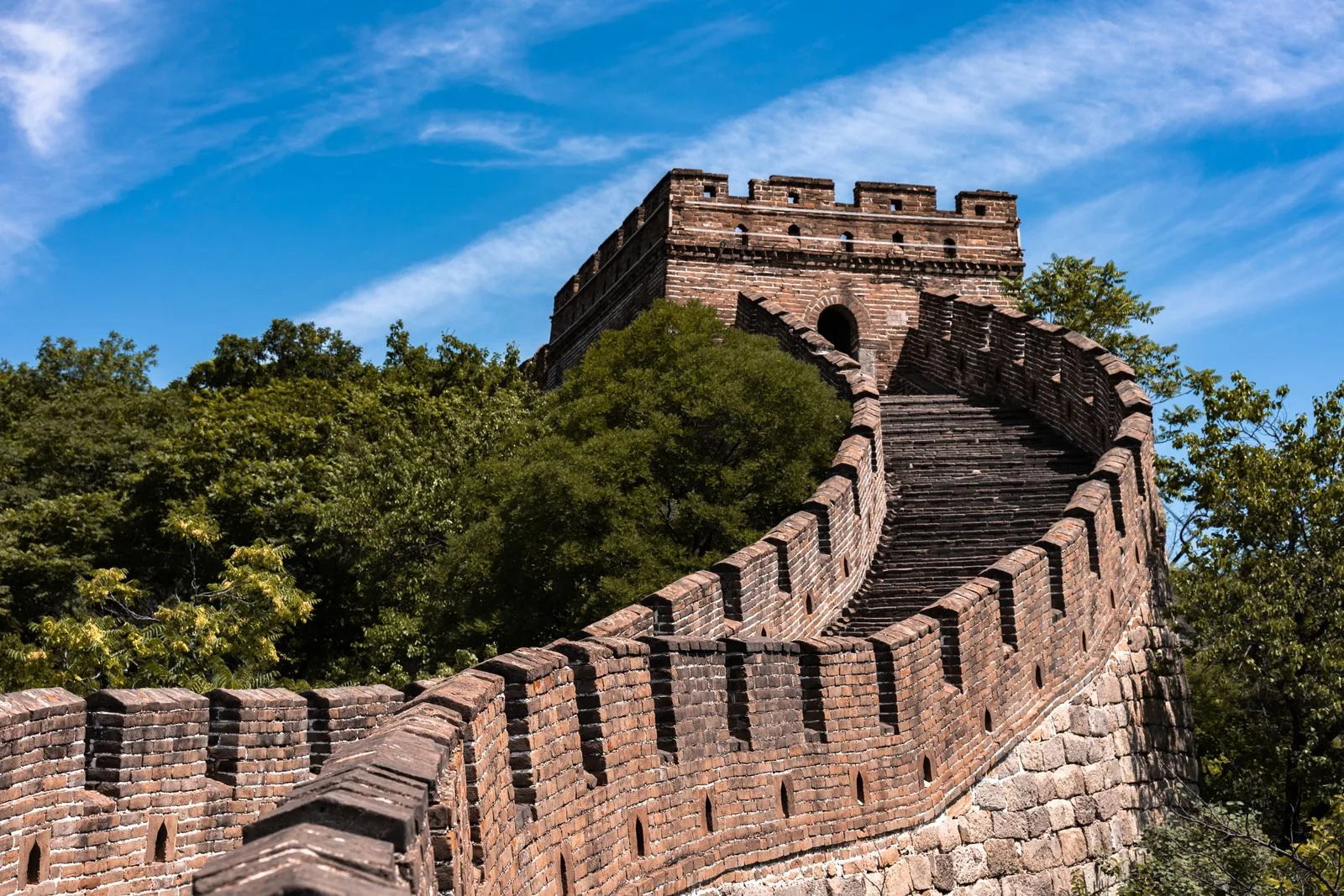
    Most visible masonry belongs to the Ming dynasty (1368–1644), which rebuilt the wall after the Mongol Yuan retreated north. Beginning in the late fourteenth century, Ming engineers faced sections with brick and stone, added hollow watchtowers and beacon platforms, and anchored the line at Jiayuguan in Gansu and Liaodong in the northeast. The best-preserved stretches near Beijing, including Badaling, Mutianyu, and Jinshanling, date from this period. UNESCO inscribed the Great Wall on the World Heritage List in 1987, describing its full length at 8,851.8 kilometres. What visitors walk today is therefore a late imperial rebuilding of a much older frontier idea.

    Brick-faced Ming wall with crenellations and a watchtower winding over a green ridge near Beijing
    Ming brickwork near Beijing is the wall most visitors see today. Mehmet Yasin Kabaklı | Pexels License (https://www.pexels.com/license/)

    A System of Control and Contact

    The wall worked as a system rather than a solid barrier. Beacon towers passed smoke and fire signals along the line, while garrison towns and passes regulated movement. Trade was not stopped: frontier markets exchanged grain, tea, and silk for horses and furs, and officials issued passes to authorised caravans. The ruined walls of the fourth-century Tuoba Wei and the earthworks of the Jin dynasty show that steppe peoples also built walls against one another. To read the Great Wall only as a dividing line is to miss its second function, which was to organise contact on terms the state could tax and police.

    The wall was never a single line on a map; it was a frontier regime made of stone, signal fire, and paperwork.

    참고 자료 및 추가 정보

    1. 만리장성 — UNESCO World Heritage Centre.
    2. Great Wall of China — 브리태니커 백과사전.
    3. The Great Wall of China — World History Encyclopedia.

    제자리에 있는 모습을 보세요

    이 항목을 따라가면 해당 영역으로 이동할 수 있습니다.

    지도로 탐색하기

    스레드를 따라가세요

    같은 태그를 가진 다른 항목들을 찾아보세요.

    태그를 찾아보세요
  • 자금성

    연대기

    자금성

    The Ming and Qing Imperial Palace

    A walled palace in Beijing that served as the seat of Ming and Qing imperial government.

    부분
    연대기
    지역
    베이징
    연대
    yuan-ming-qing
    태그
    History, Scenic Sites

    The Forbidden City was built as the ceremonial and administrative centre of the Ming and later Qing dynasties. Its courtyards and halls express rank in stone, timber, colour, and route: the emperor alone crossed the central axis to the throne hall.

    Building an Imperial Axis

    Construction began in 1406 under the Yongle Emperor, who had moved the capital from Nanjing to Beijing. The palace took roughly fourteen years to complete and opened in 1420. Its site lay south of the Yuan dynasty’s capital, Dadu, whose planner had already established a north-south axis. More than a million workers and artisans were mobilised, including convict labour and skilled craftsmen from across the empire. Timber came from southern forests, stone from quarries near Beijing, and glazed tiles from kilns in the capital’s outskirts. The name Zijin Cheng, or Purple Forbidden City, referred to the polarised Heavenly Emperor and the restrictions on entry.

    The Hall of Supreme Harmony rising above broad terraces on Beijing’s central axis
    The main throne hall stands on the palace’s central ceremonial axis. Lan Yao | Pexels License (https://www.pexels.com/license/)

    Front Court and Inner Quarters

    The palace is organised into an outer court for ceremony and an inner court for residence. The Hall of Supreme Harmony, the largest and highest hall, was used for enthronements, imperial weddings, and the winter solstice audience. Behind it stand the Hall of Central Harmony and the Hall of Preserving Harmony. The inner court includes the Palace of Heavenly Purity, the Hall of Earthly Tranquility, and the empress’s quarters. Officials approached through the Meridian Gate and crossed the Golden Water River on bridges that marked status. The design did more than impress: it separated ranks and turned movement through space into a visible grammar of power.

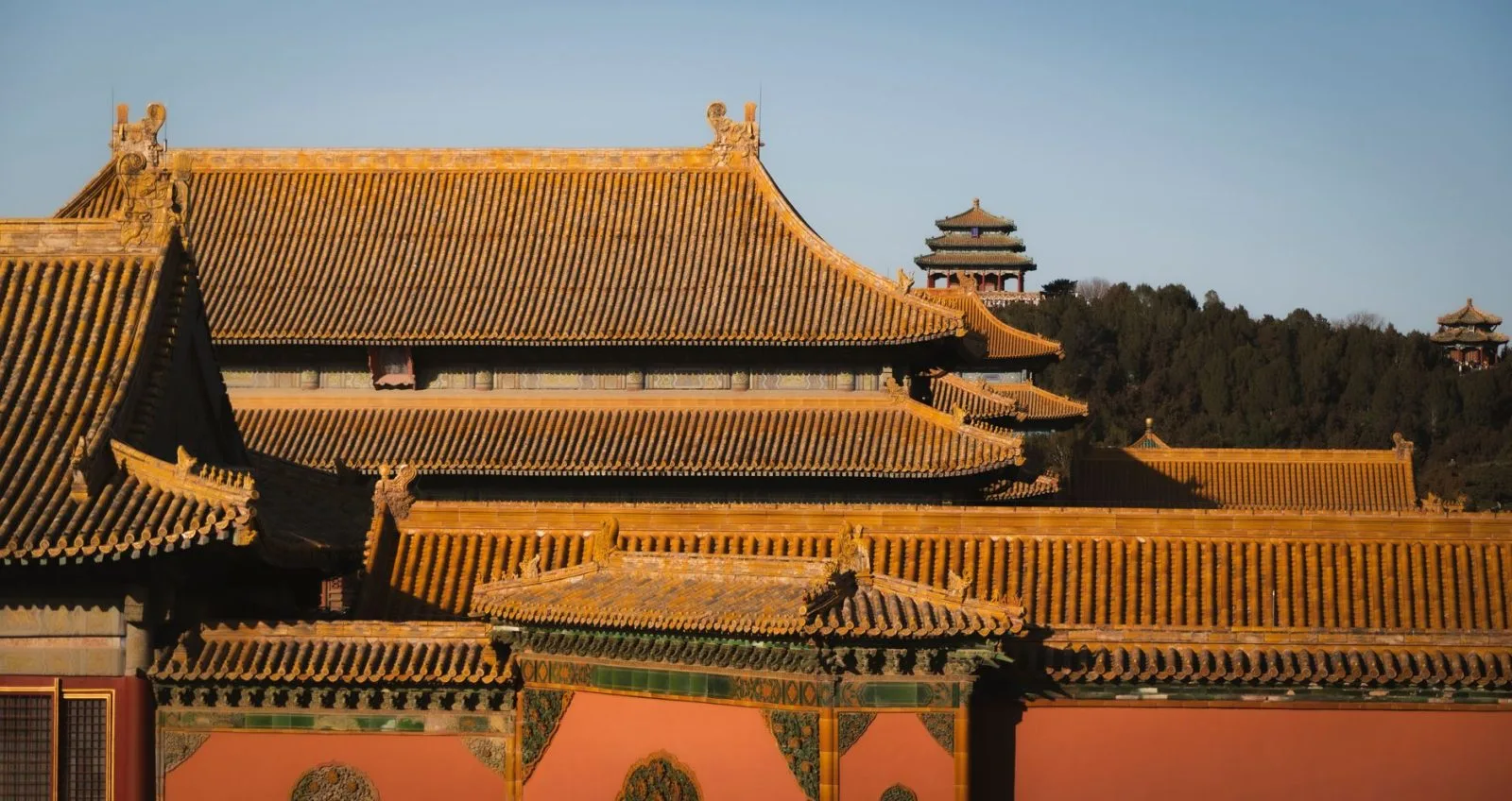
    A succession of red-walled courtyards and golden roofs viewed from a palace terrace
    Repeated courtyards made ceremonial progress part of the architecture. 虎 曼 | Pexels License (https://www.pexels.com/license/)

    Colour, Number, and Craft

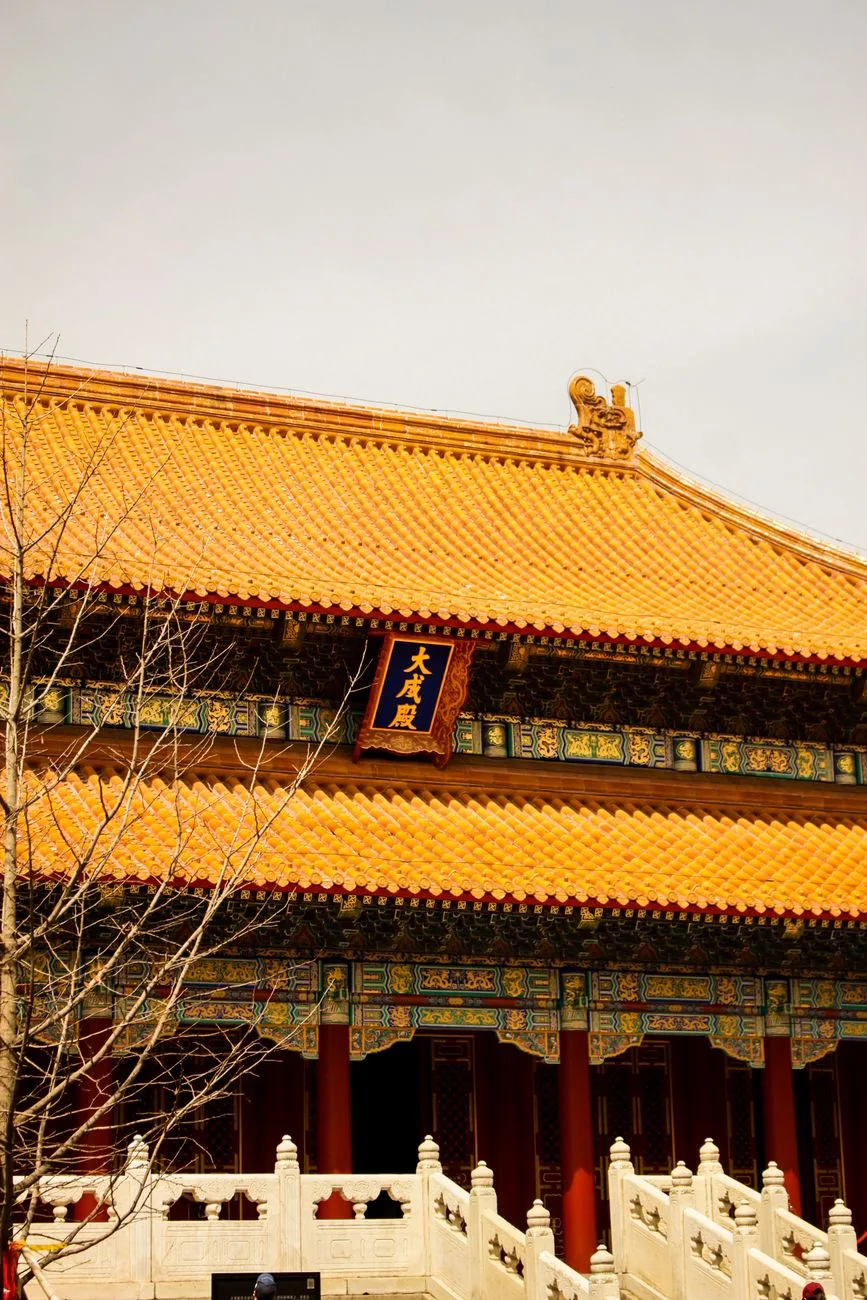
    The surviving buildings show Ming and Qing carpentry at large scale. Timber frames stand on stone plinths, with dougong bracket sets supporting deep eaves. Yellow glazed roof tiles were reserved for imperial buildings; vermilion walls, white marble terraces, and dark blue-green beams created a controlled palette. The Hall of Supreme Harmony carries ten roof figures, the highest rank, and its terrace holds bronze cranes and a tortoise. Numbers were symbolic: nine marked the emperor, and the palace is said to have 9,999 rooms, though the count depends on how spaces are defined. The Palace Museum, opened in 1925 after the last emperor left, now preserves the buildings and collections.

    • Begun in 1406 and occupied in 1420
    • Outer court for audiences, inner court for residence
    • Yellow roof tiles restricted to imperial use
    • Palace Museum opened to the public in 1925
    Golden roof tiles, bracket sets, and carved beams on a Qing palace hall
    Dougong brackets and yellow glazed tiles carried imperial rank. ravencrow BI | Pexels License (https://www.pexels.com/license/)

    Visiting the Palace Today

    The complex covers about 720,000 square metres and holds thousands of rooms, so a visit needs a route. Most visitors enter from the south at the Meridian Gate, pass the three great halls, then turn north to the inner court and the Garden of Cultivation. The Treasure Gallery and the Clock Gallery occupy separate wings and often require extra tickets. Ticket sales normally close in the afternoon and the palace is closed on Mondays except during peak holidays, so checking current rules matters. Tiananmen Square security adds time. The best views of the roofscape are from Jingshan Park to the north, which also marks the site where the Ming dynasty’s last emperor died in 1644.

    The palace made ceremony architectural: every gate, terrace, and roof colour told a visitor where power stood.

    참고 자료 및 추가 정보

    1. 자금성 — UNESCO World Heritage Centre.
    2. 자금성 — 브리태니커 백과사전.
    3. The Palace Museum — The Palace Museum.

    제자리에 있는 모습을 보세요

    이 항목을 따라가면 해당 영역으로 이동할 수 있습니다.

    지도로 탐색하기

    스레드를 따라가세요

    같은 태그를 가진 다른 항목들을 찾아보세요.

    태그를 찾아보세요