标签: 风景名胜

  • 瓷

    生活与民俗

    瓷

    Clay, fire, and the white of Dehua

    Fujian’s kilns turned local clay into porcelain that travelled across the sea and changed how the world pictured China.

    部分
    生活与民俗
    地区
    福建
    时代
    跨越时代
    标签
    Customs, History, Scenic Sites

    Porcelain is defined by its body and its firing: a pale, fine clay heated to temperatures that vitrify the material and make it ring when struck. Fujian’s Dehua kilns made a version so white it seemed translucent, known in Europe as blanc de Chine.

    What Makes Porcelain

    Porcelain differs from ordinary pottery in both material and firing. Potters use kaolin, a white clay, mixed with feldspar and quartz, then fire the shaped vessel at roughly 1,200 to 1,400 degrees Celsius. At that temperature the body vitrifies: it becomes dense, non-porous, and slightly translucent at the edges. A glassy glaze is usually applied before firing, bonding to the body rather than sitting on it as a separate layer. Chinese potters had reached this threshold by the Tang and Song periods, and Jingdezhen in Jiangxi became the great production centre. The English word china stuck to the ware because the country was the source of the finest examples. A light tap on a good cup gives a clear ring, a quick test that still works in a shop.
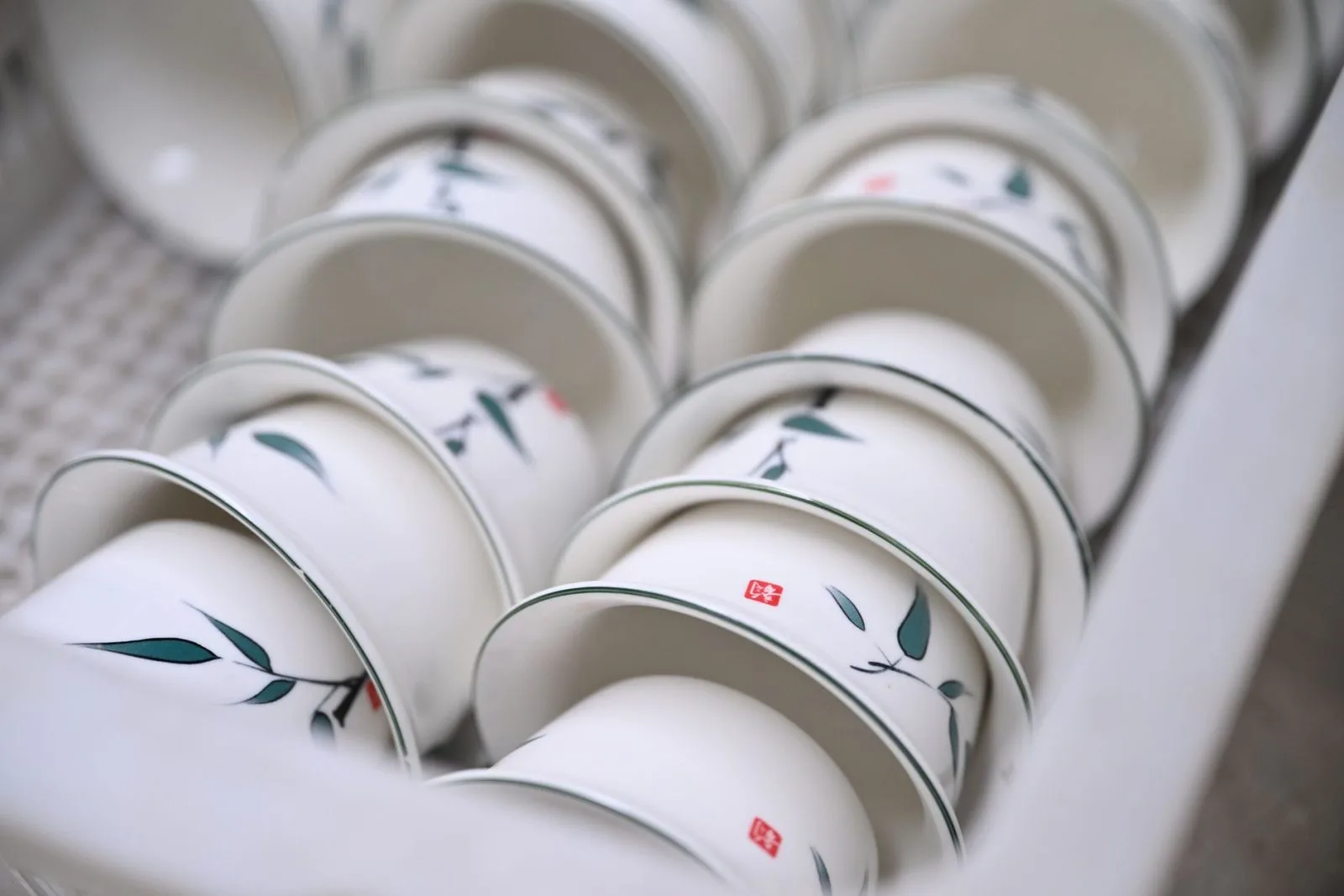
    A porcelain bowl with a pale glaze photographed against light
    True porcelain is fired hot enough to vitrify the body, giving it a hard, resonant wall. lee c | Pexels License (https://www.pexels.com/license/)

    Dehua White

    Dehua, a county in Fujian’s Quanzhou prefecture, developed a white porcelain with a warm, creamy tone. Its clay is low in iron, which lets the glaze fire almost colourless, and its potters mastered figures as well as vessels. From the Ming dynasty onward, Dehua workshops produced small statues of Guanyin, the bodhisattva of compassion, with soft modelling and a smooth, almost waxy surface. European traders called the ware blanc de Chine, and by the seventeenth century it was collected in royal cabinets and copied by potters in Meissen and elsewhere. Tea wares also left the kilns: small cups, gaiwan lids and bowls, and white vessels that showed the colour of tea clearly. Local museums trace the kiln sequence from Song-period celadons through the white wares that made Dehua famous.
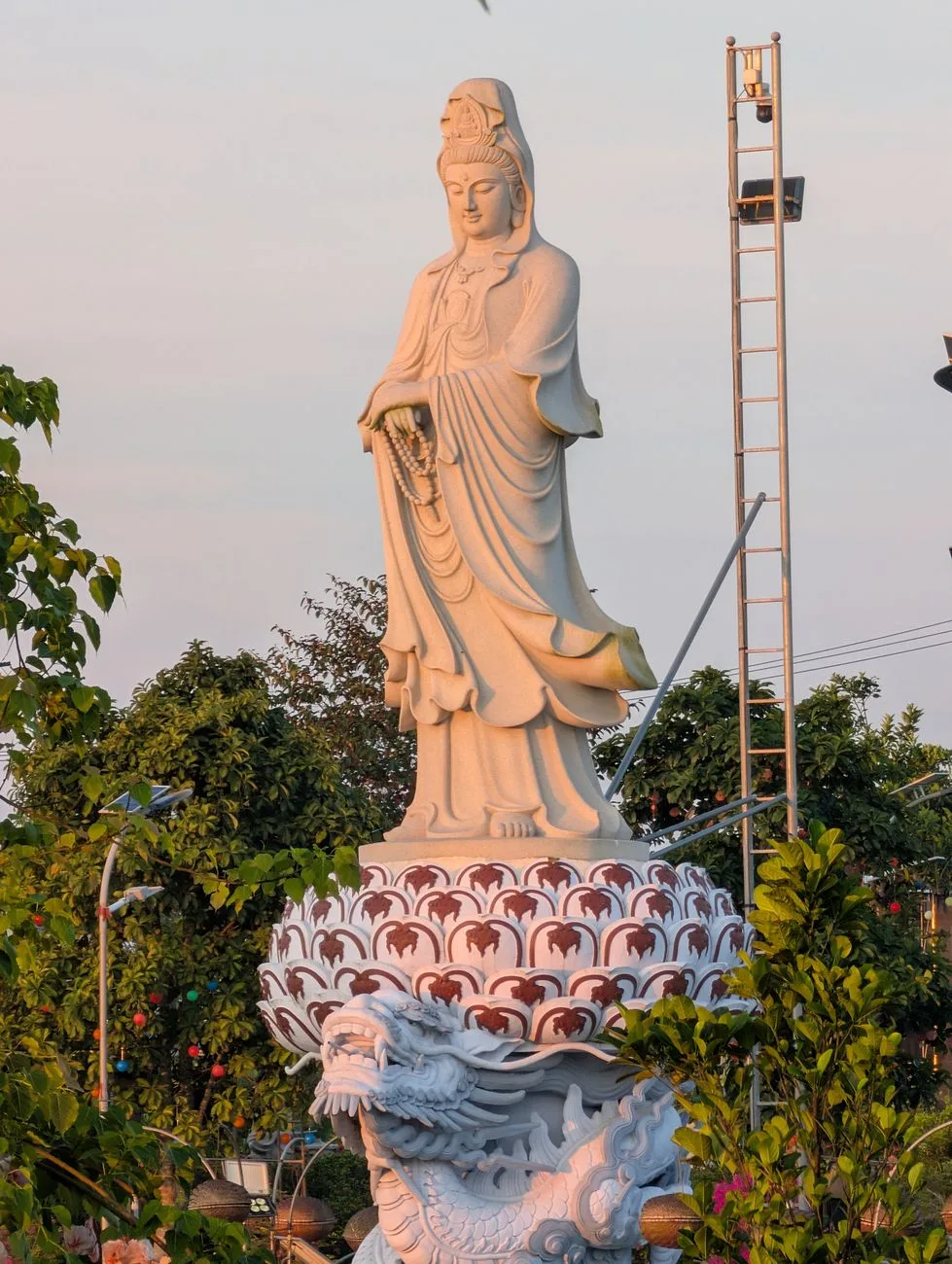
    A milky white porcelain figurine of Guanyin from Dehua
    Dehua’s porcelain figures of Guanyin became known in Europe as blanc de Chine. Quý Hoàng | Pexels License (https://www.pexels.com/license/)

    A Port for Porcelain

    Porcelain shaped trade as much as taste. Fujian’s coast faced the South China Sea, and Quanzhou became one of the busiest ports of the Song and Yuan dynasties, a place where merchants, monks, and ship crews exchanged goods and techniques. Archaeologists have recovered Chinese ceramics from ports and shipwrecks across Southeast Asia, the Indian Ocean, and East Africa; the fragments are dated by glaze and shape, making them a record of demand as well as production. UNESCO listed Quanzhou in 2021 as an emporium of the world in Song-Yuan China, with surviving mosques and temples. The export ware was not always the finest court piece. Sturdy bowls and jars packed in straw travelled in bulk, reaching households that never saw the kiln but knew the clay by its colour.
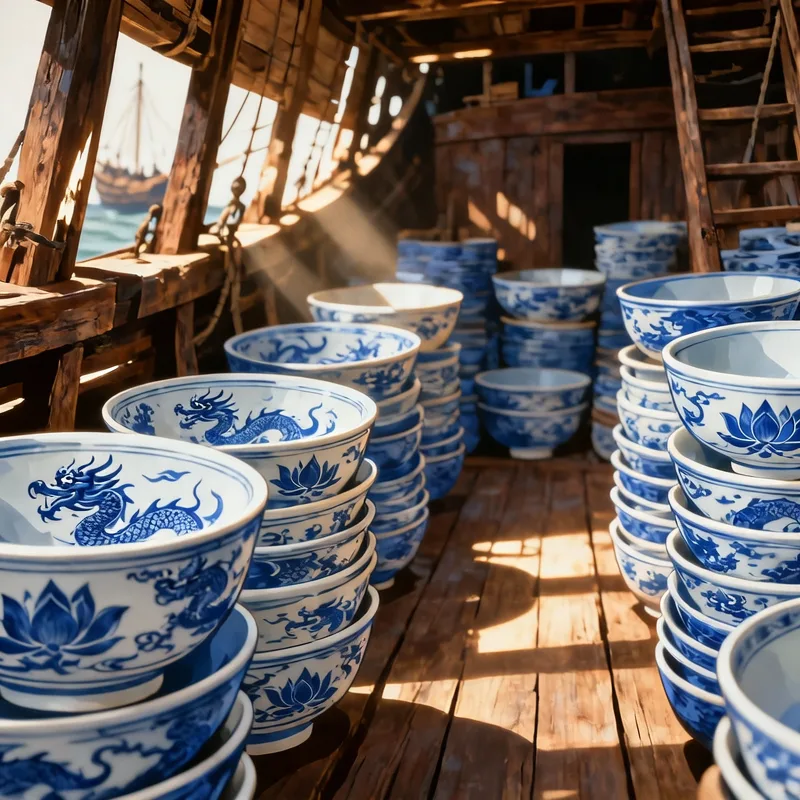
    Blue-and-white porcelain packed as cargo in a ship’s hold
    Quanzhou was a major Song and Yuan port from which Fujian ceramics were shipped abroad. AI生成的插图 · SinoViz

    Using and Collecting

    Porcelain entered daily ritual as well as trade. A gaiwan, a bowl with a lid and saucer, is used for brewing tea in northern China; the lid controls the leaves and the saucer protects the fingers. White Dehua cups make the colour of a tea liquor easy to judge. Collectors look for a clean foot ring, an even glaze, and a mark painted on the base, though many imitations copy famous reign marks. Visit a kiln museum in Dehua or a ceramic gallery in Quanzhou to see the sequence from raw clay to finished piece. Handling a cup with a saucer and a steady hand is still the simplest way to understand why this material travelled so far.

    A clear ring and a translucent edge tell you what the fire has done.

    资料来源及延伸阅读

    1. Chinese Porcelain — 大都会艺术博物馆。
    2. Quanzhou: Emporium of the World in Song-Yuan China — 联合国教科文组织世界遗产中心。
    3. Blanc de Chine ——《不列颠百科全书》。
    看看它就位

    请跟随此条目前往其所属区域。

    通过地图探索

    请关注此帖

    浏览其他与此标签相同的条目。

    浏览标签
  • 紫禁城

    编年史

    紫禁城

    The Ming and Qing Imperial Palace

    A walled palace in Beijing that served as the seat of Ming and Qing imperial government.

    部分
    编年史
    地区
    北京
    时代
    元明清
    标签
    History, Scenic Sites

    The Forbidden City was built as the ceremonial and administrative centre of the Ming and later Qing dynasties. Its courtyards and halls express rank in stone, timber, colour, and route: the emperor alone crossed the central axis to the throne hall.

    Building an Imperial Axis

    Construction began in 1406 under the Yongle Emperor, who had moved the capital from Nanjing to Beijing. The palace took roughly fourteen years to complete and opened in 1420. Its site lay south of the Yuan dynasty’s capital, Dadu, whose planner had already established a north-south axis. More than a million workers and artisans were mobilised, including convict labour and skilled craftsmen from across the empire. Timber came from southern forests, stone from quarries near Beijing, and glazed tiles from kilns in the capital’s outskirts. The name Zijin Cheng, or Purple Forbidden City, referred to the polarised Heavenly Emperor and the restrictions on entry.

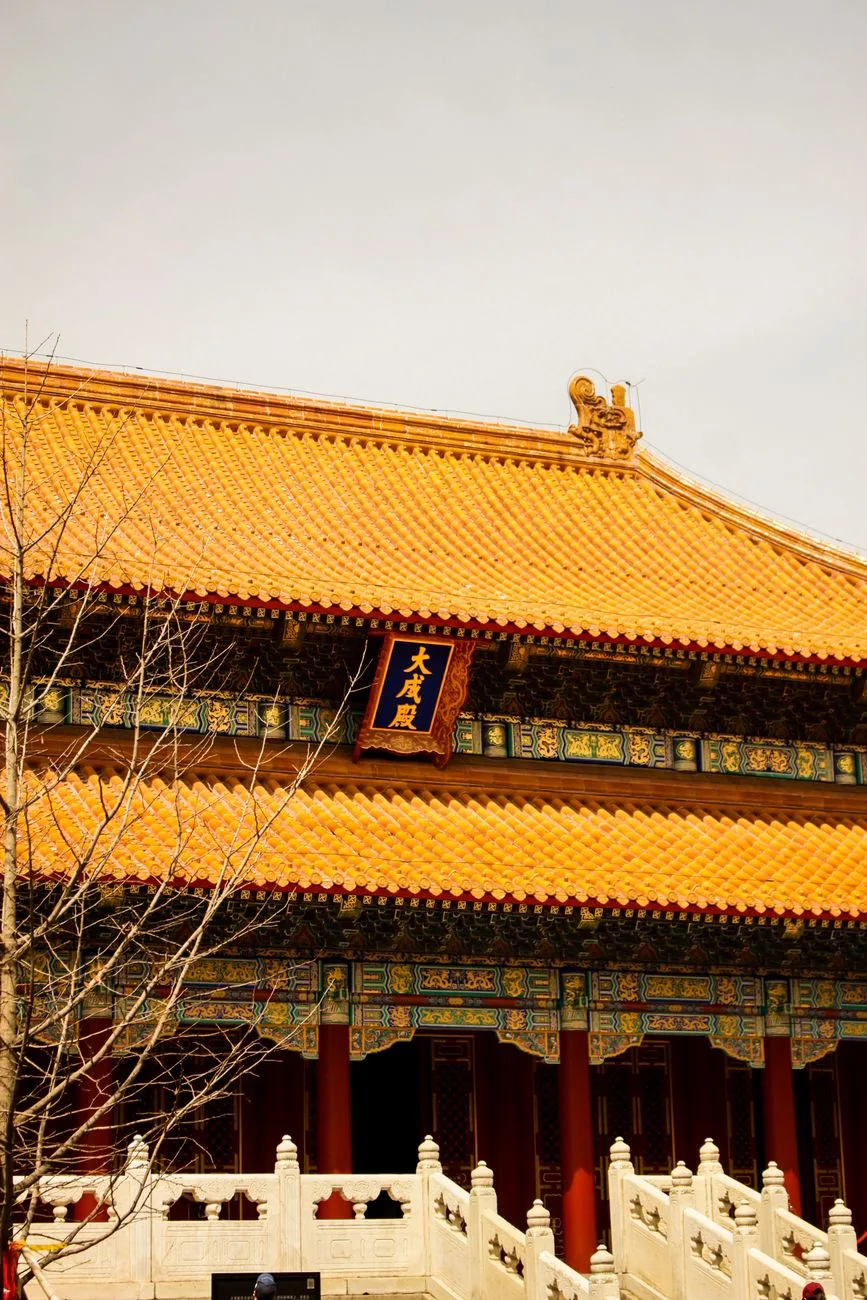
    The Hall of Supreme Harmony rising above broad terraces on Beijing’s central axis
    The main throne hall stands on the palace’s central ceremonial axis. Lan Yao | Pexels License (https://www.pexels.com/license/)

    Front Court and Inner Quarters

    The palace is organised into an outer court for ceremony and an inner court for residence. The Hall of Supreme Harmony, the largest and highest hall, was used for enthronements, imperial weddings, and the winter solstice audience. Behind it stand the Hall of Central Harmony and the Hall of Preserving Harmony. The inner court includes the Palace of Heavenly Purity, the Hall of Earthly Tranquility, and the empress’s quarters. Officials approached through the Meridian Gate and crossed the Golden Water River on bridges that marked status. The design did more than impress: it separated ranks and turned movement through space into a visible grammar of power.

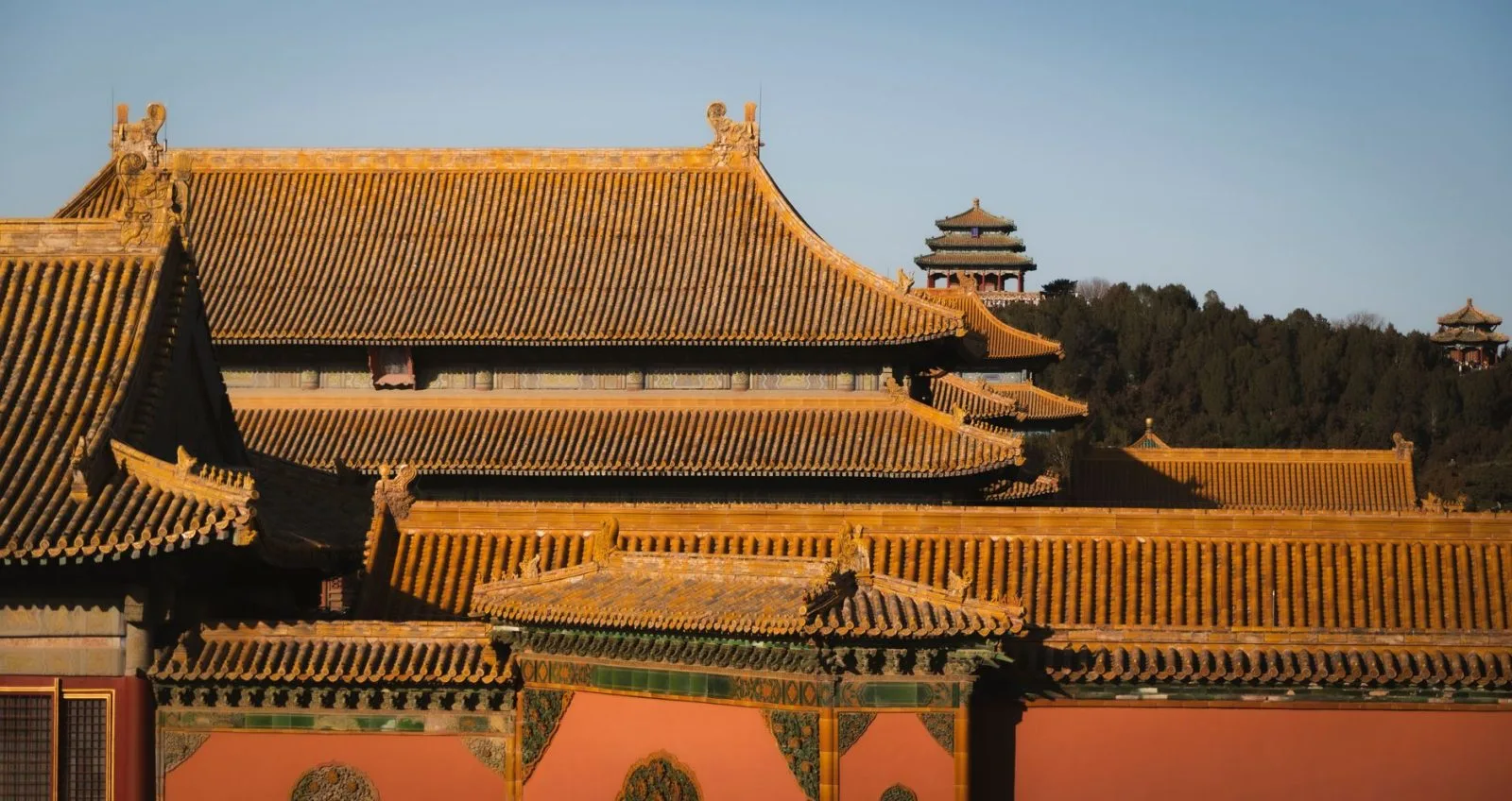
    A succession of red-walled courtyards and golden roofs viewed from a palace terrace
    Repeated courtyards made ceremonial progress part of the architecture. 虎 曼 | Pexels License (https://www.pexels.com/license/)

    Colour, Number, and Craft

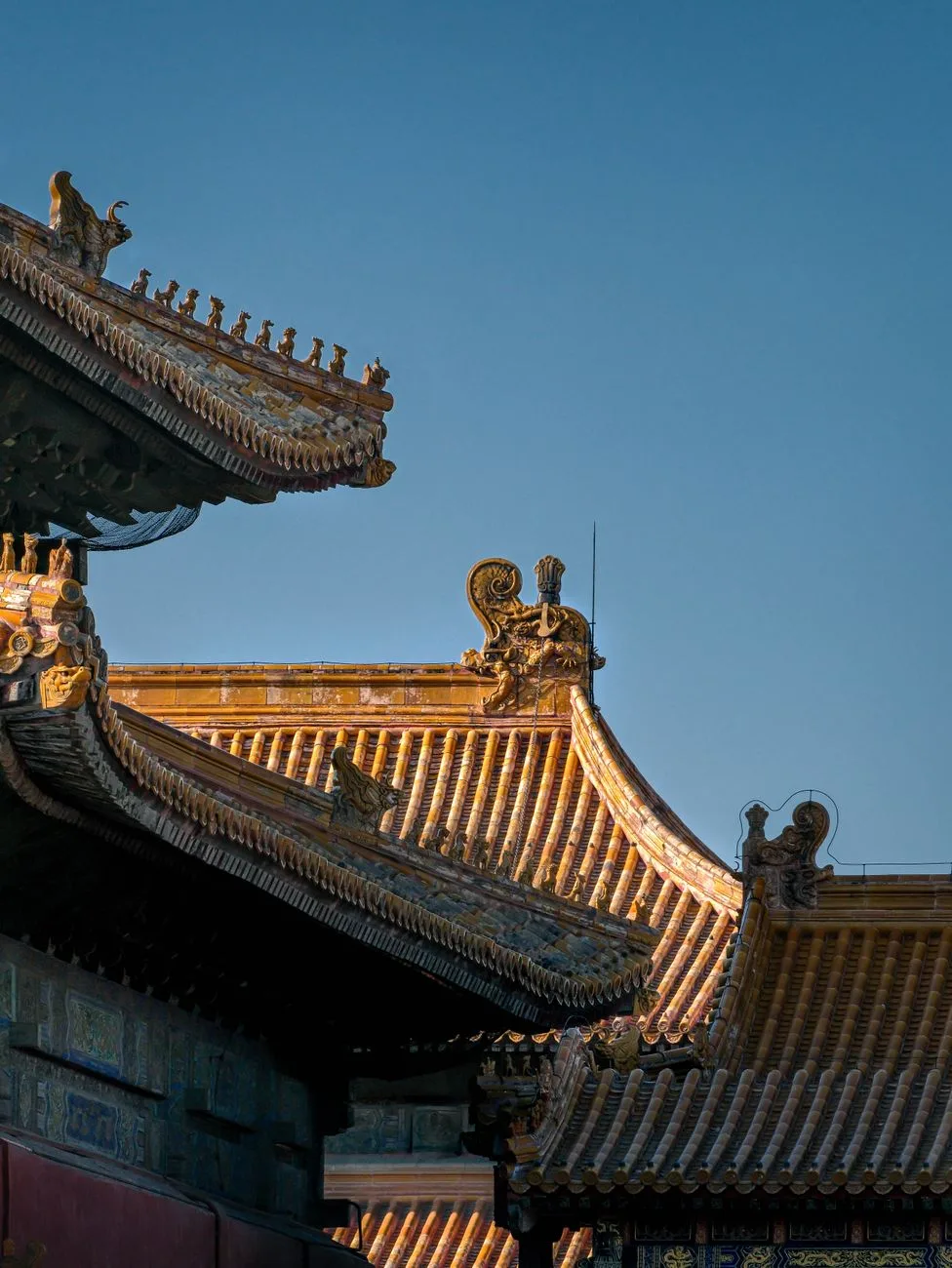
    The surviving buildings show Ming and Qing carpentry at large scale. Timber frames stand on stone plinths, with dougong bracket sets supporting deep eaves. Yellow glazed roof tiles were reserved for imperial buildings; vermilion walls, white marble terraces, and dark blue-green beams created a controlled palette. The Hall of Supreme Harmony carries ten roof figures, the highest rank, and its terrace holds bronze cranes and a tortoise. Numbers were symbolic: nine marked the emperor, and the palace is said to have 9,999 rooms, though the count depends on how spaces are defined. The Palace Museum, opened in 1925 after the last emperor left, now preserves the buildings and collections.

    • Begun in 1406 and occupied in 1420
    • Outer court for audiences, inner court for residence
    • Yellow roof tiles restricted to imperial use
    • Palace Museum opened to the public in 1925
    Golden roof tiles, bracket sets, and carved beams on a Qing palace hall
    Dougong brackets and yellow glazed tiles carried imperial rank. ravencrow BI | Pexels License (https://www.pexels.com/license/)

    Visiting the Palace Today

    The complex covers about 720,000 square metres and holds thousands of rooms, so a visit needs a route. Most visitors enter from the south at the Meridian Gate, pass the three great halls, then turn north to the inner court and the Garden of Cultivation. The Treasure Gallery and the Clock Gallery occupy separate wings and often require extra tickets. Ticket sales normally close in the afternoon and the palace is closed on Mondays except during peak holidays, so checking current rules matters. Tiananmen Square security adds time. The best views of the roofscape are from Jingshan Park to the north, which also marks the site where the Ming dynasty’s last emperor died in 1644.

    The palace made ceremony architectural: every gate, terrace, and roof colour told a visitor where power stood.

    资料来源及延伸阅读

    1. 故宫 — 联合国教科文组织世界遗产中心。
    2. 故宫 ——《不列颠百科全书》。
    3. The Palace Museum — The Palace Museum.

    看看它就位

    请跟随此条目前往其所属区域。

    通过地图探索

    请关注此帖

    浏览其他与此标签相同的条目。

    浏览标签
  • 苗银器

    生活与民俗

    苗银器

    Ornament, Memory, and Festival Dress

    Miao silver ornaments carry family history and local identity in festival dress across southwest China.

    部分
    生活与民俗
    地区
    云南
    时代
    跨越时代
    标签
    Customs, Ethnic, Scenic Sites

    Miao silverwork is a family of adornments—headdresses, collars, earrings, and bracelets—made by Miao communities in Guizhou, Yunnan, and neighbouring regions. The pieces are worn most visibly at festivals and weddings.

    A Distributed Craft Tradition

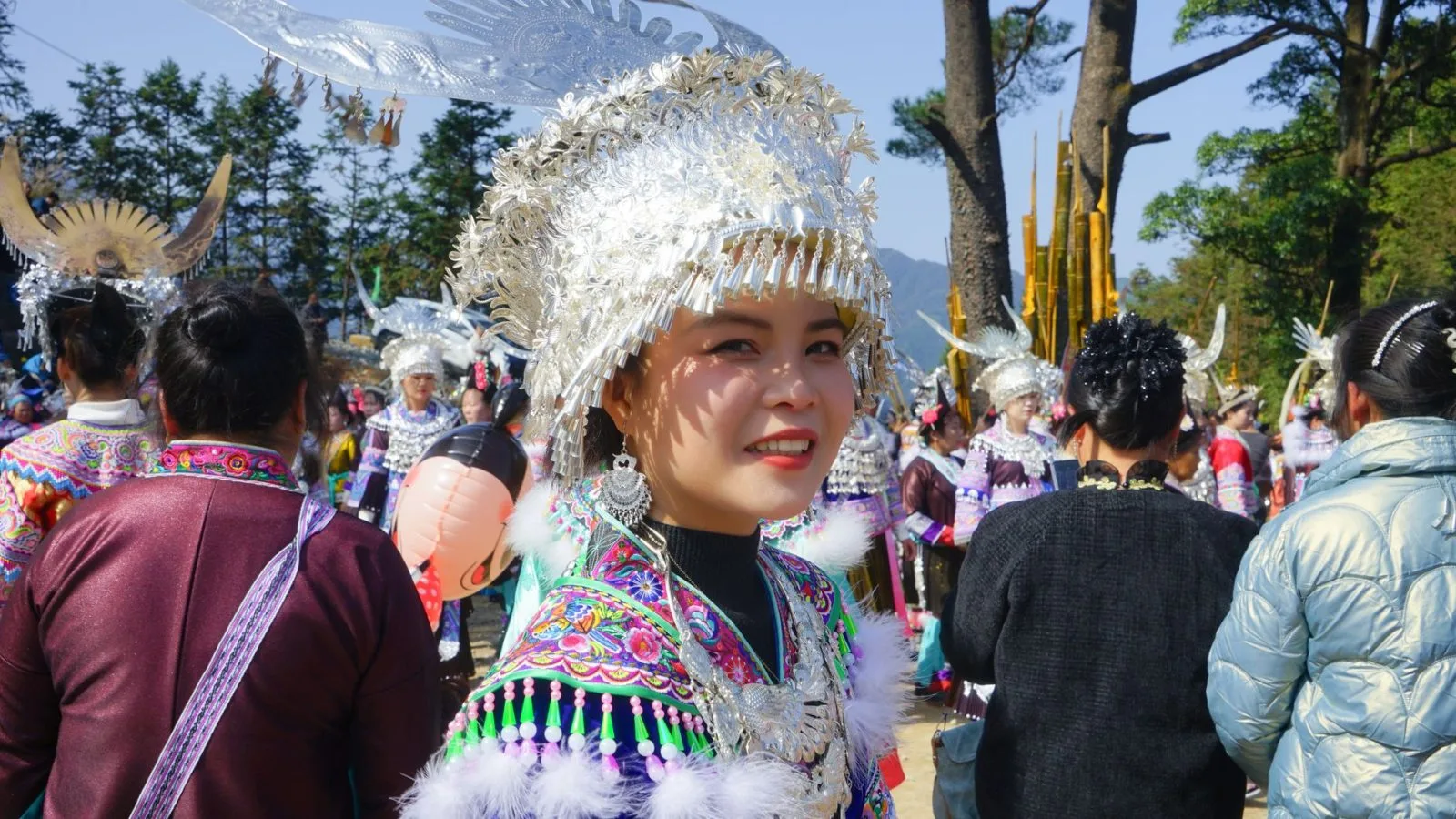
    Miao communities live across Guizhou, Yunnan, Guangxi, Sichuan, and Southeast Asia, and silverwork varies by locality. In Yunnan, Miao villages around Wenshan and Honghe maintain styles that differ from the better-known Guizhou counties of Xijiang and Kaili. Ornaments are made by specialised silversmiths who work in small workshops, often serving several villages. Designs are learned through apprenticeship rather than written patterns: a young smith repeats forms copied from older pieces and festival dress. Motifs may draw on local birds, flowers, insects, and coins, though their meanings are not fixed. Families accumulate ornaments over generations, and a daughter’s festival headdress may represent years of saving.

    A Miao headdress with silver horns, plaques, and hanging ornaments at a festival
    Headdresses combine family heirlooms with pieces made for a specific occasion. Jaqor Q.I. | Pexels License (https://www.pexels.com/license/)

    Sheet, Wire, and Repoussé

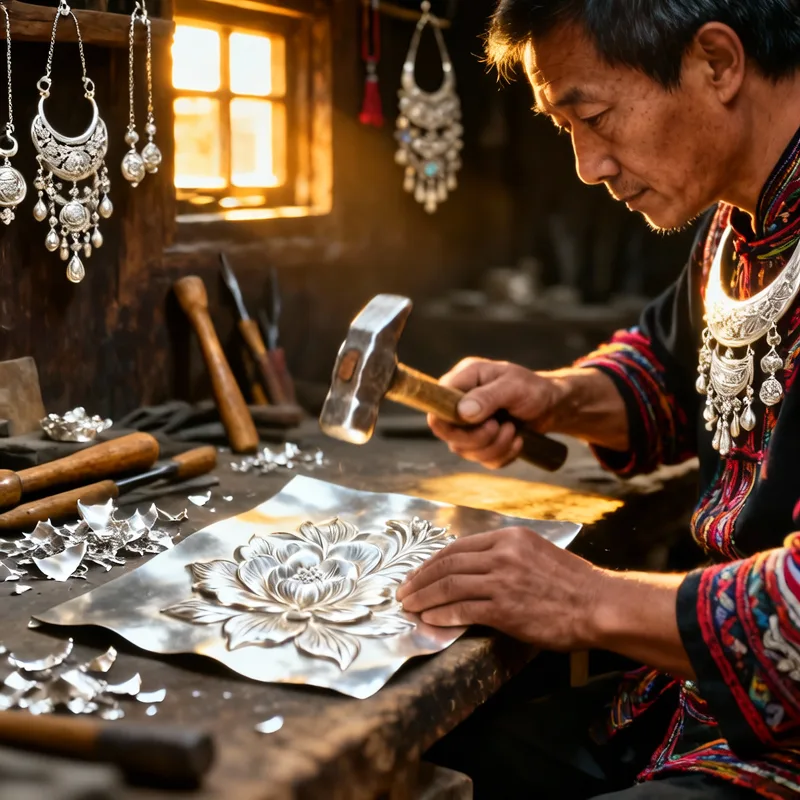
    Much Miao silverwork begins with sheet silver and wire. The smith hammers ingots into thin sheets, cuts strips, and raises patterns from the reverse with repoussé, a technique of punching and chasing to form relief. Horsehair-thin wires are twisted and soldered into filigree, then built into openwork wings, horns, and floral sprays. A large headdress may combine a hammered band, dangling chains, repoussé plaques, and rows of tiny bells that move when the wearer turns. Silver is valued for its colour, workability, and traditional association with protection and prosperity. Many ornaments are hollow to reduce weight, since a full ceremonial headdress can be heavy enough to limit long wear.

    A Miao silversmith hammering a thin silver sheet into a raised floral plaque
    Repoussé raises the design from the back of a thin silver sheet. AI生成的插图 · SinoViz

    Festival Wear and Social Meaning

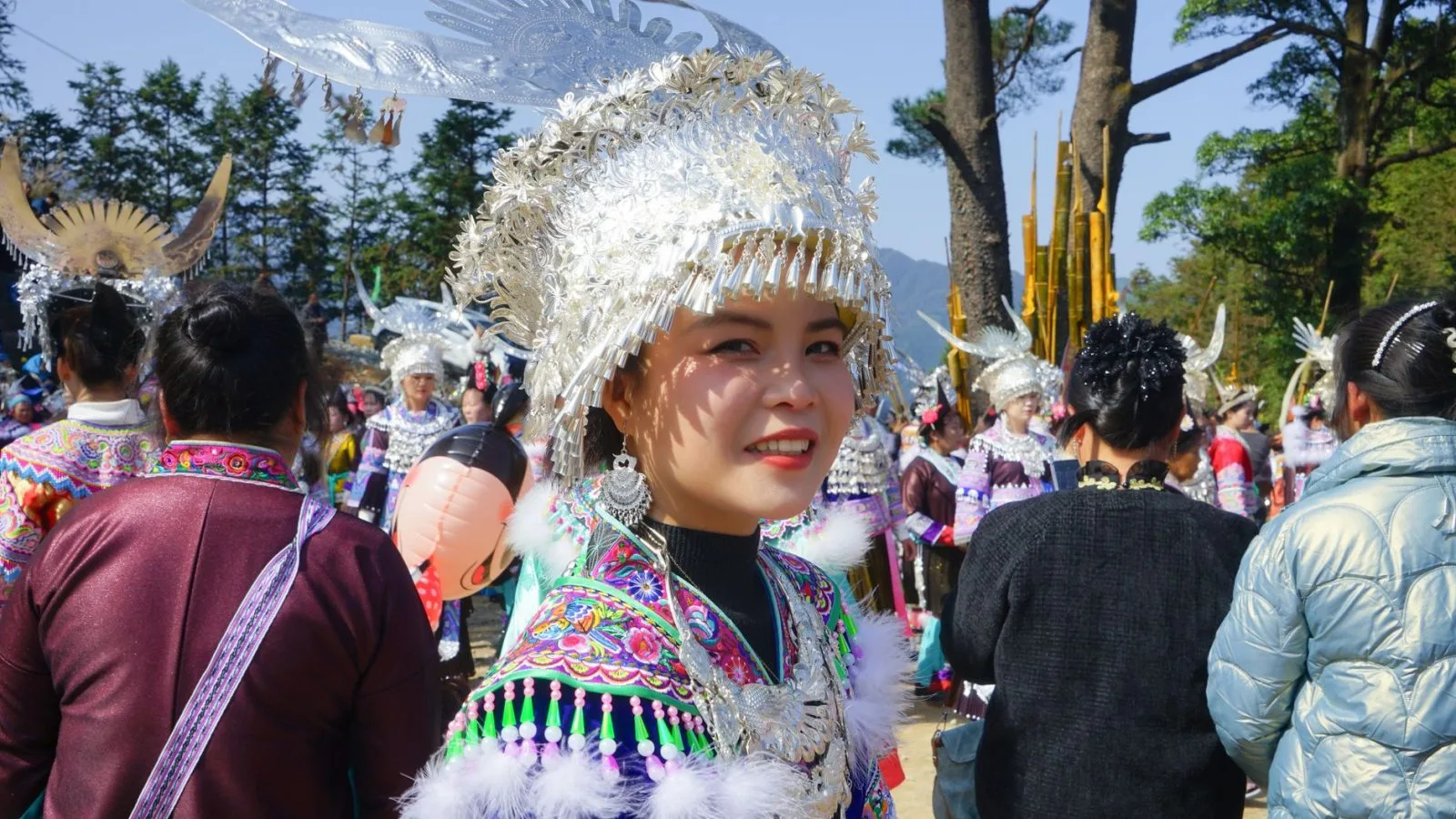
    Silver ornaments are read as part of an entire costume, not as isolated jewellery. A Miao woman’s festival dress may include a pleated skirt, embroidered jacket, woven belt, and a silver collar shaped like a crescent or a pair of wings. In some communities, the number and form of earrings or neck rings indicate village affiliation or marital status. During the Lunar New Year, harvest celebrations, and the Miao New Year in some areas, women and girls wear family sets while groups sing, dance, and process between villages. The ornaments catch light during movement, making dress a visual part of the performance. Men may wear silver buttons, chains, or small pendants with less ceremonial weight.

    • Repoussé plaques raised from thin silver sheet
    • Twisted wire and openwork filigree
    • Headdresses with horns, chains, and bells
    • Costumes worn for New Year and wedding rituals
    Women in embroidered Miao festival dress wearing heavy silver collars and earrings
    Ornaments are worn with embroidery and weaving as one costume system. Jaqor Q.I. | Pexels License (https://www.pexels.com/license/)

    Markets, Tourism, and Continuity

    Silverwork circulates through village workshops, regional markets, and tourism. Visitors to Miao villages in Yunnan and Guizhou can watch smiths shaping small pieces, though the most important heirlooms are usually not for sale. Reproductions sold as souvenirs range from careful miniatures to inexpensive plated metal, so asking whether a piece is solid silver matters. Museums and cultural centres document older headdresses and collars, but the living context remains local dress. Some communities have revived festival costumes and taught silversmithing to younger people, while migration and wage work change who has time to make and wear them. The craft’s future depends less on novelty than on continued occasions to use it.

    A Miao headdress is worn jewellery and a portable archive of family work at the same time.

    资料来源及延伸阅读

    1. Miao people ——《不列颠百科全书》。
    2. Chinese silver jewellery — Victoria and Albert Museum.
    3. Miao ethnic culture — China Highlights.

    看看它就位

    请跟随此条目前往其所属区域。

    通过地图探索

    请关注此帖

    浏览其他与此标签相同的条目。

    浏览标签
  • 兵马俑

    编年史

    兵马俑

    An Emperor’s Buried Legions

    Thousands of clay soldiers were buried near Qin Shi Huang’s mausoleum to guard the emperor after death.

    部分
    编年史
    地区
    陕西
    时代
    秦汉
    标签
    Geography, History, Scenic Sites

    The Terracotta Army was made for the tomb of Qin Shi Huang, the first emperor of China, who died in 210 BCE. The figures were part of a larger necropolis near Xi’an, not an isolated pit of statues.

    The Tomb of the First Emperor

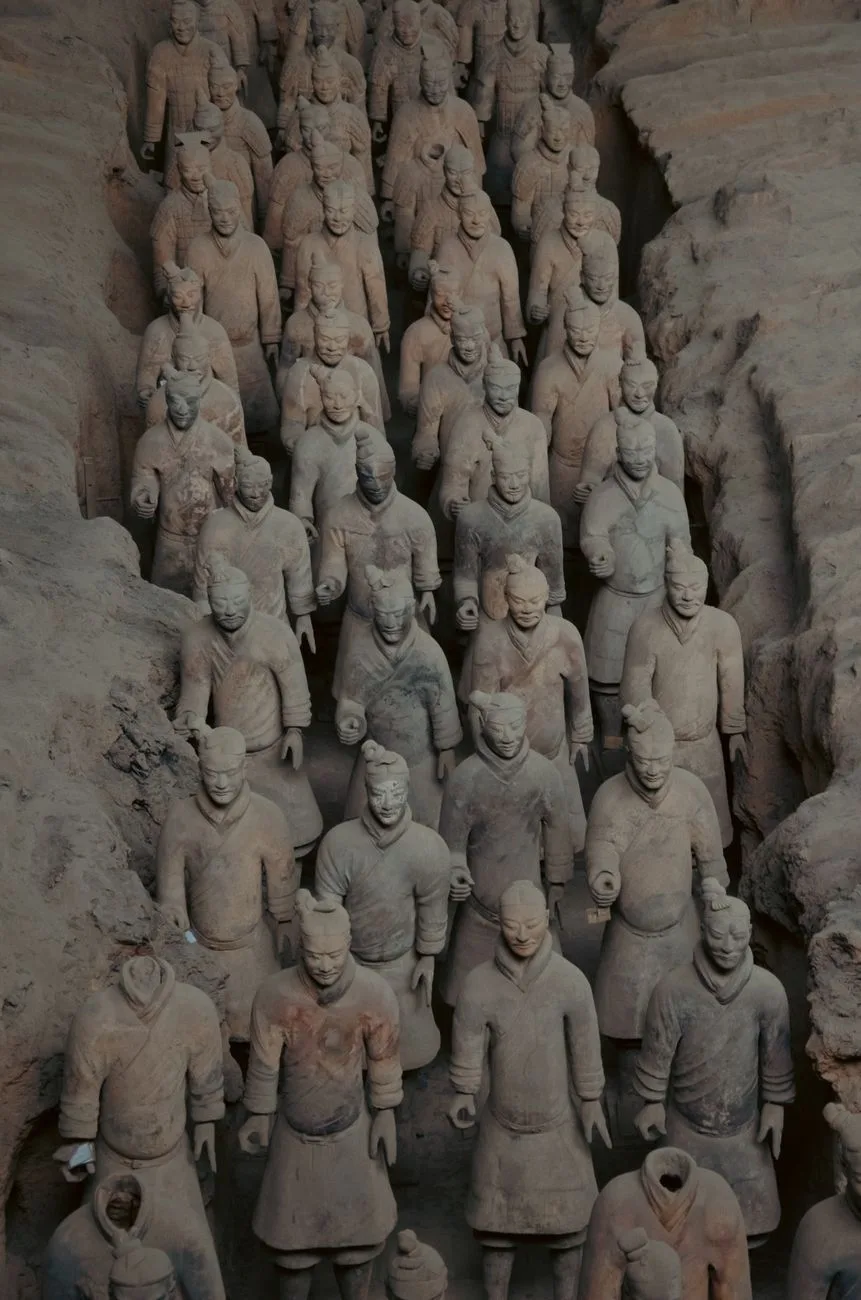
    Qin Shi Huang unified China in 221 BCE and began constructing his mausoleum near Mount Li soon after. The historian Sima Qian, writing about a century later, described a tomb filled with models of palaces, officials, and treasures, with mercury rivers and a roof painted as the heavens. Modern surveys have found a vast walled complex, a central burial mound, and more than six hundred associated pits. The main tomb chamber has not been excavated, partly because of technical and conservation concerns; readings of mercury vapour in the mound have been reported but debated. The army occupied side pits, where thousands of clay figures stood in formation to protect the emperor in the afterlife.

    A long burial pit containing rows of terracotta infantry figures in formation
    The figures stood in military formation in pits beside the imperial tomb. Jan Dvorak | Pexels License (https://www.pexels.com/license/)

    Discovery and Excavation

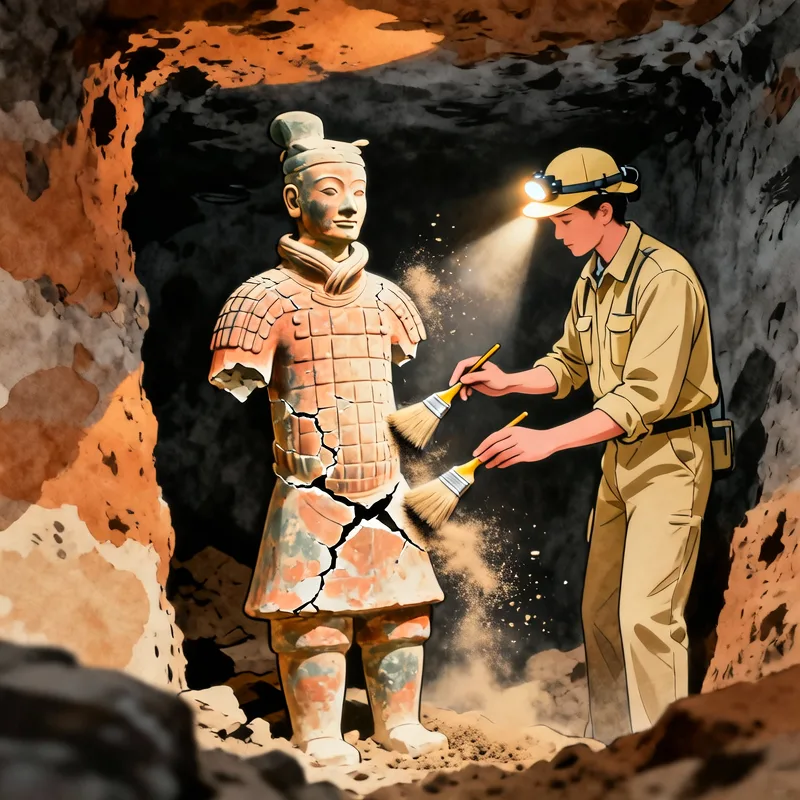
    Local farmers found fragments of clay figures in 1974 while digging a well near the village of Yangzhai. Archaeologists shortly uncovered Pit 1, a huge trench holding infantry and chariots, followed by Pits 2 and 3 with mixed troops, cavalry, and a command post. More than eight thousand figures have been counted, along with hundreds of horses and more than a hundred wooden chariots whose timber has decayed. The figures were once brightly painted with mineral pigments on a lacquer ground; exposure to air caused much of the paint to flake, and conservators now control humidity and treat surfaces quickly. Excavation continues in selected areas rather than across the entire necropolis.

    Archaeologists carefully brushing soil from a fragmented terracotta warrior in a burial pit
    Excavation is slow because paint and fragile organic material decay after exposure. AI生成的插图 · SinoViz

    Mass Production and Individuality

    The warriors were made in workshops using moulded parts, coils of clay, and hand-finished details. Heads, bodies, arms, and legs were produced in a limited number of types, then assembled and altered so that faces, hair, moustaches, and armour differ. Sculptors pressed or carved expressions into the clay before firing in kilns near the site. Height varies with rank: generals are taller than ordinary infantry, and some figures bear armour while others wear lighter dress. Tools found at the site carry names, suggesting organised teams of potters and artisans under state control. The result is neither wholesale repetition nor pure portraiture, but a system that could produce scale with controlled variation.

    • Infantry, archers, cavalry, chariots, and officers
    • Moulded components finished by hand
    • Original mineral pigments on lacquer-ground paint
    • Workshop names recorded on excavated tools
    Close view of a terracotta warrior’s face, hairstyle, and layered armour
    Standard parts were individualised in faces, hair, and armour details. Ruben VP | Pexels License (https://www.pexels.com/license/)

    Visiting the Site

    The museum lies about forty kilometres east of central Xi’an near Lintong. Three main pits are open to visitors, with viewing platforms along the excavated trenches; a separate display shows bronze chariots and horses recovered near the tomb. A circuit of the pits and museum halls takes roughly two to three hours, and an official guide or audio commentary helps explain the different ranks and formations. The site is busiest in the middle of the day, so arriving early is useful. Xi’an can be reached by high-speed rail from Beijing or Shanghai, and local buses, taxis, and tours connect the city to Lintong. Photography is allowed in many areas, but flash and tripods may be restricted.

    The army was made by workshops, but its faces were finished by hands that refused exact repetition.

    资料来源及延伸阅读

    1. 兵马俑 — 联合国教科文组织世界遗产中心。
    2. 兵马俑 ——《不列颠百科全书》。
    3. The First Emperor’s Terracotta Army — The British Museum.

    看看它就位

    请跟随此条目前往其所属区域。

    通过地图探索

    请关注此帖

    浏览其他与此标签相同的条目。

    浏览标签
  • 苏州园林

    地图探索

    苏州园林

    宋、明、清时期的围墙山水

    苏州古典园林将岩石、水景和借景变成一系列房间。

    部分
    地图探索
    地区
    浙江省
    时代
    跨越时代
    标签
    风俗、地理、风景名胜

    苏州古典园林是长江下游城市中,人们在住宅旁建造的私人景观。园林围墙掩映着精心布置的景色,亭台楼阁、池塘和假山错落有致地排列,供人漫步欣赏,而非只能从单一地点观赏。

    学者花园之城

    苏州凭借丝绸、粮食和运河贸易而富裕起来,官员和商人在城中住宅后修建园林。这一传统由来已久,但现存的杰作大多为明清时期。拙政园由官员王显辰于1509年左右设计;留园始建于明代,清代重建;网师园则于十八世纪末期进行了修缮。园林是居所的延伸,用于接待宾客、品茶、吟诗作赋和漫步。园林的名称往往带有文学典故或谦逊的自我描述,这种惯例引导游客将园林景观视为文本来解读。

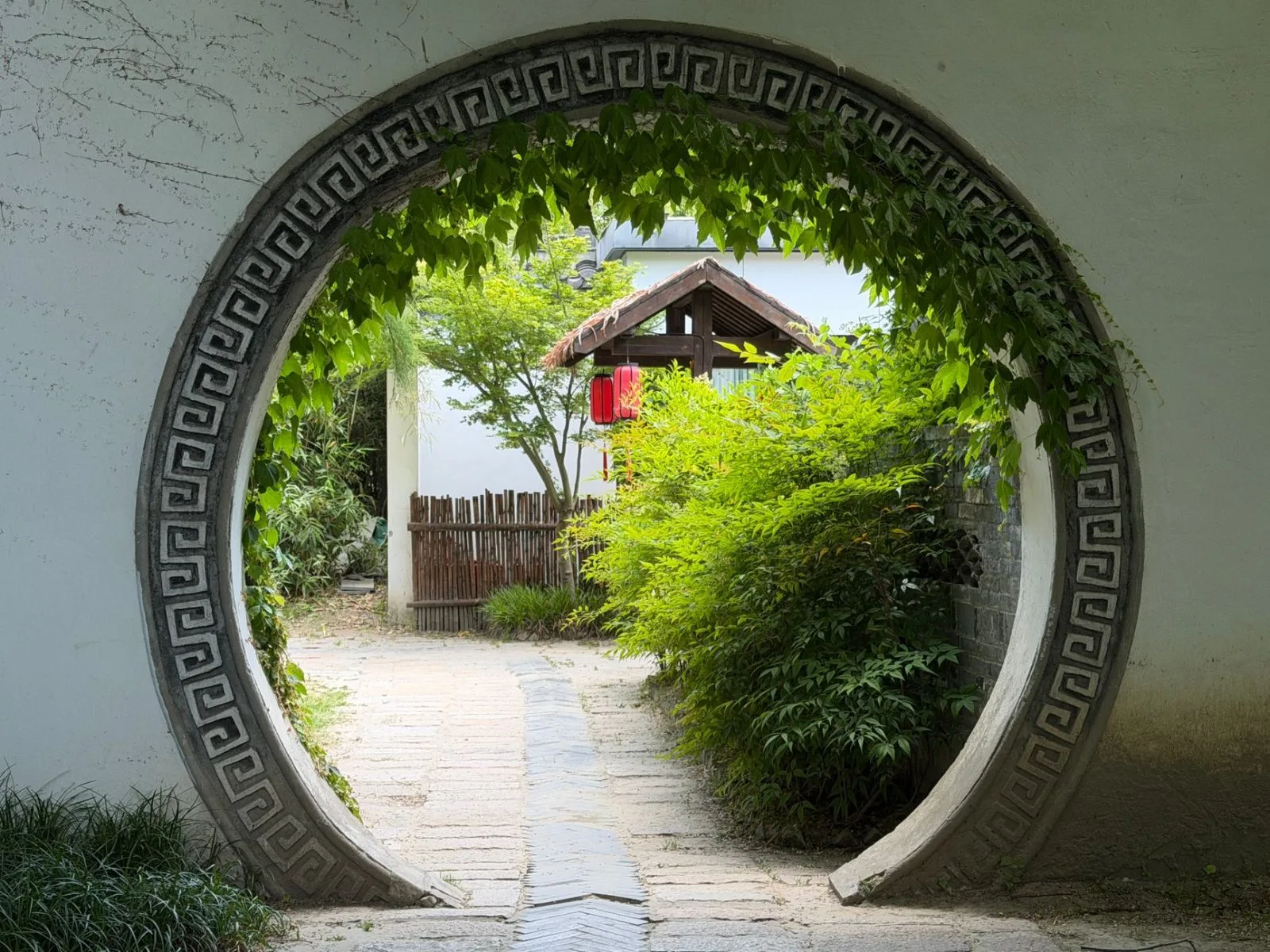
    苏州园林中,一座月亮门框住了池塘、假山和亭台楼阁。
    月门框住了一部分景色,同时遮挡住了花园的其他部分。 Frank Lv | Pexels License (https://www.pexels.com/license/)

    岩石、水和借景

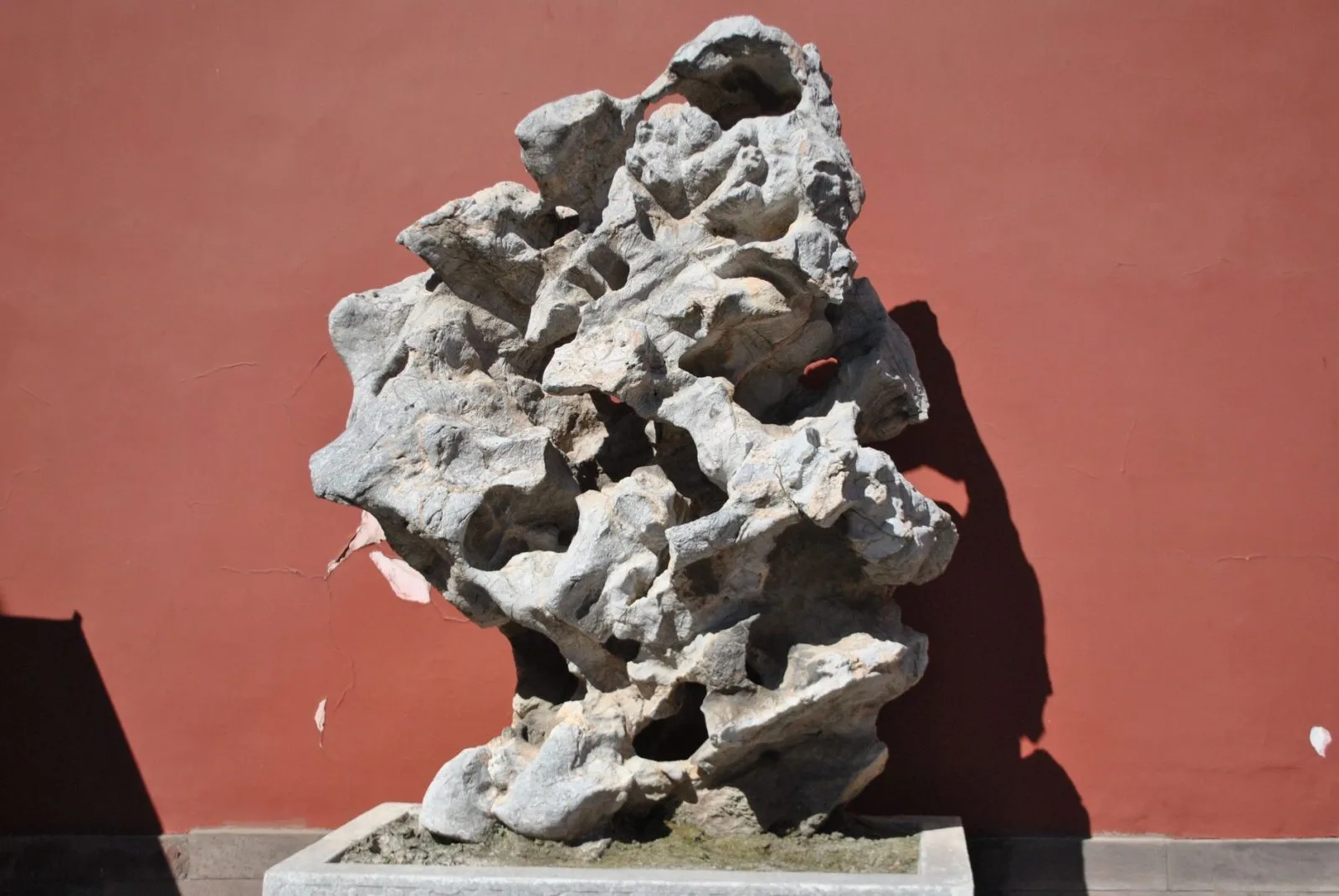
    苏州园林设计讲究层次感。取自城西太湖的岩石因其孔洞、脊棱和纤细的腰身而备受推崇;巨大的石块被堆砌成山峦,供人环绕观赏。水景是许多园林的中心,亭台楼阁或建于水边,或置于水岛之上,使观景视野随行而变化。白墙宛如画布,衬托着竹影和植物的形态。“借景”的技法将远处的宝塔、树木或山丘框入画面,使园林显得更加开阔。廊道连接着各个厅堂,透过格窗,景致不断变换。园林并非旨在让人一次性尽览所有景致,而是以一系列精心构筑的瞬间,徐徐展开。

    一块太湖石,石壁上布满孔洞,静立于水面和白色花园墙旁。
    太湖石被选用,用于制作开口和轮廓,以表现山脉的形态。 Valeria Drozdova | Pexels License (https://www.pexels.com/license/)

    四个花园对比

    拙政园是古典园林群中最大的,园内水面宽阔,岛屿低矮,远处北寺塔也隐约可见。网师园则布局紧凑,通过房间大小和庭院密度的变化,为游客带来惊喜;园内夜间表演颇受欢迎,但需提前预约入场。留园以其入口、假山和水边厅堂的巧妙布局而闻名,使游客在游览时得以延缓视线。狮子林园因形似狮子的岩石而得名,园内设有石砌迷宫,供游客细细观赏。这些园林共同展现了,即使是面积不大的城市空间,也能通过精心设计,营造出山川河流和旅行的氛围。

    • 谦逊管理者花园:开阔的水面和借来的宝塔景观
    • 网球场上的大师:紧凑的房间和精心设计的过渡
    • 留园:主池塘前的假山
    • 狮子林:太湖密石迷宫
    一条有格子窗的有顶走廊,可以俯瞰苏州狭长的庭院。
    有顶走廊将花园分隔成不同的景观区域。 Qing Luo | Pexels License (https://www.pexels.com/license/)

    参观与保护

    1997年,苏州古典园林被联合国教科文组织列入世界遗产名录,2000年又新增了部分园林。其中一些园林面积较小,游客络绎不绝,因此清晨通常是观赏水景和假山的最佳时间,视野开阔,不受遮挡。门票按园林出售,部分园林每日限流或实行分时段参观;一天内游览两座风格迥异的园林比匆匆游览四座更为明智。从上海乘坐高铁前往苏州大约需要半小时,游览老城区最好步行或乘坐出租车。由于园林需要维护和保护,因此园林的保护工作需要持续不断地进行,包括木材、灰泥、排水系统和植物的维护。

    苏州园林的设计理念是让人慢慢漫步,每一扇门都遮蔽着门后的景色。

    资料来源及延伸阅读

    1. 苏州古典园林 — 联合国教科文组织世界遗产中心。
    2. 苏州园林 ——《不列颠百科全书》。
    3. 中国园林 — 大都会艺术博物馆。

    看看它就位

    请跟随此条目前往其所属区域。

    通过地图探索

    请关注此帖

    浏览其他与此标签相同的条目。

    浏览标签
  • 厦门

    Destination · Fujian

    厦门

    Island streets and Fujian coast

    Xiamen is a coastal city with a mild climate, colonial-era Gulangyu island and easy access to Fujian’s tulou and tea regions. It blends seaside leisure with maritime history.

    最佳季节
    March–May, October–December
    建议住宿
    2-3天
    地区
    福建

    先看什么

    • Gulangyu island architecture and lanes
    • Nanputuo Temple
    • Xiamen University area and coastal walk
    • Day trip to Fujian tulou

    为什么这很重要

    Xiamen sits within Fujian’s maritime culture, shaped by overseas trade, migration and Minnan traditions. Its coast connects local life to the wider sea routes.

    到达目的地

    Xiamen has an airport, high-speed rail and ferries to Gulangyu. Book Gulangyu ferry tickets ahead on busy days.

    知道这个很有用

    Gulangyu limits vehicles; wear comfortable shoes. Summer is hot and typhoon season can affect ferries.

    阅读该地区

    Understand the landscape and culture behind this destination.

    Explore Fujian
  • 拉萨

    Destination · Xizang

    拉萨

    The Potala and the high plateau

    Lhasa is the spiritual and historical centre of Tibet. The Potala Palace, Jokhang Temple and Barkhor circuit place religious life at the heart of the city.

    最佳季节
    五月至九月
    建议住宿
    4-6天
    地区
    西藏

    先看什么

    • 布达拉宫
    • Jokhang Temple and Barkhor Street
    • Sera Monastery debates
    • Drepung Monastery and nearby mountain views

    为什么这很重要

    Lhasa has been a centre of Tibetan Buddhism and governance for centuries. Its architecture and pilgrimage routes make belief visible in urban space.

    到达目的地

    Fly or take the Qinghai-Tibet Railway to Lhasa. Allow time for altitude acclimatisation before strenuous activity.

    知道这个很有用

    Follow temple etiquette, dress modestly, and ask before photographing people. Carry permits and ID as required.

    阅读该地区

    Understand the landscape and culture behind this destination.

    Explore Xizang
  • 喀什

    Destination · Xinjiang

    喀什

    Old city and the western oasis

    Kashgar sits near the western edge of the Taklamakan, where Silk Road routes converged. Its old city, bazaars and mosques reflect centuries of oasis trade and craft.

    最佳季节
    五月至十月
    建议住宿
    2-3天
    地区
    新疆

    先看什么

    • Kashgar Old City lanes and craft workshops
    • Id Kah Mosque area
    • Sunday bazaar and livestock market areas
    • Apak Khoja Mausoleum

    为什么这很重要

    Kashgar was a key node on Silk Road caravans. Its architecture, food and music preserve the character of an oasis city shaped by movement and exchange.

    到达目的地

    Kashgar has an airport and rail links through Xinjiang. Taxis and walking are practical in the old city.

    知道这个很有用

    Dress respectfully near religious sites. Ask before photographing people, especially in markets and mosques.

    阅读该地区

    Understand the landscape and culture behind this destination.

    Explore Xinjiang
  • 苏州

    Destination · Zhejiang

    苏州

    Gardens, canals and silk

    Suzhou is known for classical gardens, canals and silk craftsmanship. Its old city offers a quieter Jiangnan counterpoint to nearby Shanghai.

    最佳季节
    三月至五月,九月至十一月
    建议住宿
    2天
    地区
    浙江省

    先看什么

    • Humble Administrator’s Garden
    • Lingering Garden or Master of the Nets Garden
    • Pingjiang Road canal walk
    • Suzhou Silk Museum

    为什么这很重要

    Suzhou gardens translate scholarship, poetry and landscape painting into built space. They show how Jiangnan elites designed nature at an intimate scale.

    到达目的地

    Suzhou is 25–30 minutes from Shanghai by high-speed rail. Metro and walking cover most old-city sights.

    知道这个很有用

    Gardens are busiest on weekends; go early. Combine one major garden with canal walks rather than rushing through several.

    阅读该地区

    Understand the landscape and culture behind this destination.

    Explore Zhejiang
  • 杭州

    Destination · Zhejiang

    杭州

    West Lake, tea and silk

    Hangzhou’s West Lake has shaped Chinese landscape aesthetics for centuries. Around it lie tea hills, temples, silk museums and the southern reach of the Grand Canal.

    最佳季节
    三月至五月,九月至十一月
    建议住宿
    2-3天
    地区
    浙江省

    先看什么

    • West Lake causeways and boat ride
    • Lingyin Temple and Feilai Feng
    • Longjing tea villages
    • China National Silk Museum and Grand Canal sites

    为什么这很重要

    Hangzhou was a Southern Song capital and a centre of Jiangnan culture. Its gardens, poems and paintings turned the lake into a model of designed nature.

    到达目的地

    Hangzhou East Station connects by high-speed rail to Shanghai, Suzhou and Beijing. Metro and buses serve West Lake areas.

    知道这个很有用

    Visit West Lake early morning to avoid crowds. Spring tea harvest makes Longjing villages busy but lively.

    阅读该地区

    Understand the landscape and culture behind this destination.

    Explore Zhejiang