標籤: Ethnic

  • The Bai People

    生活與民俗

    The Bai People

    White walls and craft around Dali

    The Bai are a Sino-Tibetan-speaking people concentrated around Dali, whose courtyard houses and indigo tie-dye define a local visual style.

    部分
    生活與民俗
    地區
    雲南
    時代
    跨越時代
    標籤
    民族、習俗

    Bai towns sit between the Cangshan mountains and Lake Erhai in northwestern Yunnan. Their language is Sino-Tibetan, and their communities carry memories of the Nanzhao and Dali kingdoms that ruled the region before the Mongol conquest of the thirteenth century.

    Between Cangshan and Erhai

    About 1.9 million Bai people were recorded in China’s 2010 census. Roughly four fifths live in Dali Bai Autonomous Prefecture, with other communities in Kunming, Chuxiong, Lijiang, Baoshan and parts of western Yunnan. Towns and villages cluster on the narrow strip of flat land between Cangshan’s slopes and the shore of Erhai, where irrigation supports rice, beans and dairy farming. The name Bai means white, a reference to the pale plaster that distinguishes local buildings. Because Dali stood on trade routes linking Yunnan with Sichuan and Tibet, Bai towns absorbed goods and techniques from several directions while keeping a strong local vocabulary of form and decoration.
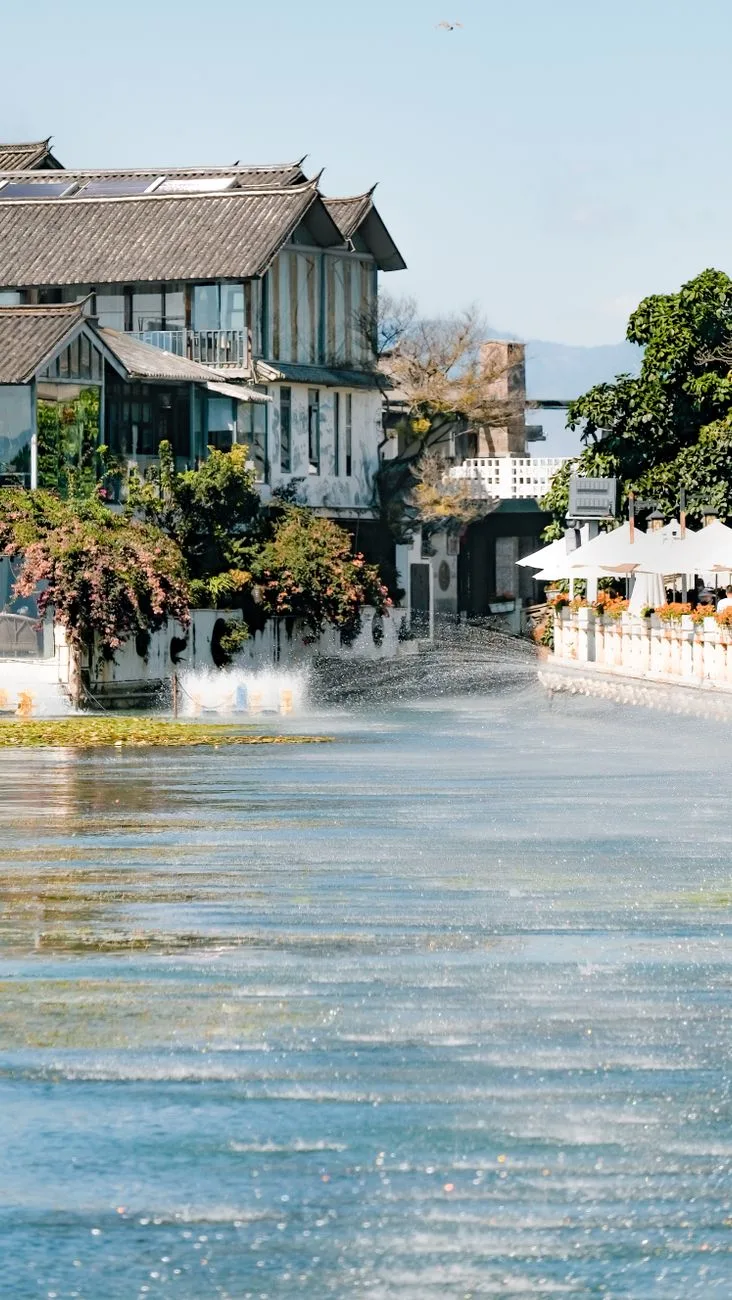
    Whitewashed Bai houses with grey tiled roofs below the Cangshan range near Dali
    White plaster and dark tile give Dali-area villages their characteristic appearance. Doing Be | Pexels License (https://www.pexels.com/license/)

    Language and historical roots

    The Bai language belongs to the Sino-Tibetan family, usually placed within Tibeto-Burman, though scholars still debate its exact position because of heavy borrowing from Chinese. There is no widely used traditional Bai script, and Chinese characters have served for writing names, contracts and local records. Bai oral tradition, including creation stories and accounts of kingdom builders, is transmitted in speech and performance. Ancestors of the Bai are associated with the Nanzhao kingdom, which flourished from the eighth to the ninth century, and the Dali kingdom that followed between 937 and 1253. Both left stone inscriptions, Buddhist carvings and fortified sites around the lake.

    Courtyards, marble and dye

    The standard Bai house follows a layout known as sanfang yizhaobi, three wings arranged around a courtyard facing a freestanding screen wall. Walls are whitewashed, roofs are covered in grey clay tiles, and doorways and windows carry deep carved wooden fretwork. The screen wall is often painted with landscapes or calligraphy, and panels of local marble are set into lintels and table tops. In Zhoucheng and nearby villages, indigo tie-dye produces blue cloth patterned by stitching and binding before dyeing. Bai embroidery, plaster carving and stonework use similar floral and geometric motifs, so the same design vocabulary appears on clothing, furniture and building facades.
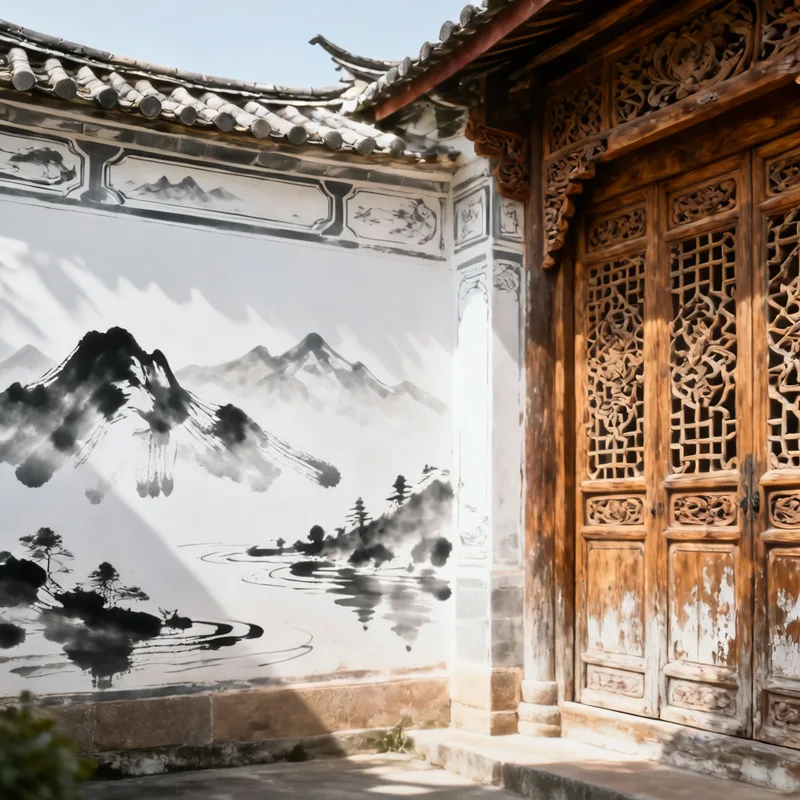
    A Bai courtyard screen wall with ink painting and a carved wooden doorway in Dali
    A painted screen wall faces the main wing of a traditional Bai courtyard house. AI生成的插圖 · SinoViz

    Tea, markets and festivals

    Three-course tea is a Bai hospitality ritual: a bitter first cup brewed from roasted leaves, a sweet second cup with nuts and honey, and a final cup that mixes the two and is said to leave a lasting aftertaste. Local dishes include air-dried milk sheets called rushan, raw pork skin salad, sour fish from Erhai and bean curd cooked with local herbs. The Third Month Fair, held in the lunar third month at Dali, began as a livestock and goods market and now fills the foothills of Cangshan with stalls, horse trading and performances. Raosanling, a pilgrimage and singing gathering, and torch-lighting customs in some villages add other dates to the year.
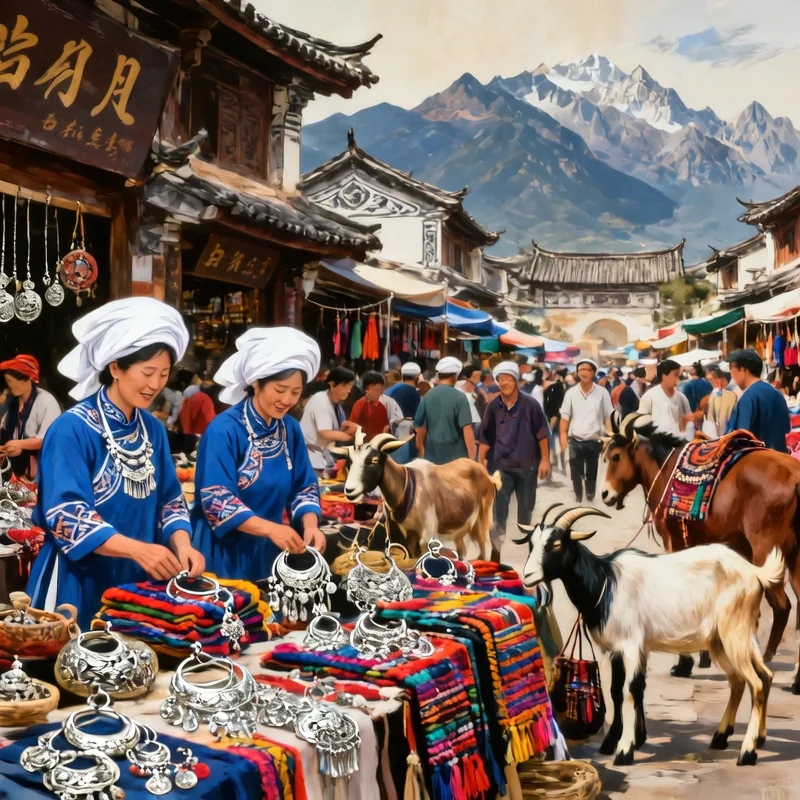
    Bai vendors and livestock at the Third Month Fair near Dali, Yunnan
    The Third Month Fair grew from a regional market into a major public gathering. AI生成的插圖 · SinoViz
    Bai craftsmen treat a house front, a tea cup and a dyed cloth as the same surface for pattern.

    資料來源及延伸閱讀

    1. Bai ——《不列顛百科全書》。
    2. Bai Ethnic Group — China.org.cn.
    看看它就位

    請跟隨此條目前往其所屬區域。

    透過地圖探索

    請關注此帖

    瀏覽其他與此標籤相同的條目。

    瀏覽標籤
  • 韓國華人社區

    生活與民俗

    韓國華人社區

    北京的韓國語言和習俗

    在中國東北地區以及北京等城市,朝鮮族人仍保持以韓語為主要語言的文化生活。

    部分
    生活與民俗
    地區
    北京
    時代
    跨越時代
    標籤
    民族、習俗

    朝鮮族中國人,中文稱朝仙族,人口約180萬。他們的聚居中心位於東北邊境沿線,但北京的望京區和五道口區已成為非常顯眼的韓語社區。

    移民與社區

    大多數朝鮮族家庭的定居歷史可以追溯到十九世紀末二十世紀初。當時,生活困苦、徵兵以及1910年日本吞併朝鮮半島,迫使朝鮮人跨越圖們江和鴨綠江遷徙至此。 1952年,延邊朝鮮族自治州在吉林省成立,長白和琿春至今仍是重要的中心城市。 1992年中韓建交後,北京的朝鮮族人口快速成長,大量學生、商人和工程師湧入北京。五道口地區因語言學校和學生公寓而聞名,而望京地區則發展出了規模化的超市、餐廳和韓國標誌。

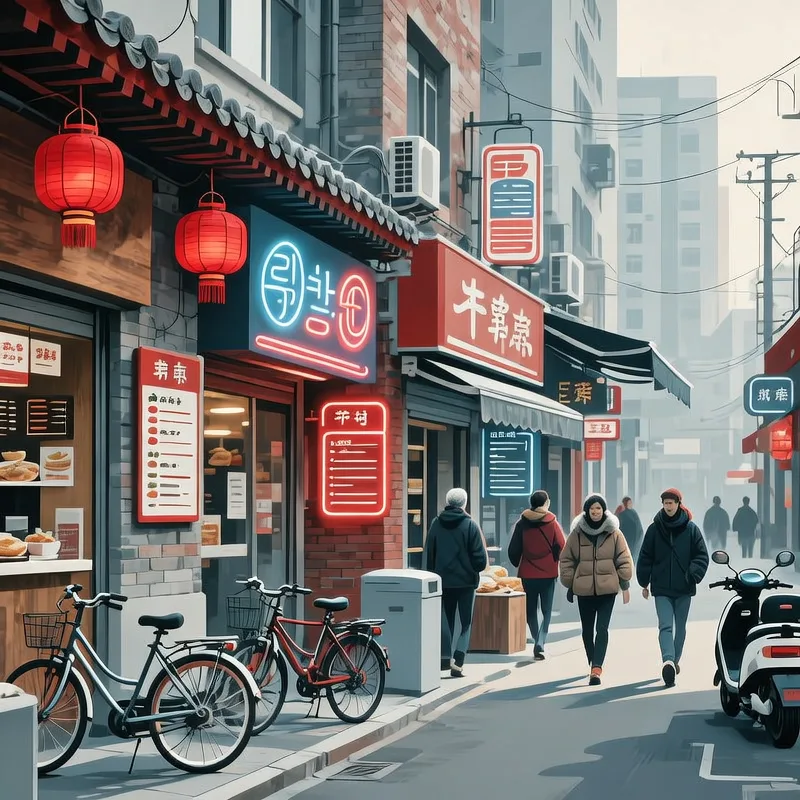
    北京望京區街道兩旁的韓文商店招牌
    王京的韓文招牌反映了數十年來學生和商人的遷徙。 AI生成的插圖 · SinoViz

    語言和寫作

    韓語屬於朝鮮語族,與該地區其他地區使用的漢語和通古斯語族語言截然不同。韓文字母韓文(Hangul)創於十五世紀,如今已成為朝鮮語書寫漢語的通用文字;漢字(Hanja)則出現在歷史文獻和一些人名中。延邊許多老年居民精通韓語和漢語,而城市出生的年輕人通常在學校和工作場所使用漢語,在家中或社區媒體中使用韓語。韓語報紙、廣播和教會禮拜等活動有助於韓語的傳承和發展,一些家庭還會將孩子送到開設韓語課程的學校,這些課程與國家課程並行。

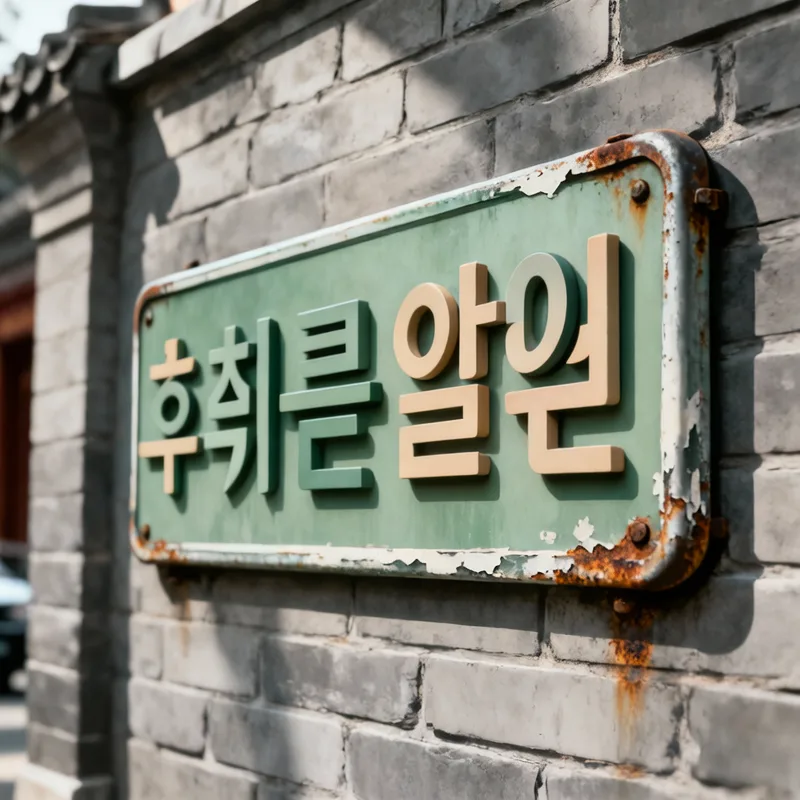
    北京某街區的韓文和中文雙語路牌
    兩種書寫系統標誌著許多韓裔華人家庭日常生活中雙語的使用。 AI生成的插圖 · SinoViz

    食物和家庭

    韓國飲食文化是韓國社區生活中最顯而易見的部分之一。泡菜是用醃製發酵的蔬菜製成的,秋季大量製作,製作和分享泡菜的習俗已被聯合國教科文組織列為韓國非物質文化遺產。每日餐點包括米飯、湯、拌飯(拌有蔬菜和辣椒醬)、烤肉和冷麵(蕎麥冷麵)。傳統房屋使用地暖(ondol),這是一種透過地暖加熱睡墊的系統,一些鄉村房屋至今仍保留著韓屋的矮桌和席地而坐的佈局。在北京,公寓式住宅改變了人們的居住環境,但飲食文化和圍坐一桌的習慣依然保留了下來。

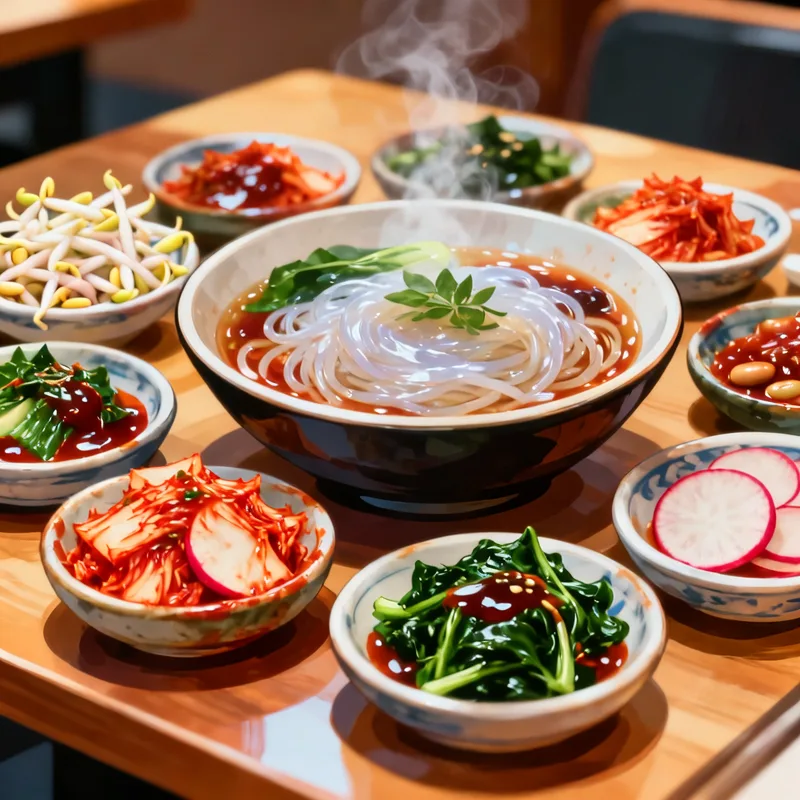
    餐廳餐桌上擺放著各式各樣的韓式小菜和冷麵。
    韓式中餐常見的特色菜包括共享小菜和涼麵。 AI生成的插圖 · SinoViz

    節慶和社區生活

    兩大主要家庭節慶分別是春節(農曆新年)和中秋節(秋收節)。春節期間,家人們會吃年糕湯(tteokguk),晚輩們會向長輩行正式的鞠躬禮。中秋節則以祭掃祖先墳墓和吃鬆餅(songpyeon)為標誌,鬆餅是一種包著豆子或芝麻的小年糕。在北京,韓裔華人社群也會聚集在一起舉行婚禮、同學會和商業活動,韓語仍然是彼此信任和共同交流的語言。他們的社交活動更體現在餐廳、旅行社和商店等場所,而非封閉的社區;同一條街道服務著來自不同背景的鄰居。

    北京的一個韓國標誌牌,與其說是標誌著國界,不如說是標誌著一種流傳下來的家庭習慣。

    資料來源及延伸閱讀

    1. Korean language ——《不列顛百科全書》。
    2. Korean Ethnic Group — China.org.cn.
    3. Kimjang, making and sharing kimchi — UNESCO Intangible Cultural Heritage.

    看看它就位

    請跟隨此條目前往其所屬區域。

    透過地圖探索

    請關注此帖

    瀏覽其他與此標籤相同的條目。

    瀏覽標籤
  • The Tujia People

    生活與民俗

    The Tujia People

    Mountain weavers east of Sichuan

    The Tujia are a Tibeto-Burman-speaking people of the Wuling Mountains, known for stilt houses, woven brocade and collective dances.

    部分
    生活與民俗
    地區
    四川
    時代
    跨越時代
    標籤
    民族、習俗

    Although listed here under the Sichuan region, most Tujia communities lie east of the Sichuan Basin in the Wuling range. Their historical connection to the ancient Ba state ties them to the wider Bashu cultural world of southwest China.

    Range and numbers

    The 2010 census counted about 8.35 million Tujia, making them one of China’s largest ethnic minorities. Their main settlements stretch across the Wuling Mountains where Hunan, Hubei, Chongqing and Guizhou meet, in counties such as Yongshun and Longshan in Hunan, Shizhu and Pengshui in Chongqing, and Yanhe in Guizhou. Villages occupy stream valleys and limestone slopes, with terraced fields and forest on the higher ground. Their inclusion in the Sichuan region on this site reflects older Bashu connections and modern movement between the basin and its eastern mountains; the densest Tujia population is not in Sichuan province itself.

    Stilted timber houses on a wooded slope in the Wuling Mountains
    Tujia villages follow stream valleys and terraced slopes rather than flat basin land. AI生成的插圖 · SinoViz

    Language and identity

    Tujia belongs to the Tibeto-Burman branch of the Sino-Tibetan family, with its closest affinities often discussed in relation to Naxi and other Qiangic languages. Today only a small number of people, mostly in a few western Hunan villages, speak it fluently; Southwestern Mandarin is the everyday language across most of the region. The name Tujia means native dwellers, and official recognition in the 1950s gave a common label to communities that had long interacted with Han, Miao, Dong and She neighbours. Oral histories preserve memories of the ancient Ba state, which controlled parts of the eastern Sichuan region until the Qin conquest of 316 BCE.

    Stilt houses and brocade

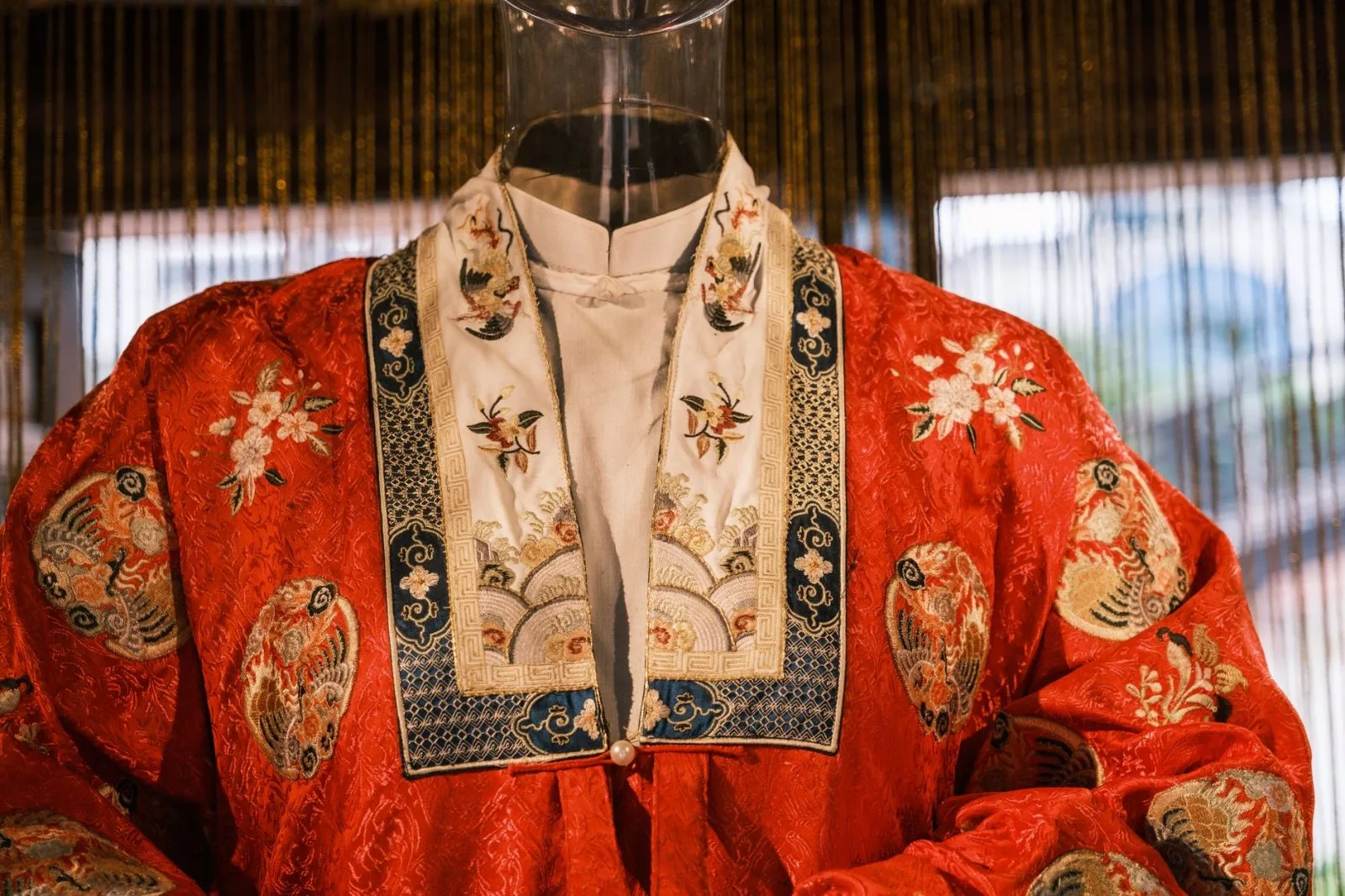
    On steep ground, Tujia builders raise diaojiaolou, houses whose upper living floor projects over a lower storey on wooden posts. A covered veranda runs along the front, and the roof is pitched to carry off heavy rain. Interior screens and window frames are carved with floral and geometric patterns. The best-known textile is xilankapu, a colourful brocade woven on a backstrap loom with motifs of flowers, birds, characters from opera and the patterned ta tai hua design. It appears in clothing, bags and wall hangings and is protected as national intangible heritage. Meals often include cured pork, smoked fish, glutinous rice cakes and a tea soup whisked with fried rice and peanuts.

    A Tujia brocade with geometric and floral motifs woven in red and black thread
    Xilankapu brocade is woven on a backstrap loom and used in dress and household textiles. AI生成的插圖 · SinoViz

    Waving dances and new year

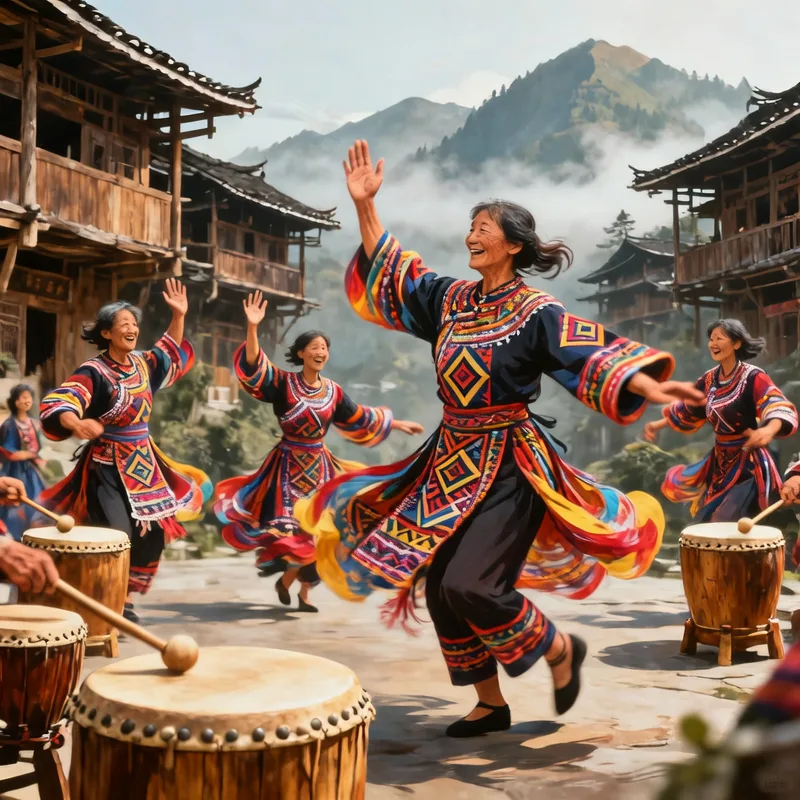
    The waving dance, bai shou wu, is performed by lines of dancers who swing their arms in time with drums and gongs. It takes place in a waving hall around the lunar new year and at the Sheba festival, where offerings are made to ancestors and village protectors. Some villages also perform Maogusi, a masked or straw-costumed dance that enacts hunting and farming scenes. Another distinctive custom is gan nian, celebrating the new year a day early, which oral tradition links to ancestors preparing for a military departure. These performances are now taught in schools and cultural centres, so a ritual once tied to a single village hall is seen by wider audiences.

    Tujia dancers in embroidered costumes performing a waving dance with drums
    The waving dance brings villagers together in coordinated arm movements and drum rhythms. AI生成的插圖 · SinoViz
    In Tujia villages, a woven pattern and a dance step both carry family memory.

    資料來源及延伸閱讀

    1. Tujia ——《不列顛百科全書》。
    2. Tujia Ethnic Group — China.org.cn.
    3. China Intangible Cultural Heritage — China ICH Net.

    看看它就位

    請跟隨此條目前往其所屬區域。

    透過地圖探索

    請關注此帖

    瀏覽其他與此標籤相同的條目。

    瀏覽標籤
  • The Manchu People

    生活與民俗

    The Manchu People

    Jurchen roots, Qing legacy in Beijing

    The Manchu are a Tungusic-speaking people whose Qing dynasty left a deep imprint on Beijing’s buildings and court culture.

    部分
    生活與民俗
    地區
    北京
    時代
    yuan-ming-qing
    標籤
    Ethnic, History

    Manchu identity took shape in the early seventeenth century among Jurchen groups of northeastern China. The Qing dynasty they founded ruled from Beijing between 1644 and 1912, and its material traces remain in the city’s palaces and archives.

    From Jurchen to Qing

    The Manchu descend from Jurchen communities of the northeast, who earlier founded the Jin dynasty of 1115 to 1234. In 1635 the ruler Hong Taiji adopted the name Manchu for his people, and in 1636 he renamed the state Qing. The dynasty took Beijing in 1644 and ruled China until 1912. Today roughly 10.4 million people identify as Manchu according to the 2010 census, making them one of the largest ethnic minorities. Most live in Liaoning, Hebei, Jilin and Heilongjiang, with substantial populations in Beijing and Tianjin. Migration into the capital after 1644 created banner neighbourhoods whose street names and food shops still register the Qing presence.

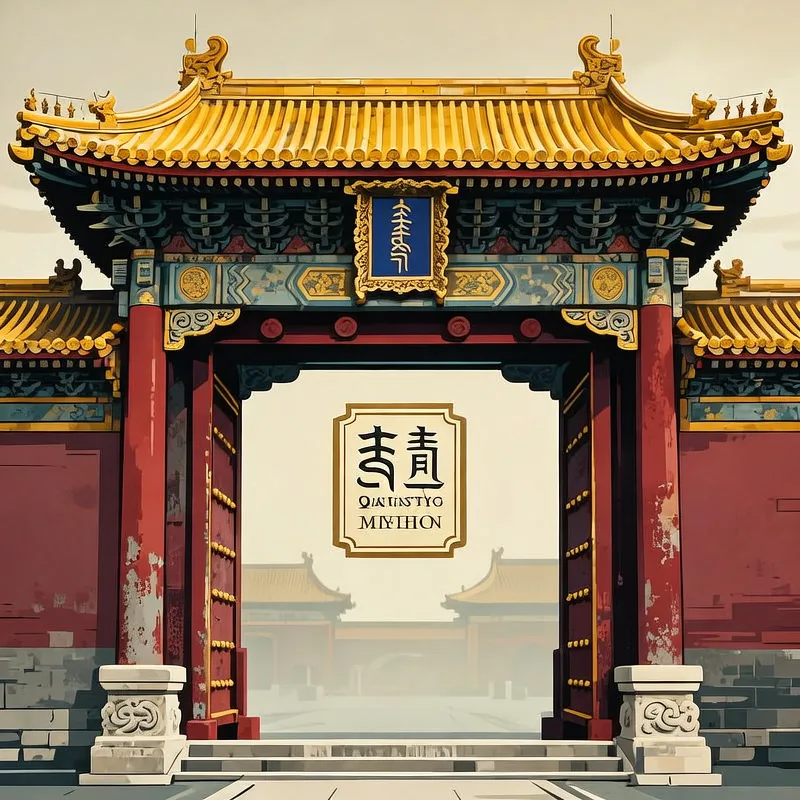
    A bilingual Manchu and Chinese plaque above a gate in Beijing’s Forbidden City
    Palace gates in Beijing carry inscriptions in both Manchu and Chinese. AI生成的插圖 · SinoViz

    A written language of archives

    Manchu is a Tungusic language, related to Xibe and more distantly to Evenki. Its written form was devised in the late sixteenth century by adapting the Mongolian script, and it became the language of Qing military records, imperial edicts and family archives. Thousands of these documents survive in Chinese and foreign collections, and they are consulted for the history of the dynasty and its frontier administration. Few people speak Manchu fluently today, mostly in a handful of northeastern villages, and Mandarin is the normal language of daily life. Even so, Manchu words survive in place names, court titles and the vocabulary of Qing institutions.

    Dress, house and food

    Manchu dress shaped the qipao, the close-fitting robe later worn widely by Han Chinese women and known abroad as the cheongsam. Older garments had horse-hoof cuffs that could be folded back over the hands, and women’s formal dress included a tall flag headdress and shoes with a raised flowerpot sole. Under the Qing, men wore a shaved forehead and a braided queue, a rule enforced until the dynasty’s end. A traditional house was arranged as a pocket room with a heated kang platform along the west wall, where honored guests slept and ancestral tablets were kept. A pole in the courtyard was used in offerings that fed crows, an animal associated with founding legends.

    A Qing dynasty Manchu robe with horse-hoof cuffs and embroidered panels
    Manchu court dress influenced the qipao and the formal clothing of the Qing elite. TBD Tuyên | Pexels License (https://www.pexels.com/license/)

    What remains in Beijing

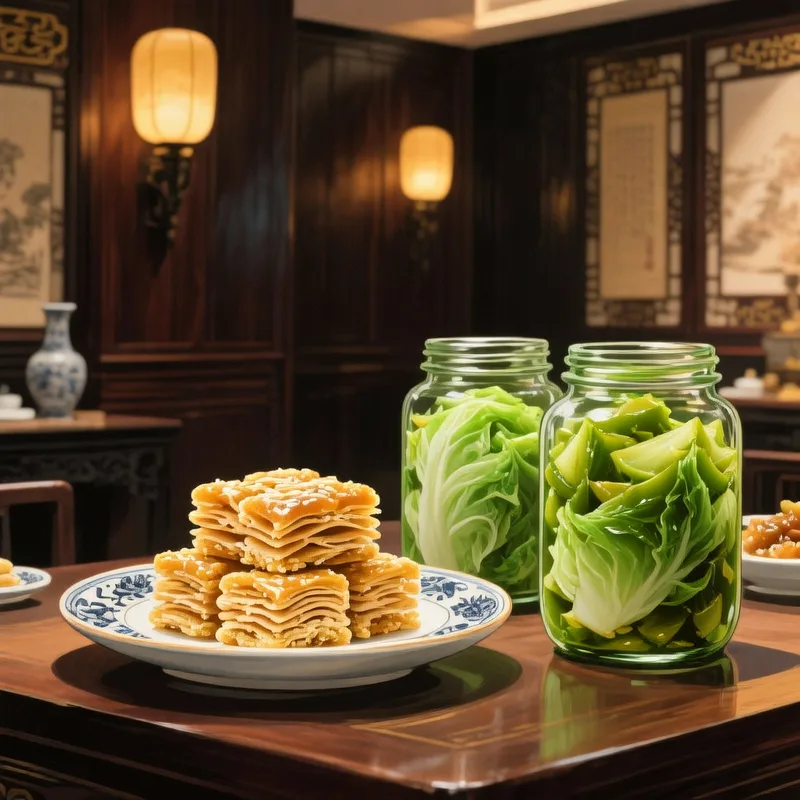
    Manchu cuisine survives in Beijing and the northeast through sachima, a sweet pastry made of fried dough and syrup, and through hot pots of pickled cabbage, pork and blood sausage. The elaborate Manchu-Han banquet is a later dining form assembled from court and regional dishes rather than a single unbroken tradition. Paper-cutting, embroidery and painted snuff bottles are among the crafts associated with Manchu households. In Beijing, the most public inheritance is architectural: the Forbidden City’s bilingual plaques, the layout of former banner quarters, and restaurants and museums that explain Qing court life. These traces make the dynasty legible on an ordinary walk through the old city.

    A Beijing restaurant display of Manchu sachima pastry and pickled cabbage hot pot
    Manchu food traditions remain visible in Beijing and northeastern China. AI生成的插圖 · SinoViz
    On Beijing’s palace gates, Manchu and Chinese script still share the same lintel.

    資料來源及延伸閱讀

    1. Manchu ——《不列顛百科全書》。
    2. Qing dynasty ——《不列顛百科全書》。
    3. Manchu Ethnic Group — China.org.cn.

    看看它就位

    請跟隨此條目前往其所屬區域。

    透過地圖探索

    請關注此帖

    瀏覽其他與此標籤相同的條目。

    瀏覽標籤
  • The Dong People

    生活與民俗

    The Dong People

    Drum towers and unaccompanied song

    The Dong, or Kam, are Kra-Dai-speaking villagers of southwest China known for timber towers, covered bridges and part-singing.

    部分
    生活與民俗
    地區
    廣西
    時代
    跨越時代
    標籤
    民族、習俗

    Dong villages gather around a drum tower and a song hall, where music is learned by ear. Their grand song, sung in parts without instruments, was inscribed on UNESCO’s Representative List of Intangible Cultural Heritage in 2009.

    Villages across three provinces

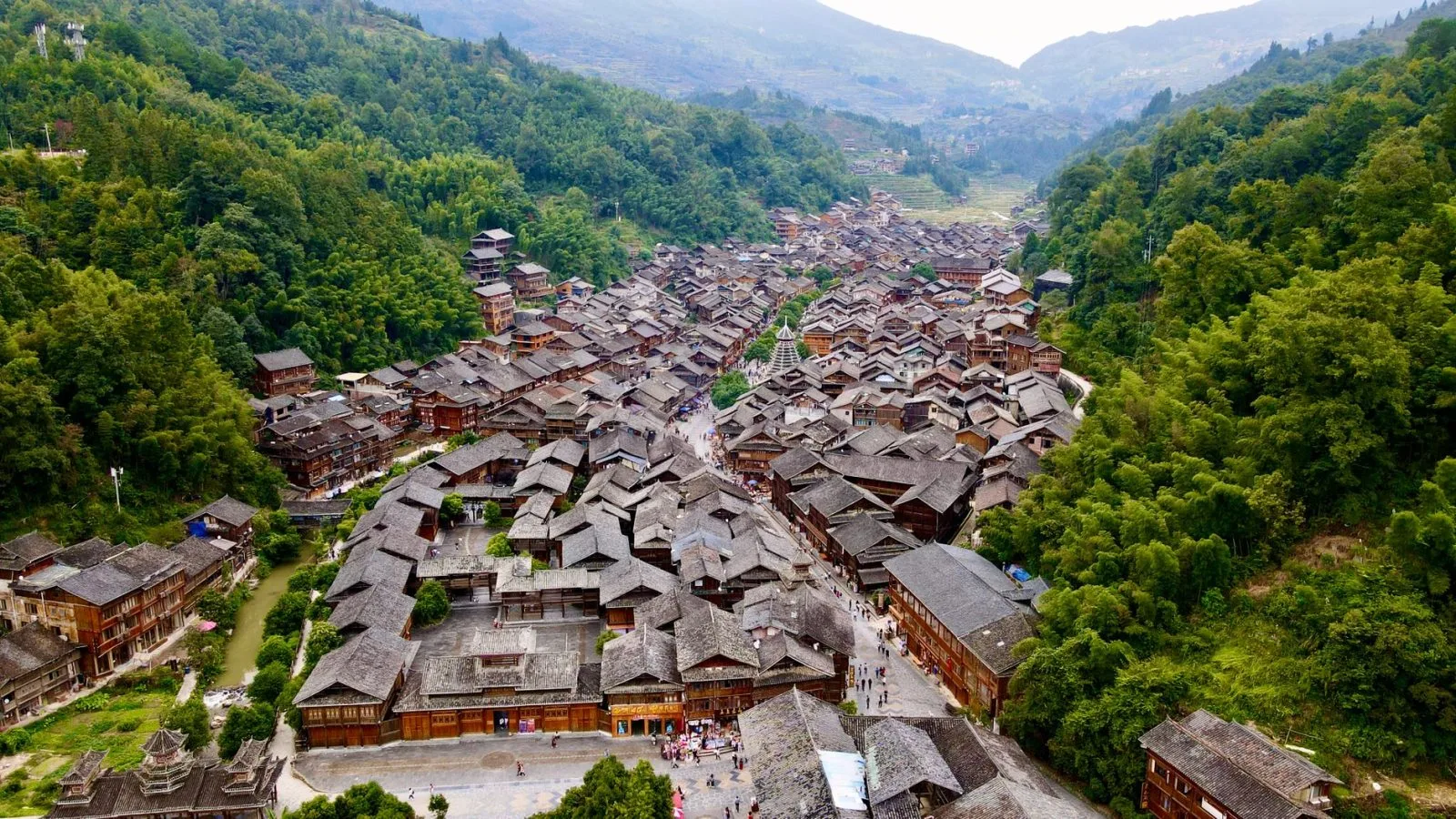
    The 2010 census recorded about 2.96 million Dong people, also known as Kam. Most live in the Qiandongnan Miao and Dong Autonomous Prefecture of eastern Guizhou, with others in Xinhuang County in western Hunan and Sanjiang County in northern Guangxi, the area tagged for this entry. Settlements cluster along streams in hilly country, where houses are built close together on timber posts and the ground floor is kept for animals and storage. Villages often form around a clan or a group of related families, and a shared drum tower marks the centre. Neighbouring Miao, Yao and Han communities shape the markets and intermarriage patterns of the region.

    Dong stilt houses clustered around a drum tower in Sanjiang, Guangxi
    Dong villages are built close together, with a drum tower at the centre. Collins Zhao | Pexels License (https://www.pexels.com/license/)

    Language and village rule

    The Dong language is also called Kam and belongs to the Kam-Sui branch of the Kra-Dai family, the wider family that includes Dai and Thai. It has tones and a large vocabulary for rice farming, forest work and village ritual. There is no old, widely shared Dong script; Chinese characters have been used for official records, and romanised spelling now helps publish dictionaries and song texts. Village life has long been regulated by compacts known as kuan, agreements on land use, marriage and dispute settlement that are recited at assemblies. Elders and elected heads speak for the village, while the song hall and the drum tower serve as places where young people learn the repertoire and the rules.

    Towers and covered bridges

    Dong timber building is famous for two structures. The drum tower rises above the rooftops as a layered pagoda with projecting eaves, built from joined timbers and used for meetings, signals and festival gatherings. The wind and rain bridge is a covered crossing with a tiled roof, benches along its length and one or more pavilion towers. The Chengyang Yongji Bridge in Sanjiang, built in the early twentieth century, is a well-known example of this bridge type. Both structures are assembled by local carpenters using mortise and tenon joints rather than metal fasteners, and whole villages contribute labour and timber when one is raised or repaired.

    A covered Dong wind and rain bridge with pagoda towers spanning a stream in Guangxi
    Covered bridges provide shelter, seating and a village landmark in one structure. AI生成的插圖 · SinoViz

    Grand song and daily food

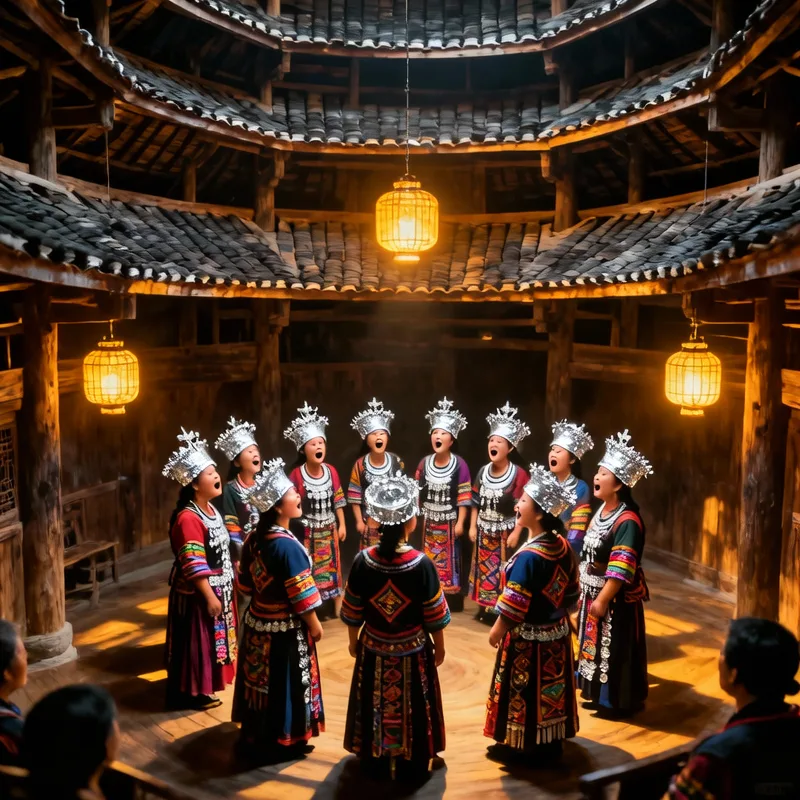
    The Kam grand song, or dongge, is unaccompanied polyphonic singing led by high voices and answered by a lower drone from the group. It is learned in song halls, where young people sit around a fireplace and rehearse through the winter, and it is performed at weddings, festivals and visits between villages. Dong New Year falls in the eleventh lunar month in many places, with drum tower gatherings and, in some areas, bullfighting. Daily food includes fermented sour fish packed with rice, sour soup, glutinous rice and you cha, a tea whisked with fried rice, peanuts and herbs. These dishes suit a wet upland climate where preservation and shared heating matter.

    Dong singers in a village song hall performing unaccompanied part-singing
    The grand song is learned in song halls and performed at communal gatherings. AI生成的插圖 · SinoViz
    In a Dong village, the drum tower is both a landmark and an invitation to gather.

    資料來源及延伸閱讀

    1. Kam grand song of the Dong ethnic group — UNESCO Intangible Cultural Heritage.
    2. Dong ——《不列顛百科全書》。
    3. Dong Ethnic Group — China.org.cn.

    看看它就位

    請跟隨此條目前往其所屬區域。

    透過地圖探索

    請關注此帖

    瀏覽其他與此標籤相同的條目。

    瀏覽標籤
  • The Dai People

    生活與民俗

    The Dai People

    Tai-speaking communities of southern Yunnan

    The Dai are Tai-speaking Buddhist communities whose villages, temples and water festivals shape the river valleys of southern Yunnan.

    部分
    生活與民俗
    地區
    雲南
    時代
    跨越時代
    標籤
    民族、習俗

    In the lowlands of Xishuangbanna and Dehong, Dai villages sit beside rice fields and Buddhist monasteries. Their language belongs to the Tai branch of the Kra-Dai family, and their festivals follow a calendar shared with communities across mainland Southeast Asia.

    Where the valleys are

    About 1.16 million Dai people were counted in China’s 2010 census. Most live in the lowlands of southern and western Yunnan, especially the Xishuangbanna Dai Autonomous Prefecture along the Lancang (Mekong) River and the Dehong Dai and Jingpo Autonomous Prefecture near the Myanmar border. Smaller communities extend through Lincang, Pu’er and Honghe. Settlement follows warm river valleys where irrigated rice can be grown year-round, rather than the cooler surrounding hills. This lowland orientation has kept Dai villages in close contact with Shan, Thai and Lao communities across the borders, and it explains why local architecture, food and festival calendars have much in common with mainland Southeast Asia.

    Dai village houses with steep roofs beside irrigated rice fields in Xishuangbanna, Yunnan
    Villages follow the warm river valleys where rice can be grown through the year. Rachel Claire | Pexels License (https://www.pexels.com/license/)

    Language, script and the wat

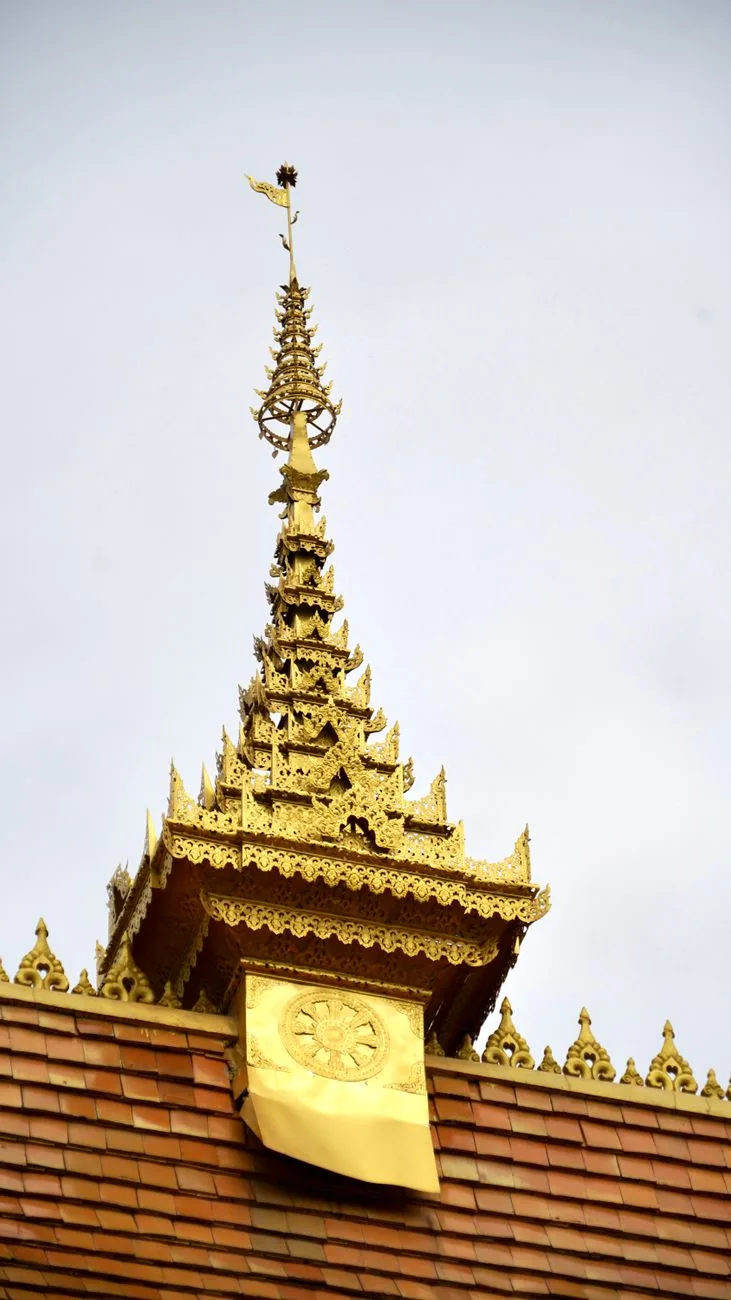
    Dai belongs to the Tai branch of the Kra-Dai language family, the same broad family that includes Thai and Lao. Three writing traditions are used in Yunnan: the Xishuangbanna script, the Dehong script and a variant used around Jinping. All derive from older Tai writing systems and were once maintained mainly through monastery education. Theravada Buddhism reached Dai communities through trade and pilgrimage routes over several centuries, and a local wat, or monastery, became the centre of village literacy and ceremony. Boys traditionally spent part of their youth as novices, learning to read scripture and recite chants. Gilded stupas and timber temples with sloping roofs remain the most visible landmarks in the landscape.

    A Dai Buddhist temple with a gilded spire and carved timber eaves in Xishuangbanna
    The local wat has long been a centre of reading, ordination and village ceremony. Eric Feng | Pexels License (https://www.pexels.com/license/)

    House, cloth and daily food

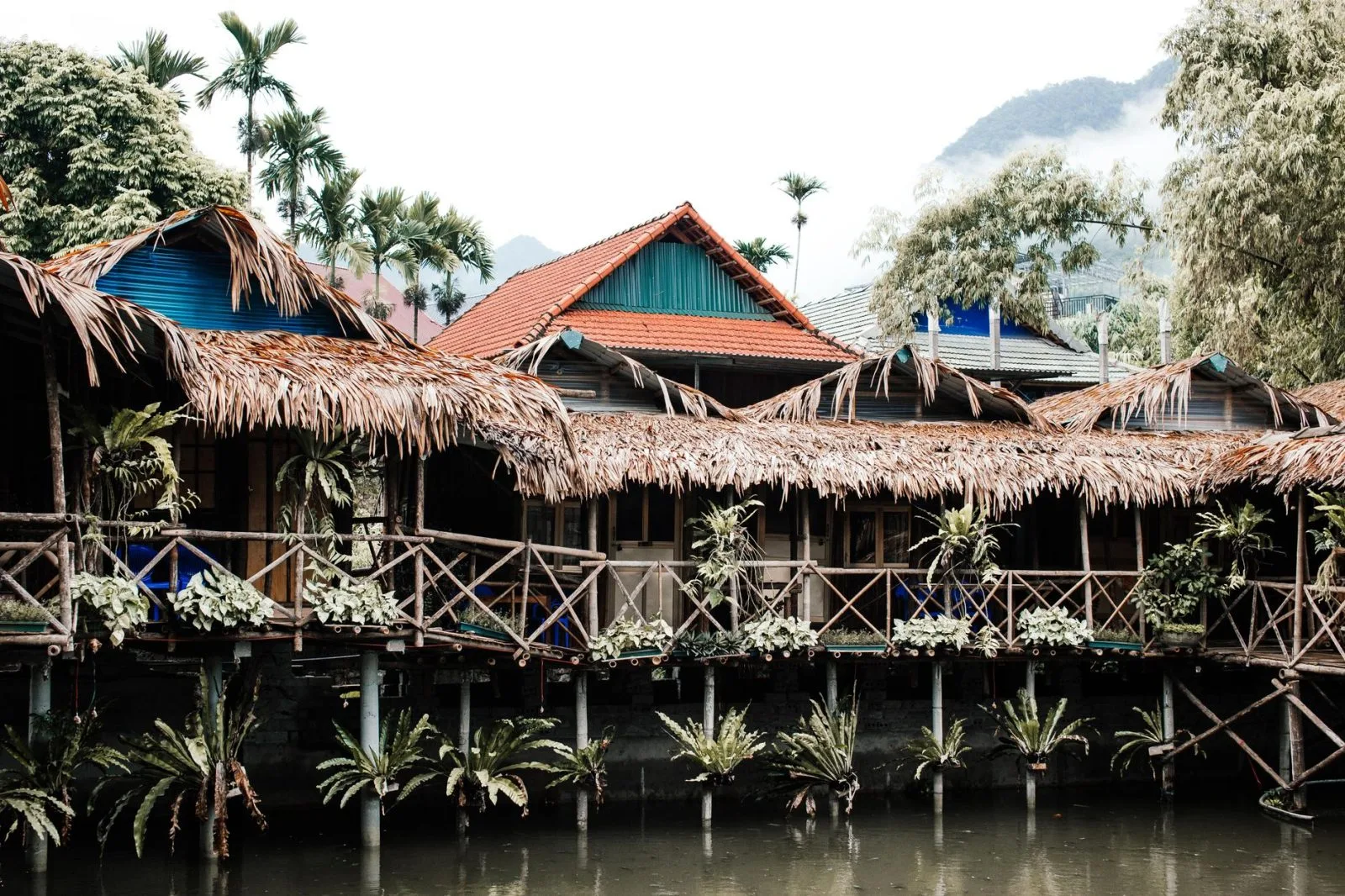
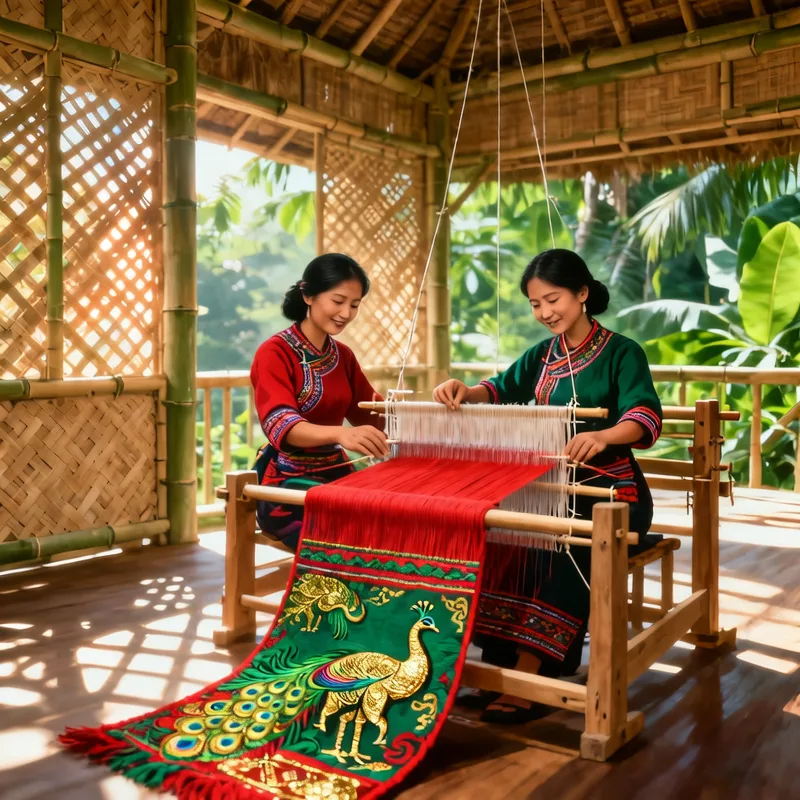
    A traditional Dai house stands on timber or bamboo posts, with the living floor lifted above the ground and a steep roof that sheds heavy monsoon rain. An open veranda serves as a work and sitting space, while the area beneath the house is used for storage and livestock. Household weaving produces cotton and silk cloth, and Dai brocade is known for peacock, elephant and geometric motifs worked in bright threads. Silver ornaments, betel nut and lacquered trays appear in daily and ceremonial exchange. Meals centre on glutinous rice, freshwater fish, sour bamboo shoots and chilli dips, often wrapped in banana leaves. Tea gardens around Xishuangbanna and Pu’er add another crop with a long regional history.

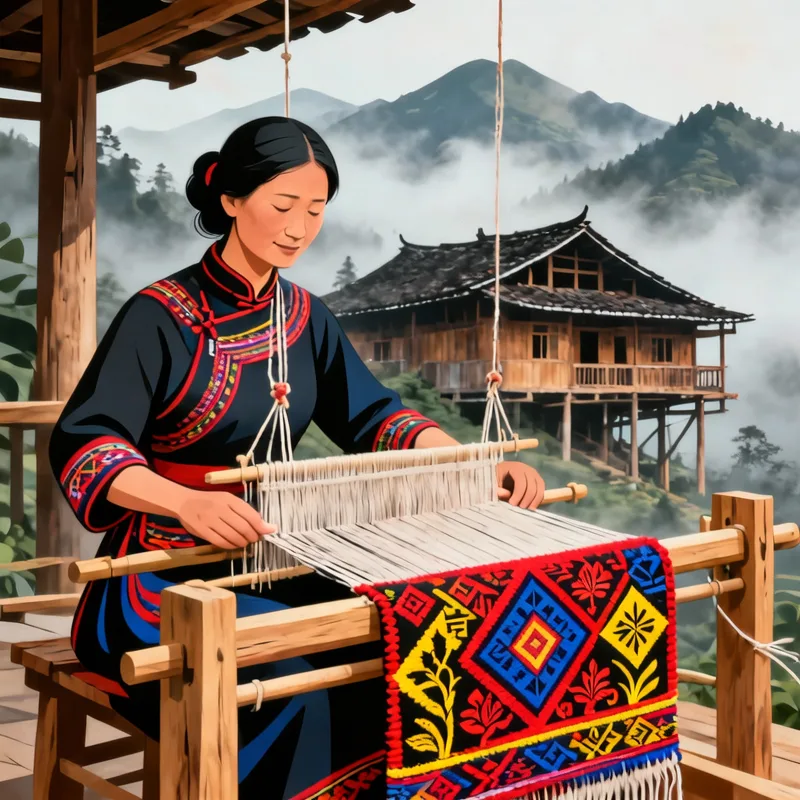
    A Dai weaver working on a backstrap loom beside a stilted wooden house
    Brocade, silverwork and betel nut are part of everyday household life. AI生成的插圖 · SinoViz

    The Water Festival

    The Dai new year falls in mid-April and is celebrated as the Water Festival, known locally as Songkran. Water is poured or sprinkled over family, neighbours and visitors as a wish for a clean and abundant year, and the day also includes visits to the monastery, the building of small sand pagodas and boat races on the rivers. In the evenings, peacock and elephant dances are performed with slow, controlled hand movements and bright costumes. These dances are also taught in cultural troupes and schools, alongside Dai opera and folk storytelling. Today the festival draws visitors from other parts of China, while monasteries and village craft workers continue to maintain the language and techniques behind it.

    In the Dai lowlands, a monastery, a rice field and a loom keep the same calendar.

    資料來源及延伸閱讀

    1. Dai ——《不列顛百科全書》。
    2. Dai Ethnic Group — China.org.cn.
    看看它就位

    請跟隨此條目前往其所屬區域。

    透過地圖探索

    請關注此帖

    瀏覽其他與此標籤相同的條目。

    瀏覽標籤
  • Chinese Paper Cutting

    生活與民俗

    Chinese Paper Cutting

    Red paper, folded and cut

    A pair of scissors and a sheet of red paper can carry a whole vocabulary of wishes.

    部分
    生活與民俗
    地區
    陝西
    時代
    跨越時代
    標籤
    Customs, Ethnic

    Chinese paper cutting, or jianzhi, turns a flat sheet into a pattern of figures, flowers, and characters. Practised for centuries in rural households, it still marks weddings and New Year, and Shaanxi’s bold window designs are among its most recognisable regional forms.

    Origins and Technique

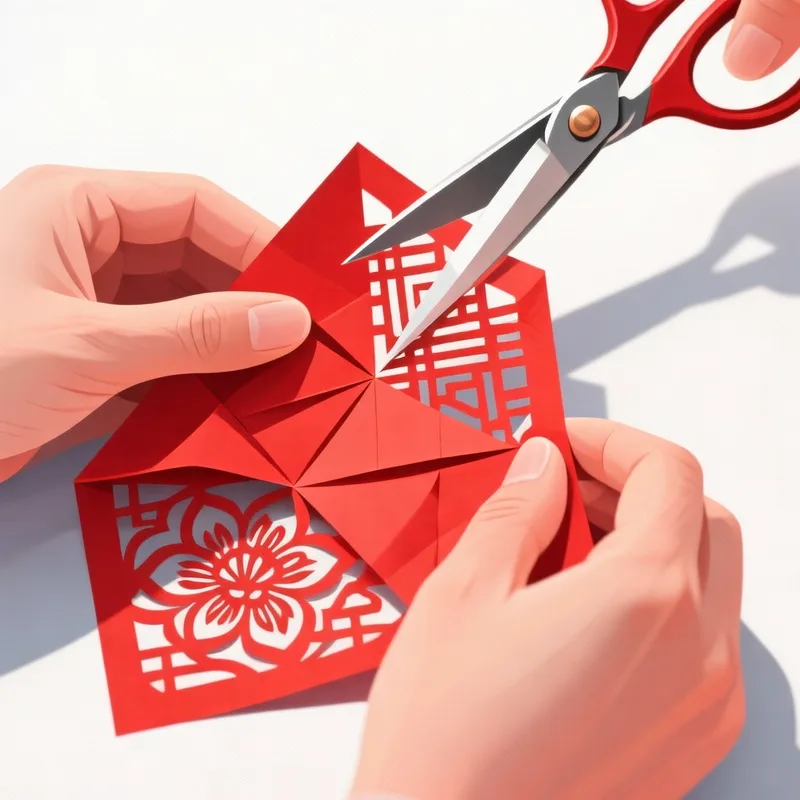
    Paper reached China in the Eastern Han period, and the first cuts followed once the material was cheap enough to experiment with. Early examples were used as offerings and as templates for embroidery; a surviving cut-paper find from the sixth century shows that the technique was established by then. Two methods developed. Scissors cut a folded sheet, creating a mirror-symmetric design with a single sequence of snips. A knife held upright cuts a stack of paper against a wax board, a method suited to finer lines and repeated motifs. Artists draw no outline for many traditional patterns; they cut directly, keeping the connecting threads that stop the design falling apart. The finished piece is light, cheap, and easy to paste on a window or door.

    Hands cutting a red paper design with small scissors
    Folding the paper before cutting produces the symmetrical patterns typical of window decorations. AI生成的插圖 · SinoViz

    A Language of Motifs

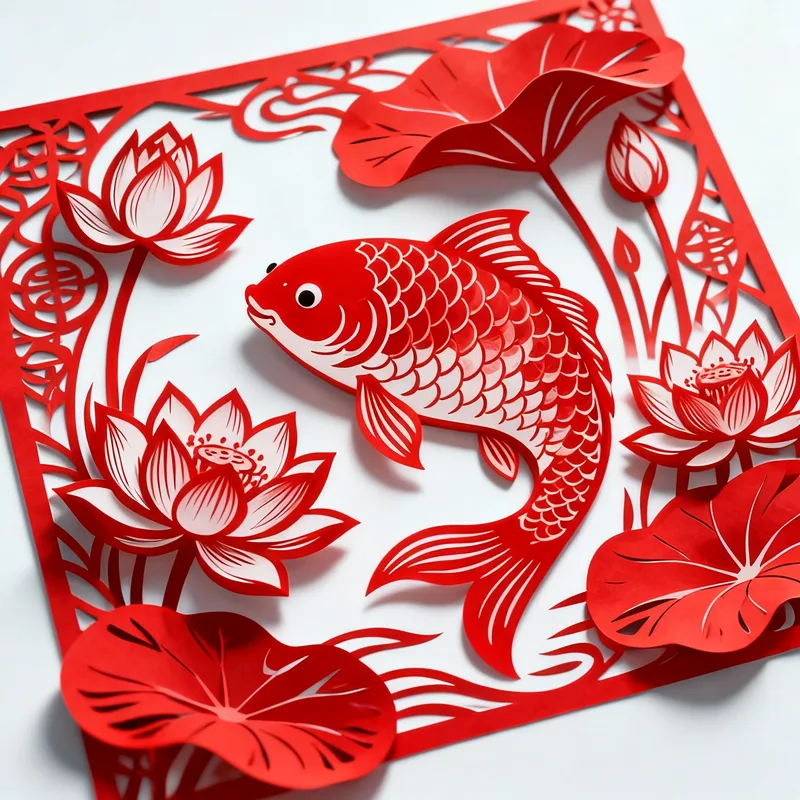
    The images are a system of visual puns. A fish means surplus, because the word for fish sounds like the word for abundance; lotus suggests purity. A pomegranate stands for many children, a bat for good fortune, and a peach for long life. The character fu, meaning good fortune, appears alone or inside a circular design, while shuangxi, double happiness, belongs to weddings. Zodiac animals, opera figures, and scenes of children at play all circulate as patterns. Colour matters as much as shape: red is the default for celebration, while white paper cuts are rarer and tied to older ritual uses. In a Shaanxi village window, the arrangement of these motifs tells a visitor what the household is hoping for in the coming year.

    Red paper-cut window decoration showing a fish and lotus flowers
    Fish and lotus form a rebus for abundance; motifs are chosen for the wish they carry. AI生成的插圖 · SinoViz

    Shaanxi Windows

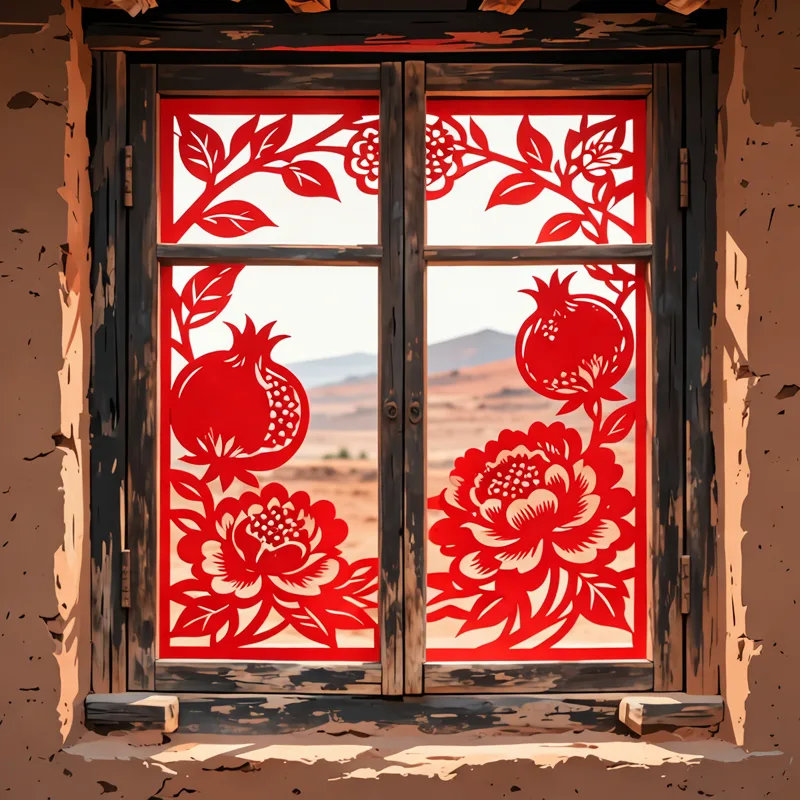
    Paper cutting in Shaanxi is associated with rural life on the Loess Plateau, especially around Yan’an. Windows there were once small and deeply set, so designs favoured bold silhouettes and broad, connected shapes that could be read from across a room. Local artists talk of cutting with the heart rather than measuring with a ruler, and compositions often show figures, animals, and plants together in a single dense frame. Window grilles, or chuanghua, are pasted at New Year and replaced when they fade. Wedding cuts carry double happiness characters and images of fertility; birthday cuts use peaches and cranes. Women were the main practitioners in many villages, passing patterns from mother to daughter, and village fairs still sell sheets cut in the old local style.

    A Shaanxi farmhouse window with bold red paper cutouts
    Shaanxi cuts favour strong silhouettes and broad shapes, designed to read from a distance. AI生成的插圖 · SinoViz

    Recognition and Travel

    Chinese paper-cut was inscribed on UNESCO’s Representative List of the Intangible Cultural Heritage of Humanity in 2009, a recognition that named both the craft and the communities that sustain it. The listing does not freeze the art. Contemporary artists cut portraits, cityscapes, and political images with the same tools, and paper cuts appear in graphic design and animation. For a visitor, the appeal is that the work is easy to find and easy to try. Museum shops sell small sheets, market stalls sell single motifs, and workshops in Xi’an and rural Shaanxi teach the basic fold-and-cut method in an hour. Bring a sharp pair of scissors and practice on cheap red paper before attempting a detailed pattern. A finished cut pasted on glass changes with the light.

    The pattern holds together because the cutter leaves just enough paper between the lines.

    資料來源及延伸閱讀

    1. Chinese paper-cut — UNESCO Intangible Cultural Heritage.
    2. Chinese Paper Cutting — China Highlights.
    3. Paper cutting ——《不列顛百科全書》。

    看看它就位

    請跟隨此條目前往其所屬區域。

    透過地圖探索

    請關注此帖

    瀏覽其他與此標籤相同的條目。

    瀏覽標籤
  • 苗銀器

    生活與民俗

    苗銀器

    Ornament, Memory, and Festival Dress

    Miao silver ornaments carry family history and local identity in festival dress across southwest China.

    部分
    生活與民俗
    地區
    雲南
    時代
    跨越時代
    標籤
    Customs, Ethnic, Scenic Sites

    Miao silverwork is a family of adornments—headdresses, collars, earrings, and bracelets—made by Miao communities in Guizhou, Yunnan, and neighbouring regions. The pieces are worn most visibly at festivals and weddings.

    A Distributed Craft Tradition

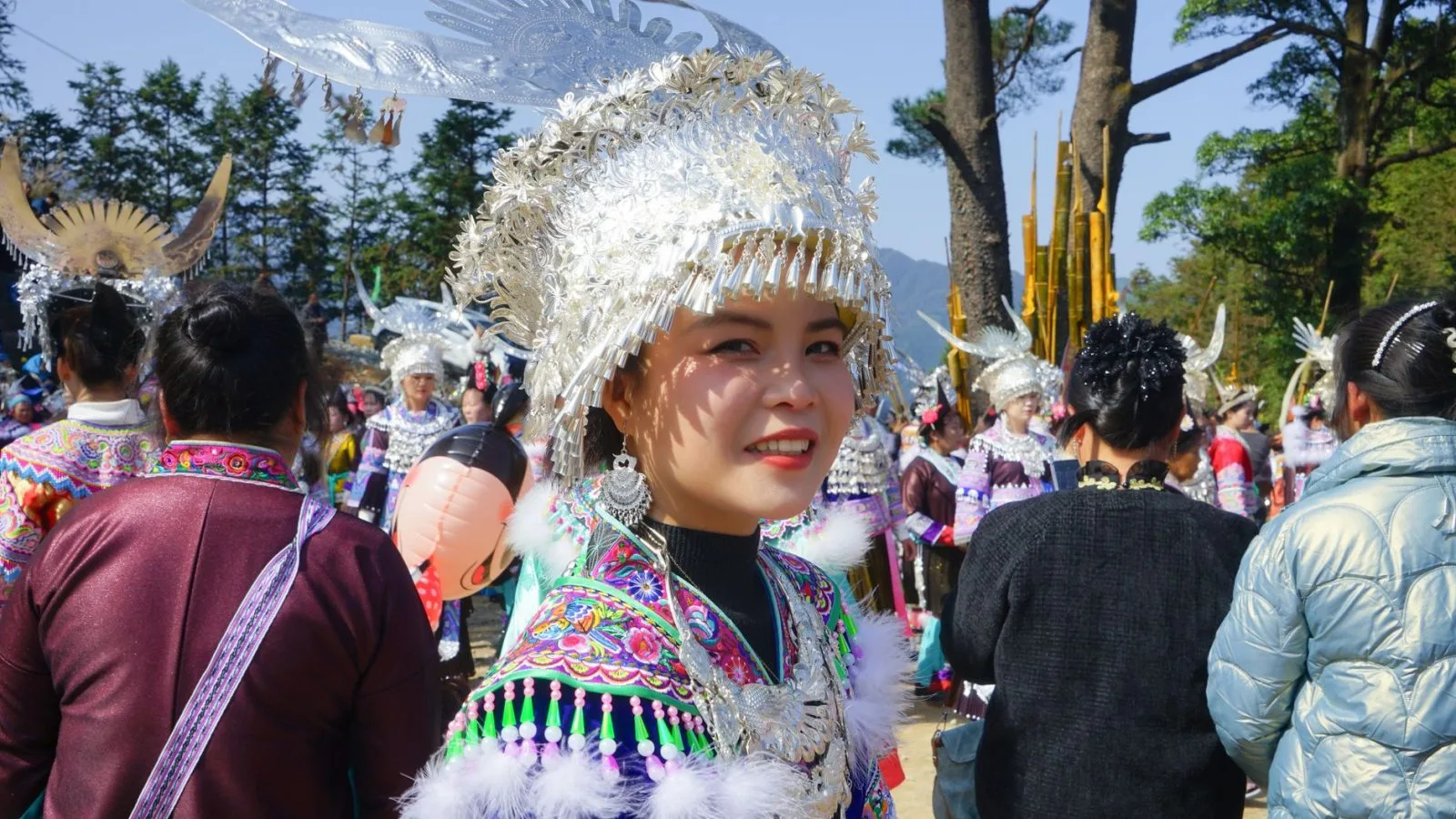
    Miao communities live across Guizhou, Yunnan, Guangxi, Sichuan, and Southeast Asia, and silverwork varies by locality. In Yunnan, Miao villages around Wenshan and Honghe maintain styles that differ from the better-known Guizhou counties of Xijiang and Kaili. Ornaments are made by specialised silversmiths who work in small workshops, often serving several villages. Designs are learned through apprenticeship rather than written patterns: a young smith repeats forms copied from older pieces and festival dress. Motifs may draw on local birds, flowers, insects, and coins, though their meanings are not fixed. Families accumulate ornaments over generations, and a daughter’s festival headdress may represent years of saving.

    A Miao headdress with silver horns, plaques, and hanging ornaments at a festival
    Headdresses combine family heirlooms with pieces made for a specific occasion. Jaqor Q.I. | Pexels License (https://www.pexels.com/license/)

    Sheet, Wire, and Repoussé

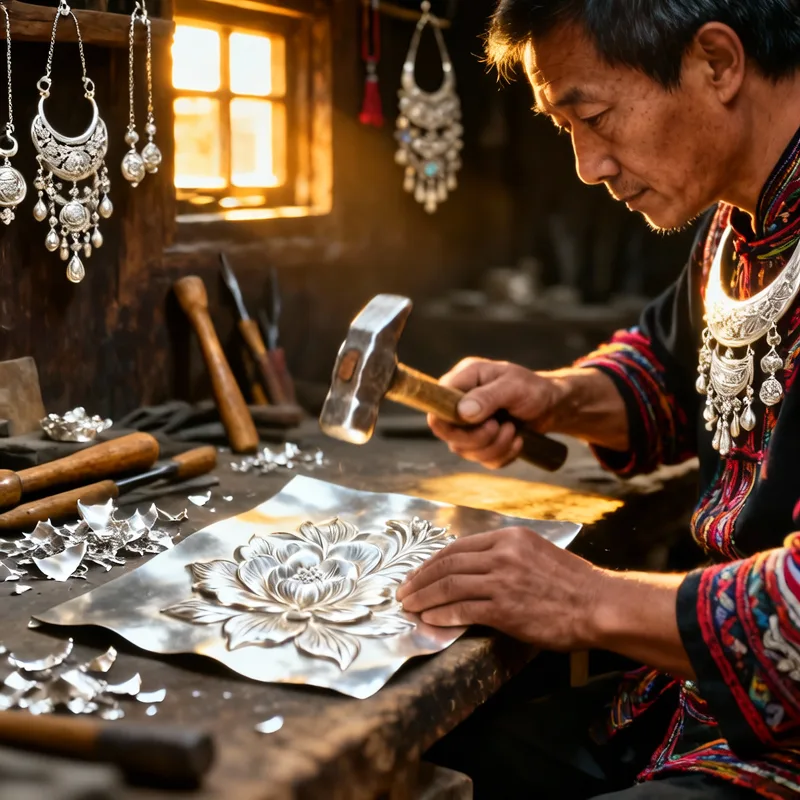
    Much Miao silverwork begins with sheet silver and wire. The smith hammers ingots into thin sheets, cuts strips, and raises patterns from the reverse with repoussé, a technique of punching and chasing to form relief. Horsehair-thin wires are twisted and soldered into filigree, then built into openwork wings, horns, and floral sprays. A large headdress may combine a hammered band, dangling chains, repoussé plaques, and rows of tiny bells that move when the wearer turns. Silver is valued for its colour, workability, and traditional association with protection and prosperity. Many ornaments are hollow to reduce weight, since a full ceremonial headdress can be heavy enough to limit long wear.

    A Miao silversmith hammering a thin silver sheet into a raised floral plaque
    Repoussé raises the design from the back of a thin silver sheet. AI生成的插圖 · SinoViz

    Festival Wear and Social Meaning

    Silver ornaments are read as part of an entire costume, not as isolated jewellery. A Miao woman’s festival dress may include a pleated skirt, embroidered jacket, woven belt, and a silver collar shaped like a crescent or a pair of wings. In some communities, the number and form of earrings or neck rings indicate village affiliation or marital status. During the Lunar New Year, harvest celebrations, and the Miao New Year in some areas, women and girls wear family sets while groups sing, dance, and process between villages. The ornaments catch light during movement, making dress a visual part of the performance. Men may wear silver buttons, chains, or small pendants with less ceremonial weight.

    • Repoussé plaques raised from thin silver sheet
    • Twisted wire and openwork filigree
    • Headdresses with horns, chains, and bells
    • Costumes worn for New Year and wedding rituals
    Women in embroidered Miao festival dress wearing heavy silver collars and earrings
    Ornaments are worn with embroidery and weaving as one costume system. Jaqor Q.I. | Pexels License (https://www.pexels.com/license/)

    Markets, Tourism, and Continuity

    Silverwork circulates through village workshops, regional markets, and tourism. Visitors to Miao villages in Yunnan and Guizhou can watch smiths shaping small pieces, though the most important heirlooms are usually not for sale. Reproductions sold as souvenirs range from careful miniatures to inexpensive plated metal, so asking whether a piece is solid silver matters. Museums and cultural centres document older headdresses and collars, but the living context remains local dress. Some communities have revived festival costumes and taught silversmithing to younger people, while migration and wage work change who has time to make and wear them. The craft’s future depends less on novelty than on continued occasions to use it.

    A Miao headdress is worn jewellery and a portable archive of family work at the same time.

    資料來源及延伸閱讀

    1. Miao people ——《不列顛百科全書》。
    2. Chinese silver jewellery — Victoria and Albert Museum.
    3. Miao ethnic culture — China Highlights.

    看看它就位

    請跟隨此條目前往其所屬區域。

    透過地圖探索

    請關注此帖

    瀏覽其他與此標籤相同的條目。

    瀏覽標籤
  • Yi

    Ethnic Community

    Yi

    Fire, mountains and an ancient script

    Yi communities live across the mountains of southwest China. The Nuosu branch preserves a distinctive script and ritual tradition, while Torch Festival has become a widely recognised Yi celebration.

    Community
    Yi
    Population
    Around 9 million; Sichuan, Yunnan, Guizhou, Guangxi
    Language
    Yi languages; Nuosu script
    01

    Where the community lives

    Yi people live mainly in Sichuan, Yunnan and Guizhou, often in mountainous areas. Liangshan in Sichuan is a major centre of Nuosu culture.
    02

    Language and belief

    Yi languages belong to the Tibeto-Burman family. The Nuosu syllabic script is a rare living indigenous writing system in China.
    03

    Festivals and daily life

    Torch Festival features bonfires, dancing and gatherings. Buckwheat, potatoes, cured meat and hearty mountain food reflect local agriculture.
    04

    Crafts and heritage

    Embroidery, lacquerware, silver ornaments and ritual texts preserve Yi aesthetic traditions. Epic storytelling and ritual specialists carry historical memory.

    See the region

    Open the map to read the land connected to this community.

    透過地圖探索
  • Zhuang

    Ethnic Community

    Zhuang

    Rice terraces and song festivals

    The Zhuang are China’s largest minority ethnic group. Their culture is closely tied to Guangxi’s karst hills, rice farming, song festivals and distinctive bronze drum traditions.

    Community
    Zhuang
    Population
    Around 19 million, mostly in Guangxi
    Language
    Zhuang (Tai-Kadai)
    01

    Where the community lives

    Most Zhuang people live in Guangxi, with communities also in Yunnan, Guangdong and Guizhou. Karst valleys and river plains shape settlement and agriculture.
    02

    Language and tradition

    Zhuang belongs to the Tai-Kadai family. Folk songs, especially antiphonal singing, are central to social life and courtship.
    03

    Festivals and daily life

    The Sanyuesan festival features singing, coloured eggs and gatherings. Rice, river fish and sour flavours appear in local food traditions.
    04

    Crafts and heritage

    Bronze drums, embroidered balls and indigo-dyed textiles are important cultural symbols. Dong and Zhuang communities also share drum tower and bridge-building traditions in some areas.

    See the region

    Open the map to read the land connected to this community.

    透過地圖探索