Nhãn: History

  • Vạn Lý Trường Thành

    Biên niên sử

    Vạn Lý Trường Thành

    Frontier Walls Across Two Millennia

    A chain of fortifications built by successive dynasties to control the steppe frontier.

    Phần
    Biên niên sử
    Vùng đất
    Bắc Kinh
    Kỷ nguyên
    qin-han
    Thẻ
    History, Geography, Scenic Sites

    The Great Wall is not one wall but a series of defensive systems raised at different times by different states. Their surviving masonry, from northwest Beijing to the Gobi, records two thousand years of contest and exchange between farming settlements and the Inner Asian steppe.

    Walls Before the First Emperor

    Wall building began long before the Qin dynasty. During the Warring States period (475–221 BCE), the states of Qin, Zhao, and Yan raised earthen ramparts along their northern and western frontiers to check Xiongnu raiders and to mark contested pasture. These were not isolated lines: they were linked to watchtowers, garrison posts, and river barriers that could slow cavalry and give farmers time to shelter. Some sections were built of tamped earth, layered and hammered into a dense wall that could stand for centuries in the dry northwest. The First Emperor later joined and extended this existing network rather than inventing the idea of a frontier wall from nothing.
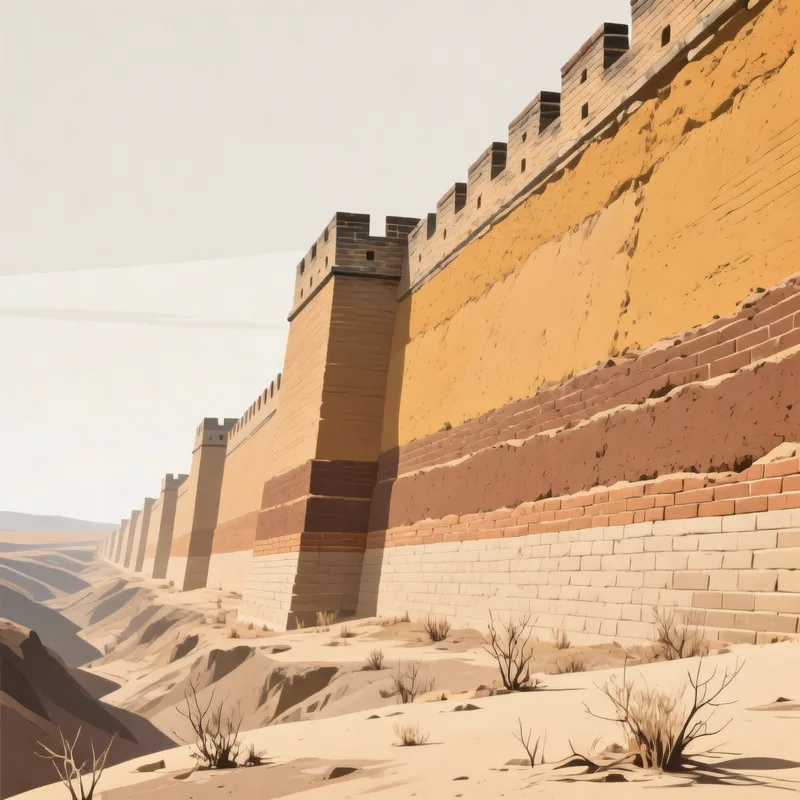
    Layered rammed-earth wall of an early northern frontier rampart rising above a dry valley
    Early walls were tamped earth, not the brick masonry familiar from Ming sections. Hình minh họa do AI tạo ra · SinoViz

    The Qin Link, 221–206 BCE

    After unifying China in 221 BCE, Qin Shi Huang ordered the general Meng Tian to connect the northern walls into a single defensive front. Reports in the Shiji describe a force of hundreds of thousands of soldiers and convict labourers working from Lintao in present-day Gansu to Liaodong in the northeast, a distance later described as ten thousand li. The aim was strategic: to push the Xiongnu north of the Yellow River loop and to protect the new commanderies planted in conquered territory. The work was expensive and unpopular, and the Qin collapsed in 209–206 BCE, but the frontier idea outlived the dynasty.
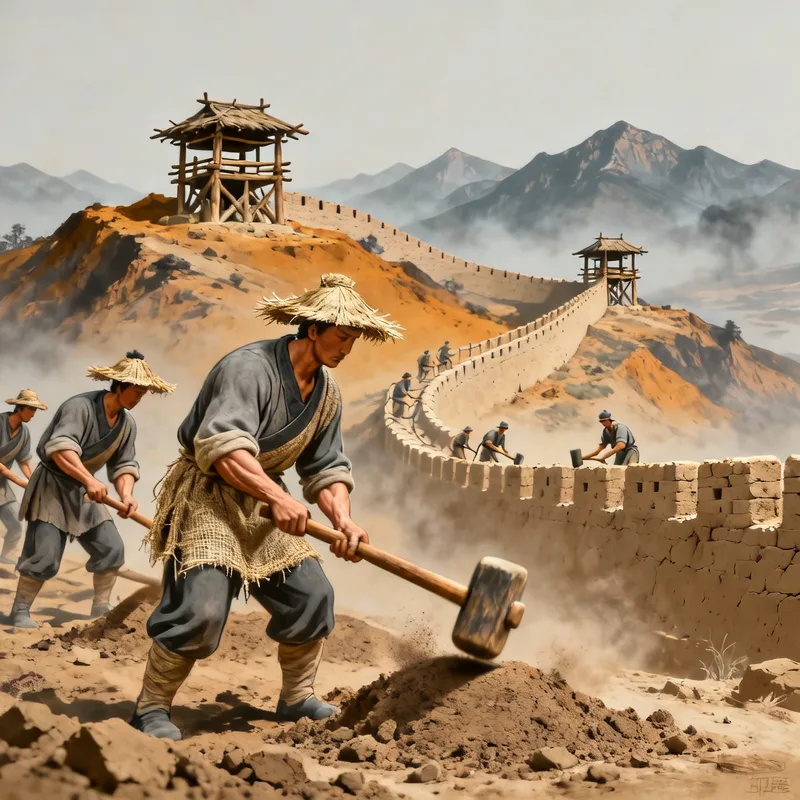
    Reconstructed Qin-era frontier wall with watchtowers crossing a loess plateau
    Meng Tian’s campaign joined older walls into a frontier stretching from Gansu to Liaodong. Hình minh họa do AI tạo ra · SinoViz

    The Ming Wall We See Today

    Most visible masonry belongs to the Ming dynasty (1368–1644), which rebuilt the wall after the Mongol Yuan retreated north. Beginning in the late fourteenth century, Ming engineers faced sections with brick and stone, added hollow watchtowers and beacon platforms, and anchored the line at Jiayuguan in Gansu and Liaodong in the northeast. The best-preserved stretches near Beijing, including Badaling, Mutianyu, and Jinshanling, date from this period. UNESCO inscribed the Great Wall on the World Heritage List in 1987, describing its full length at 8,851.8 kilometres. What visitors walk today is therefore a late imperial rebuilding of a much older frontier idea.
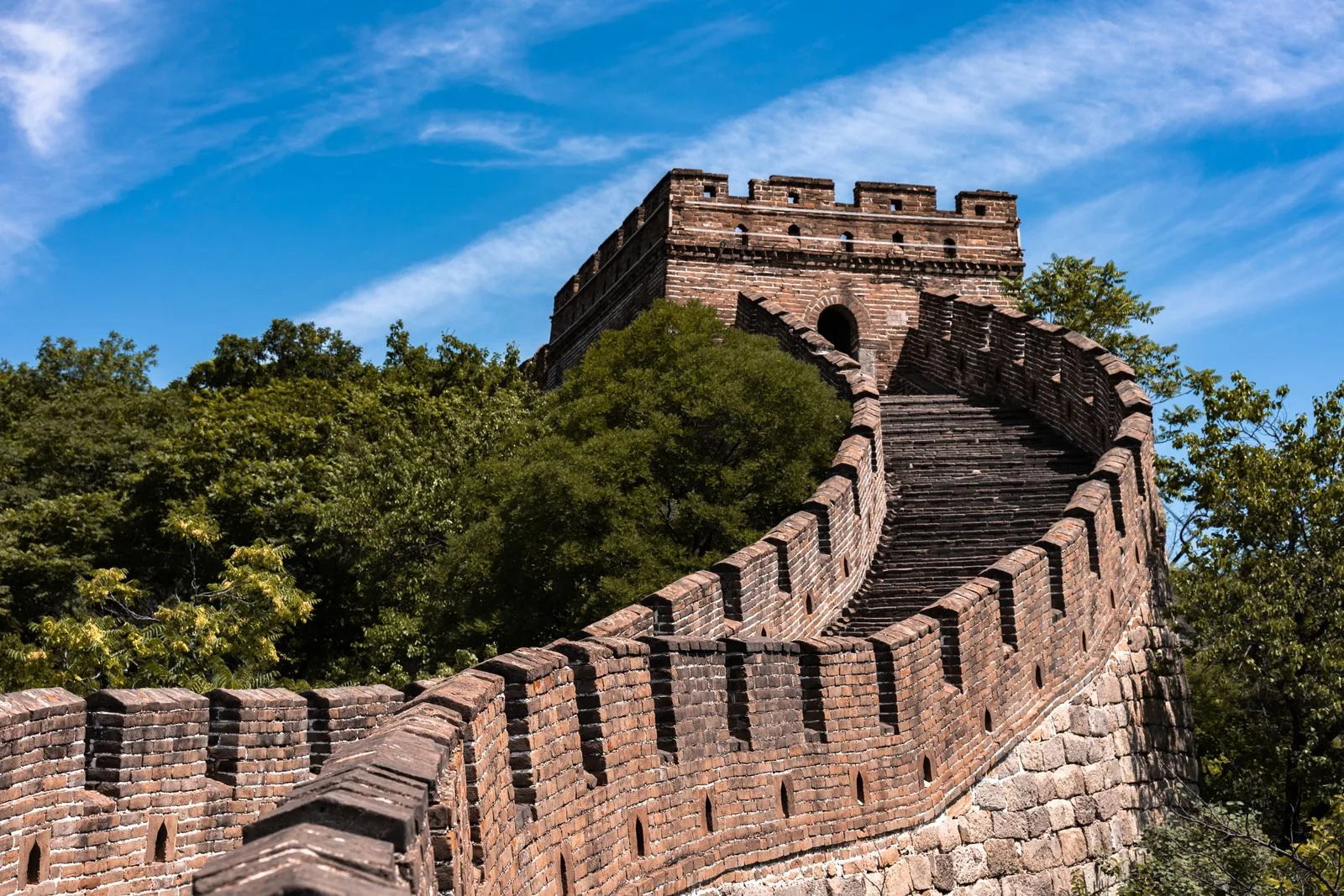
    Brick-faced Ming wall with crenellations and a watchtower winding over a green ridge near Beijing
    Ming brickwork near Beijing is the wall most visitors see today. Mehmet Yasin Kabaklı | Pexels License (https://www.pexels.com/license/)

    A System of Control and Contact

    The wall worked as a system rather than a solid barrier. Beacon towers passed smoke and fire signals along the line, while garrison towns and passes regulated movement. Trade was not stopped: frontier markets exchanged grain, tea, and silk for horses and furs, and officials issued passes to authorised caravans. The ruined walls of the fourth-century Tuoba Wei and the earthworks of the Jin dynasty show that steppe peoples also built walls against one another. To read the Great Wall only as a dividing line is to miss its second function, which was to organise contact on terms the state could tax and police.

    The wall was never a single line on a map; it was a frontier regime made of stone, signal fire, and paperwork.

    Nguồn tham khảo & tài liệu đọc thêm

    1. Vạn Lý Trường Thành — UNESCO World Heritage Centre.
    2. Great Wall of China — Bách khoa toàn thư Britannica.
    3. The Great Wall of China — World History Encyclopedia.
    Hãy xem nó tại chỗ.

    Hãy theo dõi mục này đến khu vực mà nó thuộc về.

    Khám phá bằng bản đồ

    Hãy theo dõi chủ đề này.

    Xem các bài viết khác có cùng thẻ với bài viết này.

    Duyệt thẻ
  • Sứ

    Cuộc sống & Văn hóa dân gian

    Sứ

    Clay, fire, and the white of Dehua

    Fujian’s kilns turned local clay into porcelain that travelled across the sea and changed how the world pictured China.

    Phần
    Cuộc sống & Văn hóa dân gian
    Vùng đất
    Phúc Kiến
    Kỷ nguyên
    Xuyên suốt các thời đại
    Thẻ
    Customs, History, Scenic Sites

    Porcelain is defined by its body and its firing: a pale, fine clay heated to temperatures that vitrify the material and make it ring when struck. Fujian’s Dehua kilns made a version so white it seemed translucent, known in Europe as blanc de Chine.

    What Makes Porcelain

    Porcelain differs from ordinary pottery in both material and firing. Potters use kaolin, a white clay, mixed with feldspar and quartz, then fire the shaped vessel at roughly 1,200 to 1,400 degrees Celsius. At that temperature the body vitrifies: it becomes dense, non-porous, and slightly translucent at the edges. A glassy glaze is usually applied before firing, bonding to the body rather than sitting on it as a separate layer. Chinese potters had reached this threshold by the Tang and Song periods, and Jingdezhen in Jiangxi became the great production centre. The English word china stuck to the ware because the country was the source of the finest examples. A light tap on a good cup gives a clear ring, a quick test that still works in a shop.

    A porcelain bowl with a pale glaze photographed against light
    True porcelain is fired hot enough to vitrify the body, giving it a hard, resonant wall. lee c | Pexels License (https://www.pexels.com/license/)

    Dehua White

    Dehua, a county in Fujian’s Quanzhou prefecture, developed a white porcelain with a warm, creamy tone. Its clay is low in iron, which lets the glaze fire almost colourless, and its potters mastered figures as well as vessels. From the Ming dynasty onward, Dehua workshops produced small statues of Guanyin, the bodhisattva of compassion, with soft modelling and a smooth, almost waxy surface. European traders called the ware blanc de Chine, and by the seventeenth century it was collected in royal cabinets and copied by potters in Meissen and elsewhere. Tea wares also left the kilns: small cups, gaiwan lids and bowls, and white vessels that showed the colour of tea clearly. Local museums trace the kiln sequence from Song-period celadons through the white wares that made Dehua famous.

    A milky white porcelain figurine of Guanyin from Dehua
    Dehua’s porcelain figures of Guanyin became known in Europe as blanc de Chine. Quý Hoàng | Pexels License (https://www.pexels.com/license/)

    A Port for Porcelain

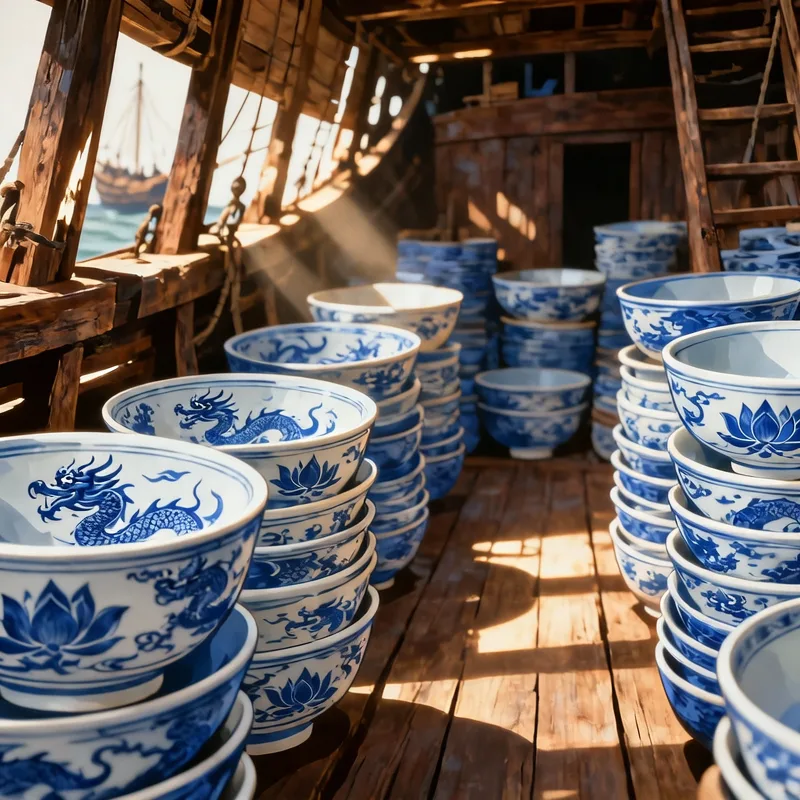
    Porcelain shaped trade as much as taste. Fujian’s coast faced the South China Sea, and Quanzhou became one of the busiest ports of the Song and Yuan dynasties, a place where merchants, monks, and ship crews exchanged goods and techniques. Archaeologists have recovered Chinese ceramics from ports and shipwrecks across Southeast Asia, the Indian Ocean, and East Africa; the fragments are dated by glaze and shape, making them a record of demand as well as production. UNESCO listed Quanzhou in 2021 as an emporium of the world in Song-Yuan China, with surviving mosques and temples. The export ware was not always the finest court piece. Sturdy bowls and jars packed in straw travelled in bulk, reaching households that never saw the kiln but knew the clay by its colour.

    Blue-and-white porcelain packed as cargo in a ship’s hold
    Quanzhou was a major Song and Yuan port from which Fujian ceramics were shipped abroad. Hình minh họa do AI tạo ra · SinoViz

    Using and Collecting

    Porcelain entered daily ritual as well as trade. A gaiwan, a bowl with a lid and saucer, is used for brewing tea in northern China; the lid controls the leaves and the saucer protects the fingers. White Dehua cups make the colour of a tea liquor easy to judge. Collectors look for a clean foot ring, an even glaze, and a mark painted on the base, though many imitations copy famous reign marks. Visit a kiln museum in Dehua or a ceramic gallery in Quanzhou to see the sequence from raw clay to finished piece. Handling a cup with a saucer and a steady hand is still the simplest way to understand why this material travelled so far.

    A clear ring and a translucent edge tell you what the fire has done.

    Nguồn tham khảo & tài liệu đọc thêm

    1. Chinese Porcelain — The Metropolitan Museum of Art.
    2. Quanzhou: Emporium of the World in Song-Yuan China — UNESCO World Heritage Centre.
    3. Blanc de Chine — Bách khoa toàn thư Britannica.

    Hãy xem nó tại chỗ.

    Hãy theo dõi mục này đến khu vực mà nó thuộc về.

    Khám phá bằng bản đồ

    Hãy theo dõi chủ đề này.

    Xem các bài viết khác có cùng thẻ với bài viết này.

    Duyệt thẻ
  • Calligraphy

    Cuộc sống & Văn hóa dân gian

    Calligraphy

    The brush as a record of the hand

    Chinese calligraphy turns writing into an art of pressure, rhythm, and restraint.

    Phần
    Cuộc sống & Văn hóa dân gian
    Vùng đất
    Thiểm Tây
    Kỷ nguyên
    Xuyên suốt các thời đại
    Thẻ
    Customs, History

    A line of Chinese calligraphy is made once: the brush touches paper, and the mark cannot be corrected. That irreversibility is part of its appeal. In Xi’an, the city’s stone steles preserve the work of centuries of calligraphers in a form anyone can still read.

    The Four Treasures

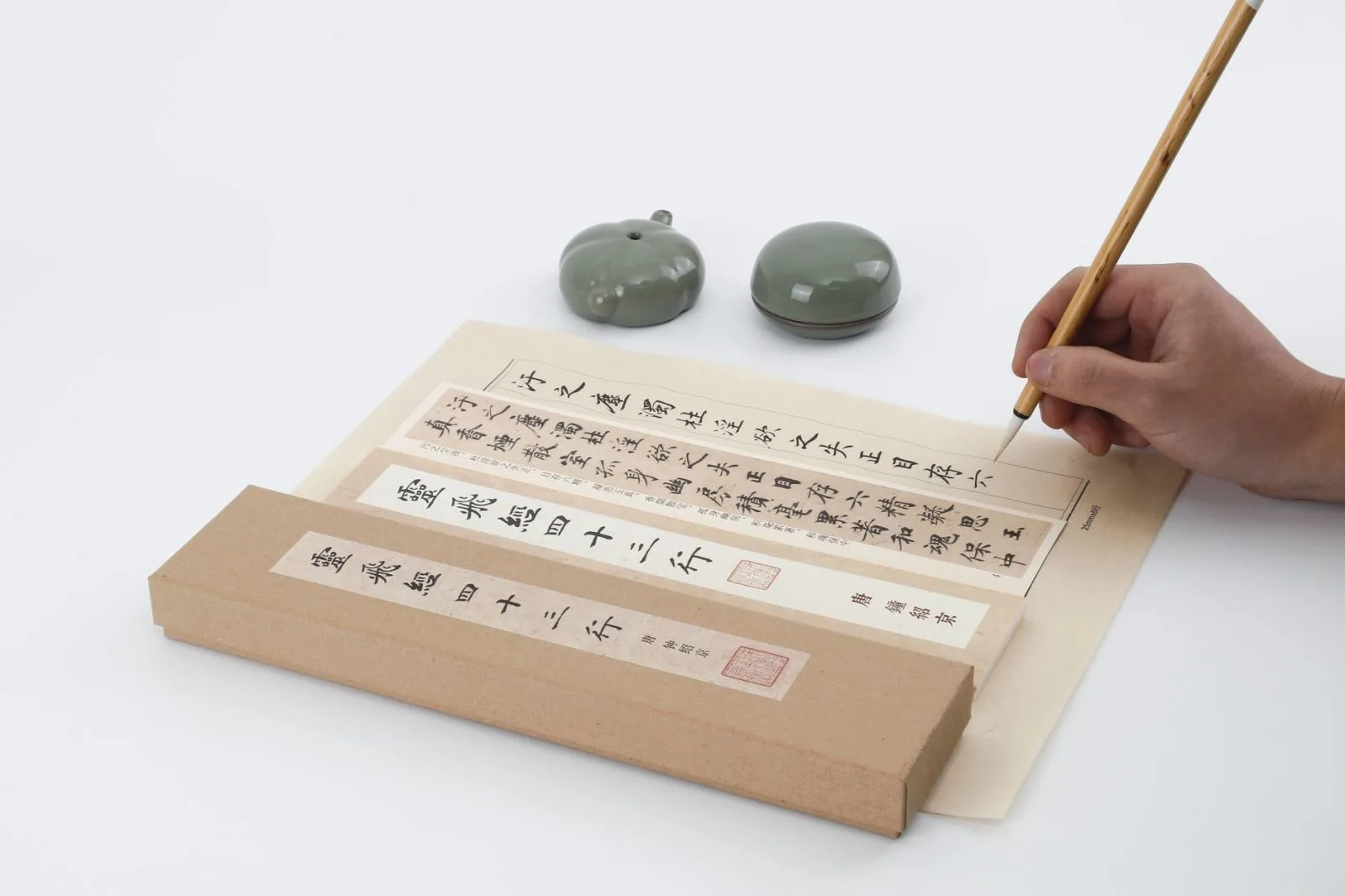
    The tools are known as the Four Treasures of the Study: brush, ink, paper, and inkstone. A brush of animal hair is held upright between thumb and fingers, and pressure makes the stroke swell and thin. Ink comes as a solid stick ground with water on a stone; the density of the mixture changes the character of the line. Paper is absorbent, so hesitation shows as a blot. Practice begins with the basic strokes, then with copying a model character hundreds of times until the hand remembers its proportions. Students still learn by tracing the regular script of Tang dynasty masters such as Yan Zhenqing and Ouyang Xun. The aim is not decorative flourish but control: a steady wrist, an even rhythm, and a line that holds its centre.

    Calligrapher’s brush, ink stick, paper, and inkstone laid on a desk
    Brush, ink, paper, and inkstone are the traditional Four Treasures of the Study. Feng Zou | Pexels License (https://www.pexels.com/license/)

    Scripts and Masters

    Chinese writing moved through several scripts, and calligraphers kept them all alive as styles. Seal script, with even, rounded lines, comes from the inscriptions on bronze and stone of the Zhou and Qin periods. Clerical script, formalised in the Han dynasty, flattened characters with a distinctive flared stroke. Regular script, settled by the Tang, is the model still taught in schools; each part of a character sits in a clear frame. Running script links strokes without losing legibility, while cursive script reduces them to rapid, connected gestures. Wang Xizhi’s Lantingji Xu, written in 353, is the famous example of running script; the original is lost, but copies carry its reputation. Later Song and Yuan artists, including Su Shi and Zhao Mengfu, made personal expression as important as correct form.

    Close view of flowing cursive calligraphy on a hanging scroll
    Cursive script compresses characters into gestures that reward slow reading. Feng Zou | Pexels License (https://www.pexels.com/license/)

    Stone Records in Xi’an

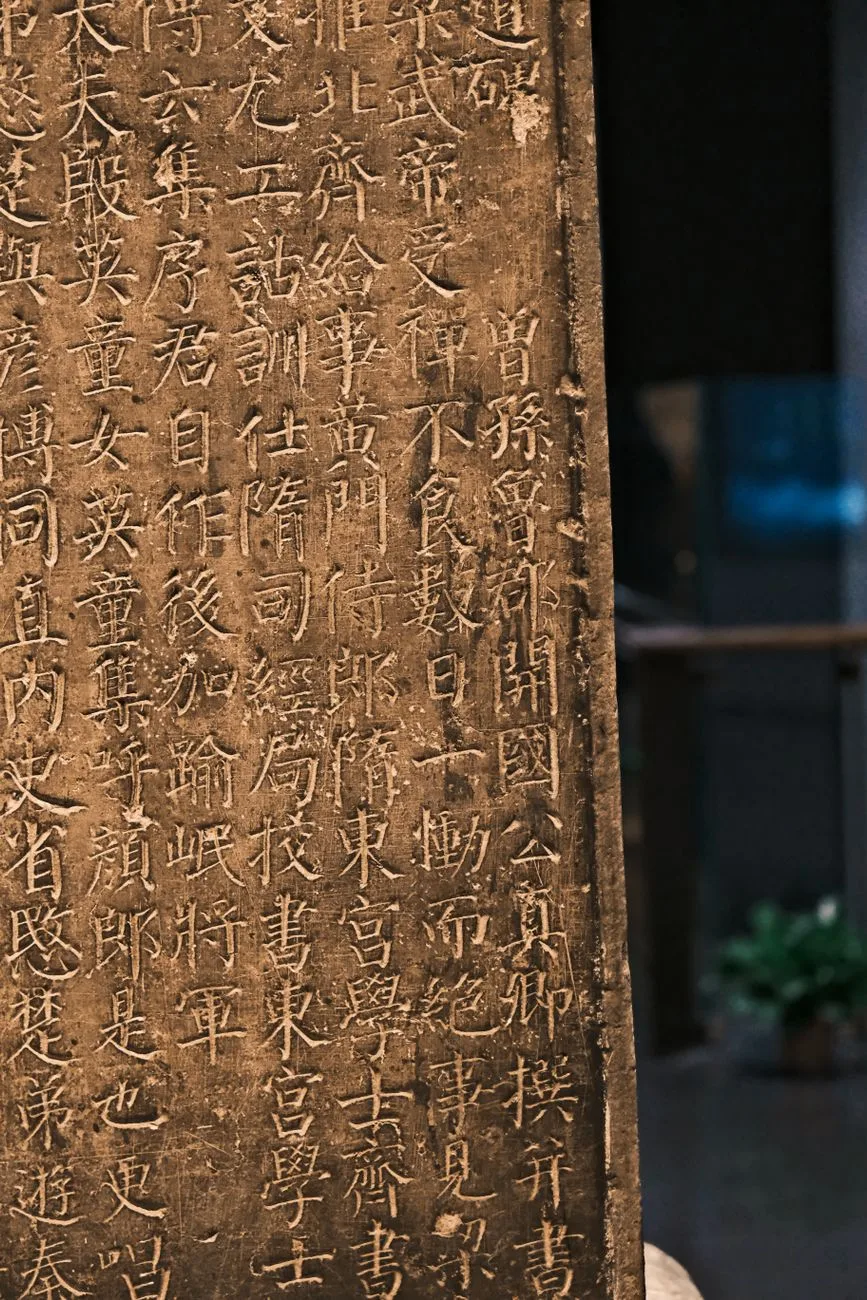
    Xi’an, the former Chang’an, preserves calligraphy on stone at the Beilin Museum, the Forest of Stone Steles. The collection began in 1087, when the Confucian classics were carved onto more than a hundred steles and installed beside the city’s Confucius Temple. Centuries of additions followed: tombstones, imperial edicts, Buddhist texts, and poems cut in several scripts. Rubbing a stele with damp paper and ink was the traditional way to study and circulate a model, and museums still demonstrate the technique. One slab records a Tang emperor’s visit to a Nestorian Christian church; another carries a Song dynasty city diagram. Walking the covered galleries, you can compare the same character written in seal, clerical, and regular forms across a thousand years.

    Rows of carved stone steles at the Beilin Museum in Xi’an
    The Beilin Museum holds thousands of steles, including Confucian classics cut into stone. Lily Lili | Pexels License (https://www.pexels.com/license/)

    Living Practice

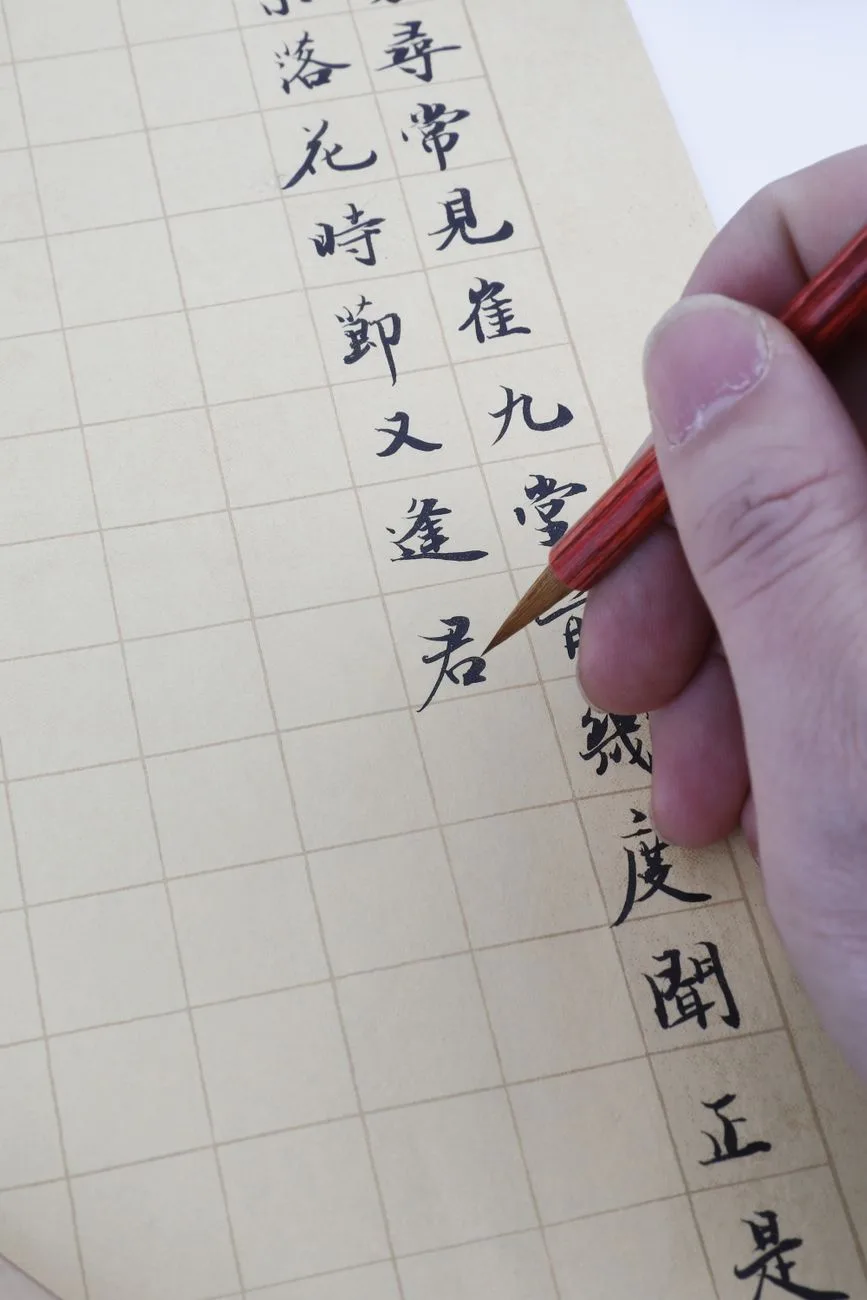
    Calligraphy remains a daily practice rather than a museum relic. Around Spring Festival, shops sell red paper couplets, and a single character for good fortune is pasted on doors, sometimes upside down to suggest that fortune has arrived. Temple names, shop signs, and station plaques are often lettered by accomplished hands. Schoolchildren practise copying characters in grid books, and older residents gather in parks to write with large water brushes on the pavement, where the characters dry in minutes. Workshops in Xi’an let visitors try a brush and learn how a stroke begins with a pause and ends with a lift. You need not read every character to see the differences: one script sits square and calm, the next leans and races.

    A stroke begins with a pause and ends with a lift; the paper keeps the record.

    Nguồn tham khảo & tài liệu đọc thêm

    1. Chinese calligraphy — Bách khoa toàn thư Britannica.
    2. Chinese Calligraphy — The Metropolitan Museum of Art.
    3. Beilin Museum, Xi’an — China Highlights.

    Hãy xem nó tại chỗ.

    Hãy theo dõi mục này đến khu vực mà nó thuộc về.

    Khám phá bằng bản đồ

    Hãy theo dõi chủ đề này.

    Xem các bài viết khác có cùng thẻ với bài viết này.

    Duyệt thẻ
  • Tử Cấm Thành

    Biên niên sử

    Tử Cấm Thành

    The Ming and Qing Imperial Palace

    A walled palace in Beijing that served as the seat of Ming and Qing imperial government.

    Phần
    Biên niên sử
    Vùng đất
    Bắc Kinh
    Kỷ nguyên
    yuan-ming-qing
    Thẻ
    History, Scenic Sites

    The Forbidden City was built as the ceremonial and administrative centre of the Ming and later Qing dynasties. Its courtyards and halls express rank in stone, timber, colour, and route: the emperor alone crossed the central axis to the throne hall.

    Building an Imperial Axis

    Construction began in 1406 under the Yongle Emperor, who had moved the capital from Nanjing to Beijing. The palace took roughly fourteen years to complete and opened in 1420. Its site lay south of the Yuan dynasty’s capital, Dadu, whose planner had already established a north-south axis. More than a million workers and artisans were mobilised, including convict labour and skilled craftsmen from across the empire. Timber came from southern forests, stone from quarries near Beijing, and glazed tiles from kilns in the capital’s outskirts. The name Zijin Cheng, or Purple Forbidden City, referred to the polarised Heavenly Emperor and the restrictions on entry.

    The Hall of Supreme Harmony rising above broad terraces on Beijing’s central axis
    The main throne hall stands on the palace’s central ceremonial axis. Lan Yao | Pexels License (https://www.pexels.com/license/)

    Front Court and Inner Quarters

    The palace is organised into an outer court for ceremony and an inner court for residence. The Hall of Supreme Harmony, the largest and highest hall, was used for enthronements, imperial weddings, and the winter solstice audience. Behind it stand the Hall of Central Harmony and the Hall of Preserving Harmony. The inner court includes the Palace of Heavenly Purity, the Hall of Earthly Tranquility, and the empress’s quarters. Officials approached through the Meridian Gate and crossed the Golden Water River on bridges that marked status. The design did more than impress: it separated ranks and turned movement through space into a visible grammar of power.

    A succession of red-walled courtyards and golden roofs viewed from a palace terrace
    Repeated courtyards made ceremonial progress part of the architecture. 虎 曼 | Pexels License (https://www.pexels.com/license/)

    Colour, Number, and Craft

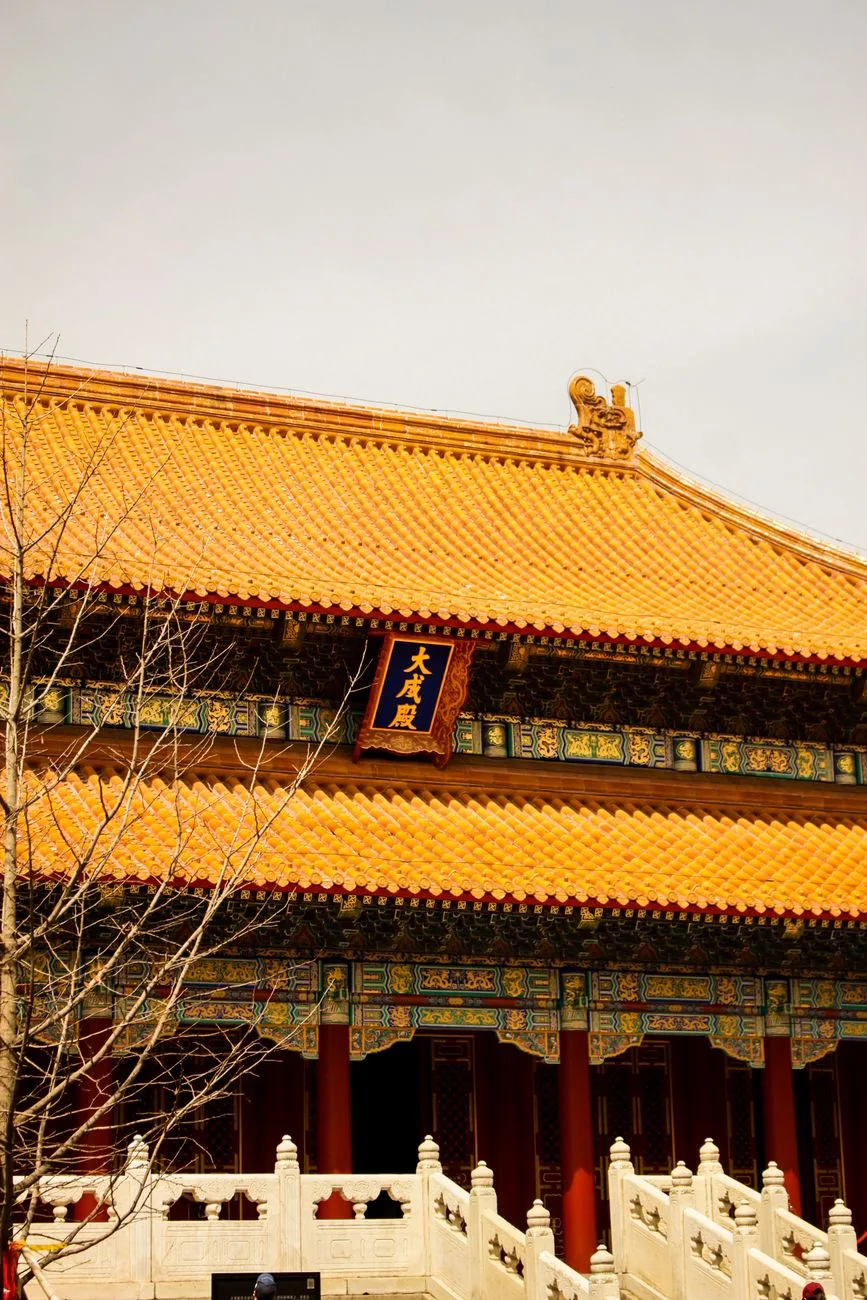
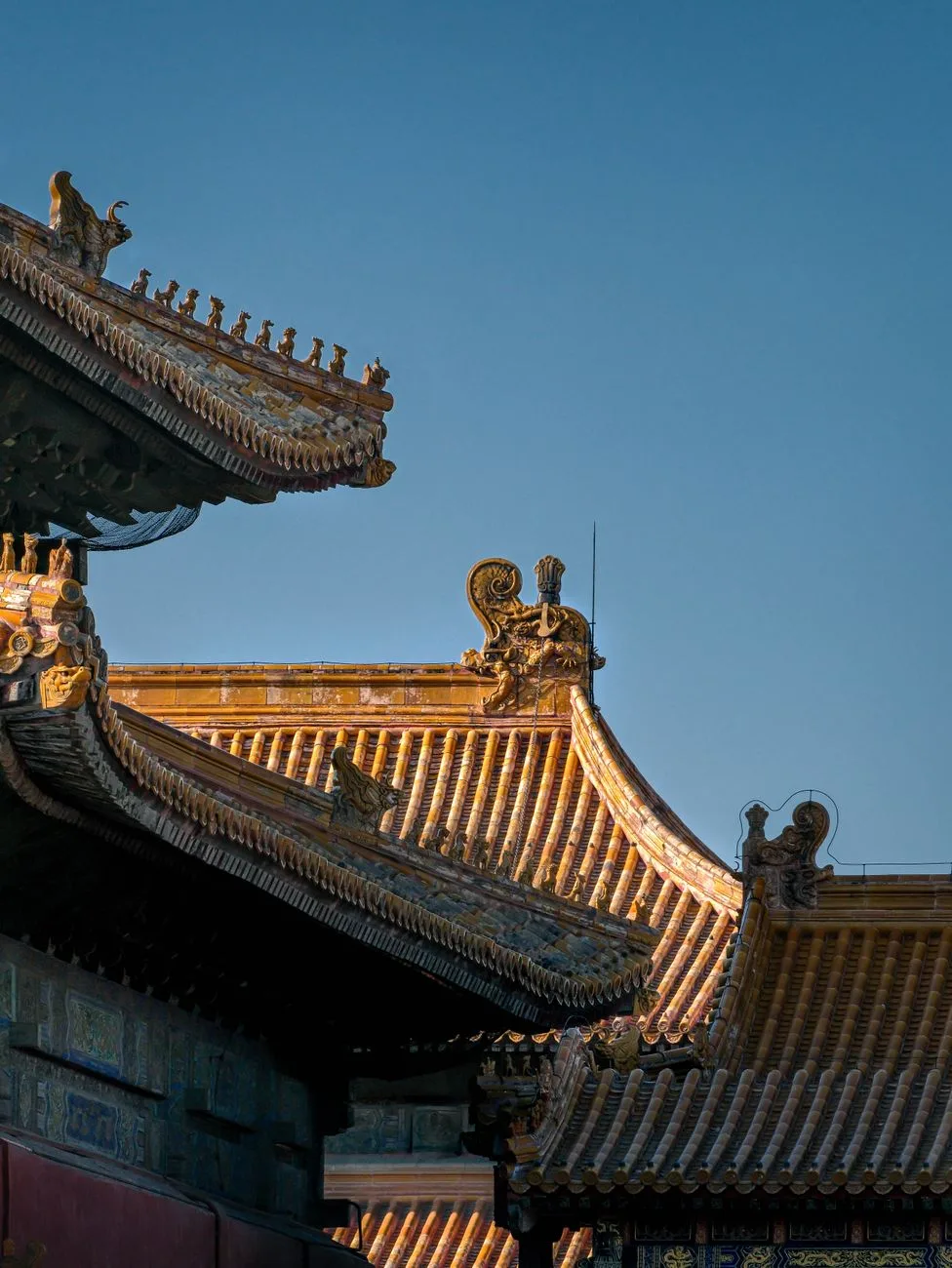
    The surviving buildings show Ming and Qing carpentry at large scale. Timber frames stand on stone plinths, with dougong bracket sets supporting deep eaves. Yellow glazed roof tiles were reserved for imperial buildings; vermilion walls, white marble terraces, and dark blue-green beams created a controlled palette. The Hall of Supreme Harmony carries ten roof figures, the highest rank, and its terrace holds bronze cranes and a tortoise. Numbers were symbolic: nine marked the emperor, and the palace is said to have 9,999 rooms, though the count depends on how spaces are defined. The Palace Museum, opened in 1925 after the last emperor left, now preserves the buildings and collections.

    • Begun in 1406 and occupied in 1420
    • Outer court for audiences, inner court for residence
    • Yellow roof tiles restricted to imperial use
    • Palace Museum opened to the public in 1925
    Golden roof tiles, bracket sets, and carved beams on a Qing palace hall
    Dougong brackets and yellow glazed tiles carried imperial rank. ravencrow BI | Pexels License (https://www.pexels.com/license/)

    Visiting the Palace Today

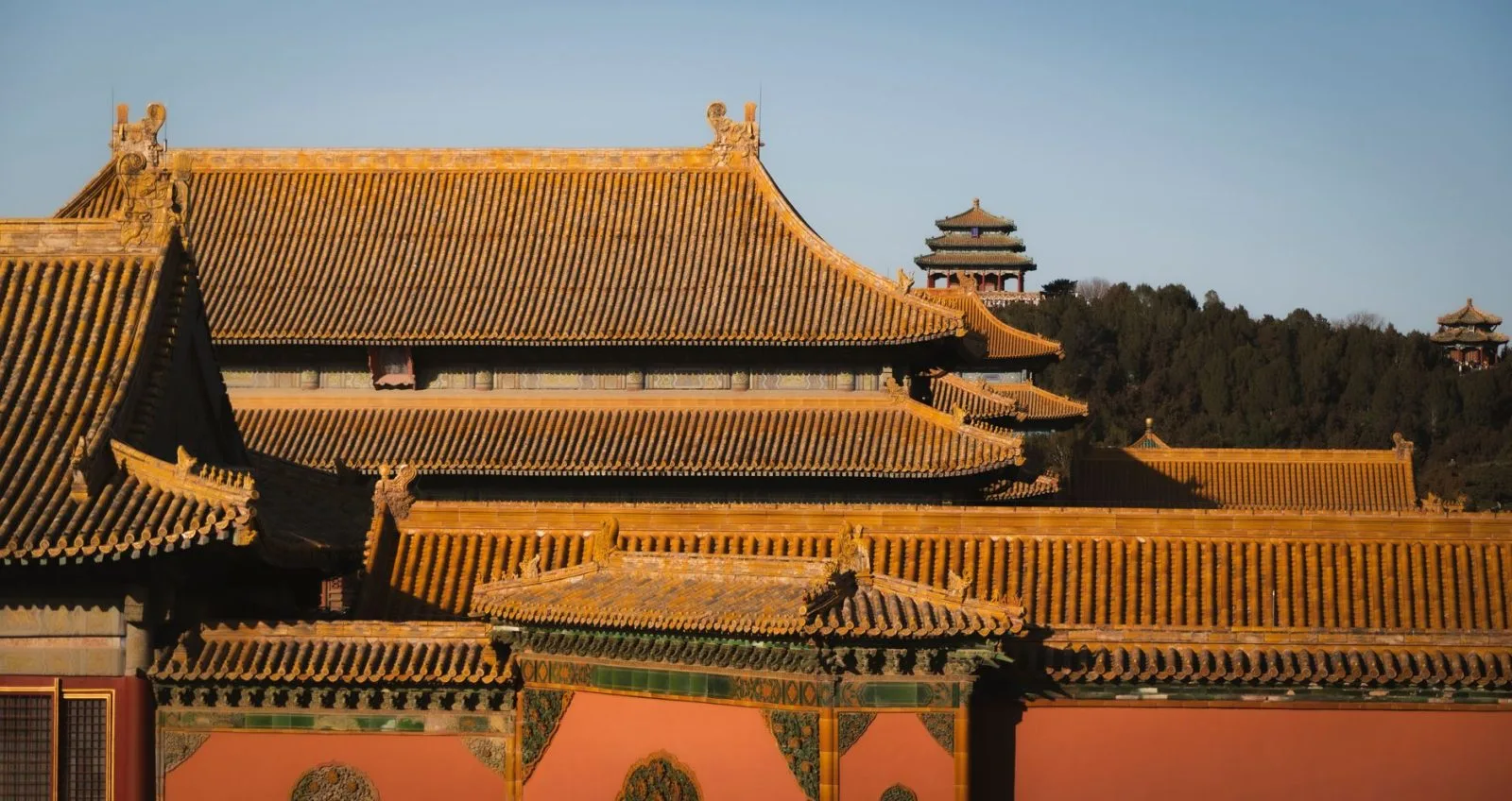
    The complex covers about 720,000 square metres and holds thousands of rooms, so a visit needs a route. Most visitors enter from the south at the Meridian Gate, pass the three great halls, then turn north to the inner court and the Garden of Cultivation. The Treasure Gallery and the Clock Gallery occupy separate wings and often require extra tickets. Ticket sales normally close in the afternoon and the palace is closed on Mondays except during peak holidays, so checking current rules matters. Tiananmen Square security adds time. The best views of the roofscape are from Jingshan Park to the north, which also marks the site where the Ming dynasty’s last emperor died in 1644.

    The palace made ceremony architectural: every gate, terrace, and roof colour told a visitor where power stood.

    Nguồn tham khảo & tài liệu đọc thêm

    1. Tử Cấm Thành — UNESCO World Heritage Centre.
    2. Tử Cấm Thành — Bách khoa toàn thư Britannica.
    3. The Palace Museum — The Palace Museum.

    Hãy xem nó tại chỗ.

    Hãy theo dõi mục này đến khu vực mà nó thuộc về.

    Khám phá bằng bản đồ

    Hãy theo dõi chủ đề này.

    Xem các bài viết khác có cùng thẻ với bài viết này.

    Duyệt thẻ
  • The Grand Canal

    Khám phá bản đồ

    The Grand Canal

    An Inland Waterway Across China

    The Grand Canal links northern and southern China through rivers, locks, and warehouse towns.

    Phần
    Khám phá bản đồ
    Vùng đất
    Chiết Giang
    Kỷ nguyên
    Xuyên suốt các thời đại
    Thẻ
    Geography, History, Transport

    The Grand Canal is a system of artificial channels and connected rivers, not one continuous trench. For centuries it moved grain, salt, silk, and imperial correspondence between the Yellow River and the Yangtze delta.

    From Warrior States to Imperial Route

    Canal building began before unification. The state of Wu dug the Han Gou channel in the fifth century BCE to move troops and grain between the Yangtze and the Huai. The Qin and Han maintained regional waterways, but the Sui dynasty (581–618) created the first broadly connected system. Emperor Yang ordered hundreds of thousands of labourers to dig the Tongji Canal, linking Luoyang toward the Yangtze, and the Yongji Canal toward the north. The cost contributed to Sui collapse, yet the route remained useful. The Yuan dynasty (1271–1368) redirected the canal around the Yellow River toward Beijing, and Ming and Qing engineers rebuilt sections with locks and stone banks.

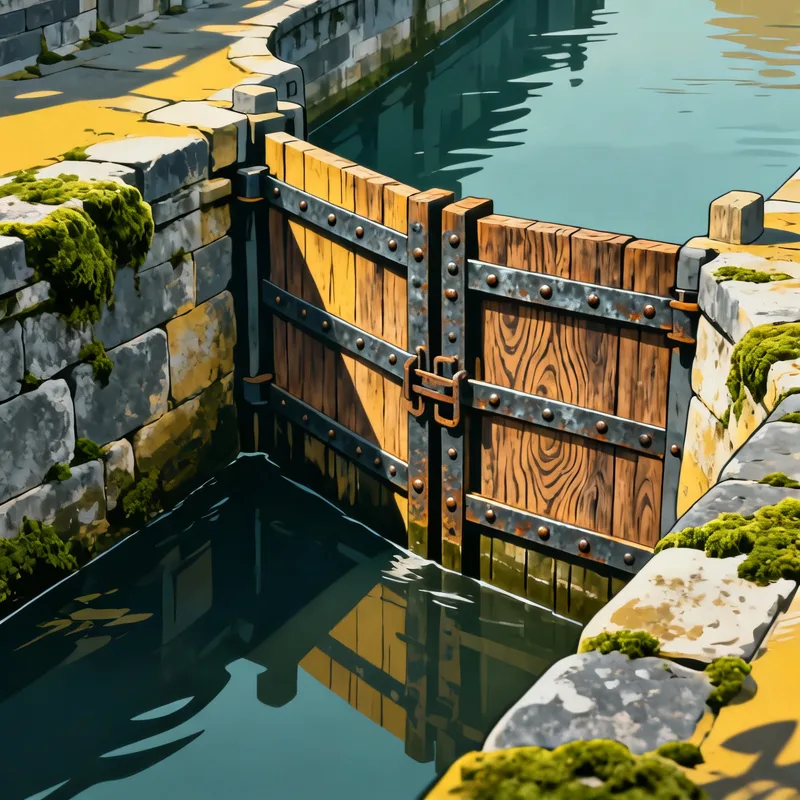
    An ancient canal lock with stone banks and a narrow timber water gate
    Locks allowed boats to cross differences in water level between river basins. Hình minh họa do AI tạo ra · SinoViz

    Grain Boats and Market Towns

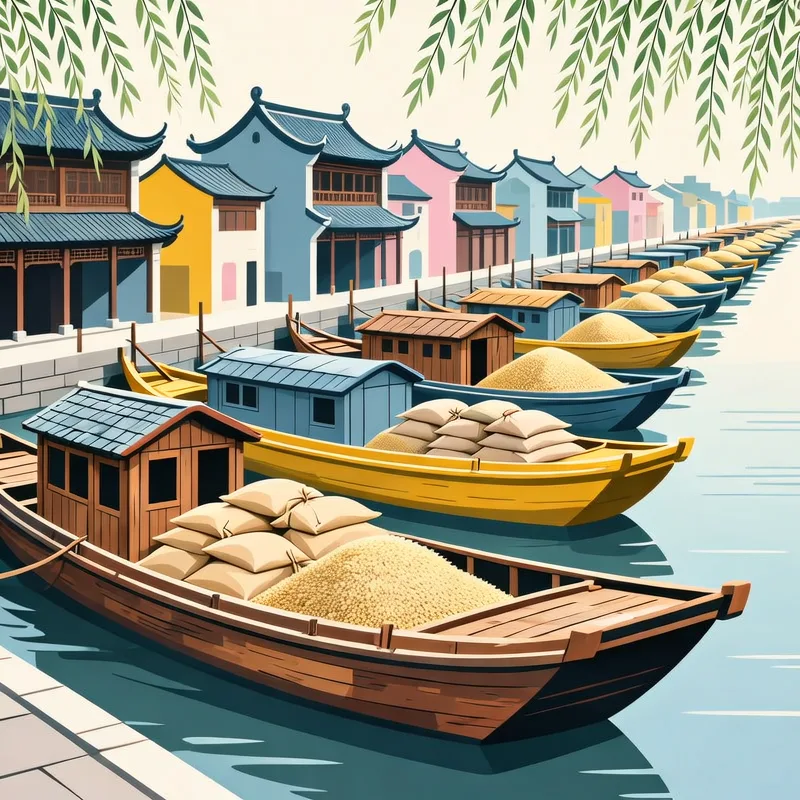
    The canal’s central purpose was transport. Under the Ming and Qing, tribute grain from the lower Yangtze moved north in huge flotillas of flat-bottomed boats, with relay crews and storage depots at key cities. The annual shipment fed the capital and the northern garrisons. Canal towns grew around wharves, granaries, guild halls, and money lenders: Linqing, Jining, Huai’an, and Yangzhou became exchange points as much as transit stops. Salt from the Huai coast, silk from Suzhou and Hangzhou, porcelain from Jingdezhen, and coal from northern mines moved along the same water. A journey that took weeks by road could be made with far greater bulk by boat.

    A long line of flat-bottomed grain boats moored along a canal wharf
    Grain flotillas tied the Yangtze delta to the political capital. Hình minh họa do AI tạo ra · SinoViz

    Southern Sections and Historic Cities

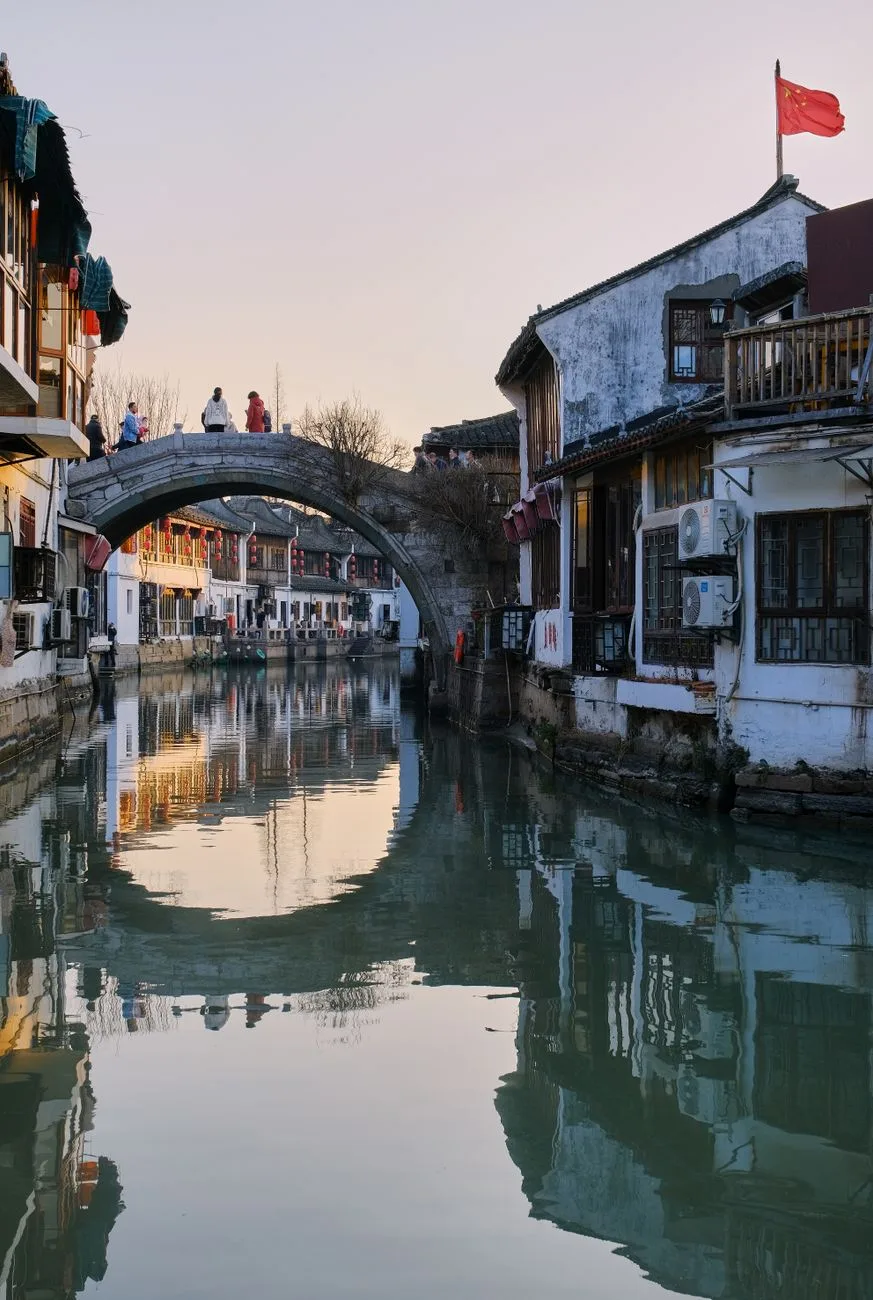
    The southern canal runs through the lowlands of Zhejiang and Jiangsu, where bridges, warehouses, and waterside houses still mark older commercial geography. Hangzhou is the southern terminus of the Sui-era system and a gateway to the Qiantang River. Suzhou’s canals were both transport routes and parts of the city’s garden landscape; its humpbacked stone bridges allowed boats to pass while pedestrians crossed. Wuxi and Zhenjiang sit at important junctions, while the Jiangnan section near the Yangtze has been widened and industrialised. UNESCO inscribed the Grand Canal on the World Heritage List in 2014, identifying thirty-one sections and twenty-seven components. The listed property includes canals, locks, bridges, and administrative sites.

    • Sui channels linked Luoyang with the Yangtze
    • Yuan engineers redirected the route toward Beijing
    • Tribute grain moved north in large boat flotillas
    • UNESCO listed thirty-one canal sections in 2014
    Stone arch bridges and old waterside houses along a canal in southern China
    In Jiangnan, canal transport and city life developed together. Vind 🌙 | Pexels License (https://www.pexels.com/license/)

    Reading the Canal Today

    Much of the northern canal is no longer navigable end to end; railways and roads took over long-distance freight, and parts were buried or rerouted during the twentieth century. Southern sections remain busy with barges, and several cities operate passenger boats for residents and visitors. A useful route for a first visit is Hangzhou or Suzhou, where canal life is visible beside gardens and markets. Water levels, engineering works, and modern flood control change the scene, so boats and landing stages may shift. The canal’s historical importance lies not in scenic continuity alone but in the way it joined climates, crops, taxes, and cities over more than a thousand years.

    The Grand Canal was less a single road of water than a machine for moving grain, tax, and news.

    Nguồn tham khảo & tài liệu đọc thêm

    1. The Grand Canal — UNESCO World Heritage Centre.
    2. Kênh đào lớn — Bách khoa toàn thư Britannica.
    3. Grand Canal of China — World History Encyclopedia.
    Hãy xem nó tại chỗ.

    Hãy theo dõi mục này đến khu vực mà nó thuộc về.

    Khám phá bằng bản đồ

    Hãy theo dõi chủ đề này.

    Xem các bài viết khác có cùng thẻ với bài viết này.

    Duyệt thẻ
  • Thơ Đường

    Biên niên sử

    Thơ Đường

    The Golden Age of Chinese Verse

    Tang poets turned courtly craft, frontier travel, and Buddhist thought into enduring short poems.

    Phần
    Biên niên sử
    Vùng đất
    Thiểm Tây
    Kỷ nguyên
    sui-tang
    Thẻ
    Customs, History

    The Tang dynasty (618–907) produced the most celebrated corpus of classical Chinese poetry. Poems travelled in manuscripts, anthologies, inscriptions, and performance, linking the capital Chang’an to frontier posts and monasteries.

    Chang’an and the Poet Official

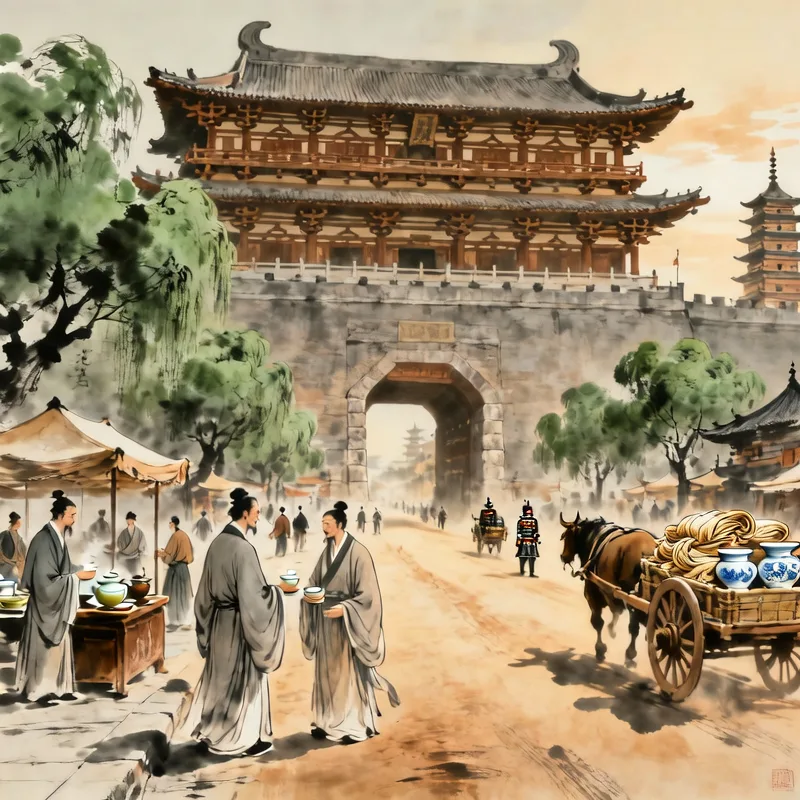
    Poetry in the Tang was tied to the examination system and official life. Candidates were tested on their ability to write regulated verse, and prose essays were accompanied by poems; success could bring appointments and the chance to circulate work among patrons. Chang’an, the capital near present-day Xi’an, held roughly a million people at its height, with markets, temples, and foreign communities. Poets served in distant posts, wrote farewell poems, and composed on public occasions. The Quan Tangshi, compiled in the early eighteenth century under imperial order, preserves more than forty-eight thousand poems by over two thousand authors. Its scale shows how thoroughly verse was woven into literati life.

    A Tang-era city gate and broad avenue in the former capital Chang’an
    Officials and poets moved through the capital’s markets, temples, and government offices. Hình minh họa do AI tạo ra · SinoViz

    Rule and Freedom in Regulated Verse

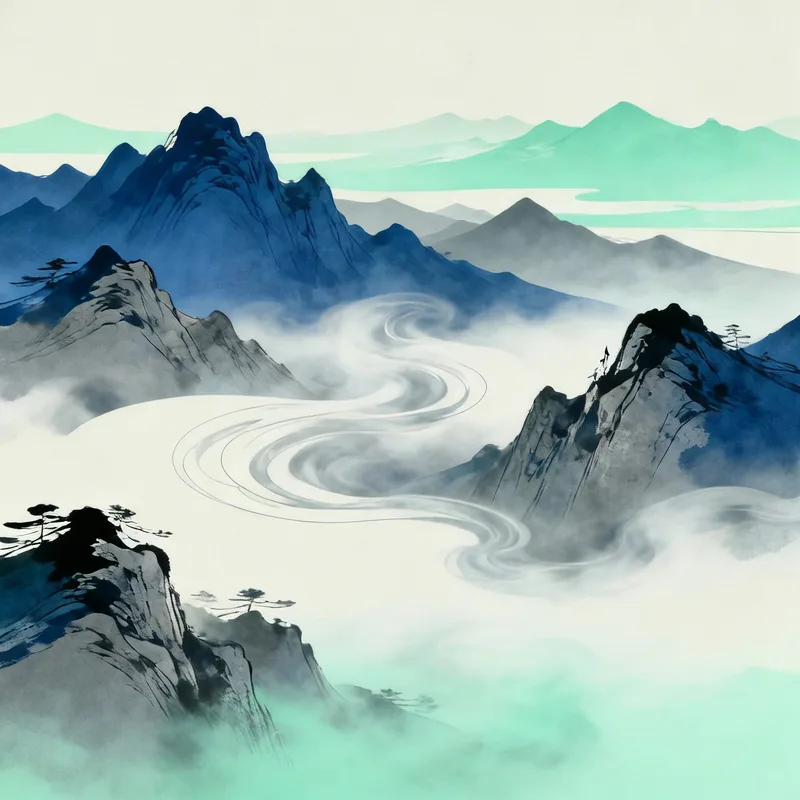
    Tang poets worked in several forms. Lüshi, or regulated verse, uses eight five- or seven-character lines, with strict tonal patterns and parallelism between the middle couplets. Jueju are four-line poems, apparently casual but often built on a sharp turn of thought. Older yuefu ballad forms and fu prose-poems remained in use. Du Fu (712–770) mastered regulated verse and brought social observation into it, writing of corruption, war, and hunger as well as landscape. Li Bai (701–762) is known for a freer, more expansive voice, though his best poems are also carefully made. Wang Wei (701–759) wrote compact landscape poems shaped by Chan Buddhism.

    An open landscape of mountains and mist resembling the settings of Tang landscape verse
    Landscape poetry often uses a small scene to suggest a larger state of mind. Hình minh họa do AI tạo ra · SinoViz

    Frontier, Exile, and the South

    The decades after the An Lushan Rebellion of 755–763 changed the poetic map. Du Fu fled through war-torn northern China and later lived in Chengdu, where thatched hut poems mix domestic detail with political grief. Officials exiled south wrote about rivers, heat, and unfamiliar languages. The frontier inspired poems about marching armies, desert wind, and a soldier’s household, as in the work of Cen Shen and Gao Shi. Li Bai’s travels took him from Sichuan to the Yangtze and north; legends of his death by drowning in a southern river are repeated but uncertain. These movements widened the subjects of classical poetry and carried Tang styles into regional literary circles.

    • Du Fu’s verse on war, poverty, and ordinary life
    • Li Bai’s expansive journeys and drinking songs
    • Wang Wei’s Chan-influenced landscapes
    • Frontier poems of Gao Shi and Cen Shen
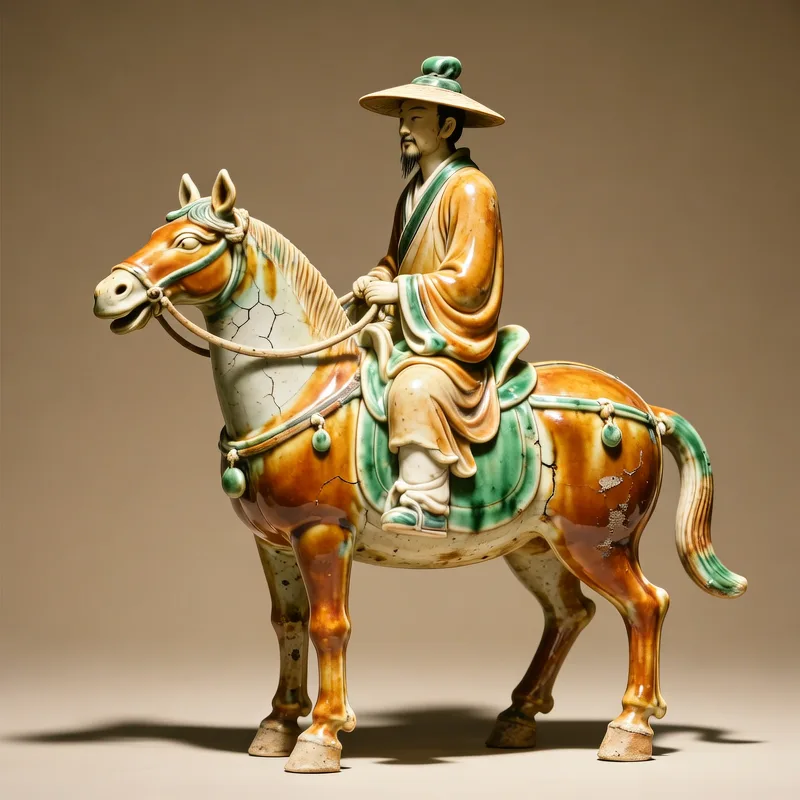
    A Tang dynasty ceramic figure of a mounted traveller on a long journey
    Travel, exile, and military service gave Tang poetry many of its subjects. Hình minh họa do AI tạo ra · SinoViz

    Afterlife of the Tang Poem

    Tang poetry became a shared cultural memory. Schoolchildren memorised lines, calligraphers copied poems, and Song writers argued with Tang models rather than abandoning them. The Tang canon was also shaped by anthologies: the Tangshi Sanbaishou, compiled in the eighteenth century by Sun Zhu, remains a standard introductory collection. In modern China, poems by Li Bai and Du Fu are recited on formal occasions and quoted in ordinary conversation. Translators render the regulated lines into other languages, though tone patterns and parallel couplets resist exact transfer. Visitors to Xi’an can connect the poems to Shaanxi’s museums, the Tang city walls, and the sites of Chang’an’s wards and markets.

    A Tang poem can hold an empire’s politics in eight lines, or a whole mountain in four.

    Nguồn tham khảo & tài liệu đọc thêm

    1. Tang dynasty — Bách khoa toàn thư Britannica.
    2. Chinese literature — Bách khoa toàn thư Britannica.
    3. Thơ Đường — The Metropolitan Museum of Art.

    Hãy xem nó tại chỗ.

    Hãy theo dõi mục này đến khu vực mà nó thuộc về.

    Khám phá bằng bản đồ

    Hãy theo dõi chủ đề này.

    Xem các bài viết khác có cùng thẻ với bài viết này.

    Duyệt thẻ
  • Đội quân đất nung

    Biên niên sử

    Đội quân đất nung

    An Emperor’s Buried Legions

    Thousands of clay soldiers were buried near Qin Shi Huang’s mausoleum to guard the emperor after death.

    Phần
    Biên niên sử
    Vùng đất
    Thiểm Tây
    Kỷ nguyên
    qin-han
    Thẻ
    Geography, History, Scenic Sites

    The Terracotta Army was made for the tomb of Qin Shi Huang, the first emperor of China, who died in 210 BCE. The figures were part of a larger necropolis near Xi’an, not an isolated pit of statues.

    The Tomb of the First Emperor

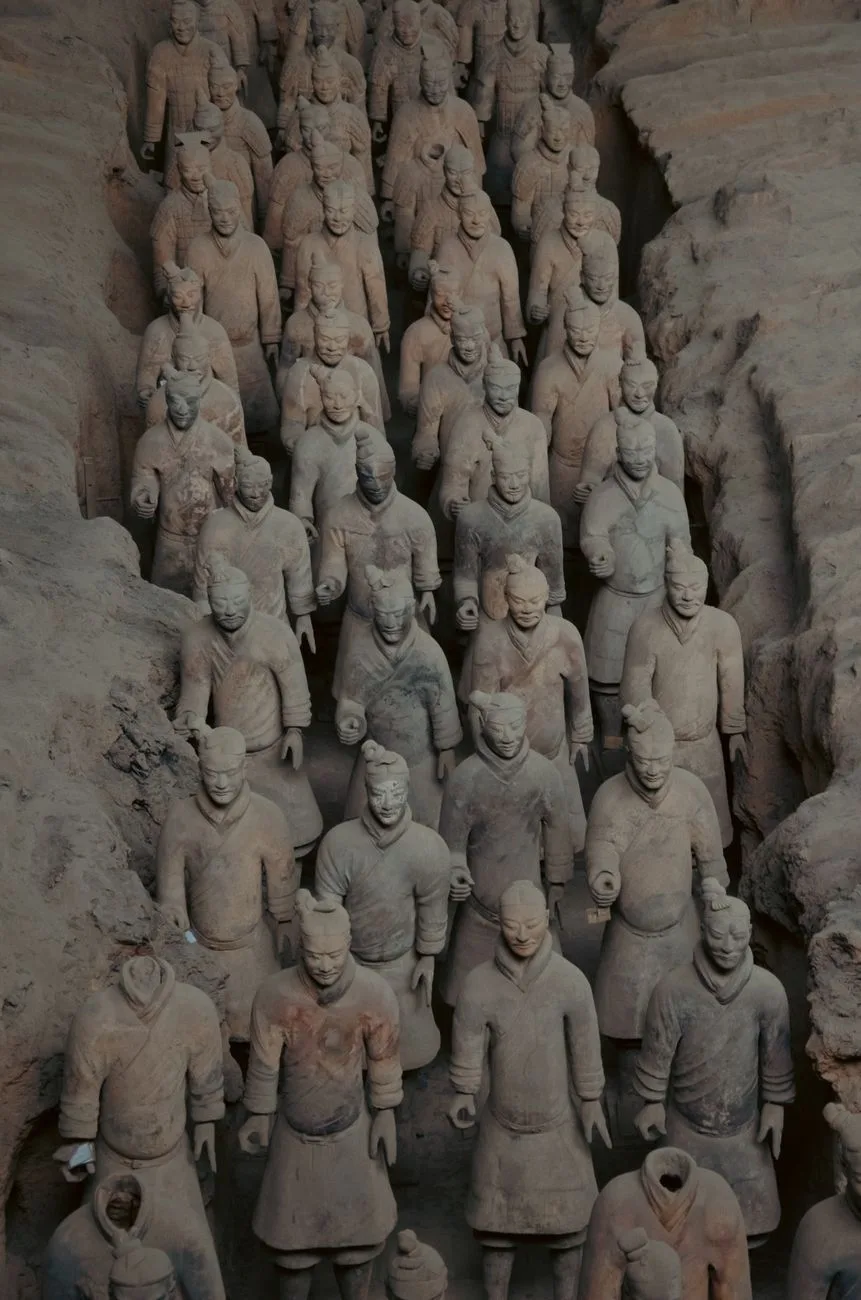
    Qin Shi Huang unified China in 221 BCE and began constructing his mausoleum near Mount Li soon after. The historian Sima Qian, writing about a century later, described a tomb filled with models of palaces, officials, and treasures, with mercury rivers and a roof painted as the heavens. Modern surveys have found a vast walled complex, a central burial mound, and more than six hundred associated pits. The main tomb chamber has not been excavated, partly because of technical and conservation concerns; readings of mercury vapour in the mound have been reported but debated. The army occupied side pits, where thousands of clay figures stood in formation to protect the emperor in the afterlife.

    A long burial pit containing rows of terracotta infantry figures in formation
    The figures stood in military formation in pits beside the imperial tomb. Jan Dvorak | Pexels License (https://www.pexels.com/license/)

    Discovery and Excavation

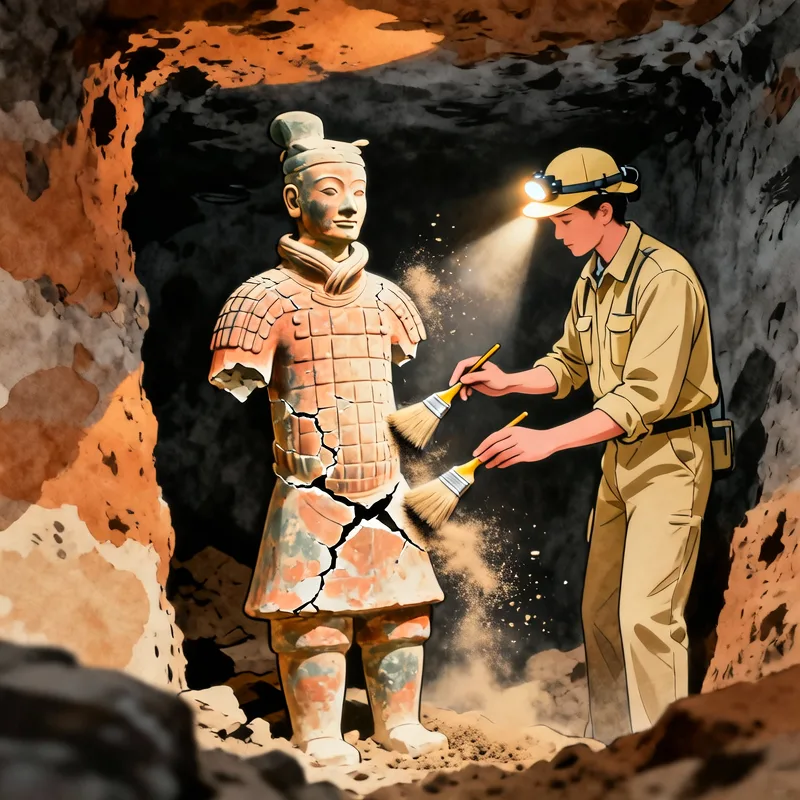
    Local farmers found fragments of clay figures in 1974 while digging a well near the village of Yangzhai. Archaeologists shortly uncovered Pit 1, a huge trench holding infantry and chariots, followed by Pits 2 and 3 with mixed troops, cavalry, and a command post. More than eight thousand figures have been counted, along with hundreds of horses and more than a hundred wooden chariots whose timber has decayed. The figures were once brightly painted with mineral pigments on a lacquer ground; exposure to air caused much of the paint to flake, and conservators now control humidity and treat surfaces quickly. Excavation continues in selected areas rather than across the entire necropolis.

    Archaeologists carefully brushing soil from a fragmented terracotta warrior in a burial pit
    Excavation is slow because paint and fragile organic material decay after exposure. Hình minh họa do AI tạo ra · SinoViz

    Mass Production and Individuality

    The warriors were made in workshops using moulded parts, coils of clay, and hand-finished details. Heads, bodies, arms, and legs were produced in a limited number of types, then assembled and altered so that faces, hair, moustaches, and armour differ. Sculptors pressed or carved expressions into the clay before firing in kilns near the site. Height varies with rank: generals are taller than ordinary infantry, and some figures bear armour while others wear lighter dress. Tools found at the site carry names, suggesting organised teams of potters and artisans under state control. The result is neither wholesale repetition nor pure portraiture, but a system that could produce scale with controlled variation.

    • Infantry, archers, cavalry, chariots, and officers
    • Moulded components finished by hand
    • Original mineral pigments on lacquer-ground paint
    • Workshop names recorded on excavated tools
    Close view of a terracotta warrior’s face, hairstyle, and layered armour
    Standard parts were individualised in faces, hair, and armour details. Ruben VP | Pexels License (https://www.pexels.com/license/)

    Visiting the Site

    The museum lies about forty kilometres east of central Xi’an near Lintong. Three main pits are open to visitors, with viewing platforms along the excavated trenches; a separate display shows bronze chariots and horses recovered near the tomb. A circuit of the pits and museum halls takes roughly two to three hours, and an official guide or audio commentary helps explain the different ranks and formations. The site is busiest in the middle of the day, so arriving early is useful. Xi’an can be reached by high-speed rail from Beijing or Shanghai, and local buses, taxis, and tours connect the city to Lintong. Photography is allowed in many areas, but flash and tripods may be restricted.

    The army was made by workshops, but its faces were finished by hands that refused exact repetition.

    Nguồn tham khảo & tài liệu đọc thêm

    1. Đội quân đất nung — UNESCO World Heritage Centre.
    2. Đội quân đất nung — Bách khoa toàn thư Britannica.
    3. The First Emperor’s Terracotta Army — The British Museum.

    Hãy xem nó tại chỗ.

    Hãy theo dõi mục này đến khu vực mà nó thuộc về.

    Khám phá bằng bản đồ

    Hãy theo dõi chủ đề này.

    Xem các bài viết khác có cùng thẻ với bài viết này.

    Duyệt thẻ
  • Modern China

    Era · 1912–present

    Modern China

    Revolution, reform and the contemporary era

    Modern China moved from imperial collapse through republic, war, revolution and reform. The period remade cities, transport, education and daily life while raising new questions about heritage and identity.

    Kỷ nguyên
    Modern China
    Years
    1912–present
    Path
    Biên niên sử

    Defining events

    • 1911 Revolution ends imperial rule
    • Republican era brings political change and cultural debate
    • The People’s Republic is founded in 1949
    • Reform and opening transform economy and cities after 1978
    • High-speed rail, digital life and heritage protection shape the present

    Figures & ideas

    • Sun Yat-sen — Revolutionary leader associated with the Republic
    • Lu Xun — Writer who challenged tradition and modernity
    • Contemporary engineers — Builders of rail, bridges and urban infrastructure

    Read the land

    Open the map to see where these events left traces.

    Khám phá bằng bản đồ
  • Sui & Tang

    Era · 581–907

    Sui Tang

    Canals, cosmopolitan cities and the great poetic age

    Sui reunified China after centuries of division and built the Grand Canal. Tang turned Chang’an into a cosmopolitan capital, expanded the exam system and produced a poetry tradition still memorised today.

    Kỷ nguyên
    Sui Tang
    Years
    581–907
    Path
    Biên niên sử

    Defining events

    • Sui reunification and construction of the Grand Canal
    • Tang Chang’an grows into a planned international capital
    • The imperial examination system expands
    • Silk Road exchange brings goods, music and faiths
    • Poetry, painting and Buddhist art reach classical heights

    Figures & ideas

    • Li Bai — Poet of imagination, travel and wine
    • Du Fu — Poet of history, war and moral witness
    • Wu Zetian — The only woman to rule as emperor in Chinese history

    Read the land

    Open the map to see where these events left traces.

    Khám phá bằng bản đồ
  • Song, Liao & Jin

    Era · 960–1279

    Song Liao Jin

    Commerce, printing and a contested northern frontier

    The Song era combined military pressure with extraordinary cultural and technical achievement. Printing, urban commerce, landscape painting and Neo-Confucian thought flourished alongside rival Liao and Jin states.

    Kỷ nguyên
    Song Liao Jin
    Years
    960–1279
    Path
    Biên niên sử

    Defining events

    • Song reunifies much of China after the Five Dynasties
    • Movable type and commercial printing expand literacy
    • Kaifeng and Hangzhou become dense urban centres
    • Neo-Confucian philosophy reshapes education and ethics
    • Maritime trade grows through southern ports

    Figures & ideas

    • Su Shi — Poet, essayist, painter and official
    • Shen Kuo — Polymath of science, engineering and observation
    • Zhu Xi — Neo-Confucian philosopher and commentator

    Read the land

    Open the map to see where these events left traces.

    Khám phá bằng bản đồ