Topic: Grand Canal

  • The Grand Canal

    Harita Keşfi

    The Grand Canal

    An Inland Waterway Across China

    The Grand Canal links northern and southern China through rivers, locks, and warehouse towns.

    Bölüm
    Harita Keşfi
    Bölge
    Zhejiang
    Dönem
    Çağlar boyunca
    Etiketler
    Geography, History, Transport

    The Grand Canal is a system of artificial channels and connected rivers, not one continuous trench. For centuries it moved grain, salt, silk, and imperial correspondence between the Yellow River and the Yangtze delta.

    From Warrior States to Imperial Route

    Canal building began before unification. The state of Wu dug the Han Gou channel in the fifth century BCE to move troops and grain between the Yangtze and the Huai. The Qin and Han maintained regional waterways, but the Sui dynasty (581–618) created the first broadly connected system. Emperor Yang ordered hundreds of thousands of labourers to dig the Tongji Canal, linking Luoyang toward the Yangtze, and the Yongji Canal toward the north. The cost contributed to Sui collapse, yet the route remained useful. The Yuan dynasty (1271–1368) redirected the canal around the Yellow River toward Beijing, and Ming and Qing engineers rebuilt sections with locks and stone banks.
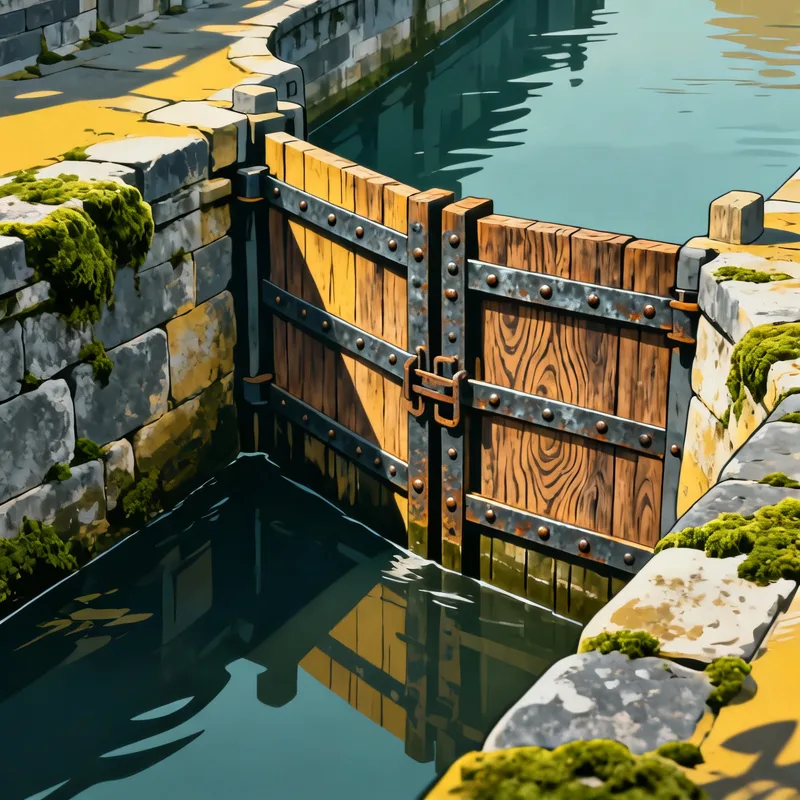
    An ancient canal lock with stone banks and a narrow timber water gate
    Locks allowed boats to cross differences in water level between river basins. Yapay zeka tarafından oluşturulmuş illüstrasyon · SinoViz

    Grain Boats and Market Towns

    The canal’s central purpose was transport. Under the Ming and Qing, tribute grain from the lower Yangtze moved north in huge flotillas of flat-bottomed boats, with relay crews and storage depots at key cities. The annual shipment fed the capital and the northern garrisons. Canal towns grew around wharves, granaries, guild halls, and money lenders: Linqing, Jining, Huai’an, and Yangzhou became exchange points as much as transit stops. Salt from the Huai coast, silk from Suzhou and Hangzhou, porcelain from Jingdezhen, and coal from northern mines moved along the same water. A journey that took weeks by road could be made with far greater bulk by boat.
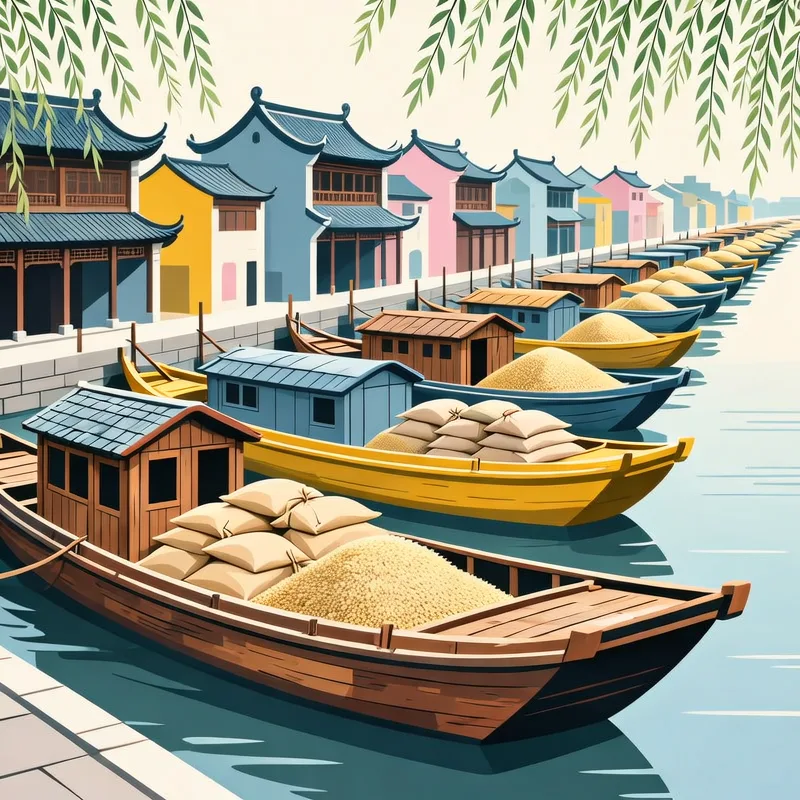
    A long line of flat-bottomed grain boats moored along a canal wharf
    Grain flotillas tied the Yangtze delta to the political capital. Yapay zeka tarafından oluşturulmuş illüstrasyon · SinoViz

    Southern Sections and Historic Cities

    The southern canal runs through the lowlands of Zhejiang and Jiangsu, where bridges, warehouses, and waterside houses still mark older commercial geography. Hangzhou is the southern terminus of the Sui-era system and a gateway to the Qiantang River. Suzhou’s canals were both transport routes and parts of the city’s garden landscape; its humpbacked stone bridges allowed boats to pass while pedestrians crossed. Wuxi and Zhenjiang sit at important junctions, while the Jiangnan section near the Yangtze has been widened and industrialised. UNESCO inscribed the Grand Canal on the World Heritage List in 2014, identifying thirty-one sections and twenty-seven components. The listed property includes canals, locks, bridges, and administrative sites.

    • Sui channels linked Luoyang with the Yangtze
    • Yuan engineers redirected the route toward Beijing
    • Tribute grain moved north in large boat flotillas
    • UNESCO listed thirty-one canal sections in 2014
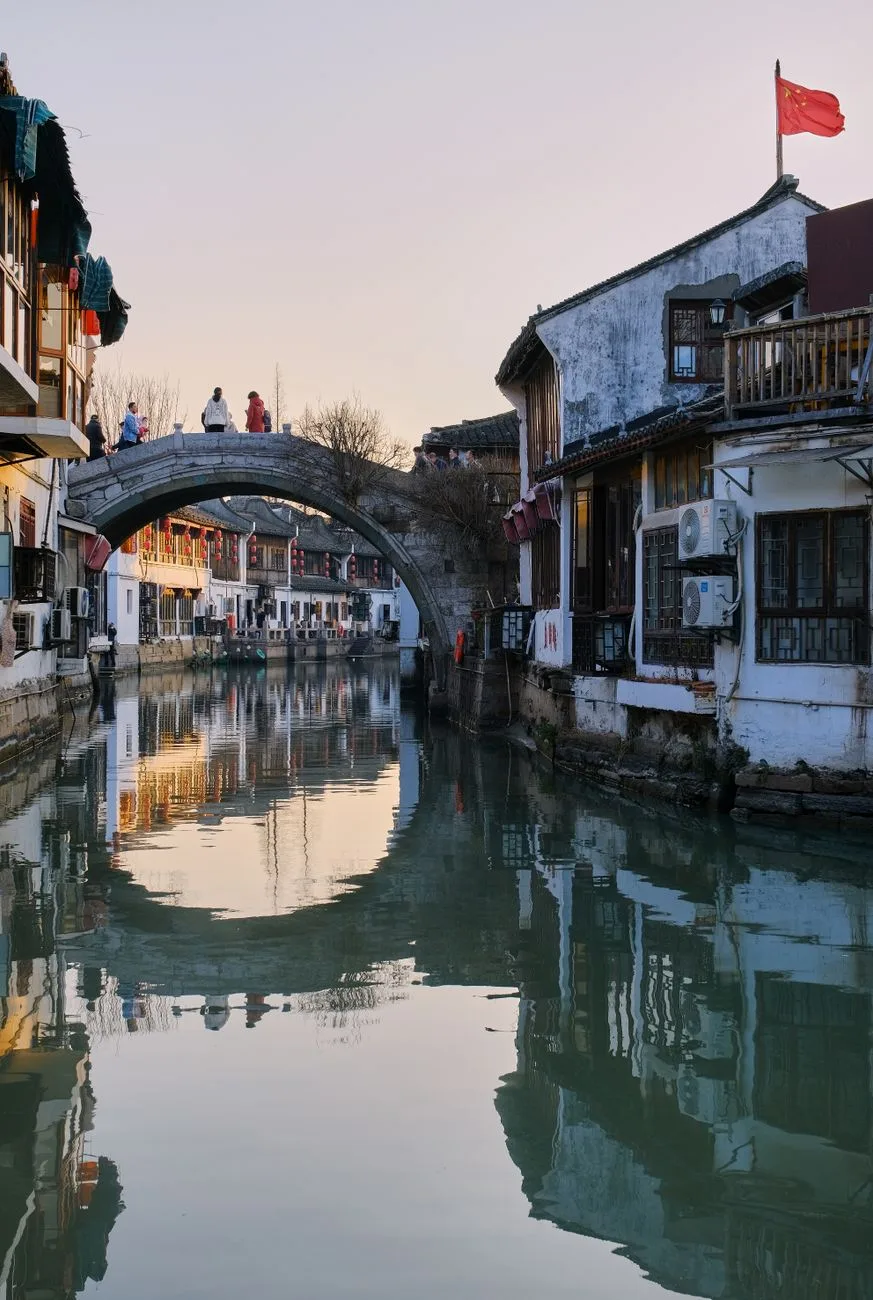
    Stone arch bridges and old waterside houses along a canal in southern China
    In Jiangnan, canal transport and city life developed together. Vind 🌙 | Pexels License (https://www.pexels.com/license/)

    Reading the Canal Today

    Much of the northern canal is no longer navigable end to end; railways and roads took over long-distance freight, and parts were buried or rerouted during the twentieth century. Southern sections remain busy with barges, and several cities operate passenger boats for residents and visitors. A useful route for a first visit is Hangzhou or Suzhou, where canal life is visible beside gardens and markets. Water levels, engineering works, and modern flood control change the scene, so boats and landing stages may shift. The canal’s historical importance lies not in scenic continuity alone but in the way it joined climates, crops, taxes, and cities over more than a thousand years.

    The Grand Canal was less a single road of water than a machine for moving grain, tax, and news.

    Kaynaklar ve daha fazla okuma

    1. The Grand Canal — UNESCO World Heritage Centre.
    2. Grand Canal — Britannica Ansiklopedisi.
    3. Grand Canal of China — World History Encyclopedia.

    Yerinde görün

    Bu kaydı ait olduğu bölgeye kadar takip edin.

    Harita üzerinden keşfedin

    Konuyu takip edin

    Aynı etiketleri paylaşan diğer içeriklere göz atın.

    Etiketlere göz atın
  • Sui & Tang

    Era · 581–907

    Sui Tang

    Canals, cosmopolitan cities and the great poetic age

    Sui reunified China after centuries of division and built the Grand Canal. Tang turned Chang’an into a cosmopolitan capital, expanded the exam system and produced a poetry tradition still memorised today.

    Dönem
    Sui Tang
    Years
    581–907
    Path
    Kronik

    Defining events

    • Sui reunification and construction of the Grand Canal
    • Tang Chang’an grows into a planned international capital
    • The imperial examination system expands
    • Silk Road exchange brings goods, music and faiths
    • Poetry, painting and Buddhist art reach classical heights

    Figures & ideas

    • Li Bai — Poet of imagination, travel and wine
    • Du Fu — Poet of history, war and moral witness
    • Wu Zetian — The only woman to rule as emperor in Chinese history

    Artifacts & sites

    Follow the era outward

    Read the objects, places and ideas that still carry this period.

    Read the land

    Open the map to see where these events left traces.

    Harita üzerinden keşfedin
  • Zhejiang

    Region · Tea hills, canals and coast

    Zhejiang

    Zhejiang links Jiangnan gardens, Buddhist islands and a working coastline. Its water towns and ports made it a centre of trade, scholarship and refined everyday culture.

    Bölge
    Zhejiang
    Koordinatlar
    30.27°N, 120.15°E
    Şunlarla tanınır:
    Tea hills, canals and coast

    Manzara

    The province combines coastal plains, river deltas and green hills. West Lake, the Grand Canal and the island of Putuoshan give Zhejiang a landscape shaped by both water and devotion.

    Miras ve yerler

    • West Lake
    • Grand Canal
    • Putuoshan
    • Liangzhu ruins

    Kültür ve günlük yaşam

    Zhejiang cuisine values freshness and seasonality. Longjing tea, silk, wood carving and literati gardens express a Jiangnan aesthetic that travelled far beyond the province.

    Bu bölgeden

    Sırada okunacak hikayeler

    Haritada, kayıtlarda ve günlük yaşamda bu yerle bağlantılı kayıtlar bulunmaktadır.

    Yolculuğa devam edin

    Bu bölgeyi bir gezi rehberiyle eşleştirin veya zaman içindeki öykülerini takip edin.

    Destinasyonları keşfedin Açık Kronik
  • Pekin

    Bölge · Kuzey başkenti

    Pekin

    Pekin, yedi yüzyıldan fazla bir süredir başkent, sınır kapısı ve tören alanı olmuştur. Sarayları, hutongları ve demiryolu hatları, imparatorluk düzeninin, Cumhuriyet döneminin değişimlerinin ve çağdaş yaşamın aynı şehirde nasıl var olduğunu göstermektedir.

    Bölge
    Pekin
    Koordinatlar
    39.90°K, 116.40°D
    Şunlarla tanınır:
    kuzey başkenti

    Manzara

    Şehir, Kuzey Çin Ovası'nın kuzeybatı ucunda, Yan Dağları'nın arkasında yer almaktadır. Eskiden nehirler ve kanallar saraya tahıl ve kereste sağlarken, bugün başkentin günlük ulaşımını çevre yolları ve yüksek hızlı trenler sağlamaktadır.

    Miras ve yerler

    • Yasak Şehir
    • Cennet Tapınağı
    • Yaz Sarayı
    • Mutianyu ve Badaling'deki Çin Seddi

    Kültür ve günlük yaşam

    Pekin mutfağı buğday, kızarmış ördek ve doyurucu kuzey lezzetlerini tercih eder. Hutong mahalleleri avlu yaşamını korurken, opera, hat sanatı ve tapınak festivalleri şehrin takviminin bir parçası olmaya devam etmektedir.

    Bu bölgeden

    Sırada okunacak hikayeler

    Haritada, kayıtlarda ve günlük yaşamda bu yerle bağlantılı kayıtlar bulunmaktadır.

    Yolculuğa devam edin

    Bu bölgeyi bir gezi rehberiyle eşleştirin veya zaman içindeki öykülerini takip edin.

    Destinasyonları keşfedin Açık Kronik