Kehidupan & Cerita Rakyat
Orang Tujia
Penenun gunung di timur Sichuan
Suku Tujia ialah orang yang berbahasa Tibeto-Burman di Pergunungan Wuling, yang terkenal dengan rumah panggung, tenunan broked dan tarian kolektif.
- Seksyen
- Kehidupan & Cerita Rakyat
- Wilayah
- Sichuan
- Era
- Merentasi zaman
- Tag
- Etnik, Adat Resam
Walaupun disenaraikan di sini di bawah wilayah Sichuan, kebanyakan komuniti Tujia terletak di sebelah timur Lembangan Sichuan di banjaran Wuling. Hubungan sejarah mereka dengan negeri Ba purba menghubungkan mereka dengan dunia budaya Bashu yang lebih luas di barat daya China.
Range and numbers
The 2010 census counted about 8.35 million Tujia, making them one of China’s largest ethnic minorities. Their main settlements stretch across the Wuling Mountains where Hunan, Hubei, Chongqing and Guizhou meet, in counties such as Yongshun and Longshan in Hunan, Shizhu and Pengshui in Chongqing, and Yanhe in Guizhou. Villages occupy stream valleys and limestone slopes, with terraced fields and forest on the higher ground. Their inclusion in the Sichuan region on this site reflects older Bashu connections and modern movement between the basin and its eastern mountains; the densest Tujia population is not in Sichuan province itself.

Language and identity
Tujia belongs to the Tibeto-Burman branch of the Sino-Tibetan family, with its closest affinities often discussed in relation to Naxi and other Qiangic languages. Today only a small number of people, mostly in a few western Hunan villages, speak it fluently; Southwestern Mandarin is the everyday language across most of the region. The name Tujia means native dwellers, and official recognition in the 1950s gave a common label to communities that had long interacted with Han, Miao, Dong and She neighbours. Oral histories preserve memories of the ancient Ba state, which controlled parts of the eastern Sichuan region until the Qin conquest of 316 BCE.
Stilt houses and brocade
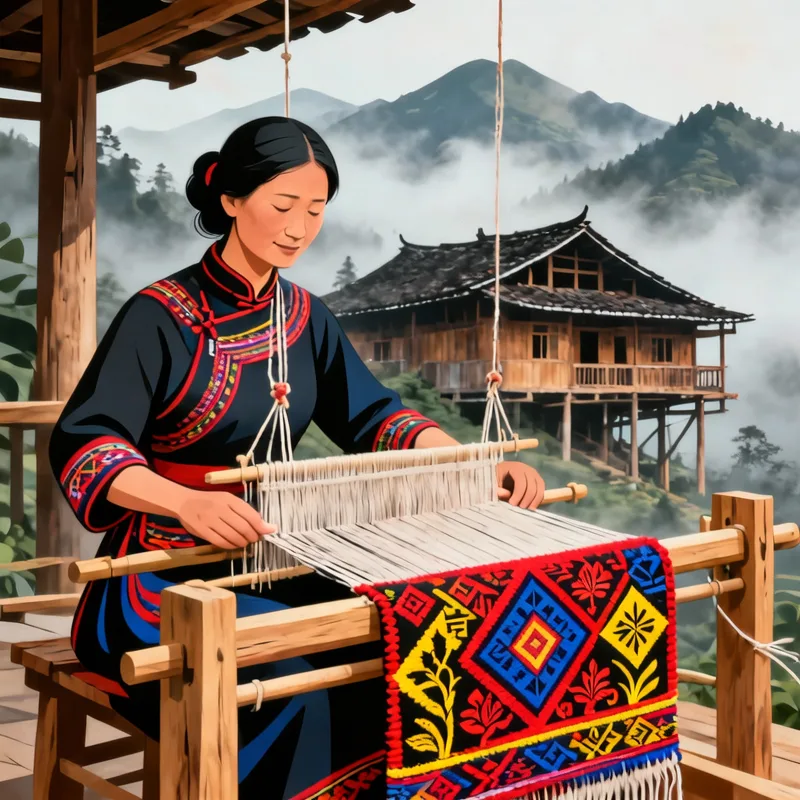
On steep ground, Tujia builders raise diaojiaolou, houses whose upper living floor projects over a lower storey on wooden posts. A covered veranda runs along the front, and the roof is pitched to carry off heavy rain. Interior screens and window frames are carved with floral and geometric patterns. The best-known textile is xilankapu, a colourful brocade woven on a backstrap loom with motifs of flowers, birds, characters from opera and the patterned ta tai hua design. It appears in clothing, bags and wall hangings and is protected as national intangible heritage. Meals often include cured pork, smoked fish, glutinous rice cakes and a tea soup whisked with fried rice and peanuts.
Waving dances and new year
The waving dance, bai shou wu, is performed by lines of dancers who swing their arms in time with drums and gongs. It takes place in a waving hall around the lunar new year and at the Sheba festival, where offerings are made to ancestors and village protectors. Some villages also perform Maogusi, a masked or straw-costumed dance that enacts hunting and farming scenes. Another distinctive custom is gan nian, celebrating the new year a day early, which oral tradition links to ancestors preparing for a military departure. These performances are now taught in schools and cultural centres, so a ritual once tied to a single village hall is seen by wider audiences.
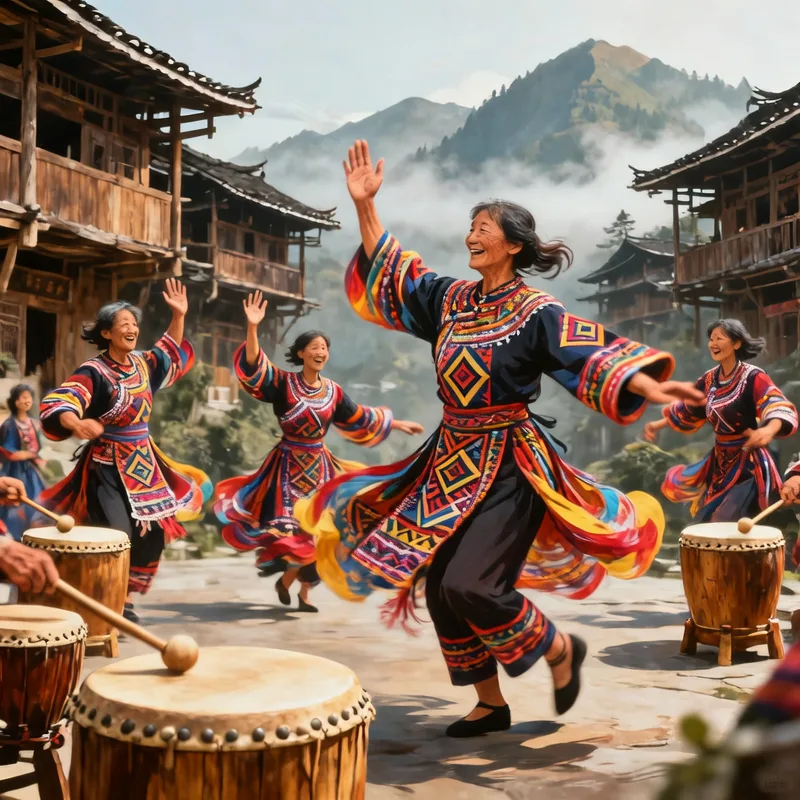
In Tujia villages, a woven pattern and a dance step both carry family memory.
Sumber & bacaan lanjut
- Tujia — Ensiklopedia Britannica.
- Tujia Ethnic Group — China.org.cn.
- China Intangible Cultural Heritage — China ICH Net.