Kronik
Çin Seddi
Frontier Walls Across Two Millennia
A chain of fortifications built by successive dynasties to control the steppe frontier.
- Bölüm
- Kronik
- Bölge
- Pekin
- Dönem
- qin-han
- Etiketler
- History, Geography, Scenic Sites
The Great Wall is not one wall but a series of defensive systems raised at different times by different states. Their surviving masonry, from northwest Beijing to the Gobi, records two thousand years of contest and exchange between farming settlements and the Inner Asian steppe.
Walls Before the First Emperor
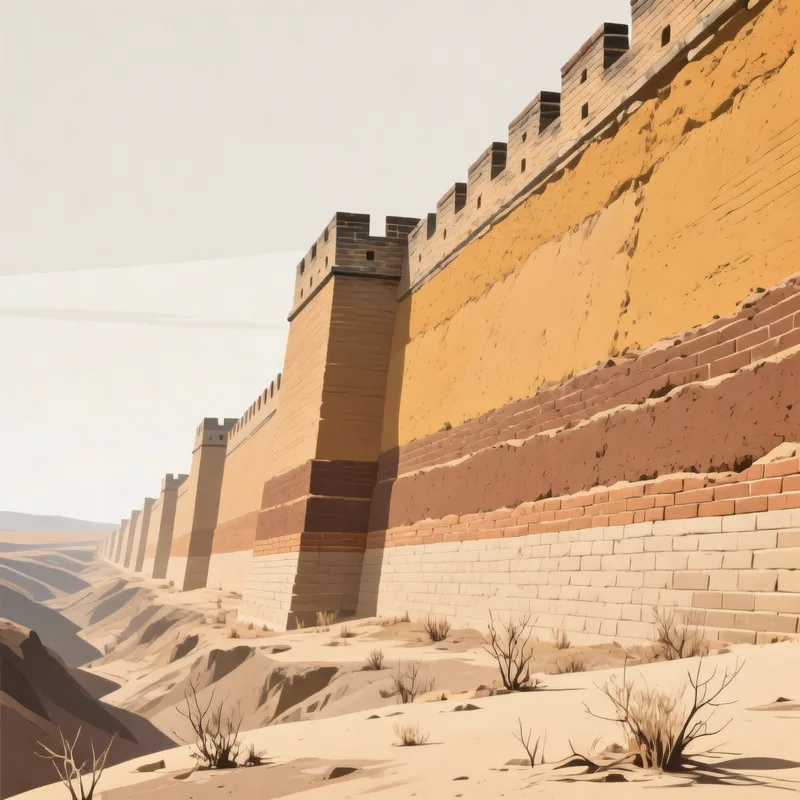
Wall building began long before the Qin dynasty. During the Warring States period (475–221 BCE), the states of Qin, Zhao, and Yan raised earthen ramparts along their northern and western frontiers to check Xiongnu raiders and to mark contested pasture. These were not isolated lines: they were linked to watchtowers, garrison posts, and river barriers that could slow cavalry and give farmers time to shelter. Some sections were built of tamped earth, layered and hammered into a dense wall that could stand for centuries in the dry northwest. The First Emperor later joined and extended this existing network rather than inventing the idea of a frontier wall from nothing.
The Qin Link, 221–206 BCE
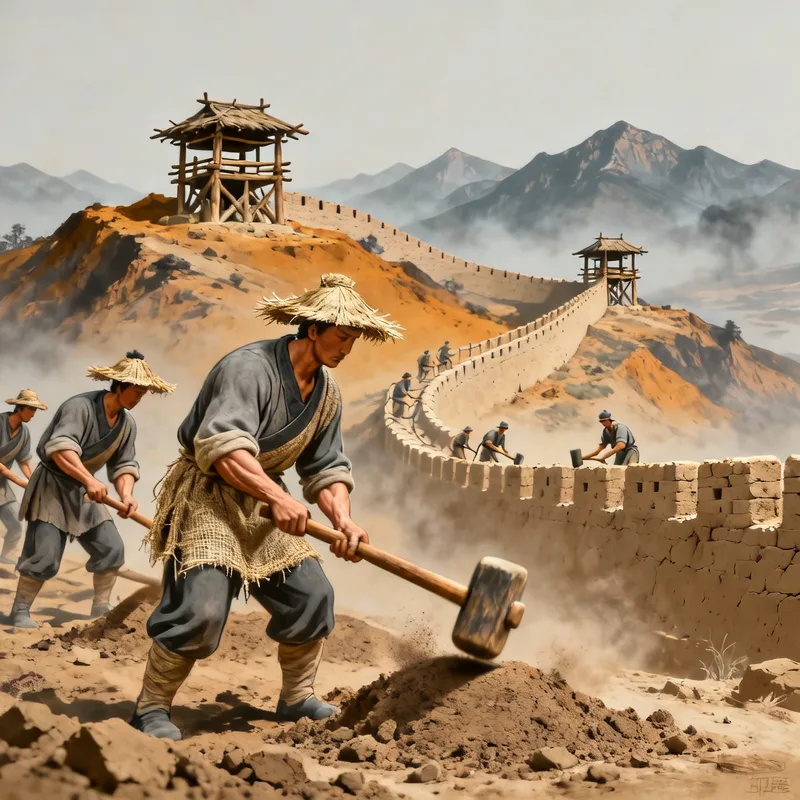
After unifying China in 221 BCE, Qin Shi Huang ordered the general Meng Tian to connect the northern walls into a single defensive front. Reports in the Shiji describe a force of hundreds of thousands of soldiers and convict labourers working from Lintao in present-day Gansu to Liaodong in the northeast, a distance later described as ten thousand li. The aim was strategic: to push the Xiongnu north of the Yellow River loop and to protect the new commanderies planted in conquered territory. The work was expensive and unpopular, and the Qin collapsed in 209–206 BCE, but the frontier idea outlived the dynasty.
The Ming Wall We See Today
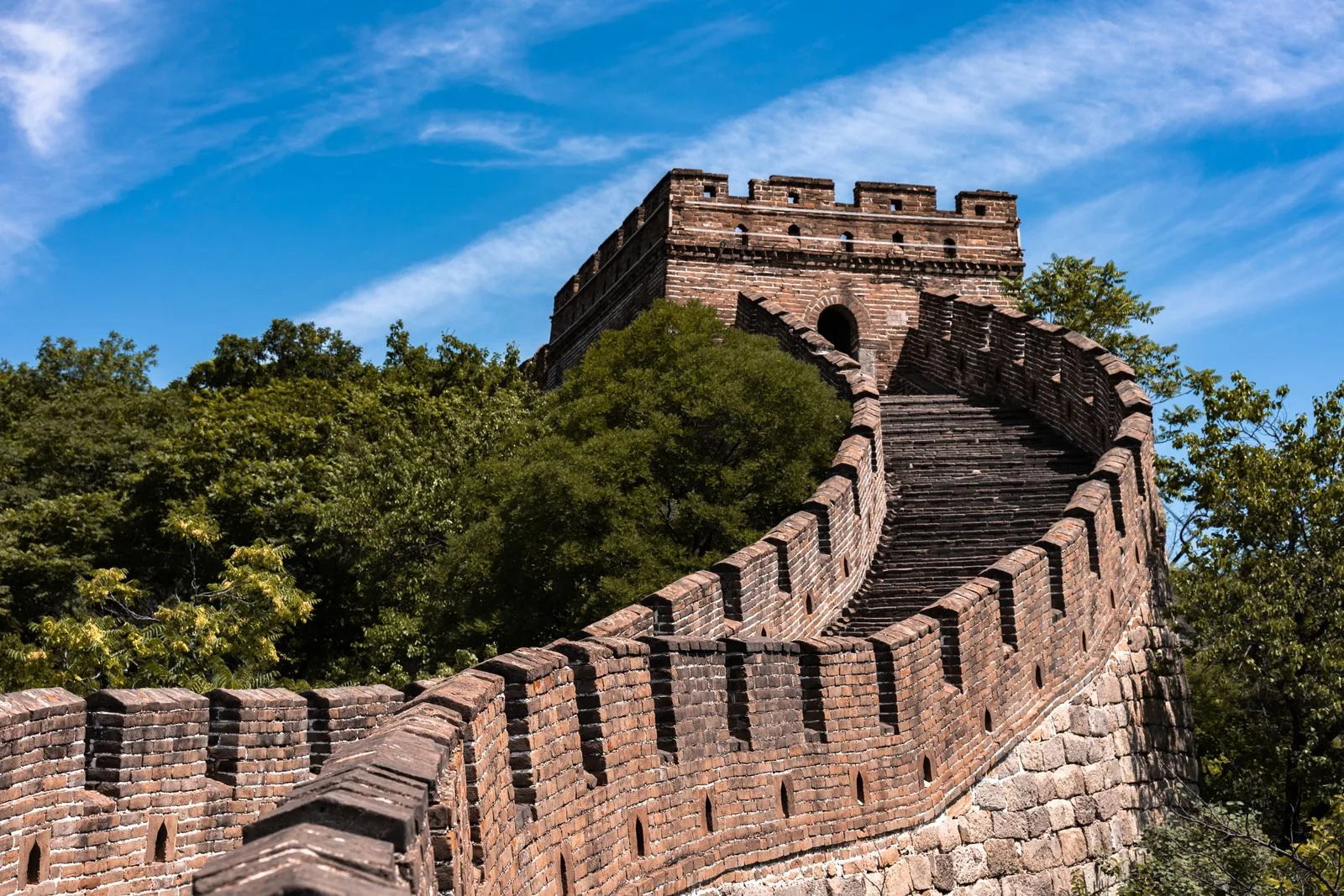
Most visible masonry belongs to the Ming dynasty (1368–1644), which rebuilt the wall after the Mongol Yuan retreated north. Beginning in the late fourteenth century, Ming engineers faced sections with brick and stone, added hollow watchtowers and beacon platforms, and anchored the line at Jiayuguan in Gansu and Liaodong in the northeast. The best-preserved stretches near Beijing, including Badaling, Mutianyu, and Jinshanling, date from this period. UNESCO inscribed the Great Wall on the World Heritage List in 1987, describing its full length at 8,851.8 kilometres. What visitors walk today is therefore a late imperial rebuilding of a much older frontier idea.
A System of Control and Contact
The wall worked as a system rather than a solid barrier. Beacon towers passed smoke and fire signals along the line, while garrison towns and passes regulated movement. Trade was not stopped: frontier markets exchanged grain, tea, and silk for horses and furs, and officials issued passes to authorised caravans. The ruined walls of the fourth-century Tuoba Wei and the earthworks of the Jin dynasty show that steppe peoples also built walls against one another. To read the Great Wall only as a dividing line is to miss its second function, which was to organise contact on terms the state could tax and police.
The wall was never a single line on a map; it was a frontier regime made of stone, signal fire, and paperwork.
Kaynaklar ve daha fazla okuma
- Çin Seddi — UNESCO World Heritage Centre.
- Great Wall of China — Britannica Ansiklopedisi.
- The Great Wall of China — World History Encyclopedia.