كرونيكل
طريق الحرير
Caravan Routes Across Inner Asia
Overland trade routes that tied Chang’an to the Mediterranean through Central Asian oases.
- قسم
- كرونيكل
- منطقة
- شينجيانغ
- عصر
- تشين هان
- الوسوم
- History, Geography
The Silk Road was a network of caravan paths, not a single highway. Its Chinese section ran from Chang’an through the Hexi Corridor into Xinjiang, where oasis towns supplied water, fodder, and translators to merchants crossing the Taklamakan Desert.
Zhang Qian Opens the Route
The route enters Chinese records through an embassy. In 138 BCE, Emperor Wu of Han sent Zhang Qian west to seek an alliance with the Yuezhi against the Xiongnu. Zhang was captured by the Xiongnu and held for about ten years, but he escaped, reached the Yuezhi in Bactria, and returned in 126 BCE with reports of cities, markets, and horses far to the west. Sima Qian preserved his account in the Shiji, written around 100 BCE. A second mission followed in 119 BCE. These reports gave the Han court both geographical knowledge and a strategic reason to secure the corridor.
Oasis Cities of the Tarim
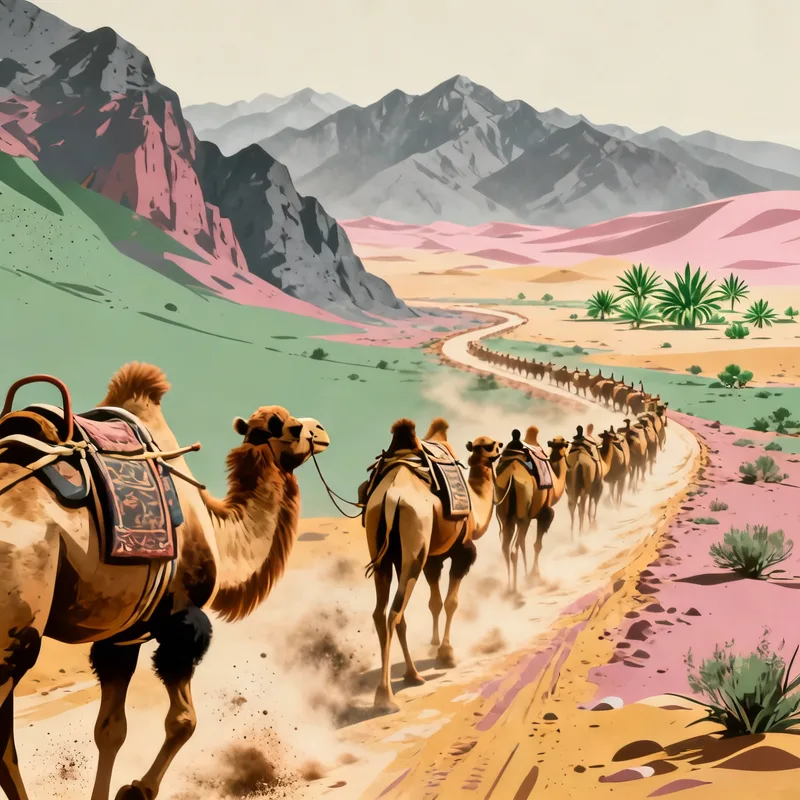
Travel across the Taklamakan followed its northern and southern rims, where mountain meltwater formed oases. Kashgar, Khotan, Yarkand, Kuqa, Karashahr, and Turpan grew into trading towns with irrigated fields, caravanserais, and multilingual populations. Sogdian merchants from Samarkand and Bukhara dominated much of the long-distance carrying trade between the fourth and eighth centuries, while local rulers taxed caravans and protected water points. Dunhuang, at the eastern edge of the desert, became the gateway where goods, envoys, and monks were recorded. The cave complex at Mogao, begun in 366 CE, preserves this mixture of languages and faiths.
What Actually Travelled
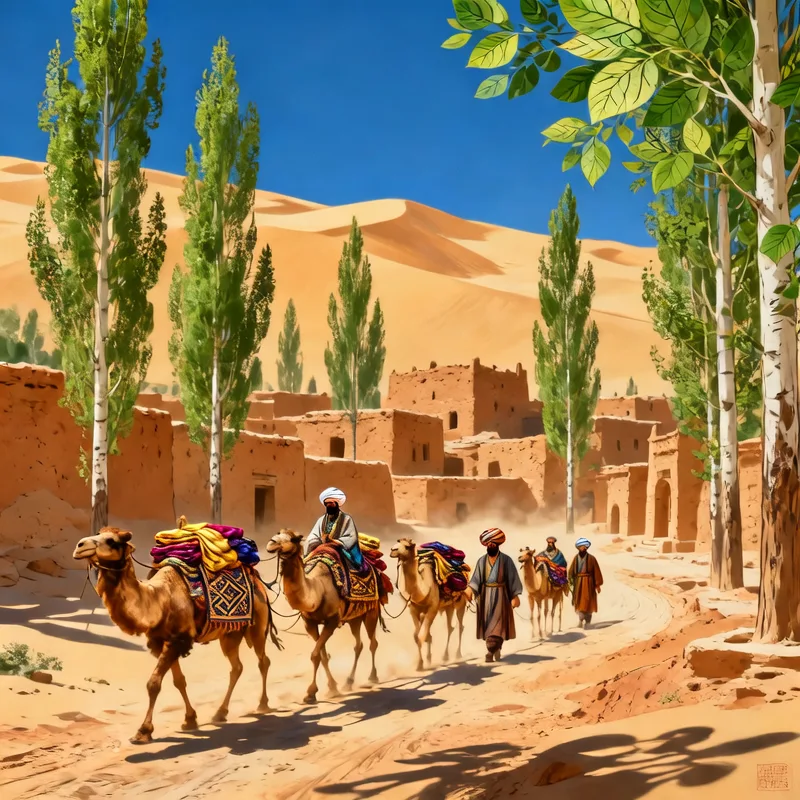
Silk gave the network its name, but caravans carried far more. Chinese silk, lacquer, and later paper moved west; Central Asian horses, jade, glassware, spices, and cotton moved east. Ideas travelled with the goods. Buddhism reached the Han capital by the first century CE, and monks such as Kumarajiva, who arrived at Chang’an in 401, translated Indian scriptures into Chinese. Technologies including papermaking and gunpowder eventually spread west, while grape growing and new musical instruments came east. The routes changed course with the politics of each dynasty, so the phrase Silk Road describes a shifting system rather than a fixed path.
- Silk and paper moving west from China
- Horses, jade, and glass moving east
- Buddhist monks and translated scriptures
- Sogdian merchants and caravanserais
Decline and Afterlife
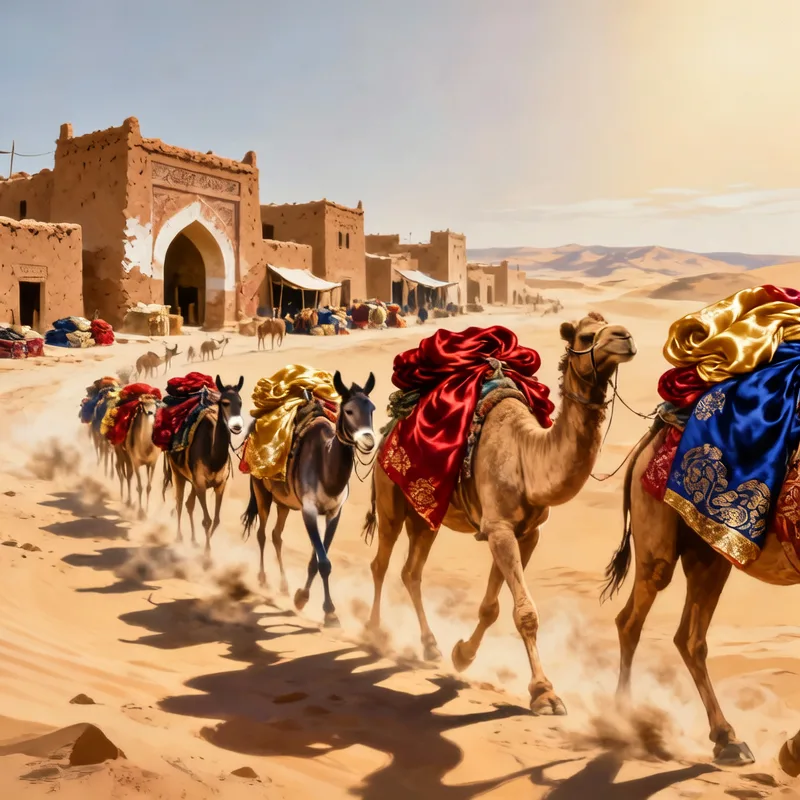
Overland trade did not end abruptly. It declined as maritime routes expanded under the Tang and especially the Song, when ships could carry bulky porcelain and tea more cheaply than pack animals. The fragmentation of Central Asian politics after the Tang collapse in 907 and the rise of new powers farther east redirected traffic. Khara-Khoto and other desert towns continued to operate under the Western Xia in the eleventh and twelfth centuries. In the twentieth century, archaeologists working at Dunhuang and Turpan recovered manuscripts and objects that revealed how varied the traffic had been. Today the name Silk Road is used for both the historical network and modern investment projects.
The Silk Road was held together by water points, translators, and credit as much as by silk.
المصادر والمزيد من القراءة
- Silk Roads: the Routes Network of Chang’an-Tianshan Corridor — UNESCO World Heritage Centre.
- طريق الحرير — موسوعة بريتانيكا.
- طريق الحرير — World History Encyclopedia.